 CUBE ChatShaala | 20 December 2025
Theme: Latitude, Temperature, and the Silent Clock of Mango Flowering
Meeting Summary
Today’s ChatShaala examined mango flowering as a biologically timed response shaped by latitude, temperature decline, and local microclimates. Using observational data from multiple Indian cities—Trivandrum (8°N), Bangalore (12°N), Mumbai (19°N), Kolkata (22°N), SapeKhati (27°N), and Delhi (~29–30°N)—the discussion highlighted how flowering intensity and timing vary across space.

Whiteboard mapping clearly showed that regions closer to the equator experience delayed or weaker flowering, while mid-latitude tropical regions show stronger, more synchronized floral initiation during early winter cooling. Temperature records from Bangalore and Mumbai illustrated how evening and minimum temperatures, rather than daytime maxima, act as critical cues.
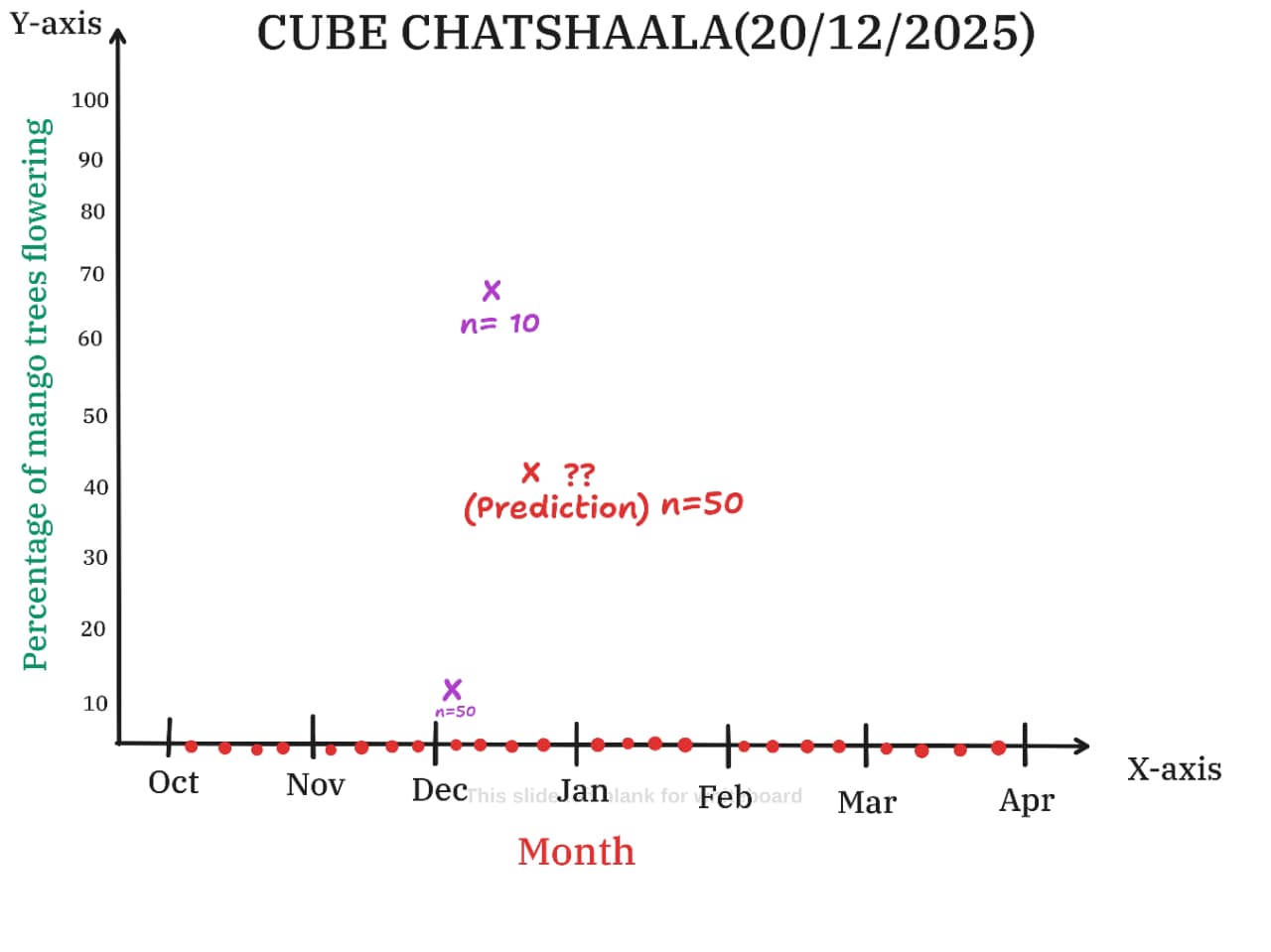
Field observations from Mumbai revealed sharp intra-city contrasts: South Mumbai showed 70–80% flowering by the second week of December, whereas Bhandup West recorded only ~8% in the first week, emphasizing the role of microclimate, urban heat retention, and local stress factors.
A temporal graph reinforced that mango flowering is not a continuous process but occurs in pulses, often following threshold drops in night temperature. Sample size (n) and observation timing were discussed as key factors influencing interpretation.
Overall, the session reframed mango flowering as a climatically negotiated event rather than a fixed seasonal certainty.
 Provocative Questions for the General Audience
-
If mango trees flower at different times in the same city, can we still call climate change a ‘global’ problem?
-
Are urban mango trees already living in a future climate we haven’t acknowledged?
-
What if night temperature matters more than sunshine for deciding the mango season?
-
Could farmers predict flowering better by watching December nights instead of calendars?
-
Are we misinterpreting poor flowering as crop failure when it is actually climate signaling?
 What I Learned Today
-
Mango flowering is triggered more strongly by declining minimum temperatures than by daytime heat.
-
Latitude sets the broad biological rhythm, but microclimate fine-tunes the response.
-
Even within Mumbai, flowering can vary dramatically due to urban structure, proximity to the sea, and heat islands.
-
Flowering data must always be read alongside sample size (n) and time of observation, or conclusions become misleading.
-
Graphs and maps together reveal patterns that numbers alone often hide.
 TINKE Moments (This I Never Knew Earlier)
-
That a difference of just 2–3°C at night can decide whether a mango tree flowers or stays vegetative.
-
That flowering does not increase smoothly over months—it happens in sudden jumps after climatic thresholds are crossed.
-
That trees at similar latitudes can behave differently due to local stress memory from previous seasons.
-
That “late flowering” is not always abnormal—it may be adaptive delay.
 Gaps and Misconceptions
-
Misconception: Latitude alone determines flowering.
Reality: Latitude sets the stage; temperature and microclimate decide the performance. -
Misconception: Day temperature is the main trigger.
Reality: Night and minimum temperatures are often more decisive. -
Gap: Limited long-term, tree-wise data across years to separate climate trends from seasonal noise.
-
Gap: Over-reliance on calendar-based agricultural expectations instead of phenological observation.
-
Misconception: Poor flowering always indicates poor tree health.
Reality: It may reflect climatic hesitation rather than physiological weakness.
 Reference