 CUBE ChatShaala – 18 January 2026
Theme: Curd as a Model System for Learning Science
Session Focus: Physics, Chemistry, and Biology embedded in everyday practices
Meeting Summary
The ChatShaala session used curd making as a deliberately simple but powerful model system to demonstrate how core scientific principles cut across disciplinary boundaries. Instead of treating physics, chemistry, and biology as isolated subjects, the discussion showed how a single domestic process integrates all three.
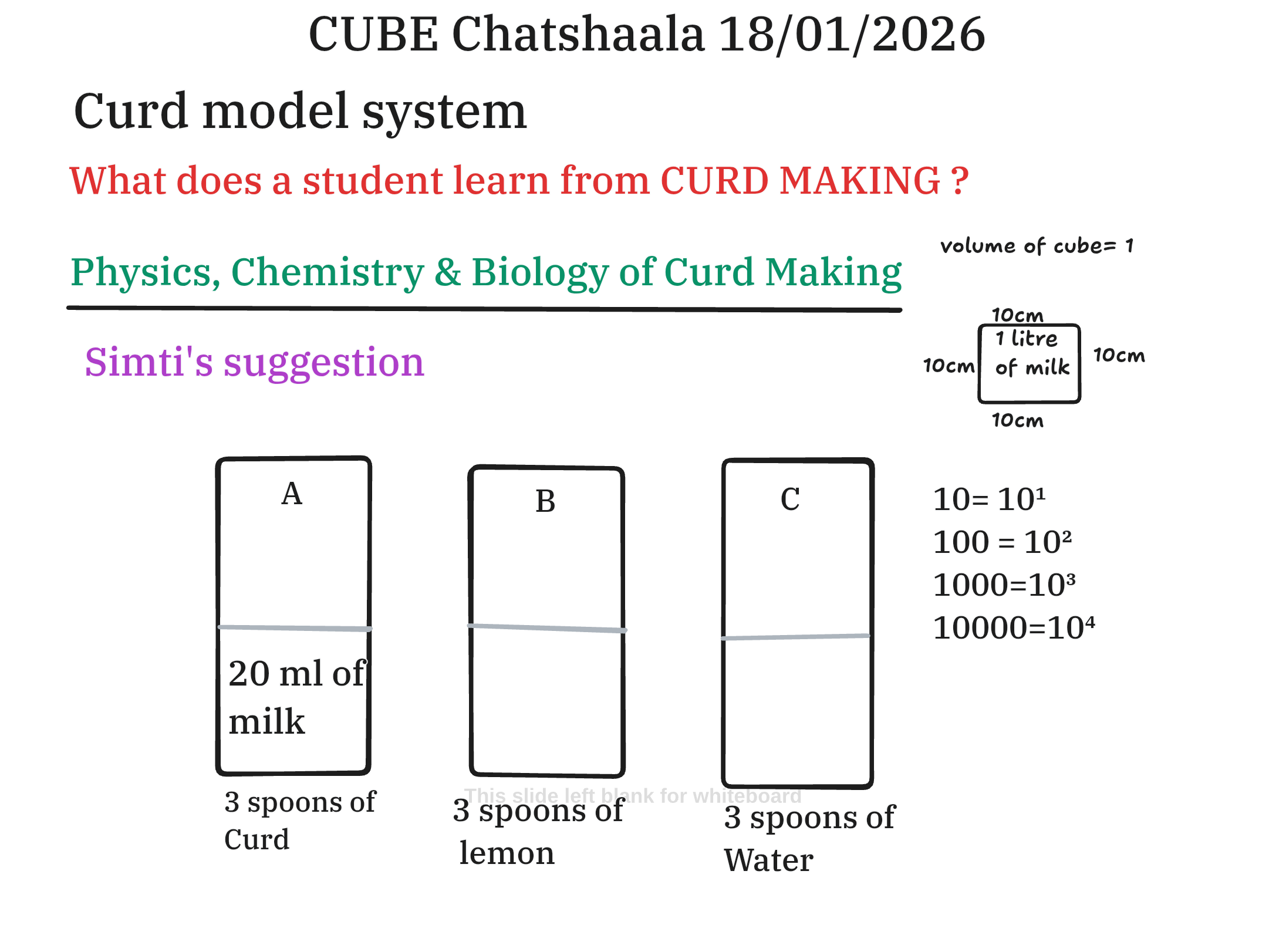

The session began with a quantitative framing of milk volume, using the cube model (10 cm × 10 cm × 10 cm = 1 litre) to reinforce dimensional reasoning, powers of ten, and scale. This grounded abstraction in physical reality, a step often skipped in classrooms.
A comparative setup using three containers—milk with curd starter, milk with lemon, and milk with water—was proposed to highlight causality over coincidence. The contrast clarified that curd formation is not a generic reaction but a biological process driven by living bacteria, not merely acidity or dilution.
Biochemically, the discussion traced lactose metabolism by lactic acid bacteria. The role of β-galactosidase in breaking lactose into glucose and galactose was emphasized, followed by glucose utilization for ATP generation. This naturally opened pathways into glycolysis, bacterial growth kinetics, and energy transformation, without invoking unnecessary jargon.
The exponential growth pattern of bacteria (1 → 2 → 4 → 8…) was used to introduce cell division, population dynamics, and time-dependent biological change—concepts students routinely memorize but rarely visualize.
Overall, the session demonstrated that curd making is not a “kitchen activity” but a legitimate scientific system capable of teaching measurement, metabolism, microbial ecology, and systems thinking.
 Whiteboard-Inspired Provocative Questions
-
If curd can explain enzymes, energy, and exponential growth, why do we still teach these ideas in isolation?
-
If acid alone could make curd, lemon juice would replace bacteria. Why doesn’t it?
-
Why do students fear units and dimensions when they pour litres every day?
-
If bacteria can demonstrate ATP production better than diagrams, why ignore them?
 What I Learned
-
Everyday processes can function as complete scientific models, not just analogies.
-
Biology becomes clearer when framed through energy flow and material transformation, not definitions.
-
Quantification (volume, scale, growth rate) is the missing bridge between theory and intuition.
-
Teaching improves when comparison and controls are built into discussion, not added later.
 TINKE Moments (This I Never Knew Earlier)
-
Curd is not “milk becoming sour”—it is milk becoming biologically organized.
-
Acidity is an outcome, not the cause of curd formation.
-
Bacterial growth is not gradual—it is exponential, and that changes everything.
-
A spoon of curd is not an ingredient; it is an inoculum.
 Gaps and Misconceptions
Misconception 1: Lemon and curd do the same thing
Why it’s wrong: Lemon causes protein coagulation chemically; curd formation requires living bacteria and metabolism.
Correction: Separate coagulation from fermentation every time this topic is taught.
Misconception 2: All glucose metabolism ends in CO₂ and water
Why it’s incomplete: Lactic acid bacteria primarily use fermentation, not full aerobic respiration.
Correction: Clarify pathway differences instead of collapsing everything into “ATP production.”
Misconception 3: Volume understanding is trivial
Why it’s dangerous: Poor dimensional intuition leads to errors across physics and chemistry.
Correction: Force unit-based reasoning early, using real objects, not symbols.
Gap Identified: Lack of time-scale discussion
Issue: Growth rate, temperature dependence, and incubation time were implied but not quantified.
Actionable fix: Introduce time as a variable in the curd-making process.
 Photographs during Chatshaala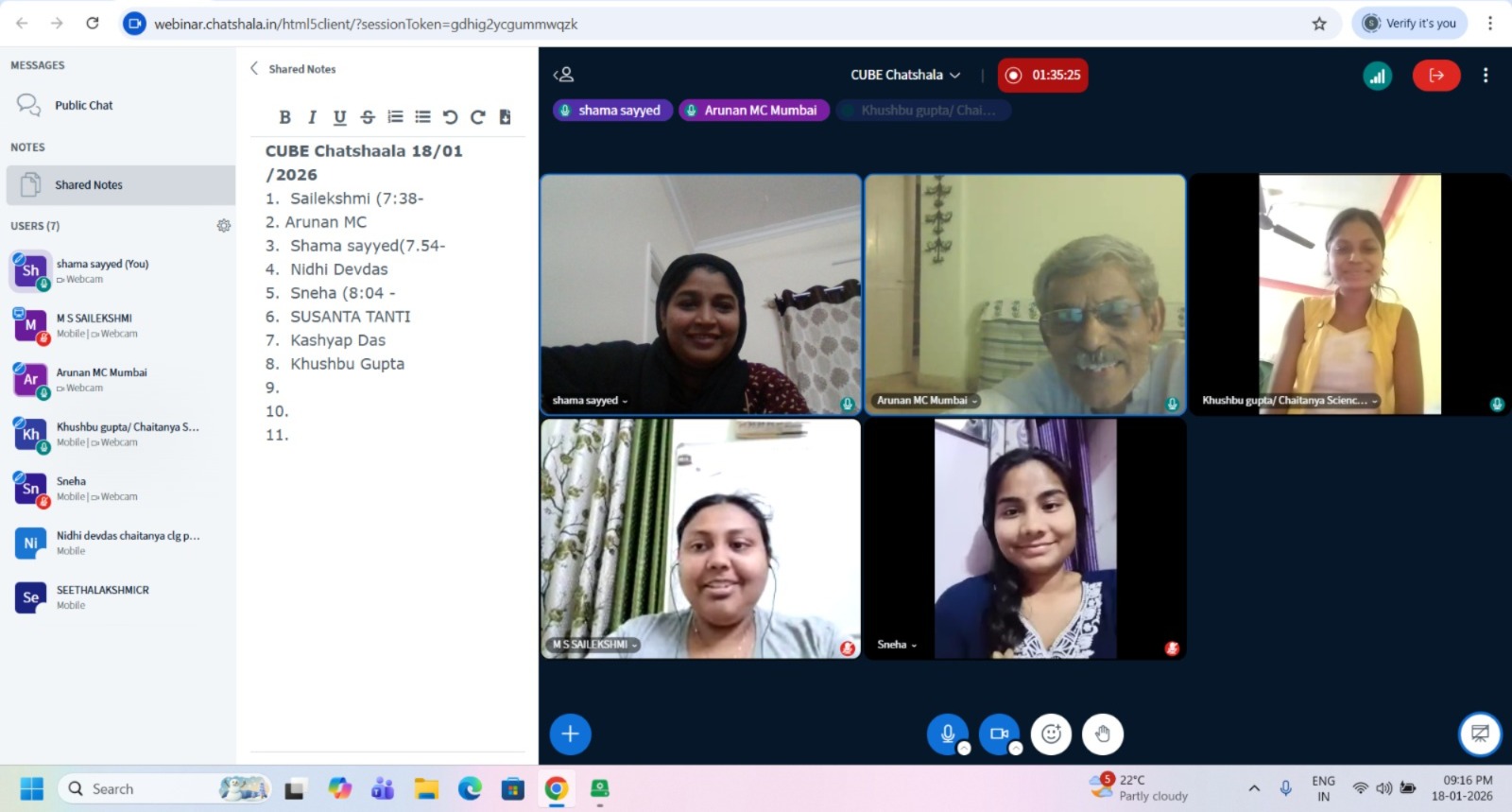

 Reference