 CUBE Chatshaala – Discussion Summary
Today’s ChatShaala session, held on the 16th of August 2026, brought together the regular CUBE community for a session that spanned close to two hours, with participants including Sailekshmi, Manali Bhujade, Niharika Baghari, Arunan MC, Kiran Varma, Kavita, Chitralekha, Aarya Takke, and Ajita, among others who joined the discussion. The whiteboard for the day carried two distinct threads of inquiry, each reflecting the CUBE philosophy of grounding scientific understanding in direct, lived observation.
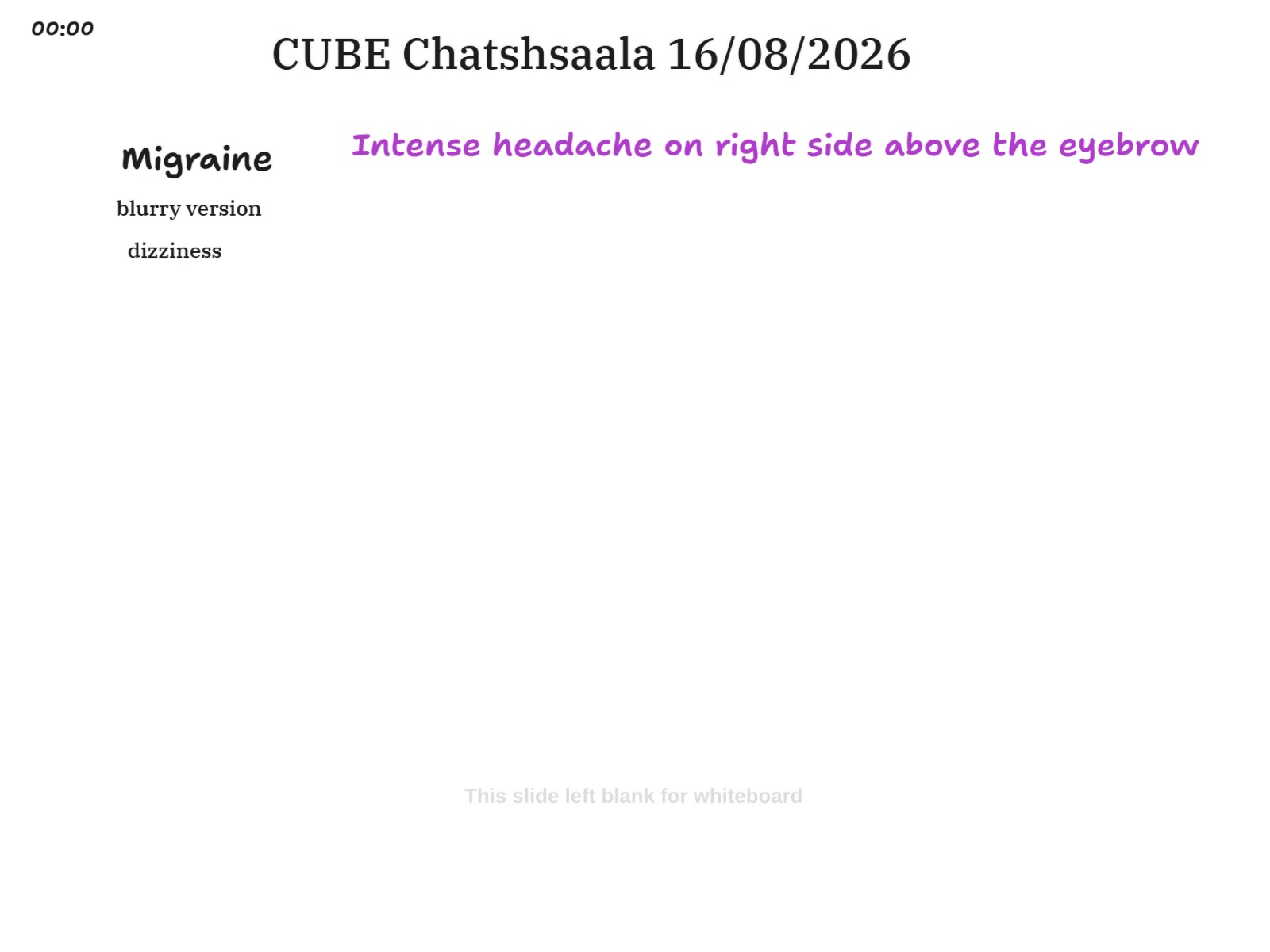
The first thread centred on migraine, framed through a very specific and personal lens: an intense headache localised above the right eyebrow, accompanied by blurred vision and dizziness. This combination of symptoms lines up closely with what clinical literature describes as a classic migraine presentation. According to the Mayo Clinic, a migraine typically produces throbbing pain concentrated on one side of the head, often paired with visual disturbance and a heightened sensitivity to light and sound. What makes migraine particularly interesting from a citizen science standpoint is that it resists simple explanation. Wikipedia’s overview notes that migraine is understood to arise from a combination of genetic, environmental, and neurological factors that lower an individual’s sensitivity threshold, meaning the same person can experience wildly different attacks depending on sleep, stress, hormonal shifts, or even the weather. The one-sided, above-the-eyebrow location described on the whiteboard fits the trigeminal nerve pathway that clinicians associate with migraine pain, since this nerve carries sensory signals from the face and eye region into the brain. Dizziness and blurred vision, meanwhile, sit within the broader constellation of symptoms that can accompany the headache phase itself, distinct from but sometimes overlapping with the aura many migraine sufferers experience before pain sets in. The Apollo Pharmacy reference on Paramet M Tablet added a practical, pharmacological dimension to this discussion, illustrating how a combination medicine pairs a pain reliever with an anti-nausea agent to address both the headache and the digestive symptoms that frequently accompany a migraine attack, since delayed stomach emptying during an attack can blunt how quickly oral medication takes effect.
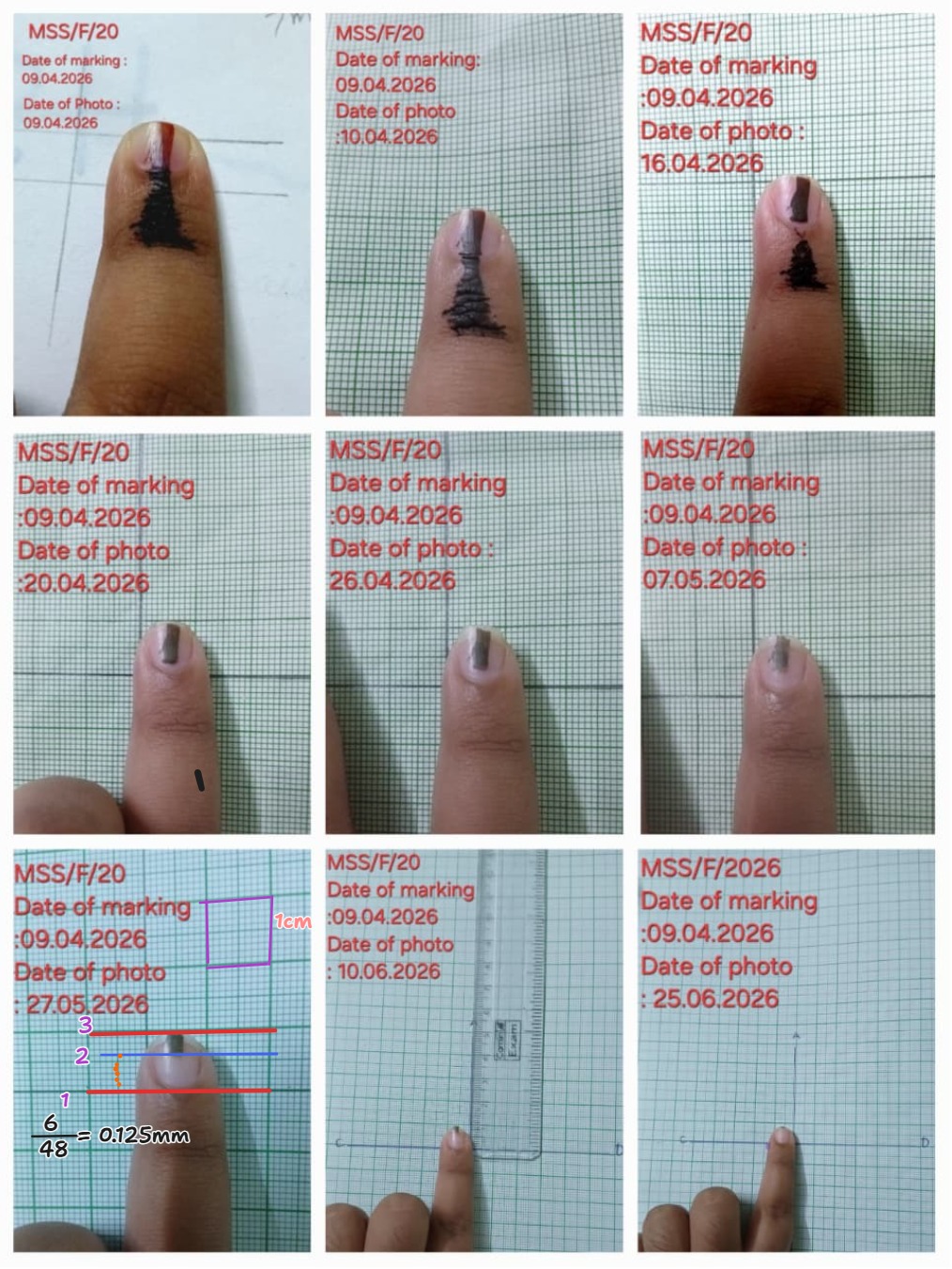
The second thread of the day returned to one of ChatShaala’s longer-running citizen science projects: tracking human nail growth using nothing more than a marked nail, a graph sheet of paper, and a careful eye. The whiteboard photographs documented a single fingernail from the ninth of April through the twenty-fifth of June 2026, with a dark marking placed near the cuticle at the outset and photographed at regular intervals as it migrated toward the nail’s free edge. By the final measurement, the group had arrived at a growth rate calculation of 0.125 millimetres, derived by dividing a measured distance of six units across forty-eight grid squares. This is a textbook demonstration of frugal, reproducible home-lab science: no laboratory equipment beyond a ruled sheet, a vote’s marker/nail polish , and a phone camera, yet the resulting data point sits comfortably within the range that dermatological literature typically reports for nail growth, which tends to hover around one-tenth of a millimetre per day depending on the individual, the specific nail, and factors like age and circulation.
 Provocative Questions
-
Why does the same trigeminal nerve pathway that carries ordinary facial sensation become, in some people, a source of debilitating pain, while in most others it never does?
-
If nail growth can be measured this precisely with a ruled grid and a marker, what other slow biological processes in the human body might be equally trackable through frugal, home-based methods?
-
Migraine is described as having a sensitivity threshold that varies by person and by day. What would it take to build a simple, low-cost way for someone to track their own personal threshold over time, the way this group tracked nail growth?
-
Given that nail growth rate can vary with age, season, and even which finger is measured, how might the group extend this project to compare growth rates across multiple participants or multiple fingers to see how much natural variation exists?
-
Is there a meaningful connection between the body’s slow, steady processes like nail growth and its more volatile ones like a migraine attack, in terms of what each reveals about individual physiological variability?
 What I Have Learned
Sitting with both of today’s topics side by side taught me something about the range of citizen science itself. Migraine is messy, subjective, and resistant to a single clean explanation, while nail growth is slow, steady, and lends itself beautifully to quantification with the simplest of tools. Yet both are, at their core, exercises in careful observation. The migraine discussion reminded me that even a symptom as common as a headache carries a genuine neurological story behind it, involving nerve pathways, chemical messengers, and blood vessel changes that scientists are still working to fully map. The nail growth project, meanwhile, reinforced something I think is central to the CUBE approach: that rigorous, publishable-quality data doesn’t require expensive instrumentation. A grid sheet and a steady hand were enough to arrive at a growth rate calculation consistent with published dermatological ranges. That is a genuinely encouraging thing to sit with as a citizen scientist.
 TINKE Moments (This I Never Knew Earlier)
The clearest TINKE moment from the nail growth data lies in what the measurement calculation itself reveals. Deriving 0.125 millimetres from six units across forty-eight grid squares is a reminder that even a very small, easily overlooked number, once properly measured and contextualised against a known reference scale, can validate itself against established scientific ranges. That is a small but genuine “This I Now Know Explicitly” realisation: that patient, low-tech observation over eleven weeks can produce a defensible, quantifiable result.
The migraine topic offers a different kind of TINKE moment. Framing the symptoms explicitly as headache location, plus blurred vision, plus dizziness, rather than treating “migraine” as a single monolithic label, foregrounds how the condition is understood clinically as a cluster of related but distinguishable symptoms. Recognising that blurred vision and dizziness are documented as part of the broader symptom picture, and not merely incidental complaints, sharpens the distinction between an ordinary headache and a migraine attack.
 Gaps and Misconceptions
Because the material available for this session consisted of two whiteboard slides and an attendance sheet, without a transcript or recorded notes of the actual conversation, this summary cannot capture the specific arguments, questions, or exchanges that unfolded between participants during the live discussion. The whiteboard alone does not indicate whether the migraine case being discussed was a personal account from a participant, a hypothetical case, or a case study drawn from outside material, and it does not specify whose nail was being tracked in the growth study or what protocol governed the measurement schedule beyond the dates visible in the photographs. Details such as which participants led each segment, what follow-up questions were raised in real time, and how the group interpreted the 0.125 millimetre figure in discussion are not available from the source material and have accordingly been left out rather than inferred.
No explicit misconceptions were documented on the whiteboard itself. However, it is worth noting a common point of confusion that the migraine topic naturally invites: the tendency to treat any intense headache as synonymous with migraine, when clinical criteria actually require a more specific combination of features, including duration, one-sided location, pulsating quality, and accompanying symptoms such as nausea or sensitivity to light and sound, before a migraine diagnosis is clinically appropriate. Similarly, on the nail growth side, a natural assumption might be that nail growth is constant and uniform across all fingers and all points in a person’s life, when in fact growth rate is known to vary with factors such as age, nutrition, season, and which specific nail is being measured, meaning the 0.125 millimetre figure obtained here represents one data point rather than a universal constant.
 Photographs during Chatshaala
 Referance