 CUBE Chatshaala - Discussion Summary
Date: 8th September 2026
During today’s CUBE Chatshaala meeting, participants worked together to examine the spatial distribution and diversity of mango varieties (Mangifera indica) across several regions of India. The main objective of the session was to test the hypothesis that different mango cultivars are systematically distributed according to geographic coordinates, specifically latitude and longitude.
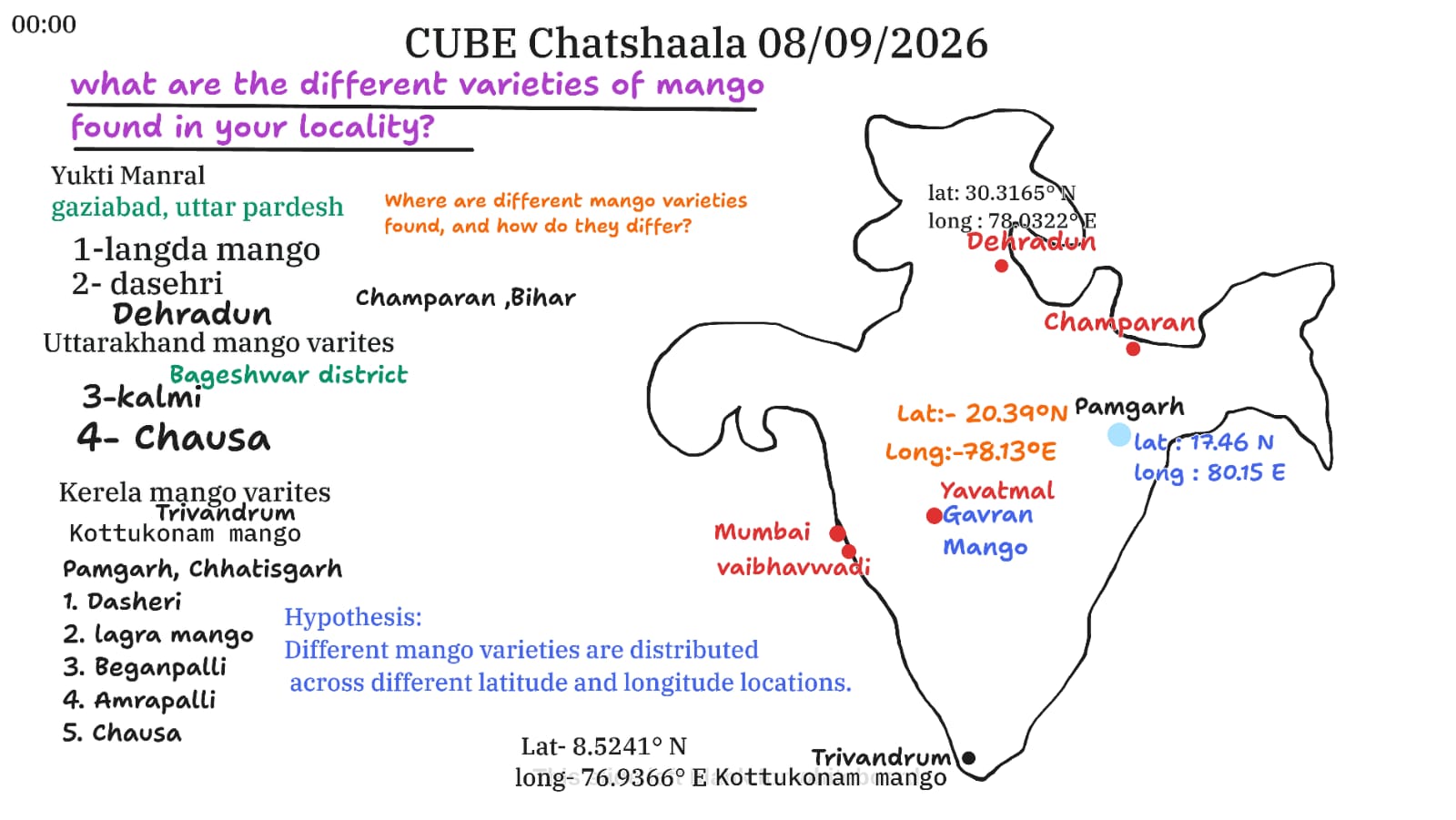
Participants shared specific cultivar data from their home regions and contributed regional data from across the country:
-
Ghaziabad & Dehradun: Yukti Manral shared details on northern varieties such as Langda, Dasehri, Kalmi, and Chausa across Uttar Pradesh and Uttarakhand. Dehradun’s coordinates were recorded at lat: 30.3165°N, long: 78.0322°E
-
Pamgarh, Chhattisgarh: Contributions from Anamika Soni, Chaitanya, and Nidhi Devdas identified several common cultivars, including Dasheri, Lagra (Langra), Beganpalli (Banganapalli), Amrapali, and Chausa, mapped around lat: 21.8722°N, long: 82.4533°E
-
Yavatmal, Maharashtra: Discussions highlighted the local Gavran mango, situated at approximately lat:20.39 N, long: 78.13°E
-
Trivandrum, Kerala: Attention was drawn to endemic southern varieties, specifically the Kottukonam (Kotturkonam) mango, mapped at lat: 8.5241°N, long:76.9366°E.
The group examined how phenotypic differences among these cultivars relate to their geographical distribution, and discussed whether these differences are mainly due to climatic variation or distinct genetic lineages.
 Provocative Questions
-
Does spatial distribution based on latitude and longitude directly dictate phenotypic traits in mangoes, or are microclimatic factors like soil composition, seasonal temperature range, and altitude the true drivers of variation?
-
Why do certain commercial varieties like Dasheri and Chausa successfully span vast geographic distances from Uttarakhand down to Chhattisgarh, while native varieties like the Kottukonam remain tightly localized to southern regions like Kerala?
-
How can a standard bio-mapping protocol be structured to effectively distinguish whether observed flavor, size, and skin differences across locations are genetically fixed or environmentally induced?
 What I Have Learned
-
Geographic Mapping as a Baseline: Recording precise latitude and longitude coordinates provides an essential framework for studying plant biogeography and tracking biological diversity across state borders.
-
Varietal Adaptability: Cultivars vary significantly in their ecological tolerance; while some commercial varieties demonstrate wide environmental adaptability across North and Central India, indigenous varieties often exhibit strict endemic distributions.
-
Refining Hypotheses: Establishing a valid biological hypothesis requires connecting physical parameters (such as geographic coordinates) directly with verifiable phenotypic data rather than relying solely on geographical presence.
 TINKE Moments (This I Never Knew Earlier)
-
Coordinate and Spatial Discrepancies: Plotting local data onto the whiteboard map revealed minor alignment errors between labeled text tags and actual geographic placements (such as the relative positioning of Pamgarh and Yavatmal coordinates).
-
Nomenclature Inconsistencies: The session highlighted how regional spelling variants (e.g., “Langda” vs. “Lagra”, “Kottukonam” vs. “Kotturkonam”) introduce ambiguity into centralized biological databases.
-
Correlation vs. Causation Realization: Participants realized that simply mapping mango names onto geographic coordinates does not inherently explain why specific varieties thrive in those locations, signaling a need to incorporate ecological metrics like rainfall and soil pH.
 Gaps and Misconceptions
-
Misconception: Assuming that latitude and longitude alone govern the distribution and physical characteristics of mango cultivars, while overlooking critical environmental drivers such as soil traits, humidity levels, and elevation.
-
Data Gap: The current dataset lacks standardized quantitative metrics (e.g., Brix sweetness levels, fruit mass, or peel thickness) needed to evaluate how cultivars differ beyond simple name listings.
-
Sampling Bias: Relying on market-based observations risks confusing commercially imported, non-native mango varieties with cultivars that are genuinely acclimatized to and grown in the local ecosystem.
 Photographs during Chatshaala


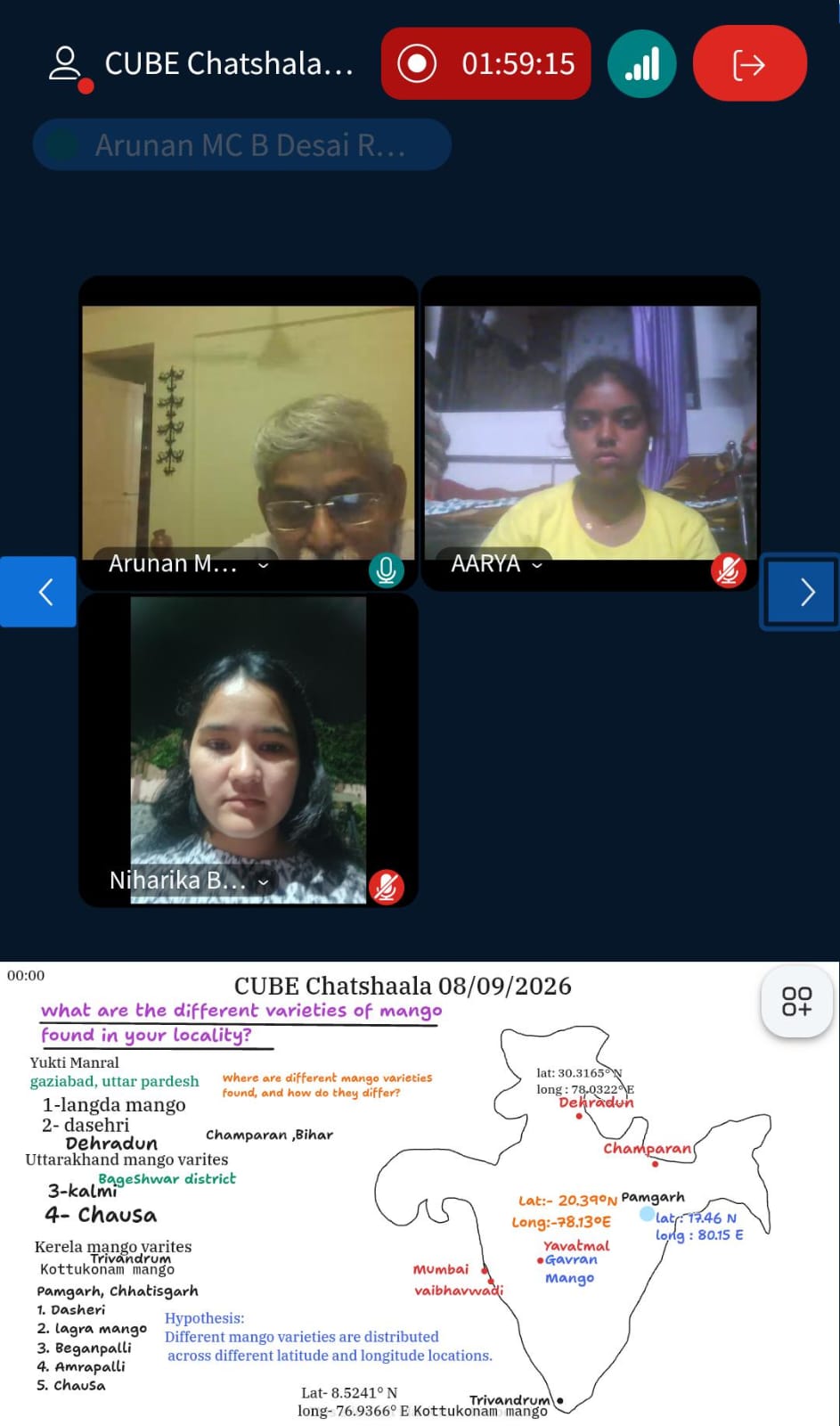
 Referance
- Reemz Basket
- ChatGPT - Uttar Pradesh Mango Varieties
- https://www.latlong.net/place/chhattisgarh-india-16504.html
- Pamgarh in Pamgarh, Pamgarh, Janjgir Champa - Apple Maps
- https://www.latlong.net/place/yavatmal-maharashtra-india-20438.html
- https://www.researchgate.net/publication/351780760_Evaluation_of_traditional_mango_Mangifera_indica_L_varieties_of_southern_Kerala Pamgarh - Wikipedia https://www.latlong.net/place/thiruvananthapuram-kerala-india-9300.html
- https://www.latlong.net/place/yavatmal-maharashtra-india-20438.html