 CUBE Chatshaala Summary: January 30, 2026
Today’s session of CUBE Chatshaala centered on the synthesis of long-term citizen science observations, specifically tracking the phenological patterns of mango flowering across different latitudes and the cultivation of Cardamine as a model system. The discussion bridged historical data from 2022 with fresh observations from late 2025, emphasizing the geographical “flowering wave” observed in Kerala.
Key Discussion Points
-
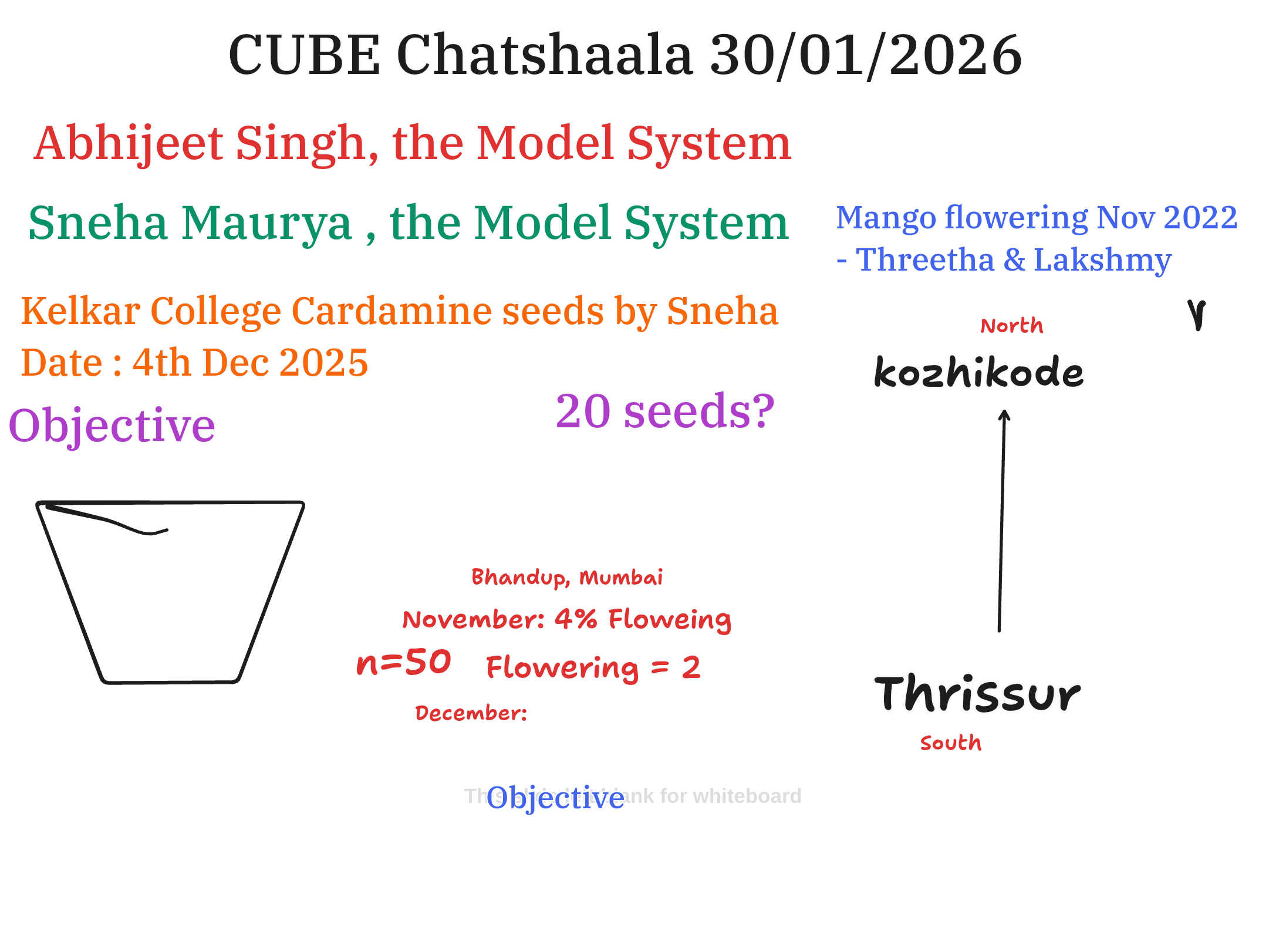
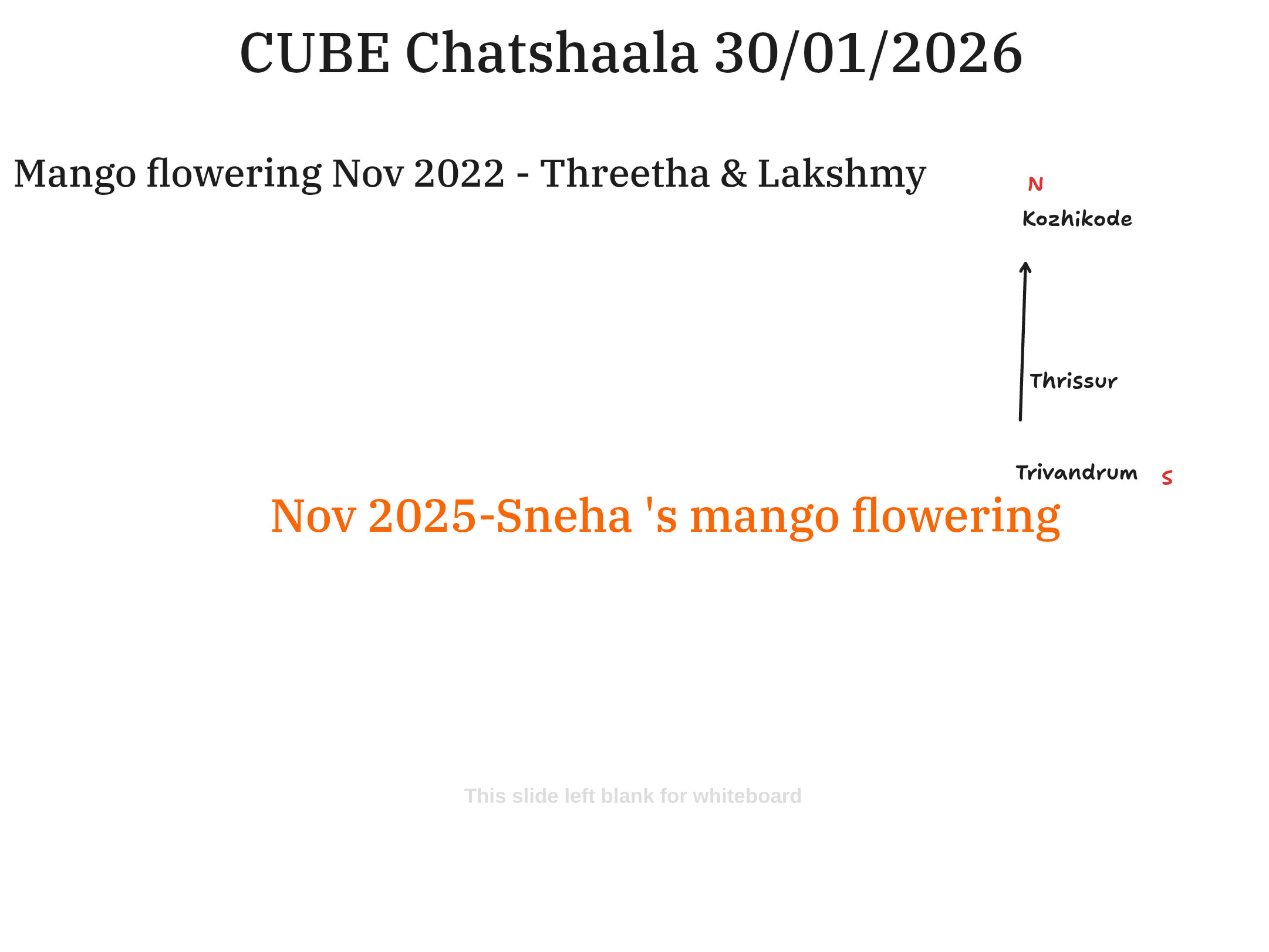
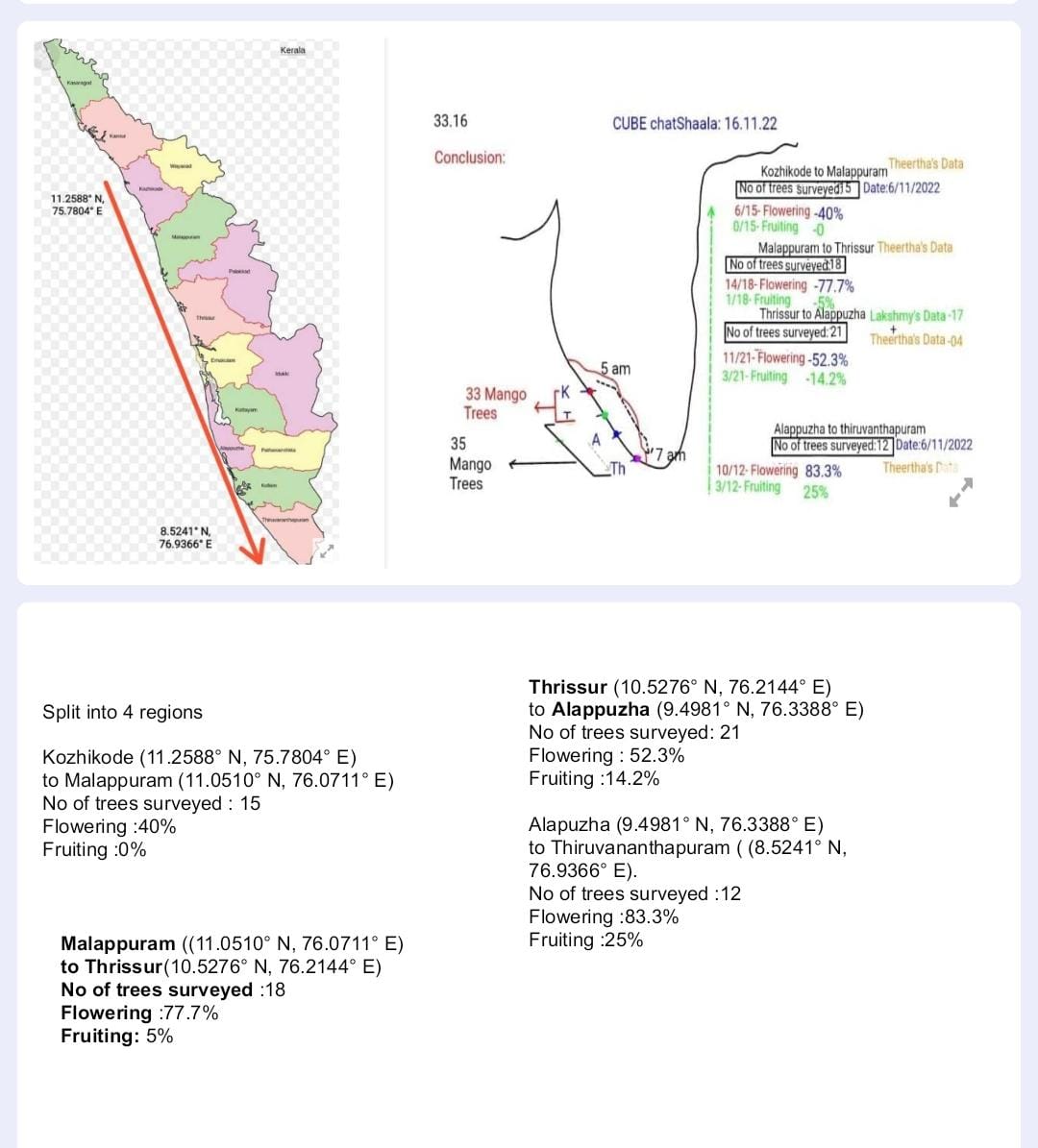
The Mango Flowering Latitudinal Gradient: A significant portion of the meeting was dedicated to analyzing data from a 2022 survey conducted by Threetha and Lakshmy. The data suggests a clear correlation between latitude and the onset of flowering. As one moves from Kozhikode (North) toward Thiruvananthapuram (South), the percentage of trees in bloom increases significantly.
- In the North (Kozhikode), flowering was recorded at 40%.
- In the South (Alappuzha to Thiruvananthapuram), flowering reached 83.3%.This reinforces the hypothesis that flowering in mangoes may be triggered by environmental cues that progress geographically.
-
Model System Updates:
- Abhijeet Singh and Sneha Maurya were highlighted for their work on establishing and maintaining “Model Systems” for study.
- Sneha Maurya’s Cardamine Project: Seeds were initiated at Kelkar College on December 4, 2025. The group is currently tracking the viability and germination of these seeds, with a specific query raised regarding the progress of “20 seeds.”
-
Current Observations (Nov 2025 - Jan 2026): Sneha reported mango flowering data from Bhandup, Mumbai, noting a 4% flowering rate (n=50, with 2 trees flowering) in November, providing a comparative data point for higher latitudes outside of Kerala.
 TINKE Moments (This I Never Knew Earlier)
-
The flowering wave, driven purely by temperature gradients, has a photoperiodic element that triggers Southern trees earlier.
-
The 2022 data shows such a stark difference in fruiting percentages (0% in the north vs. 25% in the south) within the same month.
-
The visual representation of the Kerala map shows a downward “arrow” of progression, suggesting we are looking at a biological clock moving through the state.
-
We now have established baseline data for mango flowering across at least four major Kerala districts (Kozhikode, Malappuram, Thrissur, Alappuzha).
-
The “Model System” approach (like the Cardamine seeds) allows us to control variables that are otherwise wild and unpredictable in mango trees.
 Gaps and Misconceptions
- The “Linearity” Fallacy: There is a potential misconception that flowering moves in a perfectly smooth line from South to North. Local microclimates or soil variations might disrupt this “wave,” which our current data set may be too small to show.
- Sample Size Disparity: The number of trees surveyed (n) varied from 12 in the South to 21 in the Central regions. This creates a “gap” in statistical reliability when comparing percentages directly.
- The Time Gap: While we are looking at 2022 and 2025 data, we lack consistent month-by-month data for the intervening years to determine if “early flowering” is becoming a permanent trend due to climate shifts.
Provocative Queries for the CUBE Community
1. The Kerala Bloom-Race: Is the South Stealing a Head Start?
If mangoes in Thiruvananthapuram are at 83% flowering while Kozhikode is only at 40%, are we witnessing a biological “relay race”? Does the tree “know” its latitude, or is it just feeling the heat?
2. The 4% Mystery: Why is Mumbai Sleeping?
Sneha’s Mumbai data shows a measly 4% flowering rate. Is the northern winter too harsh, or are our urban mango trees simply out of sync with their rural cousins?
3. Cardamine vs. Mango: Can a Tiny Seed Explain a Giant Tree?
We track 20 tiny seeds in a cup to understand life cycles. Can the lessons we learn from a fast-growing model system like Cardamine actually help us predict the harvest of a 50-foot Mango tree? Or are we comparing apples to… mangoes?
 What I have learned
Based on the data and discussions from today’s Chatshaala, here is a breakdown of the core insights and scientific takeaways:
1. The Latitudinal Gradient of Phenology
I have learned that geography dictates biology. In Kerala, mango flowering follows a distinct South-to-North progression. Trees in the South
(Thiruvananthapuram/Alappuzha) exhibit much higher flowering and fruiting rates (up to 83.3%) compared to those in the North (Kozhikode at 40%) during the same time window. This suggests that the environmental triggers for flowering—likely temperature or day length—reach the Southern tip of India first.
2. The Concept of a “Model System”
The session emphasized using specific organisms (like Cardamine or mango trees) as “Model Systems.” By focusing on these, you learn to:
- Standardize observations (e.g., using a fixed sample size like n=50).
- Track life cycles over time (from seed initiation in December to flowering in January).
- Quantify biological phenomena into data points (Percentage of flowering vs. total population).
3. Data Synchronization Across Years
By comparing Nov 2022 data (Threetha & Lakshmy) with Nov 2025 data (Sneha), you are learning the importance of longitudinal studies. You’ve learned that seasonal patterns aren’t just one-off events; they are recurring biological rhythms that can be mapped to see if climate change is shifting the “normal” flowering window.
4. Urban vs. Rural Phenology
The data from Bhandup, Mumbai (4% flowering) contrasted with the Kerala (40-83% flowering) data highlights how much regional climate affects the same species. You’ve learned that a “national” flowering season doesn’t exist; it is a highly localized event influenced by the specific latitude and environment of the city.
5. Quantifying Uncertainty
Through the discussion of the “20 seeds” and the varying “n” values in the Kerala survey, you have learned that sample size matters. A percentage (like 83%) is only as strong as the number of trees surveyed. You are learning to look past the “big numbers” to find the raw data (, , etc.) that supports them.
 Reference