CUBE Chatshaala – Discussion Summary
2026-03-30T18:30:00Z
Today’s ChatShaala session explored three interconnected themes: mosquito biology and prevention, Darwin’s finches and adaptation, and genetic variation in puppies.
-
Mosquito Projects (2016, Clap Trap Method):
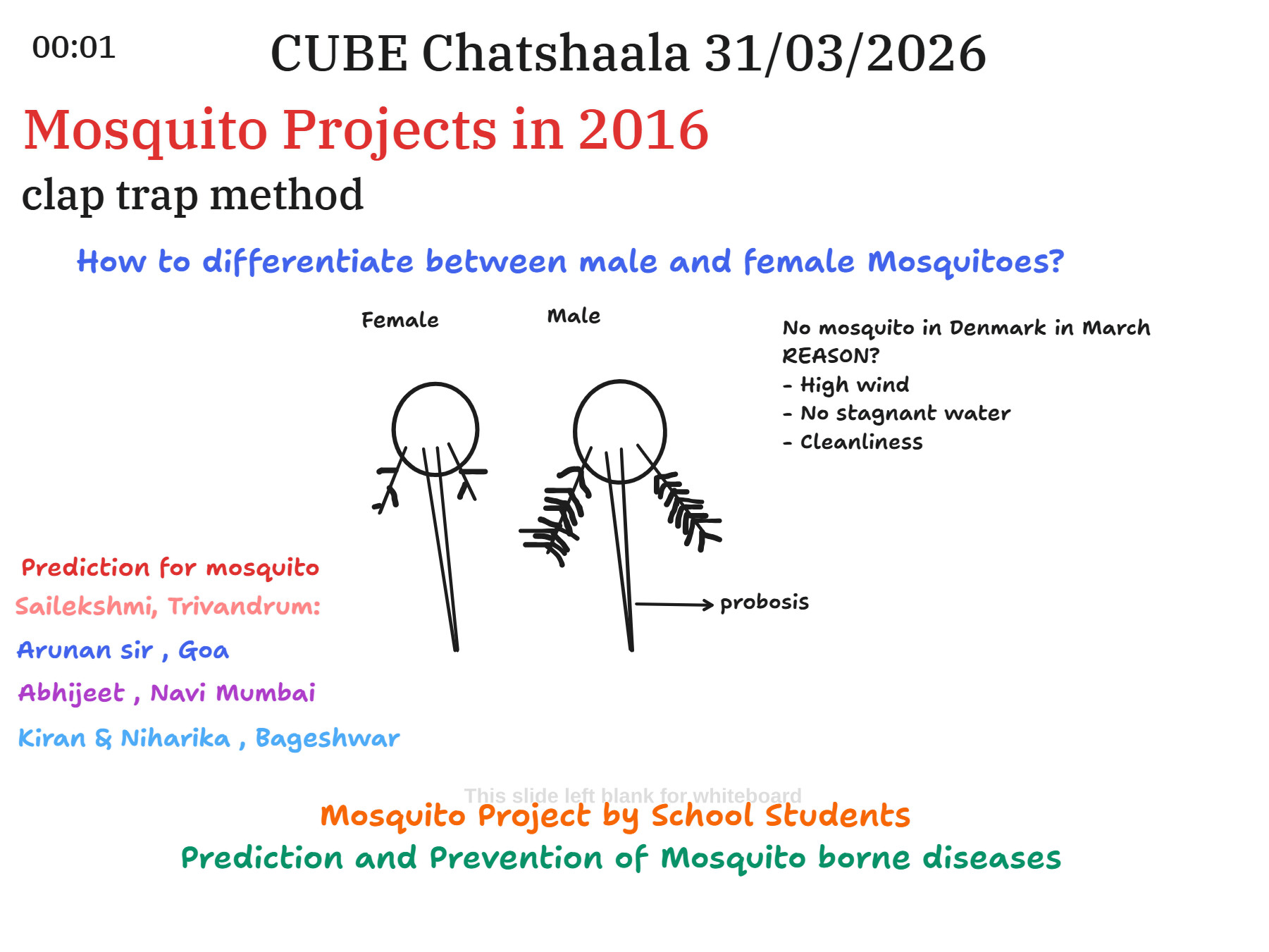
Participants discussed how to differentiate male and female mosquitoes, focusing on antennae and proboscis structure. Observations from Denmark highlighted the absence of mosquitoes in March, attributed to environmental factors such as high winds, lack of stagnant water, and cleanliness. Predictions from participants across India (Trivandrum, Goa, Navi Mumbai, Bageshwar) emphasized the importance of local conditions in mosquito prevalence and prevention strategies. -
Darwin’s Finches – Adaptation in the Galápagos:
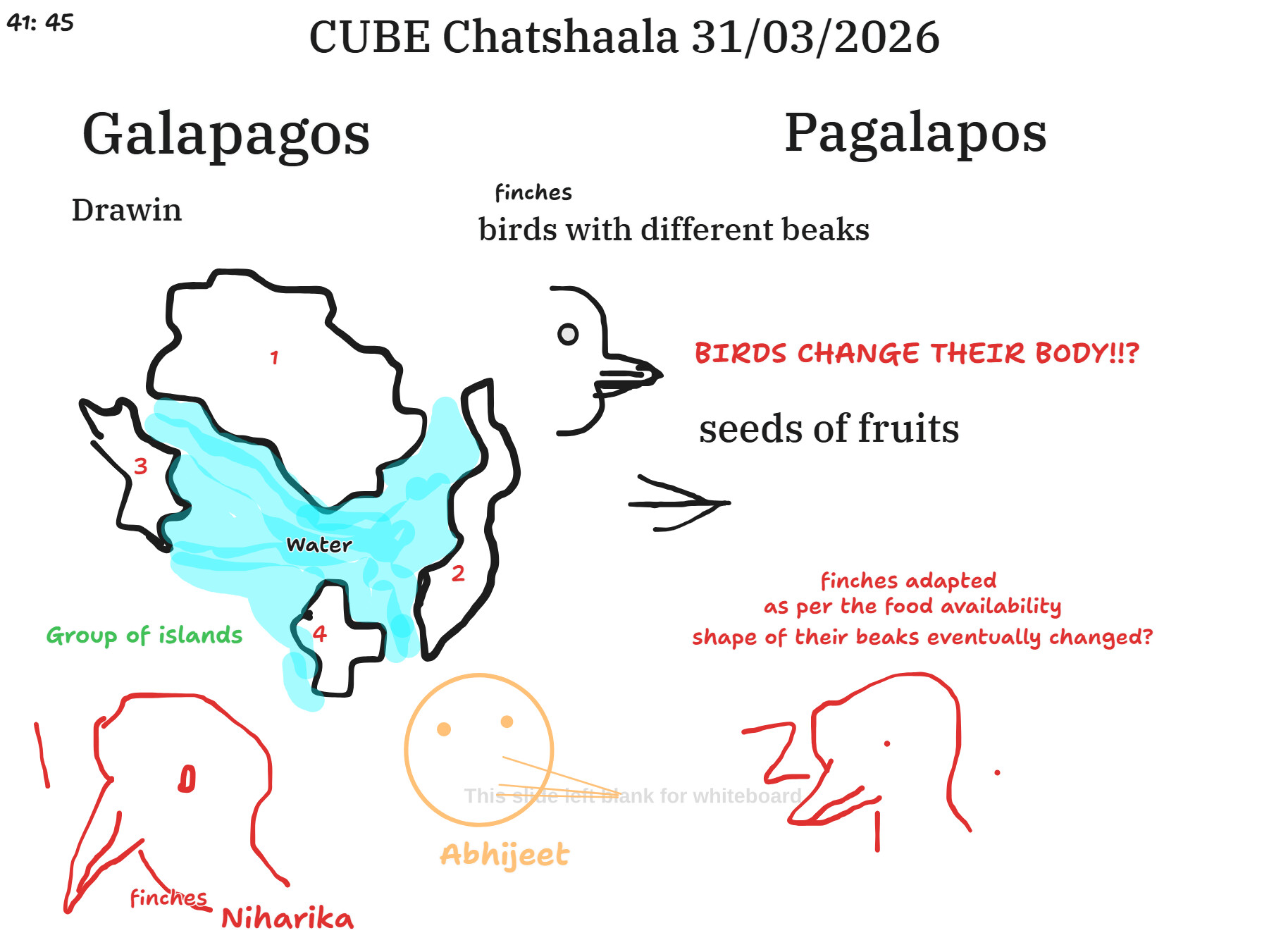
The group revisited Darwin’s study of finches, noting how beak shapes evolved in response to food availability. The playful “Pagalapos” note reflected curiosity and humor, while deeper questions emerged: do birds “change their body” actively, or is adaptation a gradual evolutionary process? The sketches of finches with varied beaks illustrated how environmental pressures shape traits over generations. -
Genetic Variation in Puppies:
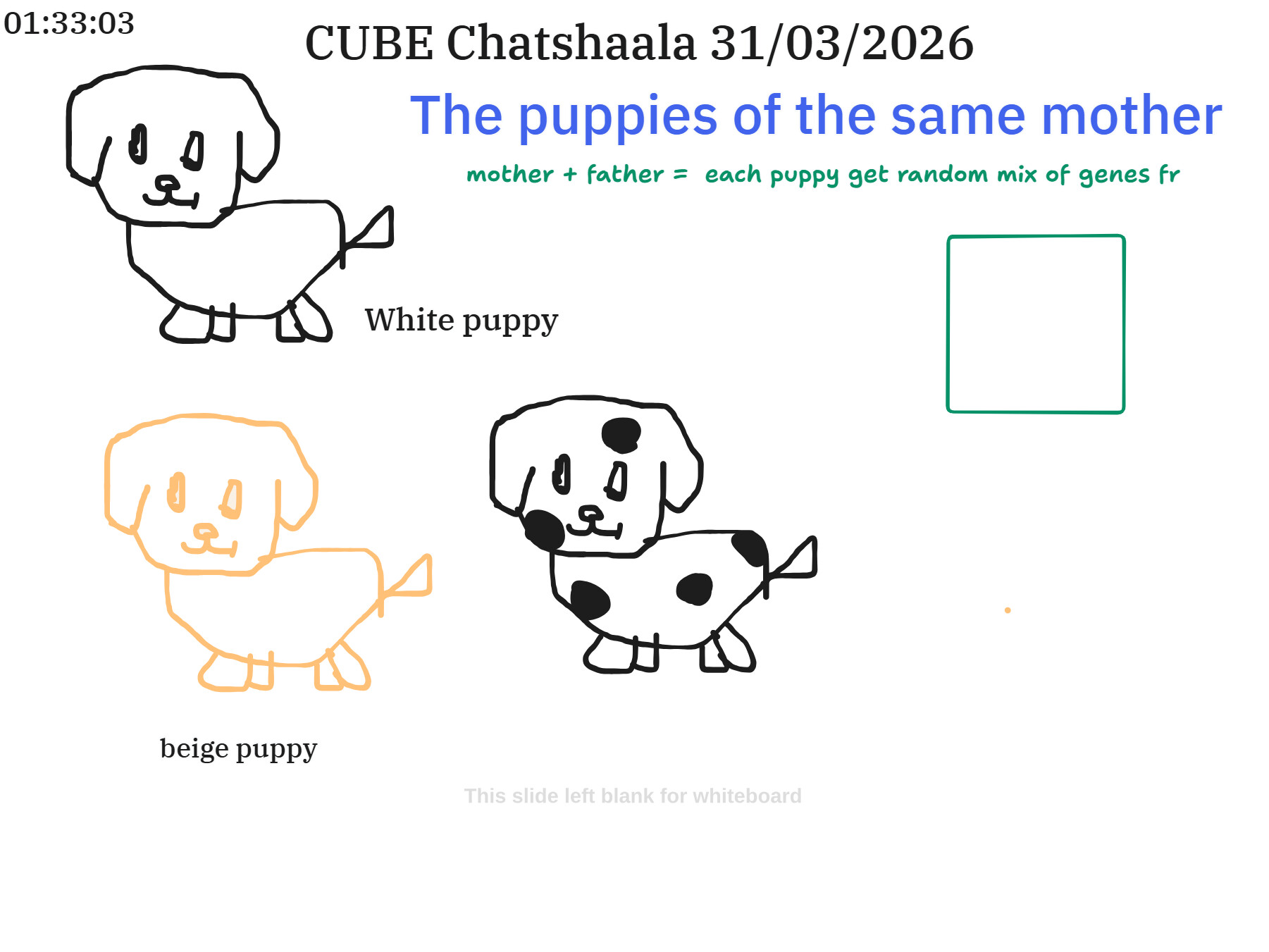
A simple but powerful illustration showed puppies of the same mother with different coat colors and patterns. This sparked discussion on inheritance, randomness in gene mixing, and how visible traits emerge from genetic combinations.
Together, these discussions highlighted the theme of variation and adaptation—whether in mosquitoes, birds, or puppies—and how environmental and genetic factors interplay in shaping life.
 Provocative Questions
-
If mosquitoes have six needle-like stylets for feeding, how might this complexity influence their efficiency in transmitting diseases?
-
Could the absence of mosquitoes in Denmark during March be replicated in tropical regions through environmental management, or are climate differences too significant?
-
Darwin’s finches adapted over generations—how do we distinguish between short-term behavioral changes and long-term evolutionary adaptations?
-
In the puppy example, how much of the visible variation is due to dominant/recessive genes versus random recombination?
-
What parallels can we draw between mosquito prevention strategies and evolutionary adaptation in finches—both shaped by environmental pressures?
 What I Have Learned
The most important takeaway from today’s session is that variation is the foundation of adaptation.
-
Mosquitoes demonstrate how environmental conditions directly influence population dynamics.
-
Finches remind us that adaptation is not immediate but a gradual process shaped by survival pressures.
-
Puppies illustrate genetic diversity within a single family, showing how inheritance creates visible differences.
Together, these examples reinforce that biology is a story of diversity, resilience, and change.
 TINKE Moments (This I Never Knew Earlier)
-
Mosquito Anatomy: Learning that mosquitoes use six needle-like stylets to pierce skin and feed was surprising and deepened understanding of their efficiency.
-
Environmental Influence: The absence of mosquitoes in Denmark due to wind and cleanliness highlighted how non-biological factors can strongly influence biological outcomes.
-
Adaptation Misconception: The question “Do birds change their body?” revealed a common misconception—adaptation is not a conscious act but a gradual evolutionary process.
-
Genetic Randomness: The puppy example clarified how traits are not simply inherited in a predictable manner but result from complex gene mixing.
 Gaps and Misconceptions
-
Adaptation vs. Conscious Change: Some participants seemed to conflate immediate physical change with evolutionary adaptation. Clarifying that evolution occurs across generations is essential.
-
Mosquito Prevention: While cleanliness and stagnant water control are important, the role of climate and geography must also be considered.
-
Genetics in Puppies: The idea of a “random mix of genes” needs refinement—inheritance follows rules of dominance, recessiveness, and probability, not pure randomness.
 Photographs during Chatshaala

 Reference