CUBE Chatshaala Summary (26/5/26)
 How a Simple Root Helped Us Understand Cancer, Cell Division, Mutualism & Practical Biology
 INTRODUCTION — SCIENCE BEYOND TEXTBOOKS
Today’s class was not just a normal biology class. It became a journey where one simple plant helped us connect many scientific concepts together. 

Instead of only reading definitions, we learned through:
 Observation
 Practical experiments
 Scientific questioning
 Discussion and curiosity
This showed us how practical learning makes science more interesting, easier, and deeply understandable.
 1. BEGINNING WITH THE HOME LAB EXPERIMENT
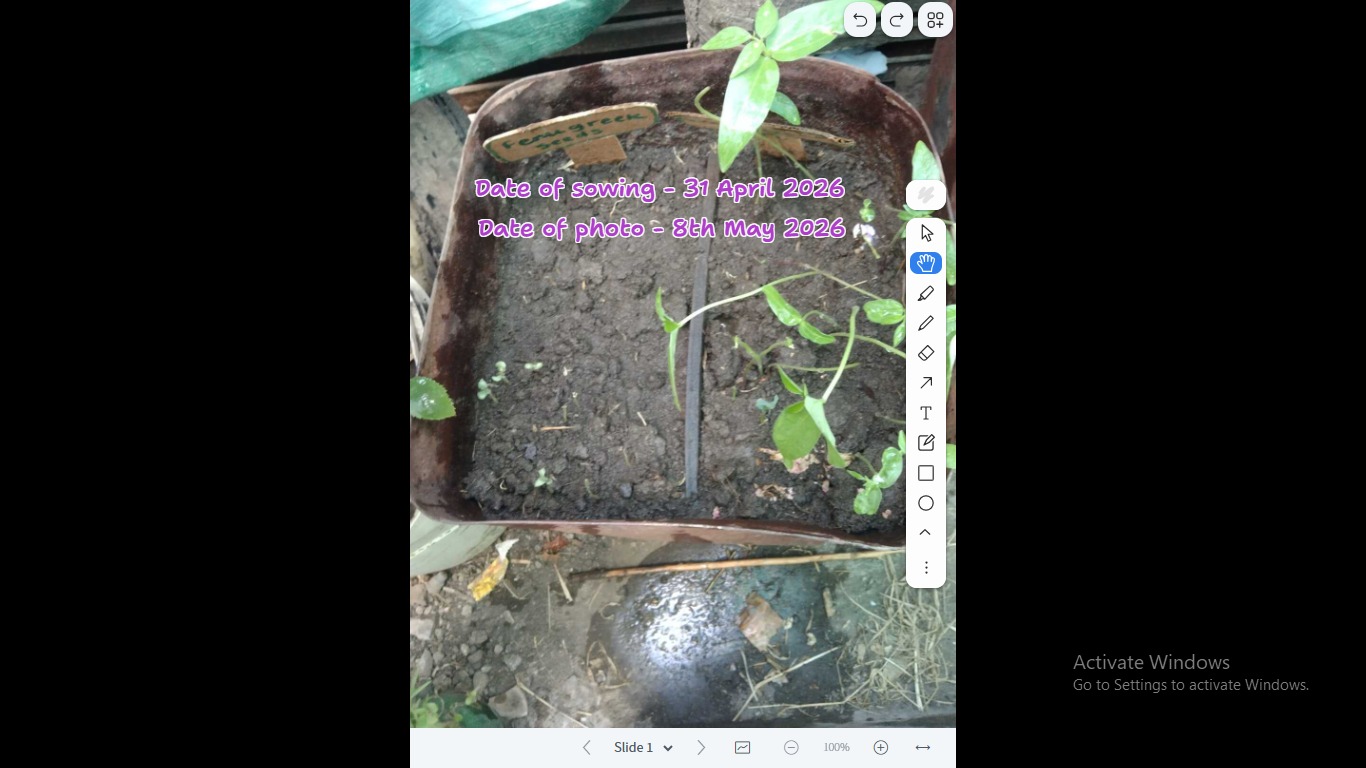
The class started with a home lab experiment by Manali Ma’am.
I also repeated this experiment myself to observe:  Root growth
Plant survival
Root nodules in leguminous plants
 ONE POT WERE USED -to grow Two different seeds -
Green gram
Fenugreek
 OBSERVATIONS THAT MADE US THINK SCIENTIFICALLY
ON 8 MAY:
Both pots had many healthy plants.
ON 10 MAY:
Fenugreek plants were damaged only four small plants survived.
Green gram plants showed healthier and better development.
This simple observation created many scientific questions in our minds
Why were some plants damaged?
Why did one plant survive better?
What makes leguminous plants special?
Why do root nodules form only in some plants?
One observation led to many scientific discussions.
 2. REAL SCIENCE INCLUDES REAL PROBLEMS
During the discussion, @manali Ma’am shared her experience from Yavatmal, Maharashtra, where rats damaged the plant setup.
 This taught us:
Experiments do not always go perfectly.
Environmental conditions can affect scientific results.
Scientists learn from unexpected situations too.
This made the class feel connected to real scientific research.
3. ROOT NODULES — SMALL STRUCTURES WITH BIG SCIENTIFIC IMPORTANCE
Then we explored root nodules in leguminous plants.
HOW ARE ROOT NODULES FORMED?
1-Rhizobium bacteria enter the root hairs.
2-The bacteria send chemical signals to the plant.
3-Plant cells start dividing in a controlled and organized way.
4-Root nodules are formed.
A tiny root structure helped us understand
Microbiology
Cell communication
Plant biology
Symbiotic relationships
 4. MUTUALISM — NATURE HELPING NATURE
Inside the root nodules:  Rhizobium bacteria fix atmospheric nitrogen.
The plant receives nitrogen for growth and protein formation.
In return:  The plant gives food and shelter to the bacteria.
THIS RELATIONSHIP IS CALLED MUTUALISTIC SYMBIOSIS
Both organisms help each other.
5. THE MOST INTERESTING CONNECTION — ROOT NODULES AND TUMORS
At first, I thought:  “Every tumor means cancer.”
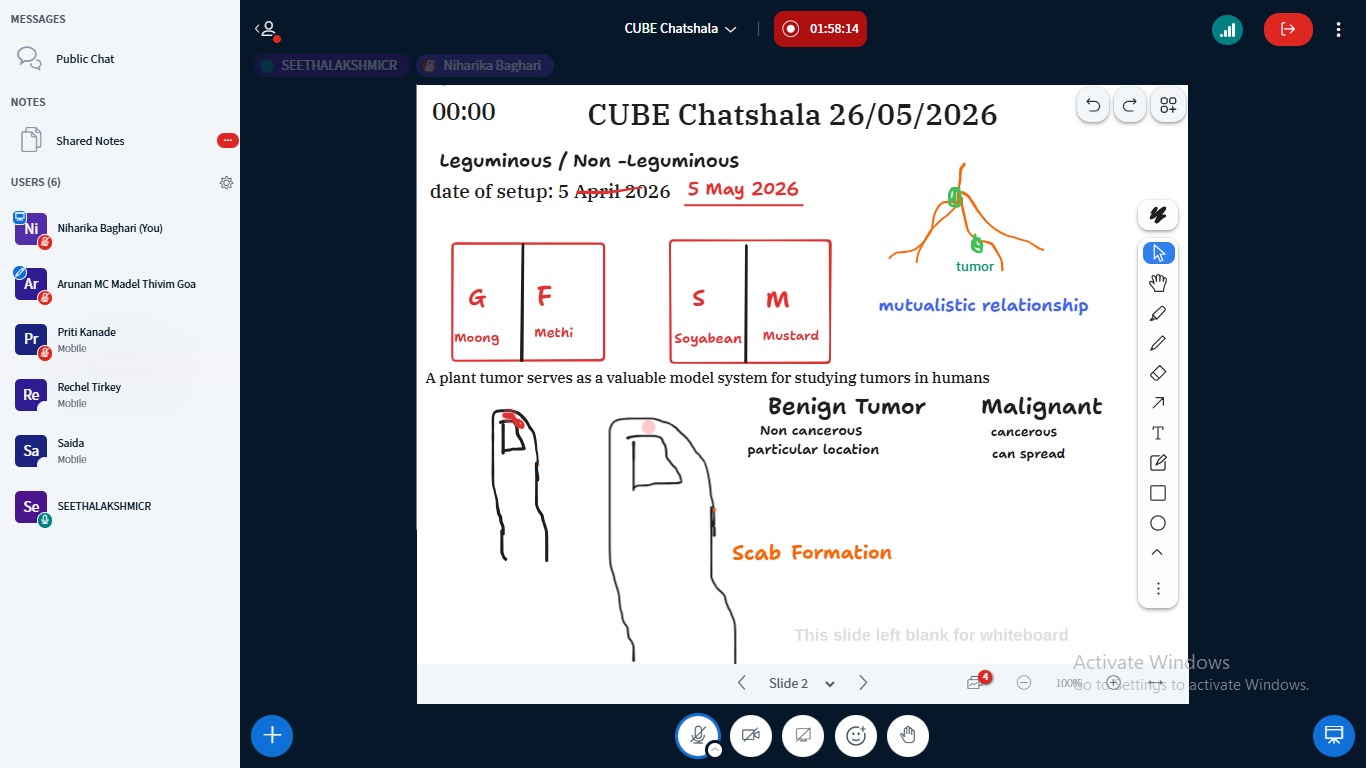
But later, @saida786110 Ma’am explained the scientific difference between benign and malignant tumors.
 BENIGN TUMOR
Non-cancerous
Localized
Controlled growth
 MALIGNANT TUMOR
 Cancerous
Harmful
Uncontrolled growth
Can spread to other body parts
IMPORTANT LEARNING: NOT EVERY TUMOR IS CANCER
6. WHY ROOT NODULES ARE SIMILAR TO BENIGN TUMORS
We discovered that root nodules and benign tumors share one important similarity:
 CONTROLLED CELL DIVISION
Both:
stay localized,
grow in an organized way,
and do not spread rapidly.
MAJOR DIFFERENCE
Root nodules are beneficial.
Tumors are unnecessary body growths.
 “Root nodules are like friendly plant tumors because they help the plant instead of harming it.”
 7. CONTROLLED VS UNCONTROLLED CELL DIVISION
1- CONTROLLED CELL DIVISION
Occurs during:
Wound healing
Growth
Tissue repair
2- EXAMPLE OF WOUND HEALING
-
 Blood clotting happens
 -
 White blood cells protect the wound
 -
 Inflammation may occur
 -
 New cells repair the tissue
Cells divide only when needed.
2-UNCONTROLLED CELL DIVISION
In cancer:
cells ignore stop signals,
continue dividing continuously,
and form harmful tumors.
Cancer happens when the cell control system becomes damaged
8. INFLAMMATION IS NOT ALWAYS CANCER
One important misconception became clear:
Every swelling or pain is not cancer.
Inflammation is: the body’s natural healing response.
This helped us understand:
how the immune system protects the body,
and why proper scientific diagnosis is important.
 9. HOW PRACTICAL LEARNING HELPED US
Today’s class proved that practical learning is powerful because:
We observed real plant growth.
We connected plants with human biology.
We understood difficult concepts through examples.
We asked scientific questions instead of memorizing answers.
One plant model explained many biological concepts together.
Instead of only learning definitions, we explored the “why” and “how” behind biology.
10. QUESTIONS THAT MADE THE CLASS MORE INTERESTING
Why do cancer cells keep dividing?
Why do root nodules stop growing after some time?
How do bacteria communicate with plant roots?
Why are some tumors dangerous while others are not?
How can one simple plant explain cancer biology?
These questions made the session deeply interactive and scientific.
CONCLUSION — ONE PLANT, ENDLESS LEARNING
Today’s class beautifully connected: Plants
Bacteria
Cell division
Cancer biology
Mutualism
 Healing processes
The most inspiring realization was:
A SINGLE PLANT CAN BECOME A COMPLETE BIOLOGICAL LEARNING SYSTEM
This session truly showed the importance of Observation
Curiosity
Practical learning
 Scientific thinking
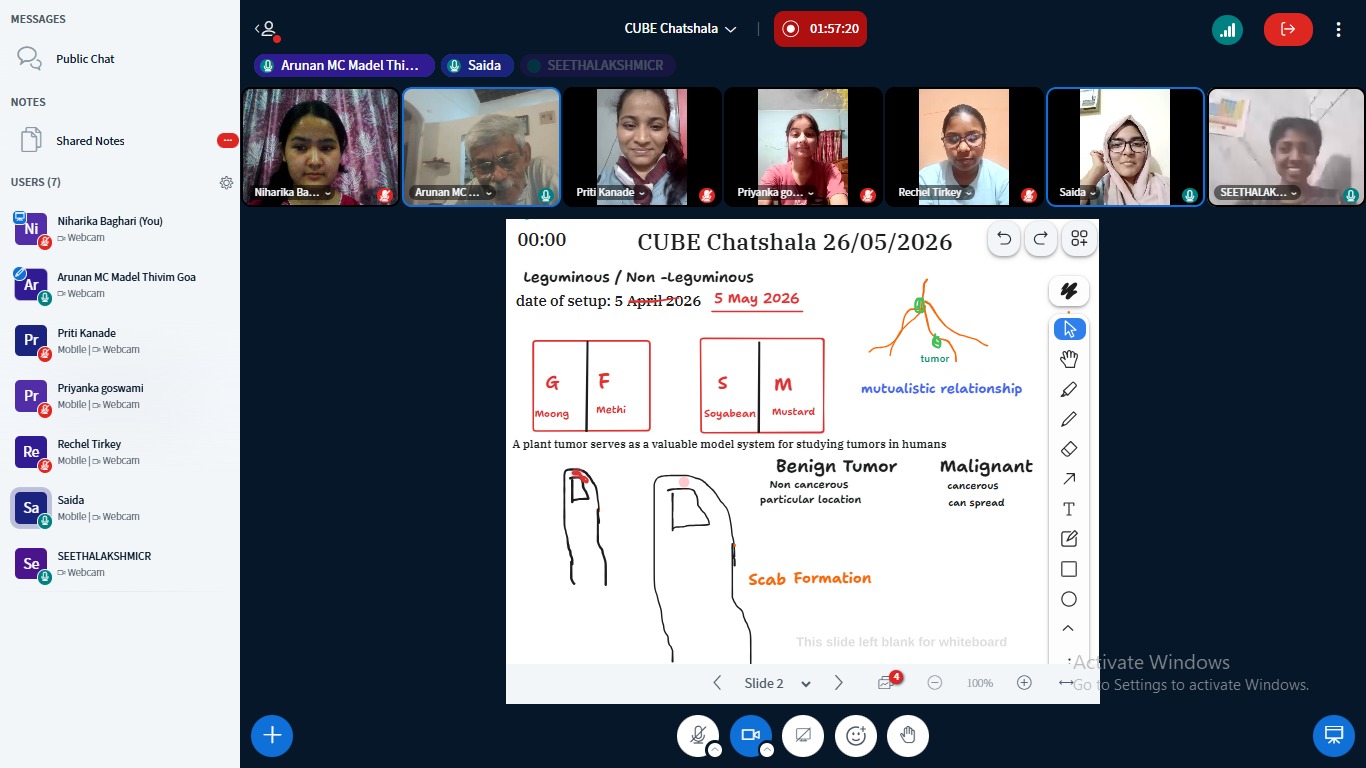
*Screenshot during Chatshaala -