 CUBE ChatShaala - Discussion Summary
The CUBE ChatShaala on 16th February 2026 session revolved around the interconnected themes of evolution, zoogeography, biogeography, and microbial ecology, with participants exploring both conceptual and experimental aspects. The discussion began with the role of geographical isolation in shaping species diversity, illustrated through the Galapagos Islands and the playful “Pagalapos” activity that encourages students to investigate local ecosystems.
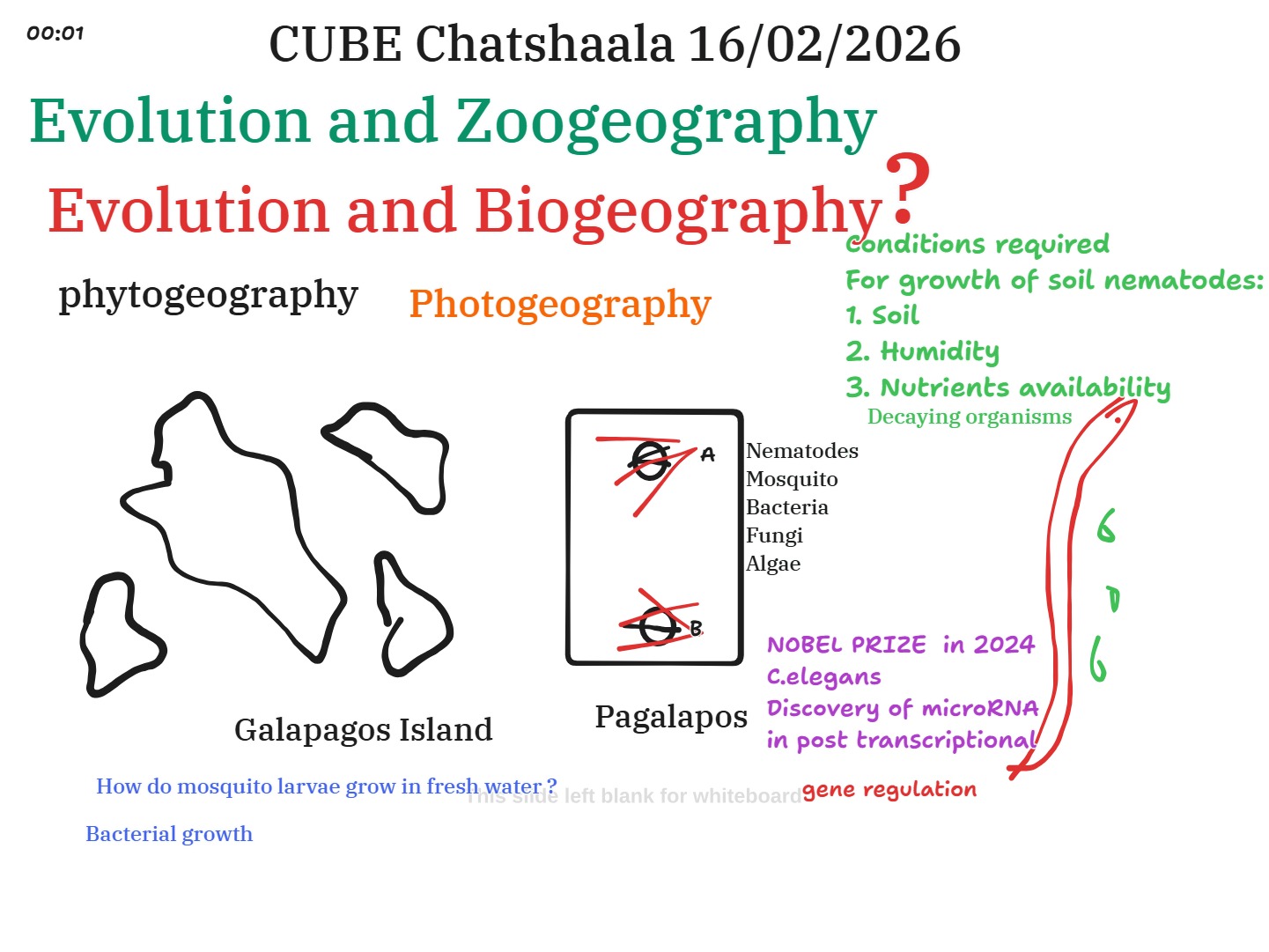
Attention then shifted to soil nematodes and mosquito larvae, examining the environmental conditions—soil, humidity, nutrient availability, and decaying organic matter—that support their growth. This tied into broader questions of microbial interactions, including bacteria, fungi, and algae, as foundational components of ecosystems.
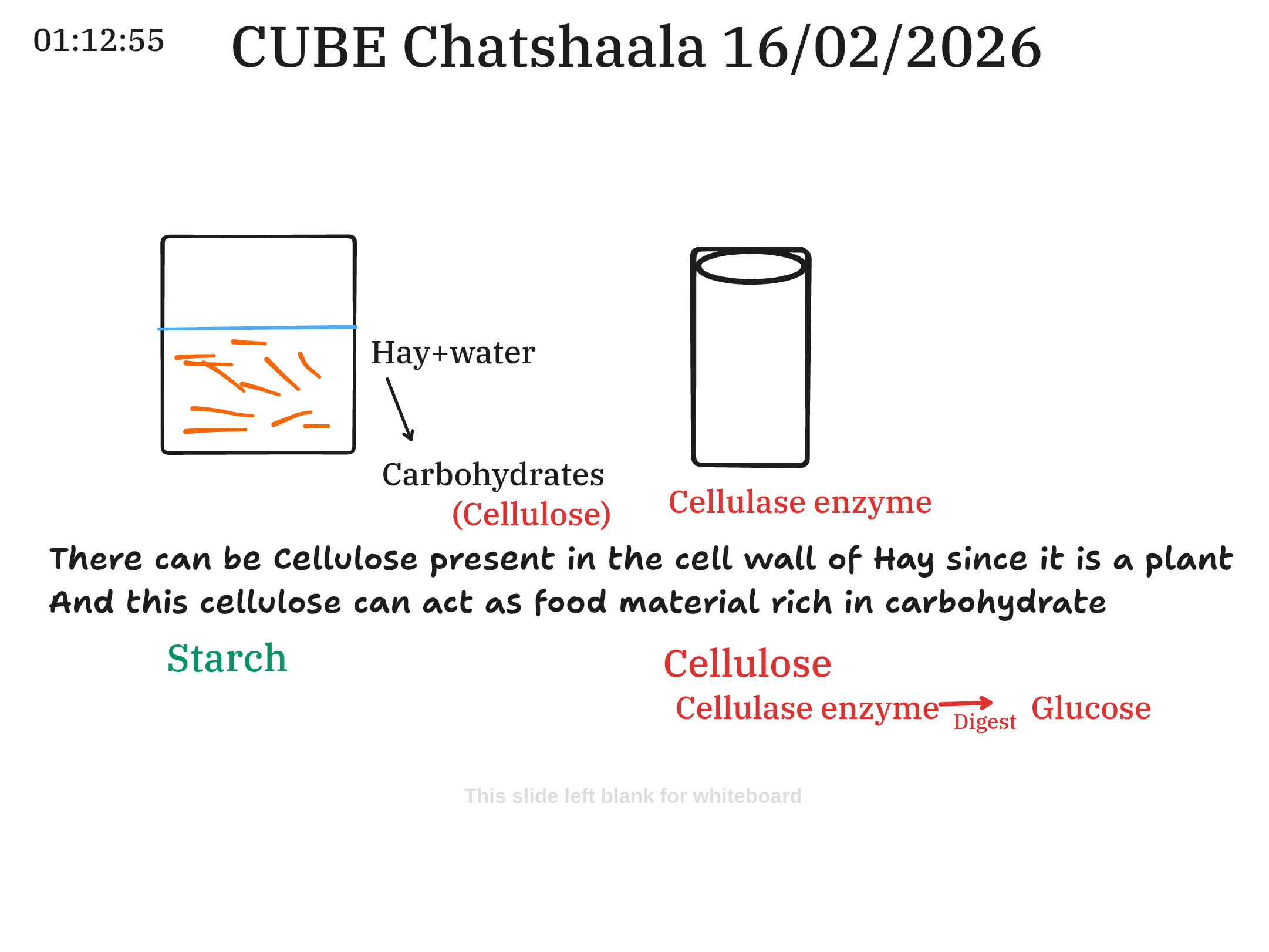
A practical dimension was introduced through methods of extracting nematodes from soil samples, highlighting simple yet effective techniques for observing live organisms in accessible settings . The conversation also touched on cellulose digestion in hay, emphasizing how cellulase enzymes break down cellulose into glucose, thereby connecting plant biology to carbohydrate metabolism.
The session linked these ecological insights to cutting-edge molecular biology, referencing the 2024 Nobel Prize in Physiology or Medicine, awarded to Victor Ambros and Gary Ruvkun for their discovery of microRNA and its role in post-transcriptional gene regulation . This discovery was contextualized within the model organism C. elegans, bridging classroom-level experiments with globally recognized research.
Finally, cubists reflected on science as culture, a principle central to CUBE’s philosophy, which emphasizes collaboration, inclusivity, and the use of simple, everyday resources to democratize science education.
 Provocative Questions
-
How does geographical isolation, as seen in the Galapagos Islands, compare to “Pagalapos” experiments in shaping our understanding of evolution?
-
What ecological roles do nematodes play in soil ecosystems, and how might their presence indicate environmental health?
-
Could mosquito larvae survival in freshwater serve as a model for studying resilience in changing ecosystems?
-
How does the digestion of cellulose by cellulase enzymes illustrate the link between plant biology and microbial metabolism?
-
In what ways does the discovery of microRNA challenge earlier assumptions about gene regulation?
-
How can simple, low-cost experiments with soil microbes inspire students to engage with complex biological concepts?
 What I Have Learned
-
Evolutionary principles are best understood not only through distant examples like the Galapagos but also through local, accessible ecosystems.
-
Soil nematodes and mosquito larvae provide practical entry points into ecological studies, connecting classroom inquiry with real-world biodiversity.
-
Cellulose digestion demonstrates how plant structures can be transformed into usable energy, reinforcing the importance of enzymes in biological processes.
-
The Nobel Prize discovery of microRNA underscores how small molecular mechanisms can have profound impacts on our understanding of life.
-
CUBE’s philosophy of “science as culture” highlights the importance of inclusivity, collaboration, and resourcefulness in education.
 TINKE Moments
-
Terminology Confusion: The playful use of “Pagalapos” alongside “Galapagos” sparked curiosity but also risked misunderstanding the scientific context.
-
Microbial Overlook: While nematodes were emphasized, other organisms (fungi, algae, bacteria) were mentioned but not deeply explored, leaving gaps in ecological integration.
-
Conceptual Leap: The transition from soil ecology to microRNA regulation was intellectually stimulating but may have felt abrupt for some participants, requiring clearer scaffolding.
-
Accessibility Challenge: While simple methods for nematode extraction were shared, participants noted the difficulty of maintaining live samples without proper conditions.
 Gaps and misconceptions
-
Limited discussion on phytogeography, despite its mention, left plant distribution patterns underexplored.
-
The role of starch vs. cellulose in plant metabolism was introduced but not fully differentiated.
-
Broader implications of microRNA in human health (e.g., cancer, autoimmune diseases) were only briefly touched upon.
-
Some participants assumed all microbes revive quickly from dry soil samples, whereas revival depends on species-specific resilience.
-
The idea that cellulose digestion directly equates to energy availability overlooked the complexity of enzymatic efficiency and microbial cooperation.
-
A tendency to view microRNA as unique to C. elegans rather than a universal mechanism across multicellular organisms.
 Photographs during Chatshaala
 Reference