 CUBE ChatShaala Summary (04.10.2025)
Today’s discussion explored how the transformation of milk into curd beautifully connects physics, chemistry, and biology.
-
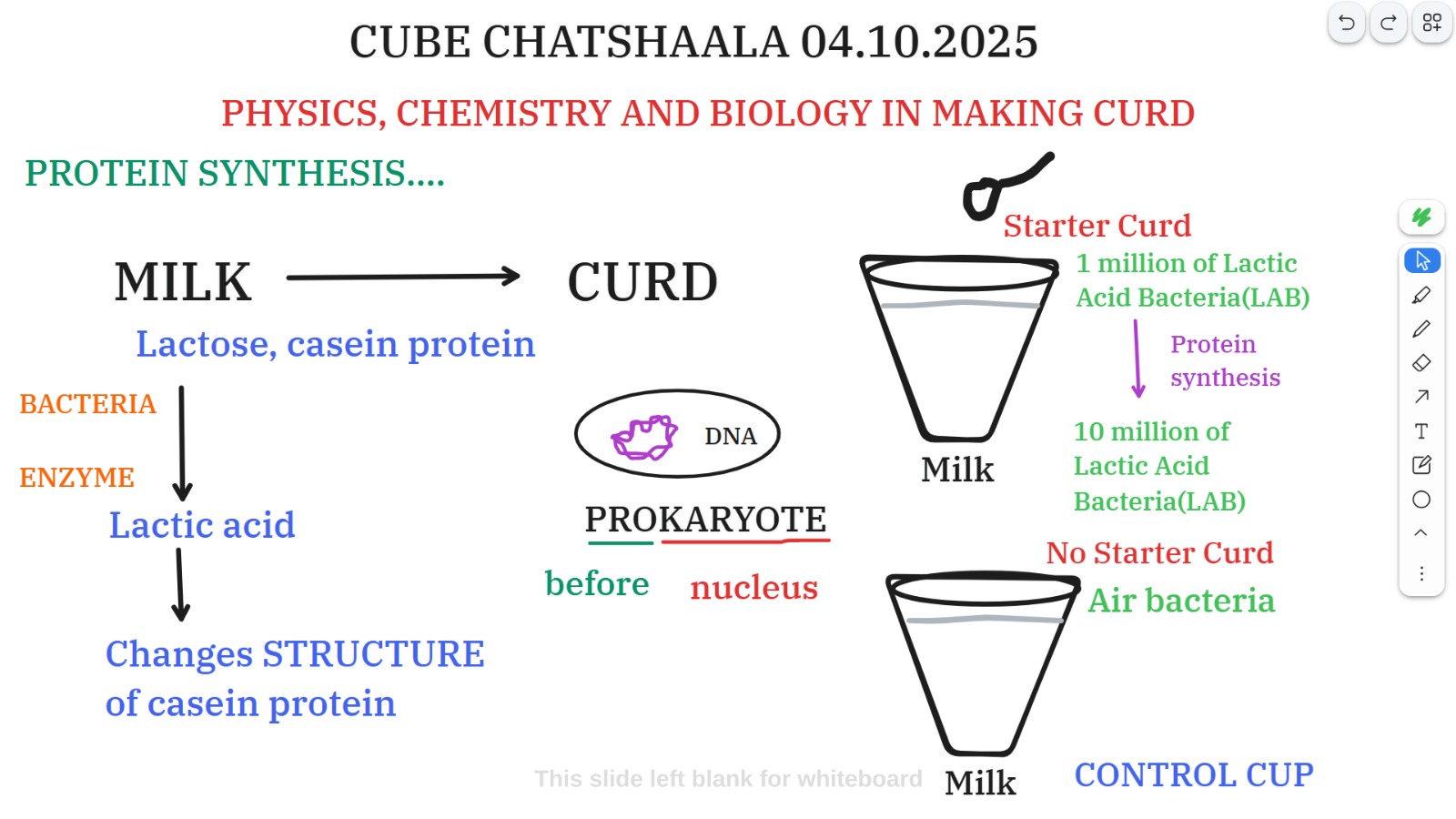
Milk Composition: Milk contains lactose (sugar) and casein (protein).
-
Role of Bacteria: When lactic acid bacteria (LAB) are introduced (via a spoonful of starter curd), they act as prokaryotes that synthesize enzymes.
-
Enzymatic Action: These enzymes convert lactose into lactic acid.
-
Protein Change: Lactic acid alters the structure of casein protein, causing milk to thicken into curd.
-
Starter vs. Control:
- With starter curd: Millions of LAB multiply rapidly through protein synthesis, producing curd.
- Without starter curd: Only random air bacteria are present, so curd formation is uncertain and delayed.
This model system helps us connect protein synthesis, enzymatic reactions, microbial growth, and food science.
 Provocative Questions for the Audience
-
Can milk ever turn into curd without adding starter curd? If yes, how long would it take and why?
-
Why do we call lactic acid bacteria “prokaryotes,” and how does this matter for curd formation?
-
Is curd formation only a chemical reaction or also a biological process? Where does physics
enter the picture? -
If curd bacteria can multiply so fast, why don’t we get sick when we eat curd?
 What I Learned
-
Curd making is not just “grandma’s recipe” but a scientific process involving enzymes, proteins, and bacterial genetics.
-
The presence of starter culture (with LAB) makes the process predictable, unlike random air bacteria.
-
The term “prokaryote” literally means “before nucleus,” reminding us of the evolutionary simplicity of LAB.
-
Protein structure can be chemically altered by acids, showing a direct link between food science and molecular biology.
 TINKE Moments (This I Never Knew Earlier)
-
Many thought curd forms just because of “air exposure,” but in reality, it needs specific bacteria (LAB).
-
Protein synthesis inside bacteria directly links microbial life to a visible kitchen phenomenon.
-
The exact role of temperature in accelerating or slowing down curd formation wasn’t deeply discussed—this could be our next exploration.
-
Could different bacterial strains produce curd with different tastes, textures, or nutritional values?
 Reference
-
https://ifst.onlinelibrary.wiley.com/doi/10.1111/ijfs.16076?utm_source=chatgpt.com
-
Fermentation of Yogurt and the Chemistry Behind It | FoodUnfolded
@Arunan, @SN1261, @sakshiconsultant2002, @magpie, @dhanraj7, @Jeene, @ankitcube, and others