CUBE ChatShaala Meeting Summary (December 5, 2025)
 Meeting Overview: NEP 2020 Implementation and Academic Pathways
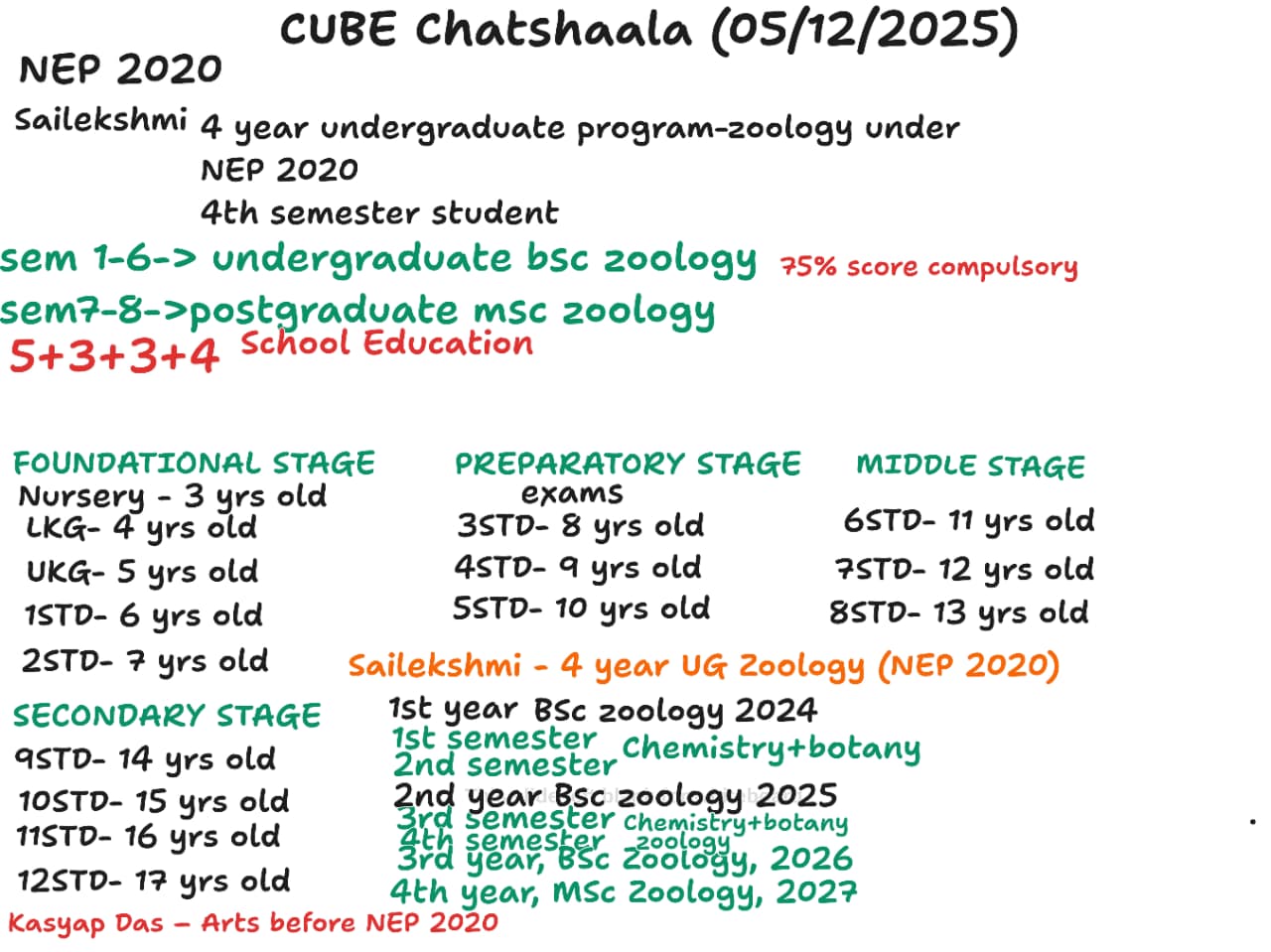
The CUBE ChatShaala session on December 5, 2025, focused on understanding the academic structure and course progression under the National Education Policy (NEP) 2020, specifically examining the undergraduate and postgraduate pathways for two students: Sailekshmi (4-year UG Zoology) and Sneha (PG Botany). Key discussions also centered on the new 5+3+3+4 school education structure and its correlation with age groups.
 Academic Pathways Under NEP 2020
1. Sailekshmi: 4-Year UG Zoology (NEP 2020)
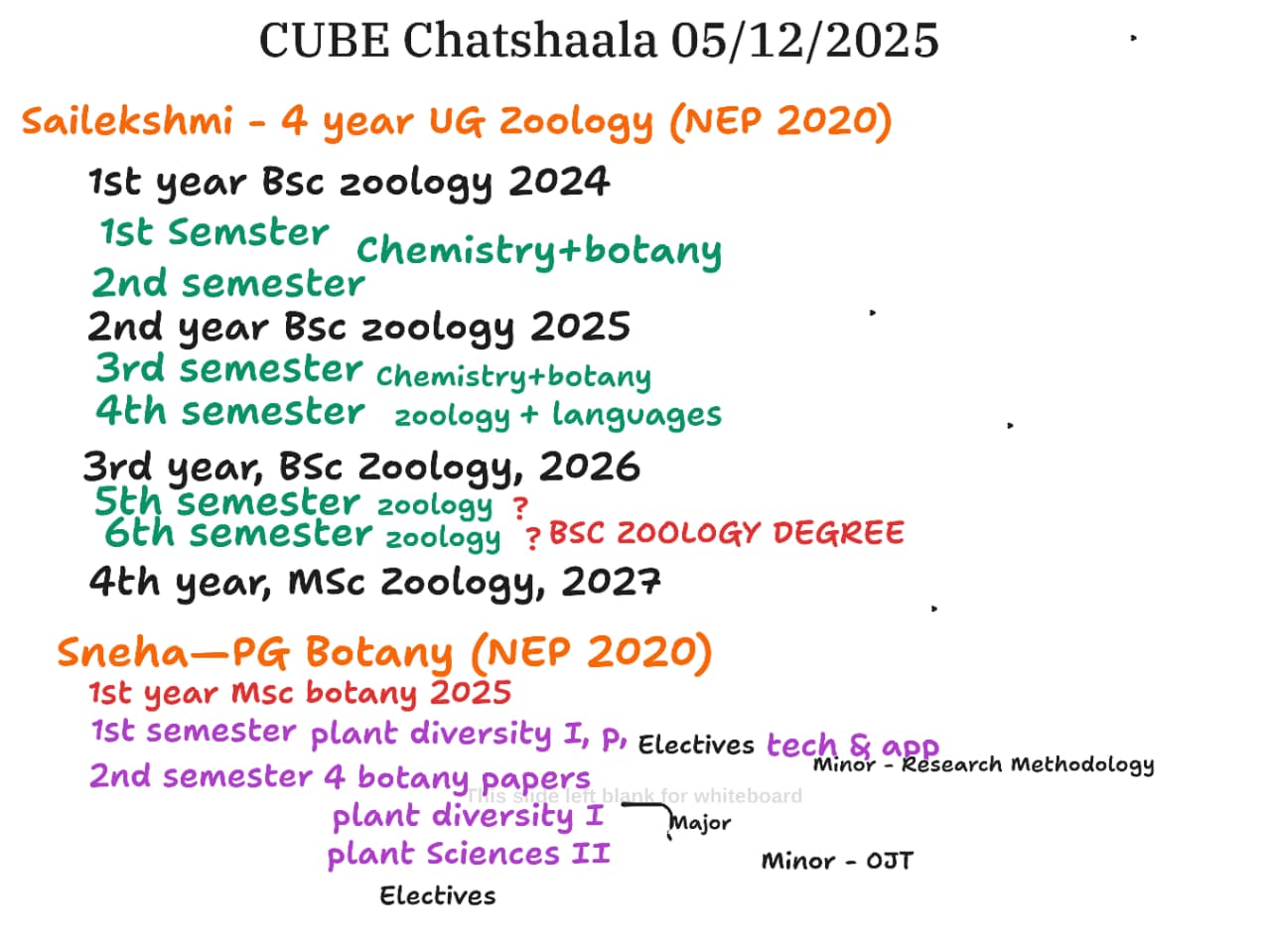
Sailekshmi is a 4th-semester student navigating the new 4-year undergraduate program in zoology. The notes outline her expected progression:
- Year 1 (2024):
- 1st Semester: Chemistry + Botany (Minor/Multidisciplinary focus)
- 2nd Semester: Chemistry + Botany (Minor/Multidisciplinary focus)
- Year 2 (2025):
- 3rd Semester: Chemistry + Botany (Minor/Multidisciplinary focus)
- 4th Semester: Zoology + Languages (Major focus on Zoology begins with an additional Languages component)
- Year 3 (2026):
- 5th Semester: Zoology (Major/Specialization)
- 6th Semester: Zoology (Major/Specialization) → BSc Zoology Degree awarded upon completion of Semesters 1-6.
- Year 4 (2027):
- 7th Semester → 8th Semester: MSc Zoology (This structure implies a direct progression into a 1-year Master’s, forming the 4-year UG + 1-year PG integrated pathway, with the 4th UG year effectively functioning as the 1st PG year.)
Note: The progression from Semester 1-6 covers the Undergraduate BSc Zoology component, requiring a 75% score compulsory for eligibility to progress. Semesters 7-8 transition to the Postgraduate MSc Zoology level.
2. Sneha: PG Botany (NEP 2020)
Sneha is pursuing a postgraduate course in botany under the NEP 2020 framework, beginning in 2025:
- 1st Year (2025):
- 1st Semester: Plant Diversity I (Major), Plant Sciences II, P, Electives (Tech & App), Minor (Research Methodology).
- 2nd Semester: 4 Botany papers, Plant Diversity I (Major), Plant Sciences II, Electives, Minor (OJT - On-the-Job Training).
 NEP 2020 School Education Structure (5+3+3+4)
The meeting reviewed the new structure and its corresponding age/grade levels:
| Stage | Structure | Grades | Age (Yrs Old) |
|---|---|---|---|
| Foundational | 5 Years | Nursery, LKG, UKG, 1st, 2nd | 3, 4, 5, 6, 7 |
| Preparatory | 3 Years | 3STD, 4STD, 5STD | 8, 9, 10 |
| Middle | 3 Years | 6STD, 7STD, 8STD | 11, 12, 13 |
| Secondary | 4 Years | 9STD, 10STD, 11STD, 12STD | 14, 15, 16, 17 |
 What I’ve Learned
By reviewing the whiteboard summaries and the discussion points of the CUBE ChatShaala, I have learned the following key features of the NEP 2020 implementation:
-
Integrated UG/PG Pathway: The 4-year undergraduate degree is not a single, monolithic block. It clearly bifurcates, with the first three years (Semesters 1-6) conferring the BSc degree, and the optional fourth year (Semesters 7-8) functioning as the initial phase of the MSc program. This offers a flexible exit and entry point for students, which is a major policy shift.
-
Emphasis on Interdisciplinary Foundations: For specialized degrees like Zoology (Sailekshmi’s case), the initial semesters (1, 2, 3) are dedicated to foundational subjects outside the core major (Chemistry + Botany). This structure mandates a broad, interdisciplinary base before intense specialization.
-
Skill-Centric Post-Graduation: The curriculum for PG Botany (Sneha’s case) explicitly includes high-value, practical components like Research Methodology and OJT (On-the-Job Training). This reflects a definitive move towards making Master’s degrees more aligned with professional research and industry requirements.
-
Compulsory Progression Score: A stringent academic requirement, specifically the 75% score compulsory rule for advancement (likely aggregate or major-specific), highlights an intention to maintain high academic standards within the flexible framework.
 TINKE Moments (This I Never Knew Earlier)
| Category | Description |
|---|---|
| Thoughts | The complexity and integrated nature of the NEP 2020 structure, especially the transition from UG to PG in the 4th year, requires precise curriculum mapping and student advisement. The degree of flexibility introduced necessitates clarity on “Major” and “Minor” paper requirements. |
| Inspirations | The emphasis on Research Methodology and OJT (On-the-Job Training)** within the PG curriculum for Sneha is a strong step toward practical, skill-based learning and industry readiness, aligning with NEP’s core principles. |
| New Knowledge | The breakdown of the 5+3+3+4 school system and its precise age mapping, which directly informs the entry point of future UG students. The knowledge that the 7th and 8th semesters of the 4-year UG program are essentially the MSc level. |
| Key Takeaways | 75% compulsory score for progression to higher UG levels is a critical academic hurdle. The 4th year UG acts as a potential exit/entry point, granting a UG degree at the end of the 6th semester and a subsequent PG degree after the 8th. |
| Extensions | Need to explore the course titles for the 5th and 6th semester Zoology papers for Sailekshmi and define the scope of the languages component in the 4th semester. |
 Gaps and Misconceptions
| Area | Gaps/Misconceptions Cleared/Identified |
|---|---|
| BSc Degree Award | Misconception: That the BSc degree is only awarded after the full 4 years. Clarification/Gap: The notes suggest the BSc Zoology Degree is awarded after the 6th semester (3rd year), and the 4th year (Sem 7 & 8) is designated for MSc Zoology. This distinction needs official confirmation regarding exit options. |
| Minor/Multidisciplinary Papers | Gap: The specific designation of chemistry and botany as minor or multidisciplinary in the first three semesters for Sailekshmi is unclear. The balance between core subject learning and multidisciplinary exposure needs defining. |
| PG Curriculum Structure | Gap: The full list of Electives and the depth of the Minor components (Research Methodology, OJT) in Sneha’s PG curriculum need to be elaborated to understand the full breadth of the course. |
| 75% Score Rule | Gap: The exact criteria for the 75% compulsory score (Is it a cumulative aggregate, subject-specific, or semester-specific?) is not specified, which is crucial for student planning. |
 Provocative Questions for the General Audience
-
The 4-Year UG Dilemma: If a BSc degree is awarded after the 6th semester, does the option to continue for the 4th year (MSc level) create a “two-tiered” Bachelor’s status? Are we devaluing the 3-year degree holders of the past or simply upgrading the standard?
-
Multidisciplinary vs. Core Strength: Sailekshmi spends her first three semesters focusing on chemistry and botany before shifting fully to zoology in the 4th. Is this broad-based approach creating well-rounded thinkers or delaying deep subject specialization? How does a delayed focus impact career readiness?
-
The Research Mandate: Sneha’s PG course mandates Research Methodology and OJT. Is Indian higher education finally prioritizing practical research skills over rote memorization, or is this just another set of papers to pass? What tangible difference will this make in the employability of postgraduates?
-
Schooling and Age: The 5+3+3+4 structure rigidly maps grades to age. Does this structured timeline adequately account for the wide range of developmental paces among children, or does it enforce an artificial, one-size-fits-all education system?
 Photographs during Chatshaala
 Reference