CUBE Chatshaala - Discussion Summary
Today’s CUBE ChatShaala (26/02/2026) session revolved around two interconnected themes: experimental setups with Cardamine seeds and the molecular biology of bacterial cell walls, particularly the role of peptidoglycan and the mechanism of penicillin.
-
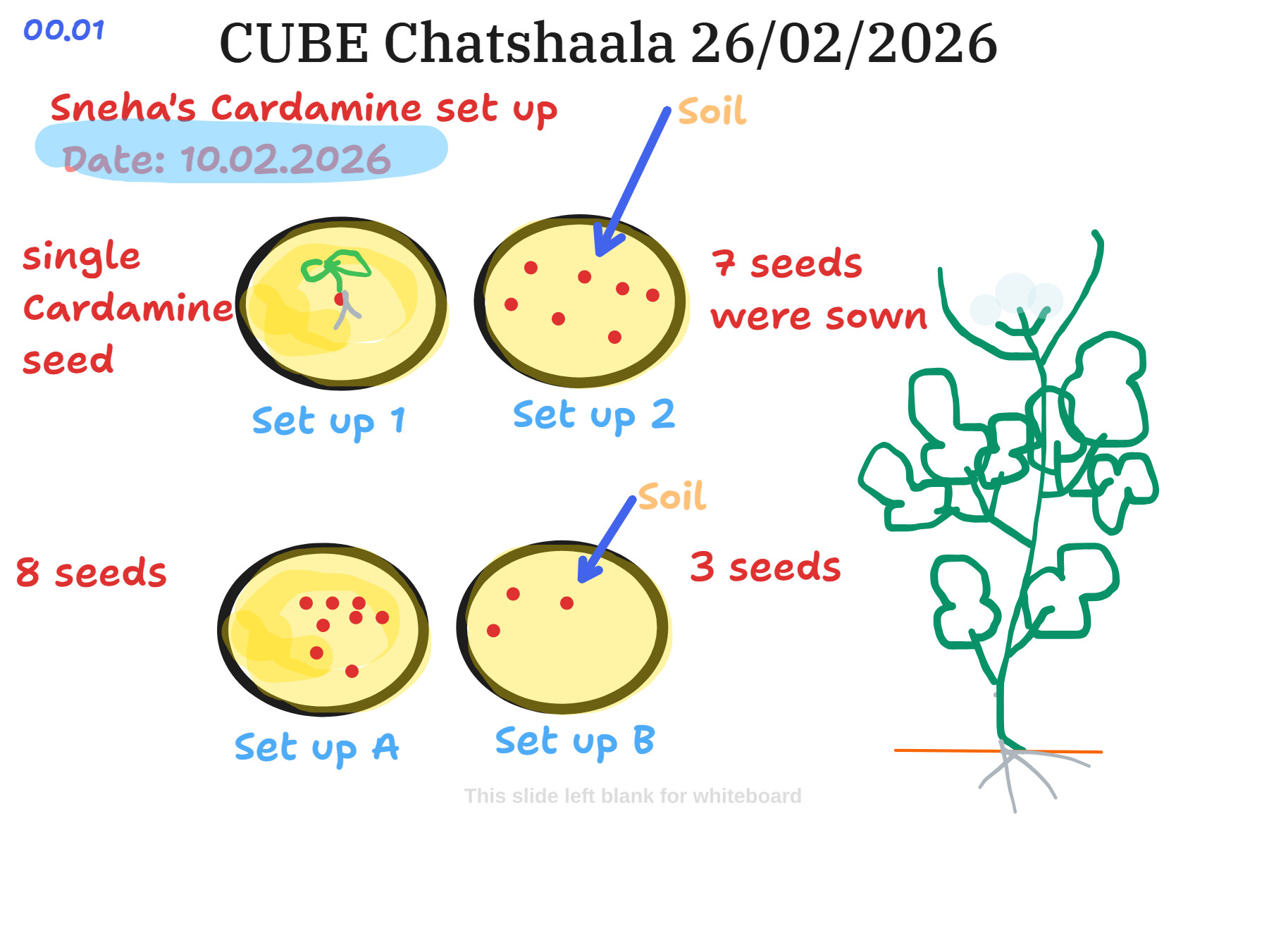
Experimental Setups: Sneha presented multiple sowing configurations of Cardamine seeds (single seed, 3 seeds, 7 seeds, and 8 seeds). These setups were designed to observe growth variations depending on seed density and soil conditions. The discussion highlighted how controlled experiments with different seed numbers can help in understanding competition, resource allocation, and developmental outcomes in plants.
-
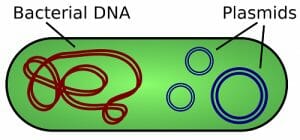
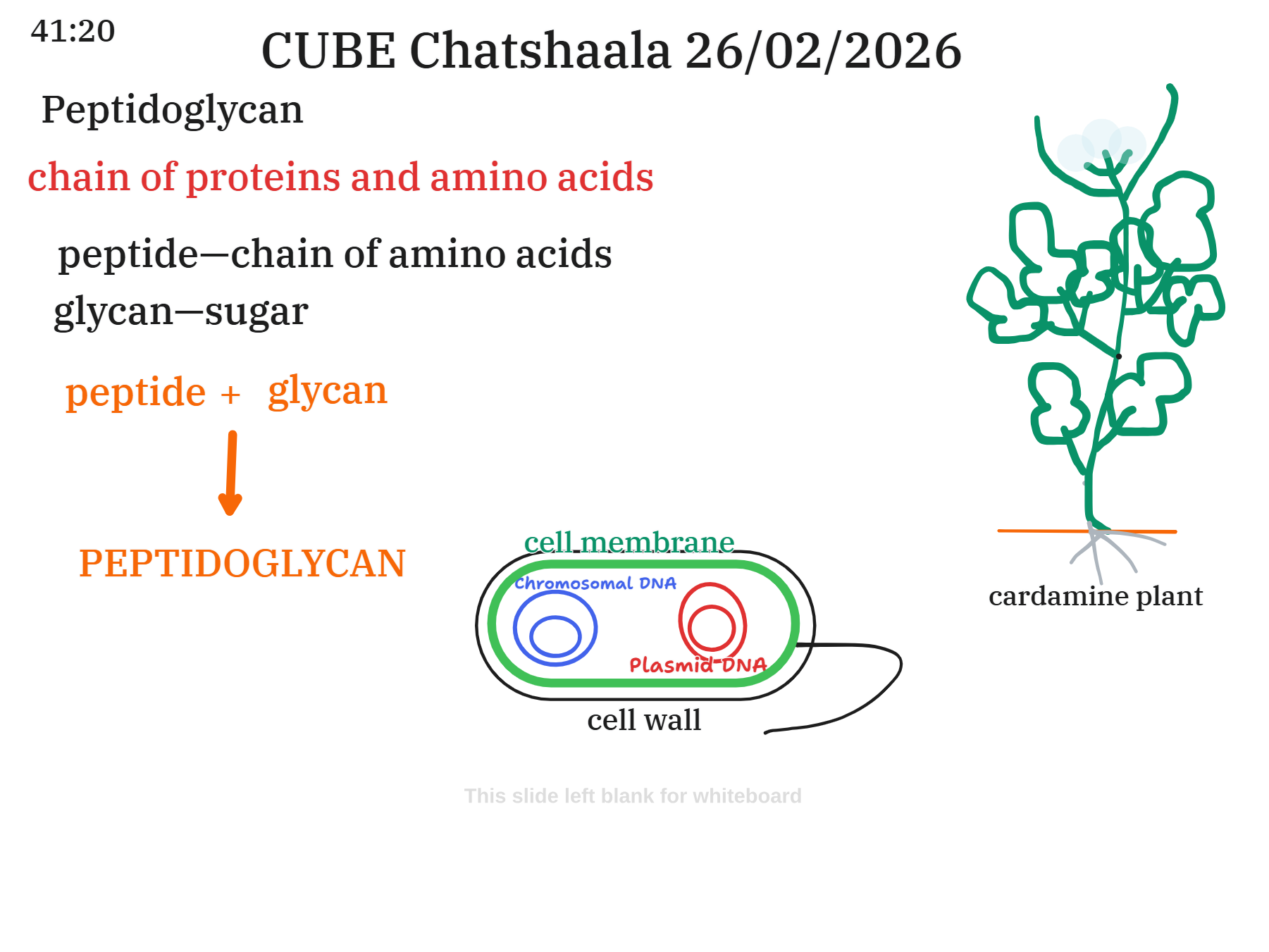
Peptidoglycan Concept: A whiteboard explanation clarified that peptidoglycan is formed by combining peptides (chains of amino acids) with glycans (sugars). This structural polymer is essential for bacterial cell wall integrity. A diagram illustrated the bacterial cell structure, including chromosomal DNA, plasmid DNA, cell membrane, and cell wall, alongside a sketch of a Cardamine plant to connect microbiology with plant biology.
-
Penicillin Mechanism: explains how penicillin works by binding its beta-lactam ring to DD-transpeptidase, an enzyme that cross-links peptidoglycan strands. This inhibition prevents new cell wall synthesis, making bacteria vulnerable to osmotic pressure and resulting in lysis. Importantly, penicillin does not degrade existing cell walls, but rather inhibits repair and synthesis. Because human cells lack cell walls, penicillin selectively kills bacteria while leaving human tissues unharmed.
-
Discussion Point: A key question emerged—if penicillin does not degrade the existing wall, what mechanisms or factors contribute to the breakdown of bacterial cell walls once synthesis is halted? This opened a broader inquiry into bacterial autolysins and natural enzymatic processes.
 Provocative Questions
-
Why does seed density influence Cardamine growth, and how might this parallel microbial colony dynamics?
-
If peptidoglycan provides structural integrity, what evolutionary advantage did bacteria gain by relying on this specific polymer compared to other possible structures?
-
How do bacterial autolysins complement the action of penicillin in weakening the cell wall?
-
Could plasmid DNA play a role in bacterial resistance to penicillin, and how might this be experimentally demonstrated?
-
What lessons can plant biology experiments (like Sneha’s setups) teach us about resource competition that might also apply to microbial ecosystems?
-
If penicillin only prevents new wall synthesis, what happens to bacteria in a dormant state where cell wall turnover is minimal?
 What I Have Learned
-
Seed Experiments: Even simple variations in seed number can yield insights into plant competition and growth dynamics.
-
Peptidoglycan: It is a hybrid molecule of peptides and sugars, forming the backbone of bacterial cell walls.
-
Penicillin’s Selectivity: Penicillin targets bacterial enzymes without affecting human cells, making it a powerful antibiotic.
-
Mechanistic Clarity: Penicillin does not destroy existing walls but halts new synthesis, leading to eventual bacterial death through osmotic imbalance.
-
Cross-disciplinary Insight: Linking plant experiments with microbiology fosters a broader understanding of growth, competition, and structural integrity across life forms.
 TINKE Moments (This I Never Knew Earlier)
-
Penicillin’s Mode of Action: I had assumed penicillin directly degraded bacterial walls, but today clarified that it only blocks synthesis, leaving natural bacterial enzymes to complete the breakdown.
-
Autolysins’ Role: The idea that bacteria possess their own wall-degrading enzymes was surprising and deepened my understanding of how antibiotics exploit natural bacterial processes.
-
Seed Density Analogy: The comparison between seed competition in soil and bacterial survival under antibiotic stress was an unexpected but enlightening parallel.
-
Plasmid DNA Connection: The mention of plasmids reminded me that resistance traits can be horizontally transferred, adding complexity to antibiotic effectiveness.
 Gaps and Misconceptions
-
Misconception: Penicillin directly destroys bacterial cell walls. Correction: It inhibits synthesis, while autolysins and osmotic pressure contribute to wall degradation.
-
Gap: The exact role of autolysins in penicillin-mediated bacterial death was not fully explored and remains an area for deeper discussion.
-
Gap: While seed density experiments were introduced, the expected outcomes (growth rate, morphology, competition effects) were not yet analyzed, leaving room for future observation.
-
Misconception: Plasmid DNA was mentioned but not fully connected to antibiotic resistance in the discussion, which could be clarified in subsequent sessions.
 Photographs during chatshaala

 Reference