 CUBE ChatShaala – Discussion Summary
Date: 11 March 2026
Topic: Context to Curriculum on pH – Practical Determination Using Soil and Water Samples
The session began with a practical setup involving four containers labeled A to D, each filled with 500 ml of different water mixtures:
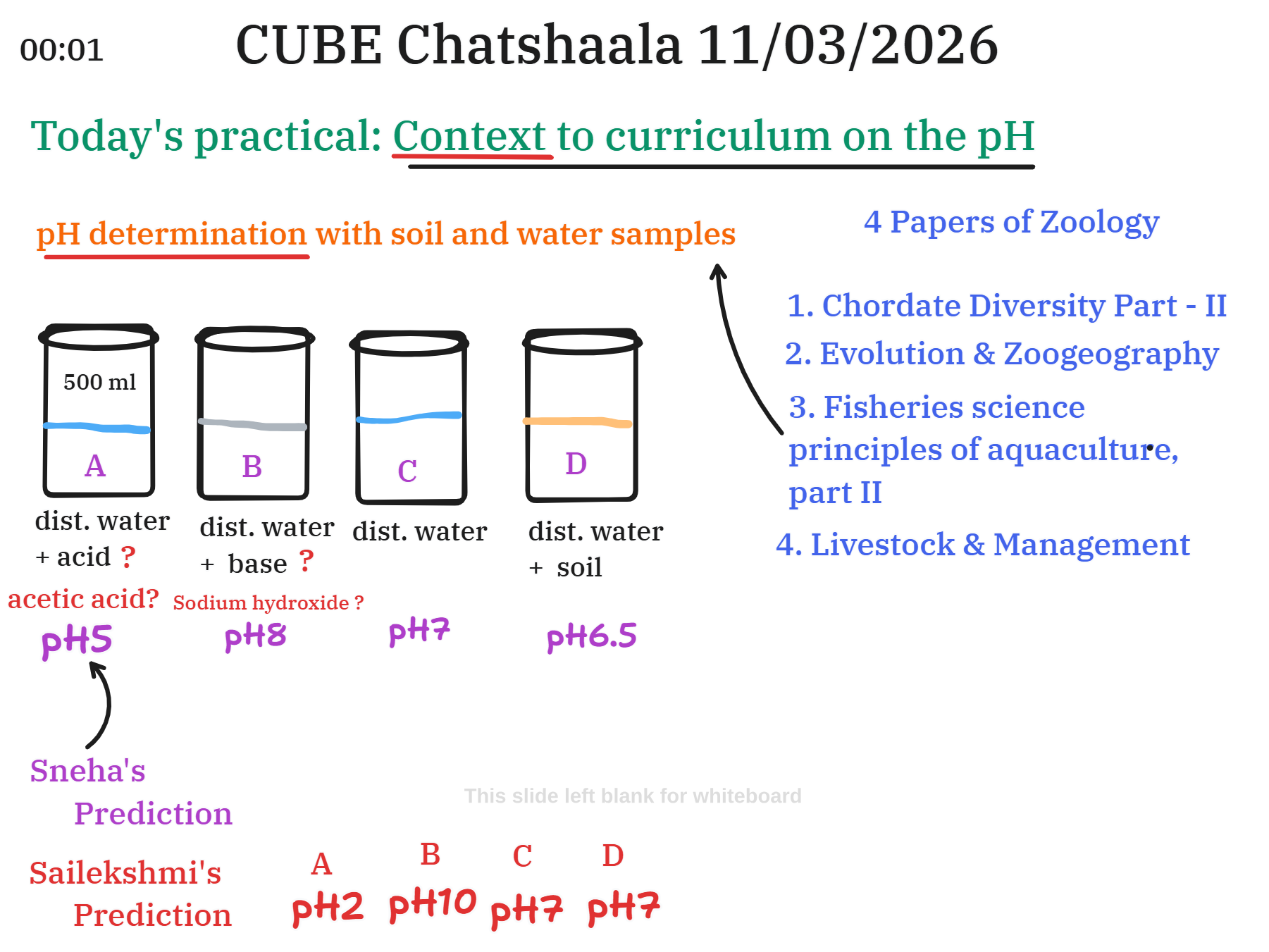
- A: Distilled water + acid (likely acetic acid)
- B: Distilled water + base (likely sodium hydroxide)
- C: Pure distilled water
- D: Distilled water + soil
Cubists Sneha and Sailekshmi made predictions about the pH values of each beakers:
| Beakers | Sneha’s Prediction | Sailekshmi’s Prediction |
|---|---|---|
| A | pH 5 | pH 2 |
| B | pH 8 | pH 10 |
| C | pH 7 | pH 7 |
| D | pH 6.5 | pH 7 |
This led to a discussion on how acids and bases influence pH, the neutrality of distilled water, and the buffering effect of soil. The group explored how soil pH is influenced by factors such as organic matter, climate, and parent rock material with an extremely alkaline pH (Trials). The importance of soil pH in nutrient availability and plant health was emphasized, linking the experiment to real-world agricultural and ecological contexts.
The session also briefly touched on zoology curriculum topics, including Chordate Diversity, Evolution & Zoogeography, Aquaculture Principles, and Livestock Management, suggesting interdisciplinary connections.
 Provocative Questions
-
Why did Sneha and Sailekshmi predict such different pH values for the same samples?
-
How does the presence of soil alter the pH of distilled water, and what does that reveal about soil composition?
-
Can we use simple household materials to test pH accurately? What are the limitations?
-
How do soil pH levels affect microbial activity and nutrient cycling?
-
What implications does soil pH have for aquaculture and livestock management?
 What I Have Learned
-
Soil pH is a critical factor in determining nutrient availability and plant health. Most nutrients are best absorbed in soils with a pH between 6 and 7.
-
Distilled water is neutral, but its pH can shift when mixed with acids, bases, or soil due to chemical interactions.
-
Soil acts as a buffer, often moderating extreme pH changes due to its organic matter and mineral content.
-
Prediction accuracy depends on understanding chemical properties, not just assumptions—highlighting the value of experimental validation.
-
Curriculum connections can be enriched by practical demonstrations that link textbook concepts to real-world phenomena.
 TINKE Moments (This I Never Knew Earlier)
-
Misconception about acid strength: Sailekshmi predicted pH 2 for acetic acid, which is a weak acid. This sparked a discussion on acid dissociation and strength, clarifying that not all acids drastically lower pH.
-
Neutrality of soil: The assumption that soil mixed with distilled water would yield a neutral pH (pH 7) overlooked the natural acidity or alkalinity of soil, which varies by region and composition.
-
Overconfidence in distilled water’s neutrality: While distilled water is neutral in theory, its pH can shift due to CO₂ absorption from air, a subtle but important detail.
-
Curriculum disconnect: The zoology paper list felt disconnected from the pH experiment, suggesting a need to better integrate interdisciplinary themes.
 Gaps and Misconceptions
-
Acetic acid’s pH misunderstood: It’s a weak acid, typically around pH 4–5, not as low as pH 2.
-
Soil’s buffering capacity underexplored: The role of organic matter and clay in resisting pH changes deserves deeper attention.
-
No actual measurements taken: The session relied on predictions, missing an opportunity to validate with pH strips or meters.
-
Curriculum linkage unclear: The zoology papers were listed but not discussed in relation to the experiment, leaving a thematic gap.
 Photographs during Chatshaala
 Reference