CUBE Chatshaala - Discussion Summary
The CUBE ChatShaala session on 13 February 2026 centered on seed germination experiments with moong (green gram) and explored differences in germination rates across progenies. Participants documented two setups (A and B) with 10 seeds each, noting early swelling and germination within 20 hours in one case and delayed germination in others. A key focus was the comparison between progenies: one seed germinated within 24 hours (OGP—One-day Germination Progeny), while another took five days (FGP—Five-day Germination Progeny). The plants grown from these seeds produced new seeds, which showed distinct germination patterns—30% of OGP seeds germinated within 24 hours, whereas FGP seeds showed negligible germination within five days.
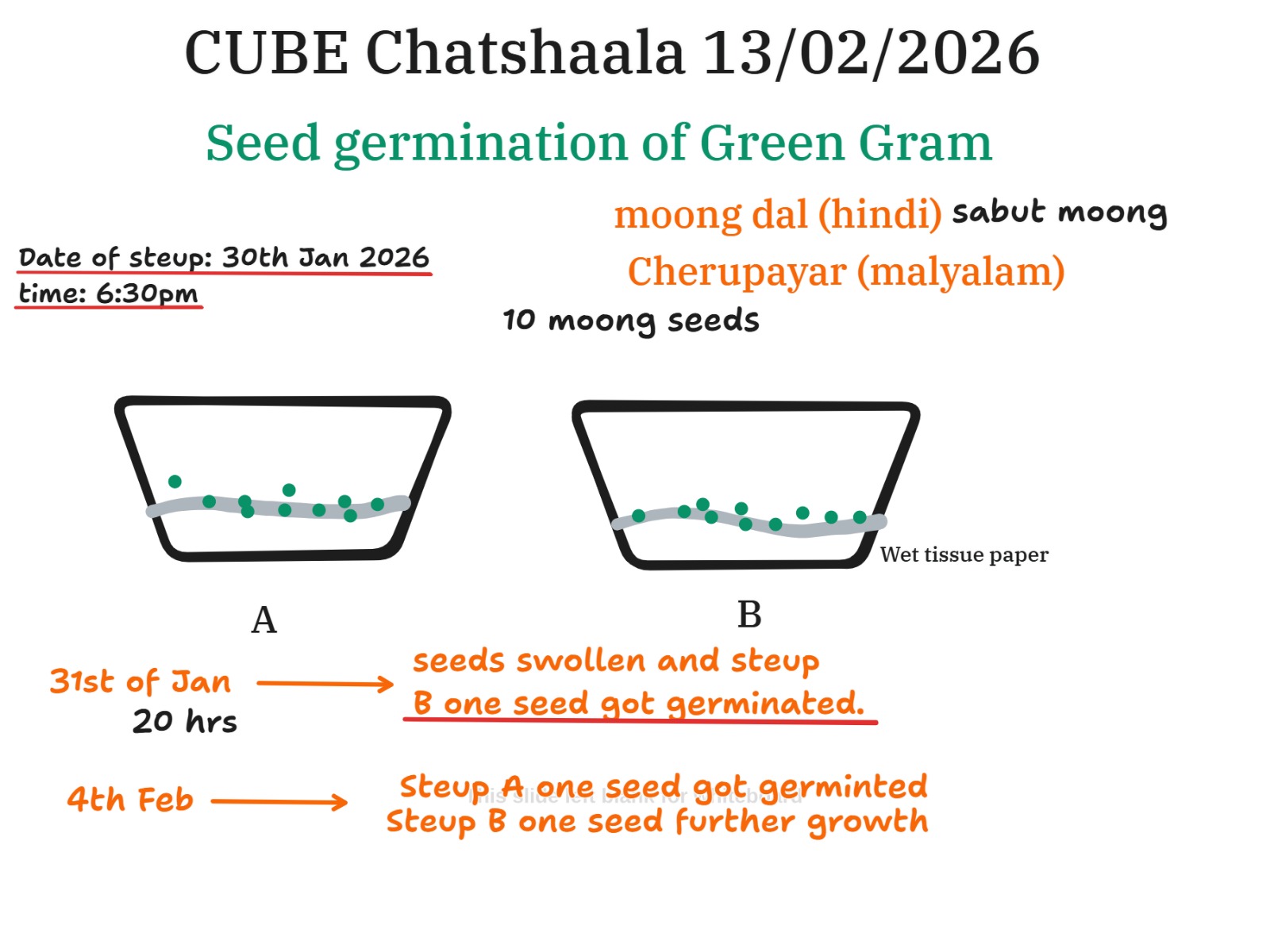
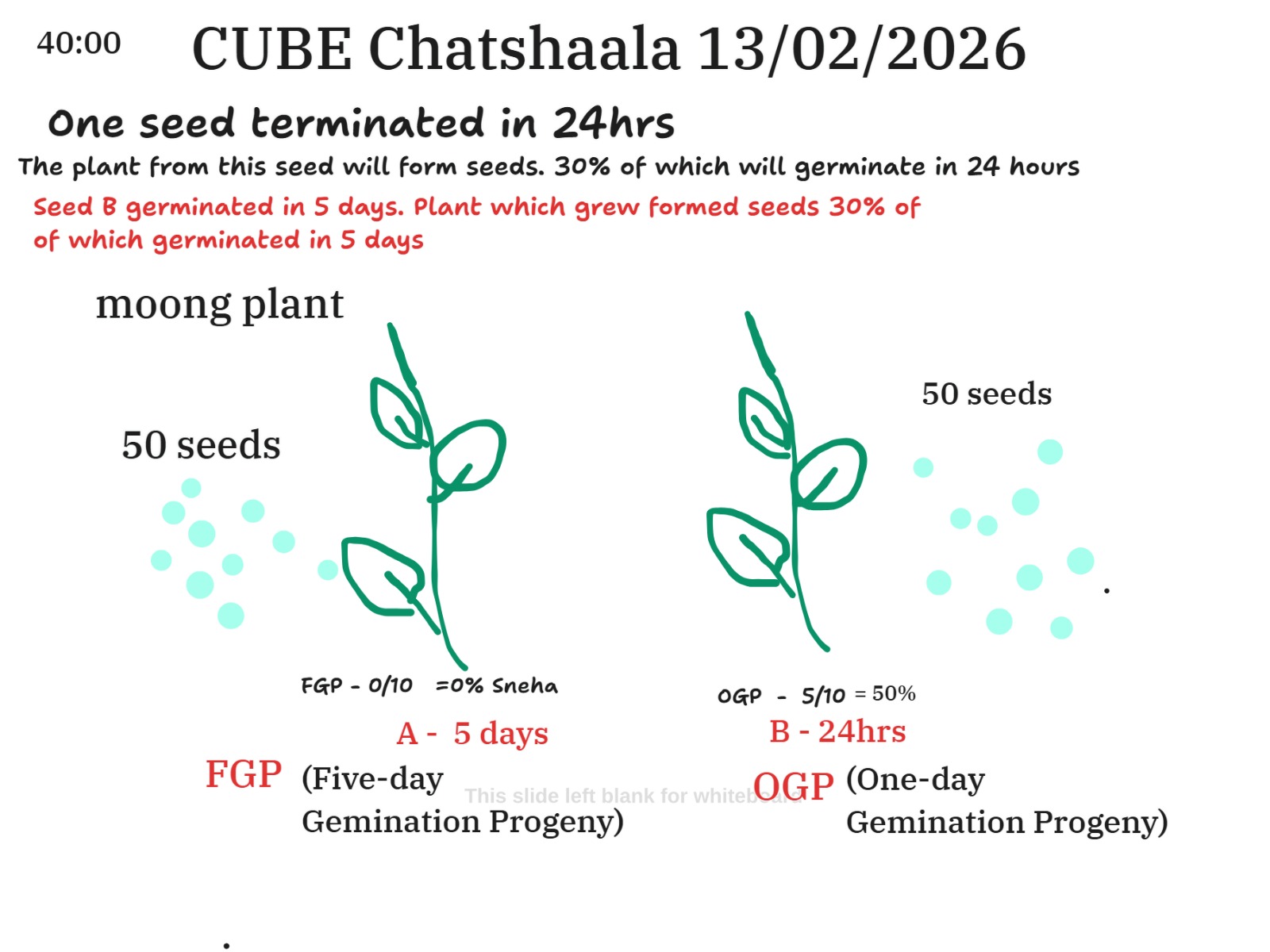
This highlighted the potential heritability of germination speed and raised questions about variability, environmental influences, and genetic factors. The discussion emphasized careful observation, documentation, and the importance of distinguishing between environmental and genetic contributions to seed behavior.
 Provocative Questions
-
If rapid germination is heritable, what evolutionary advantages or disadvantages might it confer to moong plants in natural environments?
-
Could environmental conditions (temperature, moisture, light) have influenced the apparent differences between OGP and FGP, rather than genetics alone?
-
How might selective breeding for faster germination impact crop yield, resilience, or nutritional value?
-
What role does seed dormancy play in balancing survival strategies versus agricultural efficiency?
-
Could the observed differences be explained by maternal effects (conditions of the parent plant) rather than genetic inheritance?
 What I Have Learned
The most important takeaway from this session is that seed germination is not merely a uniform biological process but a complex interplay of genetics, environment, and possibly maternal influences. The experiment demonstrated how even within the same species, progenies can exhibit strikingly different germination timelines. I learned that documenting these differences with precision is crucial for drawing meaningful conclusions and that small-scale experiments can reveal larger questions about plant breeding, adaptation, and agricultural practices.
 TINKE Moments (This I Never Knew Earlier)
-
The idea that germination speed could be heritable and passed on to progeny, rather than being purely environmental.
-
The surprising observation that seeds from the fast-germinating plant maintained a higher proportion of rapid germination in the next generation.
-
The realization that delayed germination may not always be a disadvantage—it could serve as a survival mechanism in unpredictable environments.
 Gaps and Misconceptions
-
Gap in clarity: The experiment did not fully control for environmental variables, leaving open the possibility that differences were due to external factors rather than genetics.
-
Misconception risk: Assuming that faster germination is always beneficial could overlook ecological trade-offs, such as vulnerability to drought or pests.
-
Documentation gap: While observations were recorded, quantitative data across larger sample sizes would strengthen conclusions.
 Photographs during Chatshaala
 Reference