 CUBE ChatShaala Summary
Date : 31 December 2025
Theme : Temperature, Latitude and understanding of mango flowering phenology
Session Overview
The ChatShaala session of 2025 focused on the phenology of mango trees, specifically analyzing the timeline from floral bud initiation to fruit ripening across different geographical locations in India. By comparing data from Bengaluru, Thiruvananthapuram (Trivandrum), and Thrissur, the cubists aimed to test biological hypotheses against real-time environmental variables.
Temperature and Local Environment
The session began by recording current meteorological data to provide context for the biological observations:
-
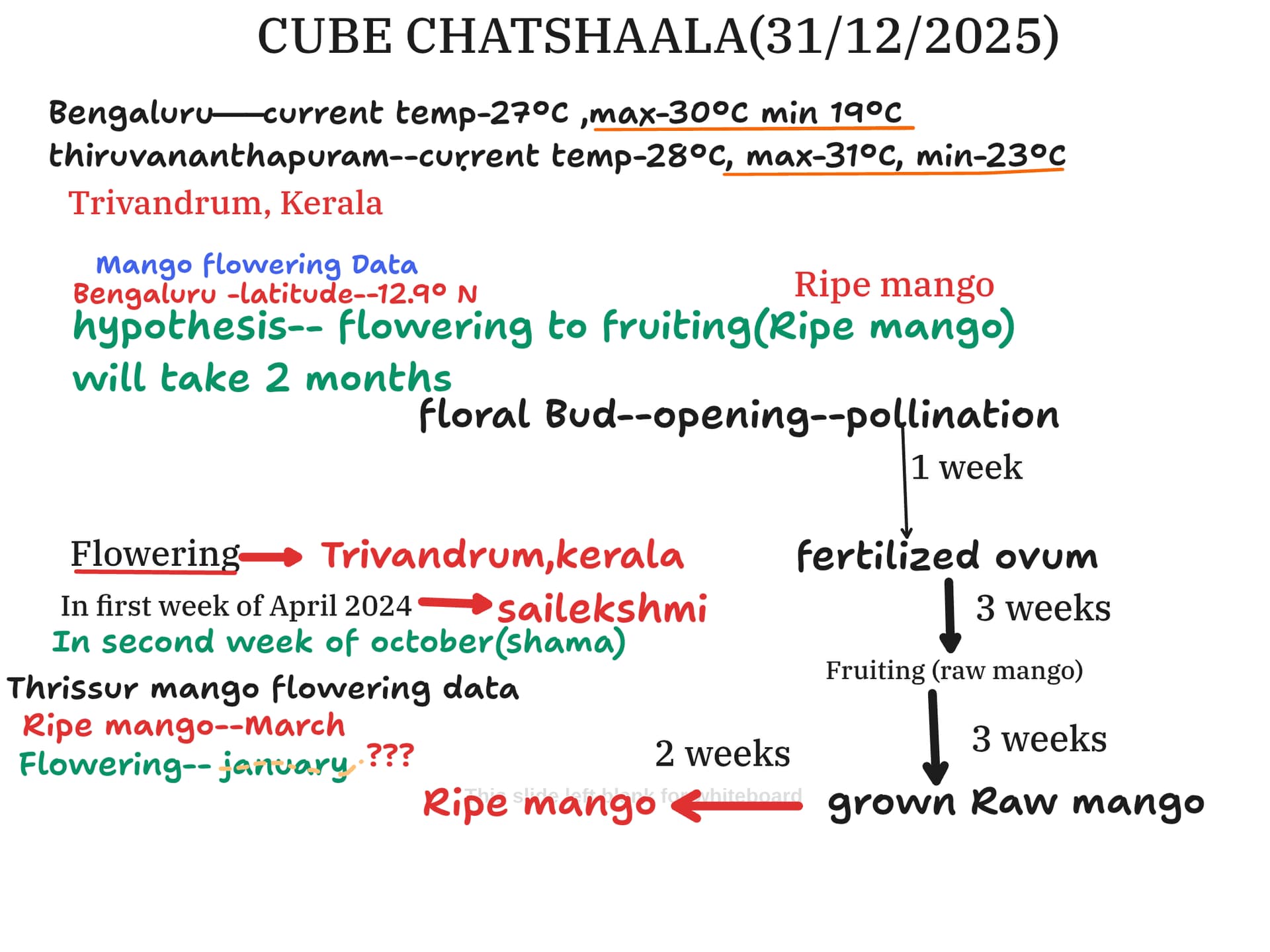
Bengaluru (Lat: 12.9° N): Reported a current temperature of 27°C, with a diurnal range between 19°C (min) and 30°C (max).
-
Thiruvananthapuram: Recorded a slightly warmer profile with a current temperature of 28°C and a maximum of 31°C.
Hypothesis Testing: The Flowering-to-Fruiting Window
A primary hypothesis was proposed: The transition from flowering to ripe mango takes approximately 2 months. To validate this, the group mapped out the physiological stages of the mango lifecycle:
- Floral Bud to Pollination: 1 week.
- Fertilized Ovum to Raw Mango (Initial Fruiting): 3 weeks.
- Raw Mango to Full-Grown Raw Mango: 3 weeks.
- Maturation to Ripe Mango: 2 weeks.
Summing these stages results in a total duration of roughly 9 weeks (approx. 2 months and 1 week), largely supporting the initial hypothesis but allowing for variation based on cultivar and climate.
Comparative Flowering Data
Discrepancies in flowering times were noted across regions:
-
Trivandrum: Observations by Sailekshmi showed flowering in the first week of April 2024, while Shama observed flowering as late as the second week of October.
-
Thrissur: Data suggested a ripening period in March, implying a flowering start date in January. This highlights the “off-season” or “early-season” variations typical of the Kerala coastline.
 TINKE Moments (This I Never Knew Earlier )
-
Noticing the “Why”: We noticed that while the biological clock of the mango tree is relatively consistent (approx. 9 weeks), the trigger for that clock (the flowering date) varies wildly between April and October even within the same state (Kerala).
-
Exploring Latitudinal Impact: We began to explore how a few degrees of latitude (Bengaluru at 12.9° N vs. Trivandrum further south) shift the ripening window.
-
Knowing the Stages: We solidified our knowledge of the specific physiological intervals, moving from vague “growing” periods to specific 1-3 week milestones.
 Gaps and Misconceptions
-
The “Two-Month” Generalization: A significant gap identified was the assumption that all mango varieties follow the same 60-day rule. The breakdown actually totaled ~63+ days, and we realized that external factors like humidity in coastal Trivandrum vs. dry heat in Bengaluru might stretch or compress these weeks.
-
The Flowering Trigger Misconception: There was an initial misconception that flowering is strictly seasonal (Spring). The data from October (Shama) proved that localized microclimates or specific mango varieties can lead to significant deviations from the traditional January/February flowering period.
-
Pollination Efficiency: The summary assumes a 1-week window for pollination, but we identified a gap in our data regarding how pollinator availability (bees/insects) changes during the “off-season” flowering in October.
 Provocative questions to inspire
-
If we can’t predict when a tree flowers, do we really understand the climate, or are we just guests in the mango’s world? Are the trees telling us something about shifting seasons that our thermometers are missing?
-
Is this a “biological error,” or is the mango tree more adaptable than we give it credit for? If a tree can “choose” to fruit in the rainy season, what does that mean for the future of food security in a changing world?
-
If you moved a seedling 100km North, would it “remember” its old schedule, or does the soil dictate the soul of the fruit? Who is really in charge—the DNA of the seed or the heat of the sun?
 What I Have Learned
I learned that biological timing is not a fixed calendar but a fluid response to the environment. Breaking down the growth of a fruit into “weeks” (1 week for pollination, 3 for the ovum, etc.) turns a generic natural process into a measurable, scientific experiment. Most importantly, I learned that local “citizen science” data (like the observations from Sailekshmi and Shama) is often more valuable than general textbook rules for understanding the true diversity of life.
 Photographs during Chatshaala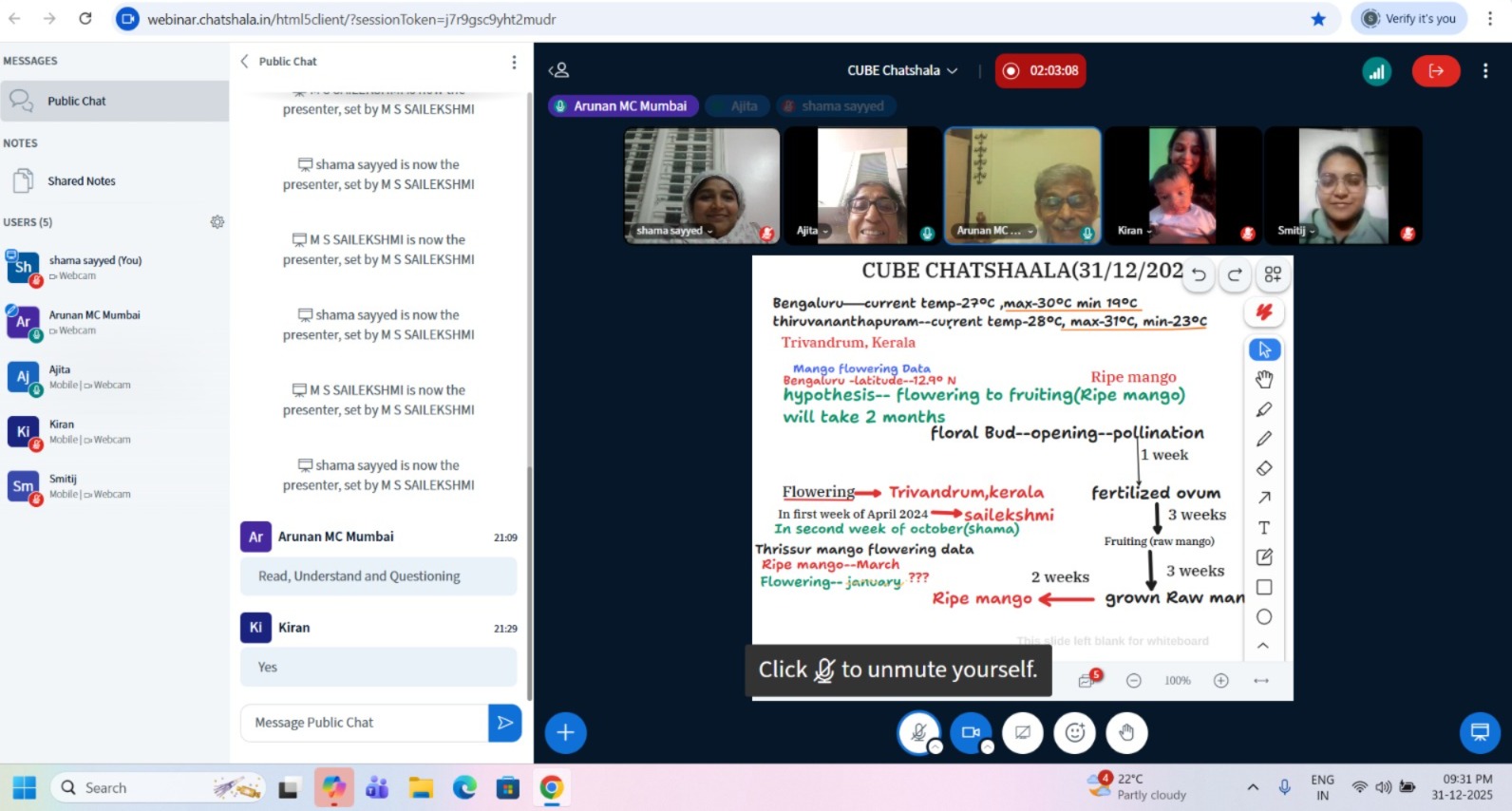
 Reference