CUBE ChatShaala whiteboard summary - 04/01/2026
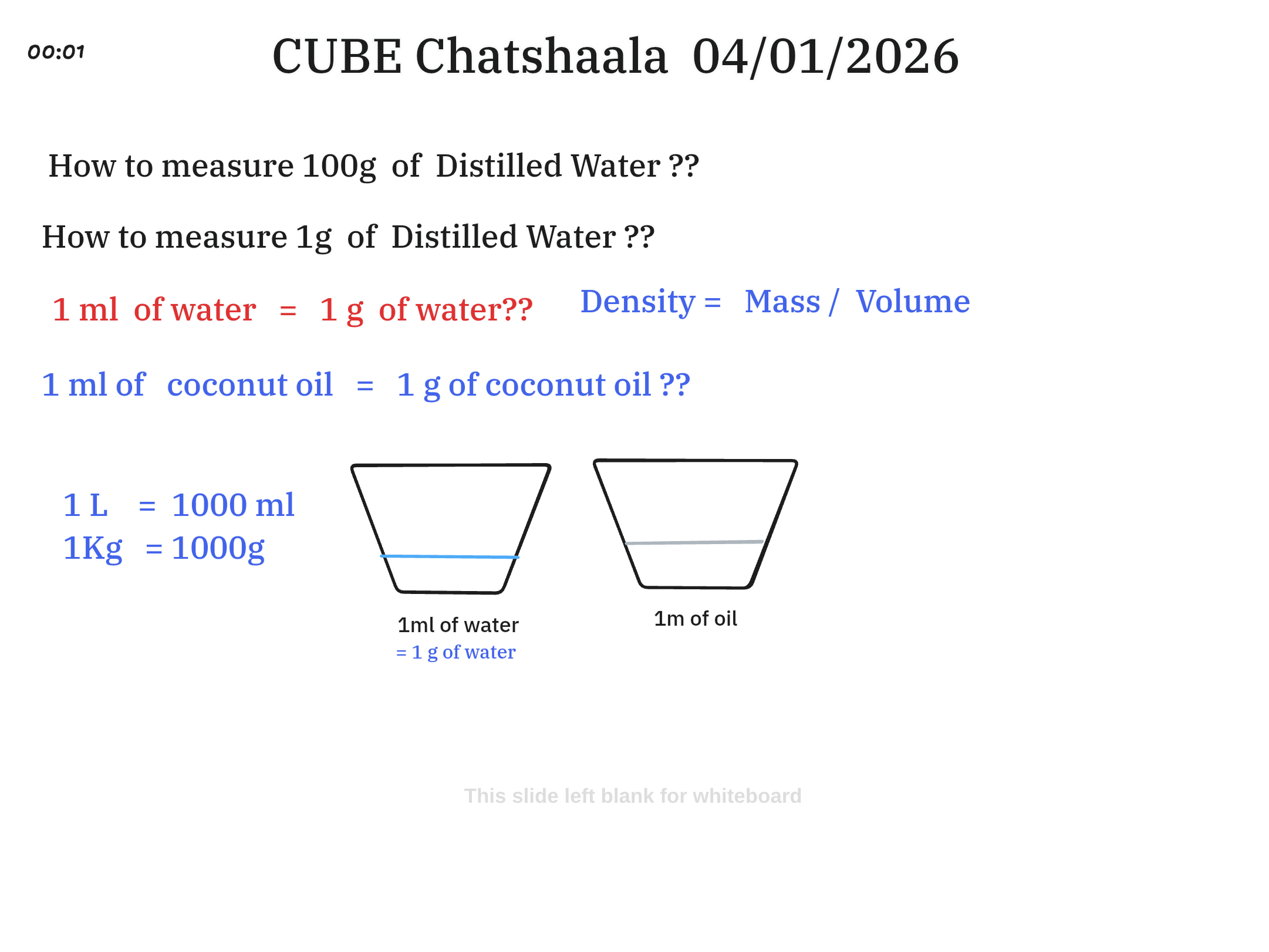
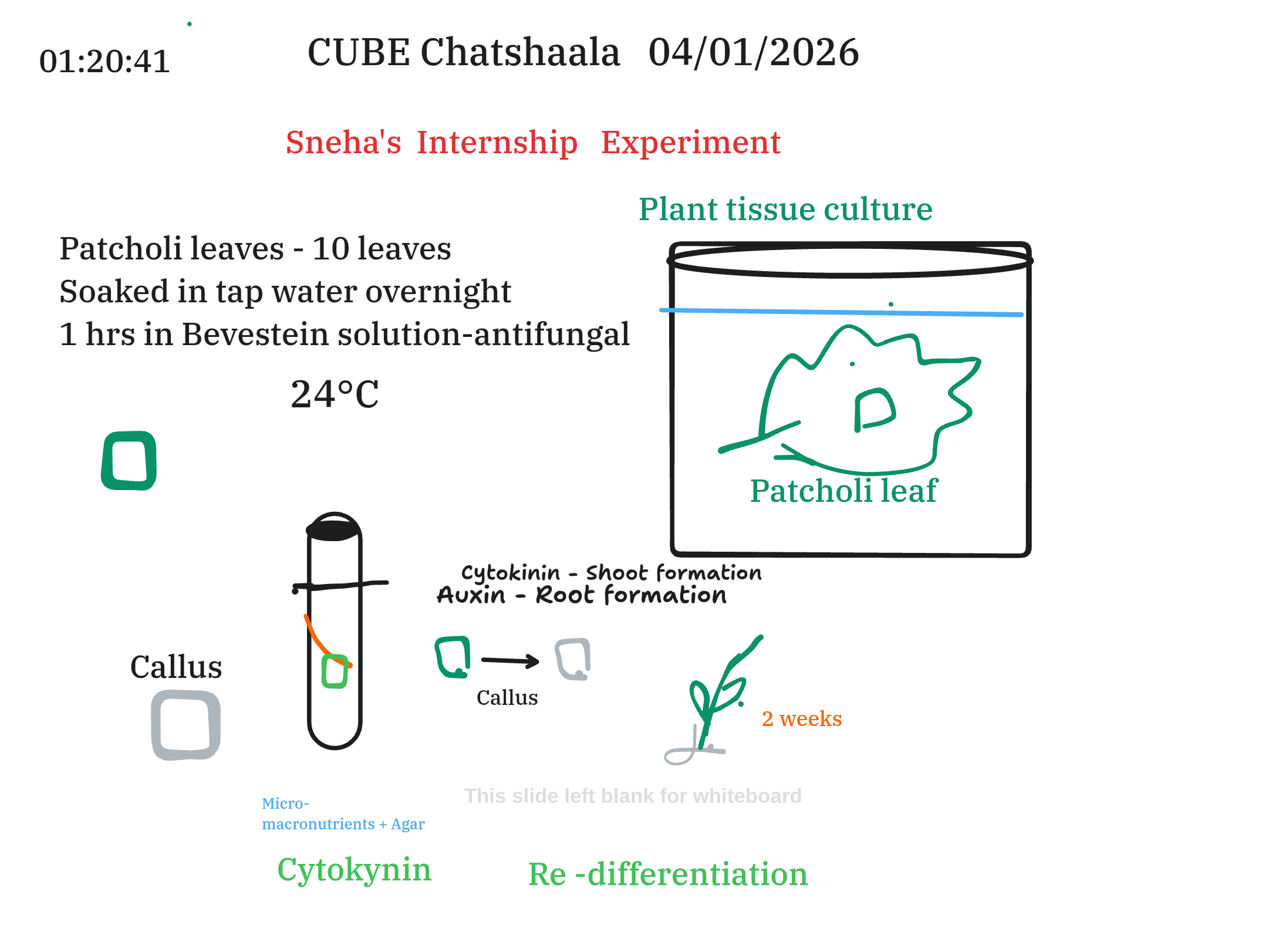
Today’s session kicked off with a deep dive into the physics and chemistry of measurement. We explored why we often equate mass and volume in common scenarios (like water) but why that logic fails with other substances. We transitioned from these physical constants into Sneha’s Internship Experiment, focusing on Plant Tissue Culture using Patchouli leaves.

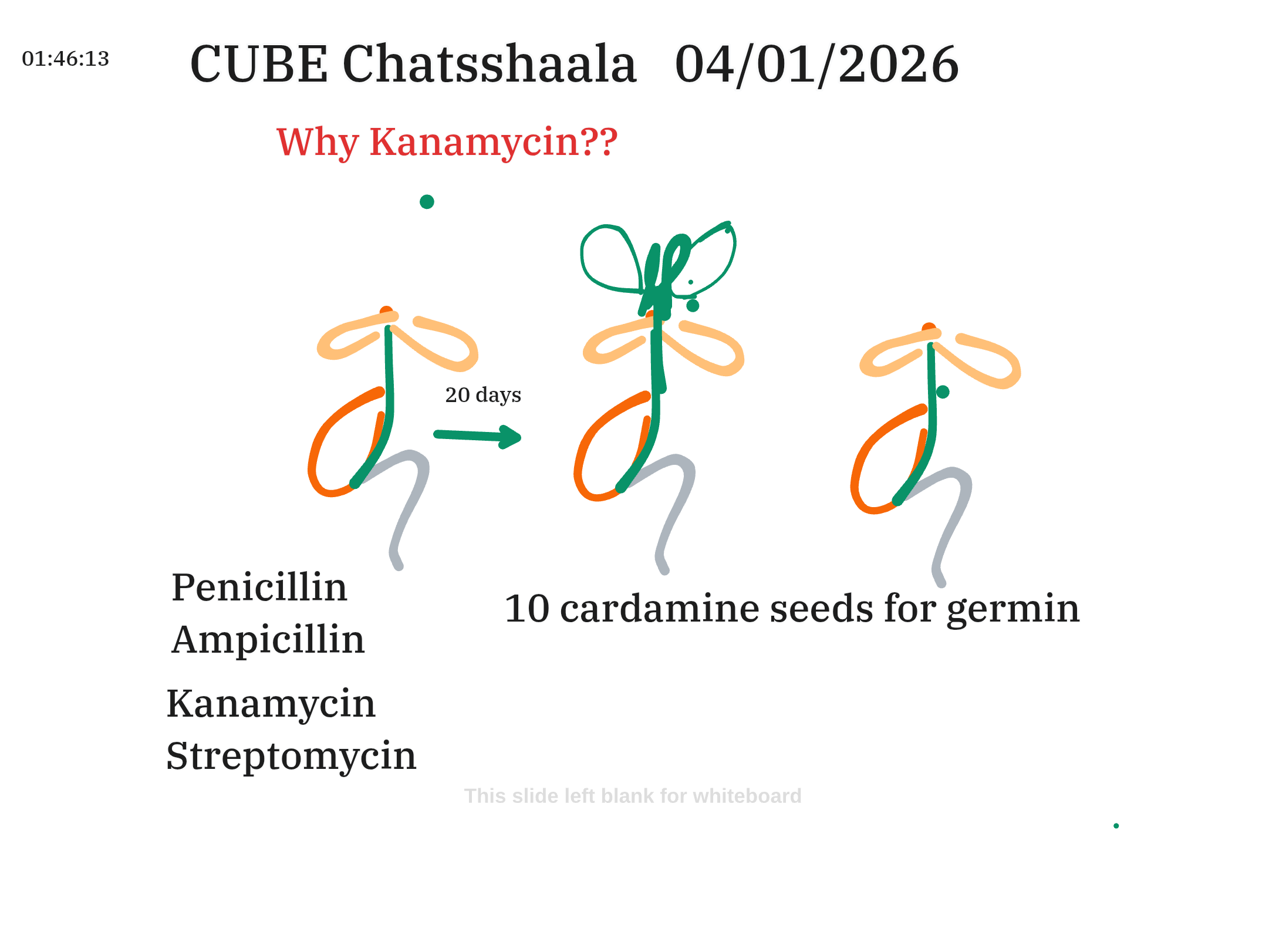
The conversation then evolved into the “Cardamine Story” by Sneha, where we discussed the Floral Dip method and the role of genetic engineering. We used Bt Cotton as a case study to understand how specific genes protect plants from pests like the bollworm. Finally, we looked at the critical role of antibiotics like Kanamycin as selection markers in plant transformation, ensuring that only the genetically modified seeds successfully germinate and grow.
 Provocative Queries for the CUBE Community
-
If you have a 1-liter bottle of water and a 1-liter bottle of coconut oil, why does the oil bottle feel lighter even though they take up the same space? If “Density = Mass / Volume,” what happens to the volume of oil when it freezes in winter? Does its weight change too?
-
We discussed Bt Cotton and its ability to kill the ballworm. If we can engineer a plant to produce its own pesticide, are we solving a hunger crisis or creating a “super-pest” that will eventually evolve to survive the toxin? How do we draw the line?
-
In Sneha’s experiment, we use Kanamycin to kill off any seeds that didn’t take the new DNA. Is it “cruel” to the seeds, or is this the only way to ensure scientific progress? If you were a cell, would you rather be “re-differentiated” into a leaf or a root?
 What I Have Learned
I’ve learned that science isn’t just about big machines; it starts with a weighing scale and a beaker. Understanding that density is a unique fingerprint for every substance is vital for accuracy in the lab. Furthermore, the Floral Dip method is a fascinatingly elegant way to bypass complex tissue culture by transforming the plant right at its reproductive source
 TINKE Moments (This I Never Knew Earlier)
-
The Density Discovery: We paused to notice that while we often use volume (ml) and mass (g) interchangeably in the kitchen, they are not the same. We explored the formula to know exactly why a liter of oil and a liter of water don’t balance on a scale.
-
The Callus Transition: It was a powerful moment to think about how a piece of a Patchouli leaf—which is already “specialized”—can be forced to “forget” what it is and become a Callus (a mass of undifferentiated cells). This led us to inquire about the specific power of Cytokinin in “re-differentiating” those cells into new shoots.
-
Genetic Gatekeeping: We noticed that Kanamycin acts as a “filter.” We explored the idea that in genetic engineering, the antibiotic isn’t there to heal the plant, but to serve as a high-stakes test: only those with the new DNA (the “transformed” ones) are allowed to survive and germinate.
 Gaps and Misconceptions
-
The “Universal” 1:1 Ratio: A common misconception during the session was the assumption that 1ml = 1g for all liquids.
-
The Correction: This is only true for distilled water at . For substances like coconut oil, the density is lower (approx. 0.92g/ml), meaning 100ml of oil weighs significantly less than 100g.
-
Antifungal vs. Antibiotic Roles: There was a gap in understanding why Sneha used both Bevestein and Kanamycin.
-
The Clarification: Bevestin is an antifungal used for surface sterilization (cleaning the outside of the leaf from mold). Kanamycin is an antibiotic used inside the growth medium to select for genetically modified cells. Using one for the other’s purpose would result in either contamination or total experimental failure.
-
The “Floral Dip” Confusion: Initially, there was a gap regarding how the DNA gets into the plant.
-
The Clarification: Some might think the DNA is “injected” like a vaccine. In the Floral Dip method, we are actually targeting the developing flower buds so that the seeds produced are the ones carrying the new genetic information, rather than trying to change the DNA of the entire adult plant.
 Photographs during Chatshaala

 Reference