 CUBE Chatshaala - Discussion Summary
Today’s session, held on 21st July 2026, moved between two seemingly separate areas of biology — pharmacology and biochemistry — before drawing them together through a shared thread: the humble molecule histamine.
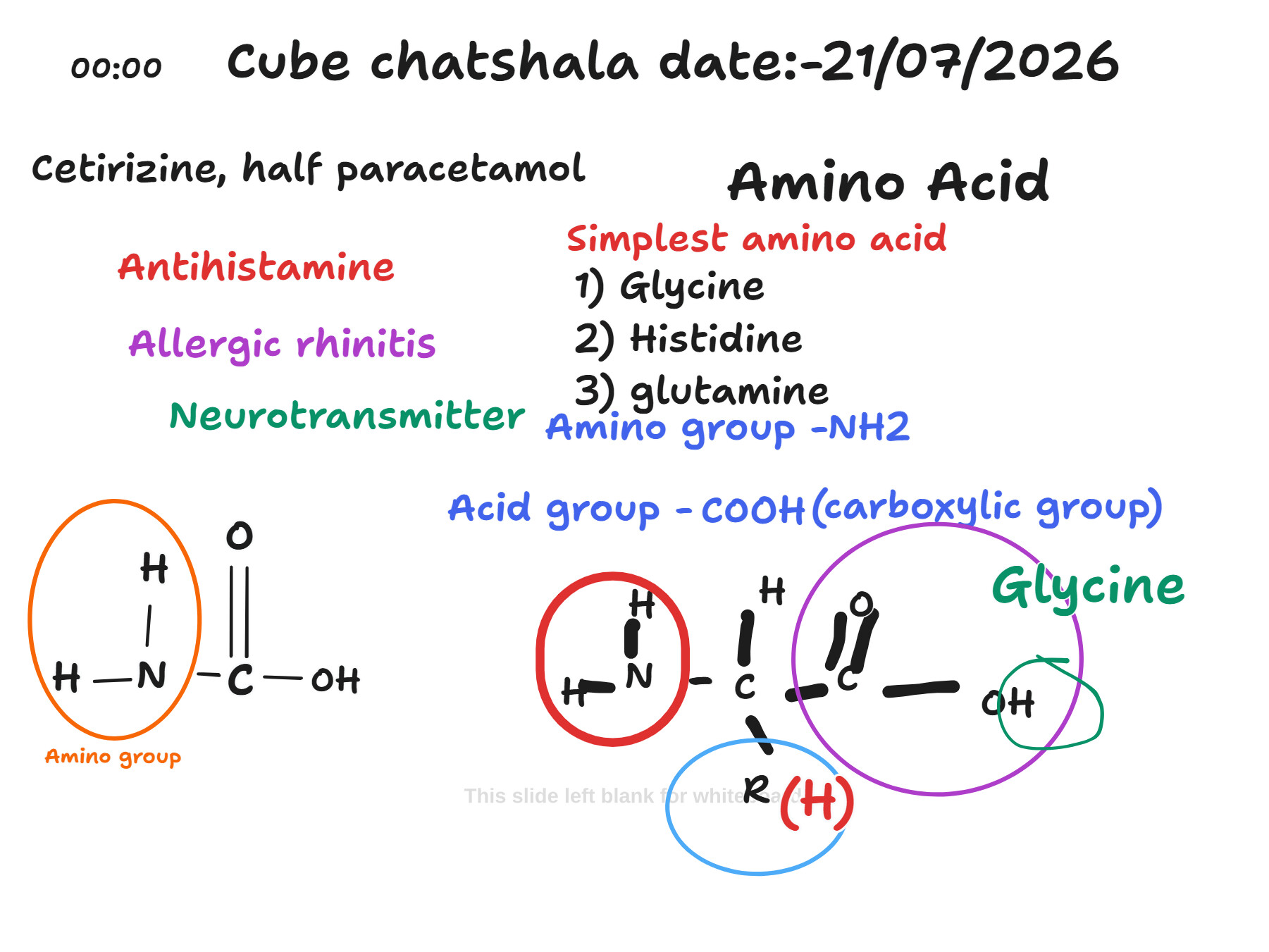
The discussion opened with an everyday example: a combination of cetirizine and half a tablet of paracetamol, something many participants may have encountered themselves during an allergy or cold. This led naturally into a conversation about cetirizine as an antihistamine. The group discussed how cetirizine is a second-generation antihistamine, derived from the older drug hydroxyzine, and prescribed largely for allergic rhinitis. What makes cetirizine clinically preferable to first-generation antihistamines is that it does not cross the blood-brain barrier to any significant extent, which keeps its sedative side effects to a minimum while still relieving symptoms such as sneezing, watery eyes, and a runny nose. The drug works as a fast-acting, highly selective peripheral histamine H1-receptor antagonist, primarily targeting receptors found on respiratory smooth muscle, vascular endothelial cells, immune cells, and the gastrointestinal tract.
This raised a deeper question that the group explored: what exactly is histamine, and why does blocking its receptor produce such a wide range of effects? Here the conversation shifted to histamine’s biochemical identity. Histamine is a biogenic amine synthesized from the amino acid L-histidine through the action of the enzyme L-histidine decarboxylase, which requires pyridoxal-5′-phosphate as a cofactor. It is stored predominantly in mast cells and basophils, and once released, it doesn’t linger in the body for long — the vast majority of histamine is rapidly broken down through two enzymatic pathways, histamine N-methyltransferase and diamine oxidase. Participants noted that histamine’s biological role is far broader than allergy alone; it is also implicated in gastric acid secretion, hematopoiesis, and neurotransmission, acting through four distinct receptor subtypes (H1 through H4), each tied to a different physiological function.
This is where the whiteboard notes made an important distinction that participants flagged as easy to overlook: histamine is not just an allergy mediator, it is also classified as a neurotransmitter. The group connected this back to the H1 receptor’s role beyond inflammation, since H1 receptor signaling also contributes to the regulation of sleep-wake cycles, appetite, thermoregulation, emotional and aggressive behavior, locomotion, memory, and learning. This helped explain why older, first-generation antihistamines that cross into the brain often cause drowsiness — they are essentially interfering with histamine’s neurotransmitter function, not just its allergic one.
The second half of the session pivoted to organic chemistry and the structure of amino acids, using glycine as the anchor example. The whiteboard diagram broke down the general amino acid structure into its parts: an amino group (–NH2) on one side, a carboxylic acid group (–COOH) on the other, and a central alpha carbon connecting them, with a variable “R” group attached. For glycine specifically, the group identified that the R group is simply a hydrogen atom, which is precisely why glycine is considered the simplest of all the amino acids — it has no side chain complexity to speak of. Participants also listed histidine and glutamine alongside glycine in the discussion of simple amino acids, with someone drawing the connection back to the earlier part of the session: histidine, notably, is the very amino acid from which histamine itself is synthesized. This linkage between the two halves of the meeting gave the session a satisfying full-circle quality, tying pharmacology back to fundamental biochemistry.
 Provocative Questions
-
If cetirizine barely enters the brain, why does a noticeable minority of people still report drowsiness after taking it?
-
Histamine is degraded by two separate enzyme systems (HNMT and DAO). What might happen physiologically if one of these pathways is genetically underactive in a person?
-
Given that histidine is the direct precursor of histamine, could a diet unusually rich or poor in histidine meaningfully influence a person’s baseline histamine levels?
-
Why might evolution have “reused” the same molecule, histamine, for both defending the body against allergens and regulating something as unrelated as sleep and wakefulness?
-
Glycine’s R group is just a hydrogen atom. What functional trade-offs come with having “no side chain” compared to amino acids with large, complex R groups?
-
Since H2 receptor antagonists were historically used for ulcers before proton pump inhibitors became dominant, what does this tell us about how drug classes rise and fall in clinical favor over time?
 What I Have Learned
This session reinforced how often a single molecule can wear many different hats depending on where in the body it is acting. Before today, my mental model of histamine began and ended with allergies: itching, sneezing, watery eyes. What stood out to me was learning that histamine is equally at home in the stomach, driving acid secretion through H2 receptors, and in the brain, functioning as a genuine neurotransmitter through H1 receptors. That single fact reframes why some antihistamines make people drowsy while others don’t — it isn’t a side effect in the vague sense; it’s a direct consequence of which receptors the drug happens to reach.
I also appreciated the way the session tied structure to function on the amino acid side. Seeing glycine broken down piece by piece — amino group, carboxyl group, alpha carbon, and a bare hydrogen where the R group would normally sit — made the abstract idea of “simplest amino acid” concrete rather than just a fact to memorize. And the moment someone pointed out that histidine, one of the amino acids discussed on the whiteboard, is the direct precursor to histamine, discussed earlier in the same session, was a genuinely satisfying connection. It’s a good reminder that biology rarely sits in isolated boxes; pharmacology, biochemistry, and molecular structure are constantly overlapping.
 TINKE Moments (This I Never Knew Earlier
TINKE Moment 1 — Antihistamines are not just “anti-allergy” drugs.
Many participants likely assumed, going into the discussion, that antihistamines act narrowly on allergic symptoms. The session made explicit that H1 receptor blockade touches sleep regulation, appetite, mood, and memory, because histamine itself is a neurotransmitter. This reframes drowsiness from an unrelated “side effect” to a direct, mechanistically predictable outcome of central H1 blockade.
TINKE Moment 2 — The link between histidine and histamine.
Before today, histidine and histamine may have registered as two separate vocabulary terms with a similar sound. The session made explicit that histamine is literally synthesized from histidine via a single enzymatic step. This is a good example of how surface-level naming similarities in biology are often not coincidental at all.
TINKE Moment 3 — “Simplest” amino acid has a precise structural meaning.
Calling glycine the “simplest” amino acid could easily remain a vague, memorized label. The whiteboard breakdown made it explicit that simplicity here has an exact structural definition: an R group that is nothing more than a single hydrogen atom, with no additional carbon chain or functional group attached.
 Gaps and Misconceptions
- Incomplete receptor picture: The discussion focused heavily on the H1 receptor, given its relevance to cetirizine, but the H3 and H4 receptor subtypes received comparatively little attention despite their emerging importance in neurological and autoimmune research. A follow-up session could usefully explore these newer receptor targets.
- Dosage and mechanism not fully separated: The opening reference to “cetirizine, half paracetamol” was noted on the whiteboard but not explicitly unpacked in terms of why these two drugs are commonly paired (one addressing allergic or histamine-driven symptoms, the other addressing pain or fever through a distinct, non-histaminergic pathway). This distinction is worth clarifying explicitly in a future session to avoid the misconception that both drugs work through a similar mechanism.
- Amino acid list left incomplete: Glutamine was mentioned on the whiteboard as a “simplest” amino acid alongside glycine and histidine, but glutamine’s side chain is considerably more complex than glycine’s single hydrogen R group. This may be worth revisiting, as it could otherwise create a misconception that all three amino acids listed share comparable structural simplicity.
- No explicit discussion of the DAO/HNMT balance and food intolerance: Given that diamine oxidase also breaks down dietary histamine, a natural extension of today’s biochemistry discussion would be histamine intolerance from food sources, which was not addressed but connects directly to the enzymatic pathways discussed.
 Photographs during Chatshaala
 Referance