 CUBE ChatShaala Summary – 18.08.2025
Topic : Food Preference & Olfactory Behaviour in Model Organisms
Discussion Highlights
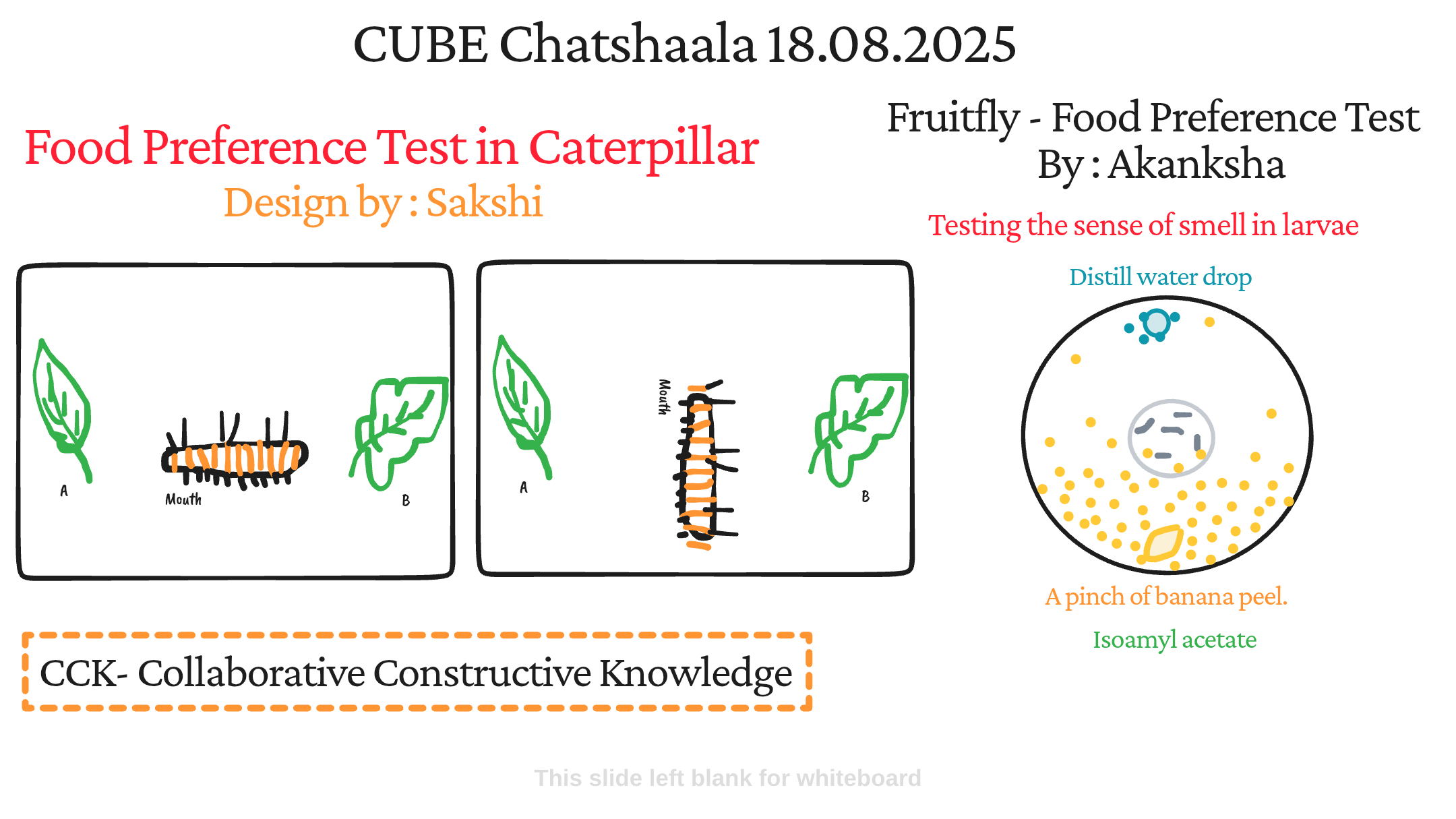
- Food Preference Test in Caterpillar (Design: Sakshi)
-
Caterpillars were placed between two leaves (A and B) to observe their choice.
-
The experiment design emphasized positioning the caterpillar with its mouth facing the leaves to check directed preference.
-
This opens questions about whether caterpillars select food based on taste, texture, or chemical cues.
- Fruit Fly Food Preference Test (By: Akanksha)
-
A simple setup was shown:
- Distilled water drop,
- A pinch of banana peel,
- Isoamyl acetate (a key banana odor compound).
-
Aim: to test the sense of smell in larvae and determine if larvae are attracted to specific volatile chemicals.
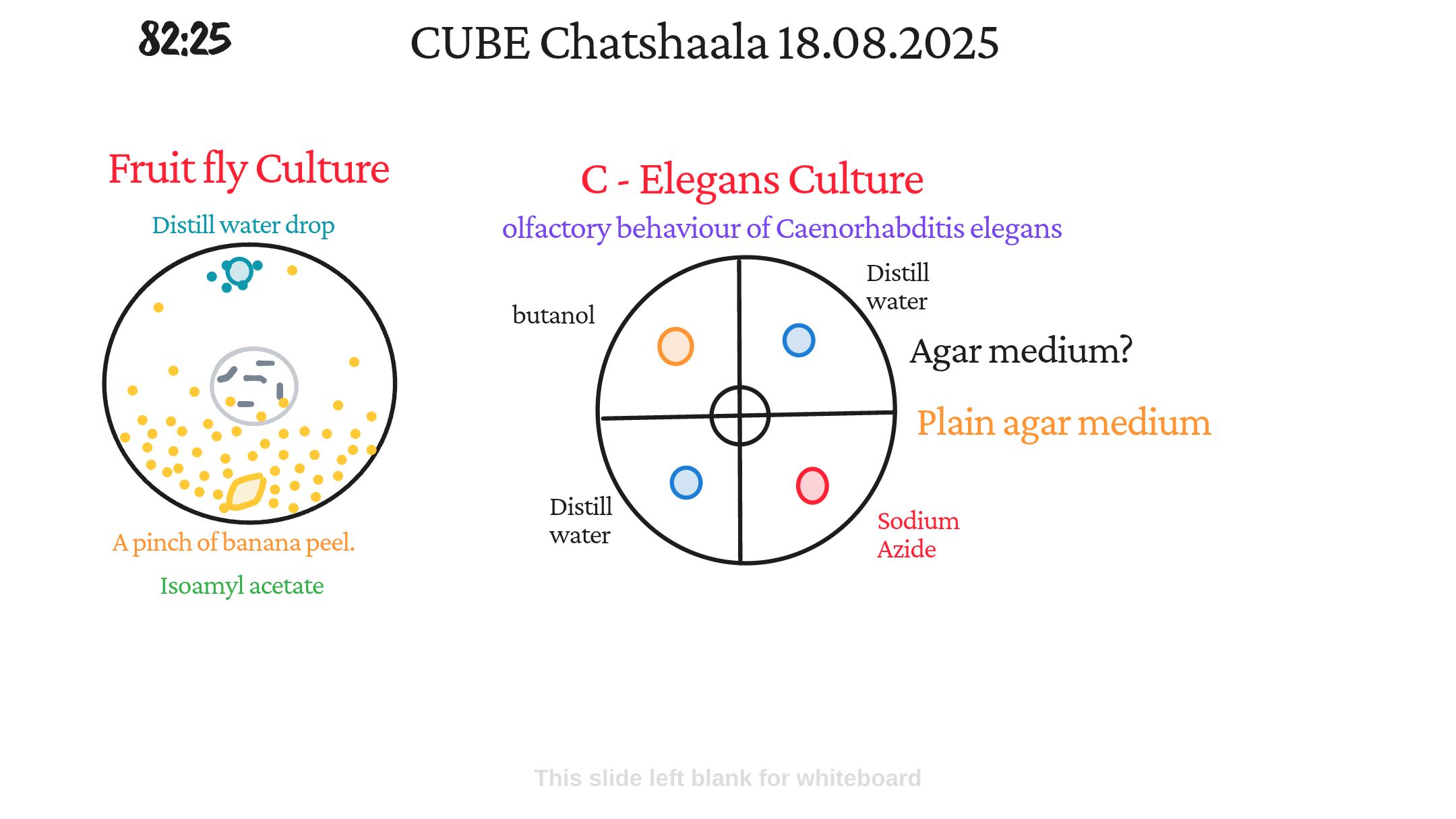
- C. elegans Culture – Olfactory Behaviour
-
Experiments to test nematode chemotaxis were discussed.
-
Setup included agar plates with quadrants containing:
-
- Butanol,
- Sodium azide (immobilizing agent),
- Distilled water (as control).
-
This system helps track movement towards or away from chemical cues, thereby studying olfactory decision-making.
CCK (Collaborative Constructive Knowledge)
The meeting collectively built knowledge on designing low-cost olfactory and food preference assays across model systems — caterpillars, fruit flies, and nematodes — highlighting the comparative biology of sensory behaviour.
 Provocative Queries for the General Audience
 Caterpillar Choices: Do caterpillars choose leaves because of their taste after biting or can they sense differences before touching?
 Fruit Fly Smell Test: If fruit fly larvae are given banana peel vs. pure isoamyl acetate, will they choose the natural mix of chemicals or the single compound?
 C. elegans Olfaction: How do such tiny worms detect and respond to smells? Could they be used as bio-indicators of environmental toxins?
 Cross-Species Insight: Do these three organisms (caterpillar, fruit fly, nematode) share common sensory mechanisms, or is each one unique in evolution?
 What I Learned
-
Experimental Design matters: Orientation of the organism (like caterpillar’s mouth direction) can strongly affect results.
-
Natural vs. Pure Stimuli: Organisms may respond differently to natural mixtures compared to single chemical compounds.
-
Model Organisms Teach Us: Even small creatures like nematodes and flies can help us understand universal sensory biology.
-
Low-Cost Science: These experiments show how simple household materials can be used to ask profound biological questions.
 TINKE Moments (This I Never Knew Earlier )
-
Realized that caterpillars might sense food from a distance, not just when they bite into leaves.
-
Learned that isoamyl acetate, the chemical behind banana smell, is a standard tool in olfactory research.
-
Understood that Sodium azide is used to immobilize C. elegans at the target spot, ensuring measurable results.
-
Saw how different organisms can be tested for the same scientific question (food/smell preference) using simple comparative methods.
 Reference
-
https://www.entsoc.org/sites/default/files/files/education-outreach/PRJ_MS_CaterpChooseLeaves.pdf
-
Overview of chemotaxis behavior assays in Caenorhabditis elegans - PMC.
@Arunan @KiranKalakotiR @SN1261 @ajitadeshmukh13 @sakshiconsultant2002 @2020ugchsncnseethala @dhanraj7 and others