 CUBE ChatShaala Meeting Summary
Date: 28th November 2025
Topic: Moina Culturing, Water Chemistry, and Biological Oxygen Demand (BOD)
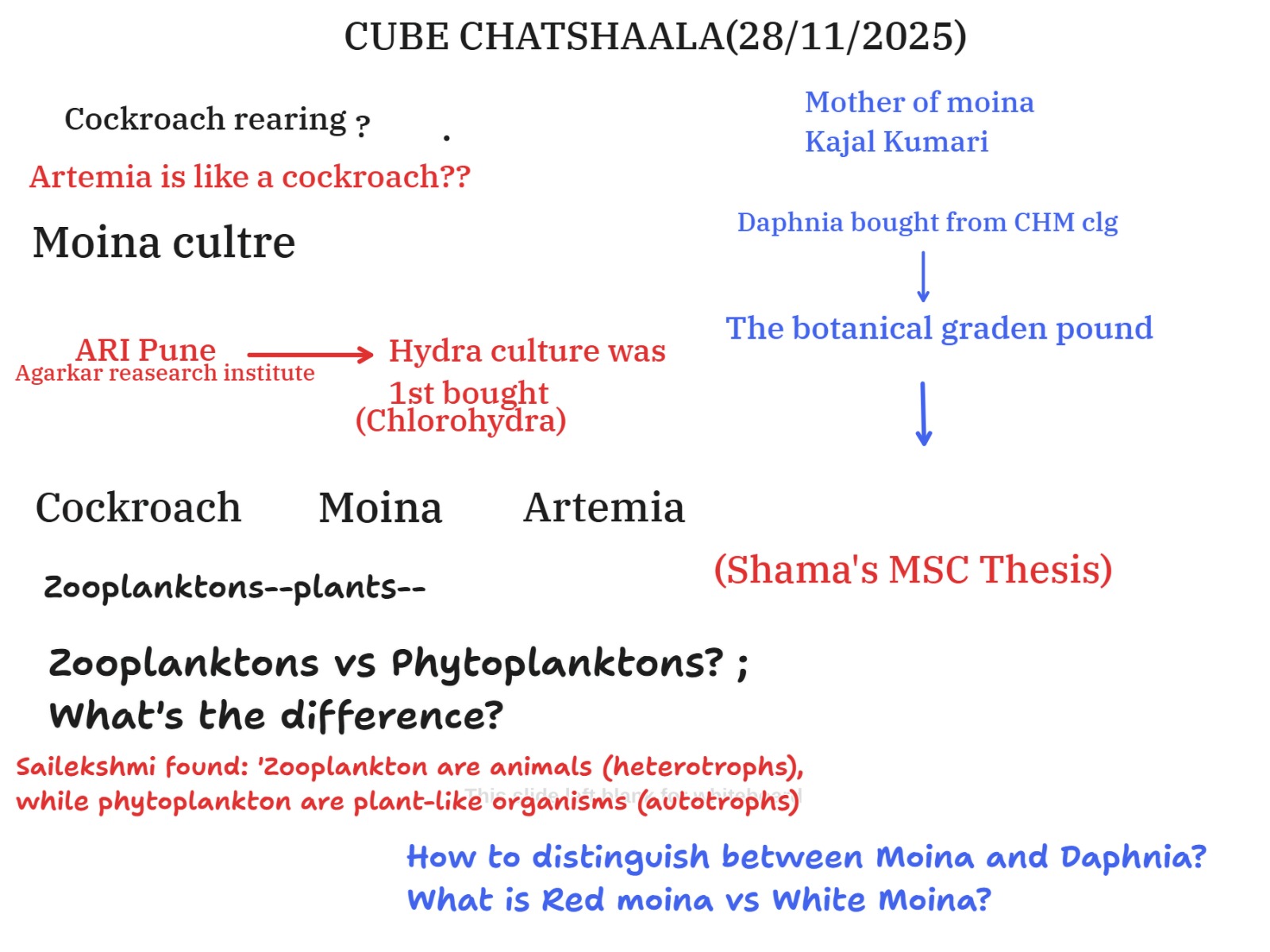
Today’s session was a vibrant exploration of aquatic model organisms, specifically focusing on the “Mother of Moina” and the intricate balance required to sustain these cultures. The discussion, led by student investigators including Shama, Ayana, and Sailekshmi, along with Shama’s MSc thesis on the moina culture as the model system, moved fluently between biological observations and chemical principles.

1. The “Milk Hypothesis” and Culture Maintenance
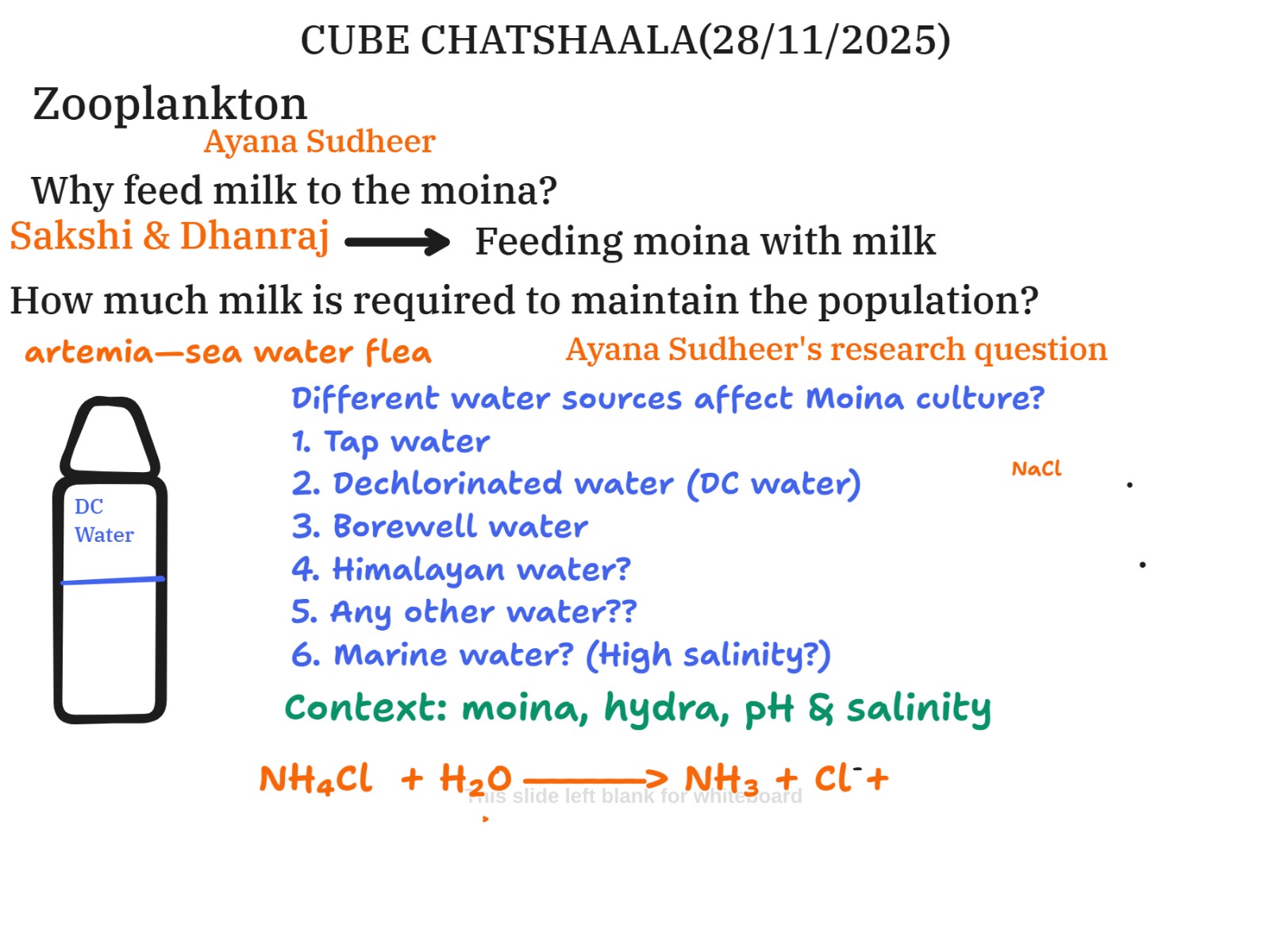
A central theme was the optimization of feeding protocols. Shama came to know that Sakshi and Dhanraj introduced the practice of feeding milk to Moina, sparking a critical debate on dosage. While Shama’s established protocol suggests 1 drop of milk per 500ml of water, the group is actively investigating the upper limits of this nutrient source to answer: How much milk is required to maintain the population without crashing the culture due to bacterial bloom?
2. Water Sources and Environmental Resilience
Ayana Sudheer spearheaded the discussion on water parameters, presenting a comparative look at how different water sources—tap, dechlorinated (DC), borewell, Himalayan, and marine—affect culture viability. This segment highlighted the remarkable resilience of Moina, drawing a provocative comparison between Artemia (seawater fleas) and cockroaches, questioning if they share a similar ecological “toughness.”
3. The Chemistry of Survival: BOD and Ammonia
The session took a technical turn into Shama’s MSc thesis work regarding the Biological Oxygen Demand (BOD) experiment conducted at her college during her BSc. We conducted a detailed analysis of the Winkler method, outlining the reagents involved (MnSO₄, alkaline iodide-azide, and concentrated H₂SO₄, which results in a white precipitate) and emphasizing the important function of starch as an endpoint indicator.
The experimental design presented involves three conditions to test metabolic stress:
- Control: Moina in DC Water.
- Sample 1: Moina in NaCl + DC Water (Salinity Stress).
- Sample 2: Moina in HCl + DC Water (pH Stress).
We also touched upon the chemical dissociation of ammonium chloride (NH₄Cl + H₂O —> NH₃ + Cl⁻), realizing that maintaining the correct pH is vital to prevent the accumulation of toxic ammonia (NH₃).
Provocative Queries & Catchy Titles
-
We observed “Red Moina” vs. “White Moina.” Is the red coloration a sign of health, or is it a desperate cry for help? Does the Moina synthesize hemoglobin only when oxygen levels are critically low?
-
If 1 drop of milk feeds a city of Moina, do 2 drops start a plague? Are we feeding the Moina directly, or are we farming the bacteria that the Moina eat?
-
We call Artemia the cockroach of the sea. But considering Moina macrocopa can survive in sewage-rich environments, who really deserves the title of the “Ultimate Survivor”?
-
Moina salina breaks the rules by living in both fresh and sea water. How does it manage its internal osmotic pressure when the world outside changes so drastically?
 What I Have Learned
-
The Specificity of Taxonomy: The distinction between Moina and Daphnia is not merely cosmetic. Sailekshmi’s point on zooplankton (heterotrophs) vs. phytoplankton (autotrophs) grounded us, but identifying the visual difference (spines vs. no spines) is crucial for accurate data.
-
Chemistry is the Invisible Hand: Rearing simple organisms is fundamentally a chemistry experiment. The equilibrium between ammonium (NH₄) and ammonia (NH₃) is a silent killer in our cultures, dependent entirely on pH.
-
The “Indicator” Insight: In the BOD experiment, starch isn’t a reactant; it is the detective that reveals the presence of iodine only at the very end. Without it, the titration is blind.
 TINKER Moments (This I Never Knew Earlier)
-
The “Saltwater” Moina: The realization that Moina isn’t strictly a freshwater organism. The existence of Moina salina, which tolerates both fresh and marine environments, challenges our rigid categorization of “freshwater cultures.”
-
The “Cockroach” Analogy: Connecting the resilience of Artemia to that of a cockroach changed the perspective from “delicate creature” to “evolutionary tank,” prompting us to respect their survival mechanisms more.
 Gaps and Misconceptions
1. “Oxidation” vs. “Oxygen” Demand
-
Misconception: On the whiteboard, BOD was written as “Biological Oxidation Demand.”
-
Correction: The standard scientific term is Biological Oxygen Demand (or Biochemical Oxygen Demand). While oxidation is the mechanism, the metric is the oxygen consumed.
2. Direct vs. Indirect Feeding
-
Gap: We say “Moina eats milk.”
-
Clarification: Moina are filter feeders. It is highly likely that the milk promotes bacterial growth, and the Moina graze on the bacteria. Understanding this “Food Chain in a Bottle” is vital for controlling water quality.
3. Visual Identification
-
Gap: We discussed Moina and Daphnia, but many students still struggle to tell them apart under the microscope.
-
Action: We need to sketch or find a clear diagram showing the prominent caudal spine of Daphnia versus the rounded posterior of Moina.
 Reference
-
Google Search (Zooplankton Vs Phytoplankton)
-
Google Search (Moina vs Daphnia)