 CUBE Chatshaala – Discussion Summary
Today’s ChatShaala session (09/03/2026) focused on two interconnected themes: academic preparation for zoology examinations and hands-on scientific inquiry through water quality and DNA analysis experiments.
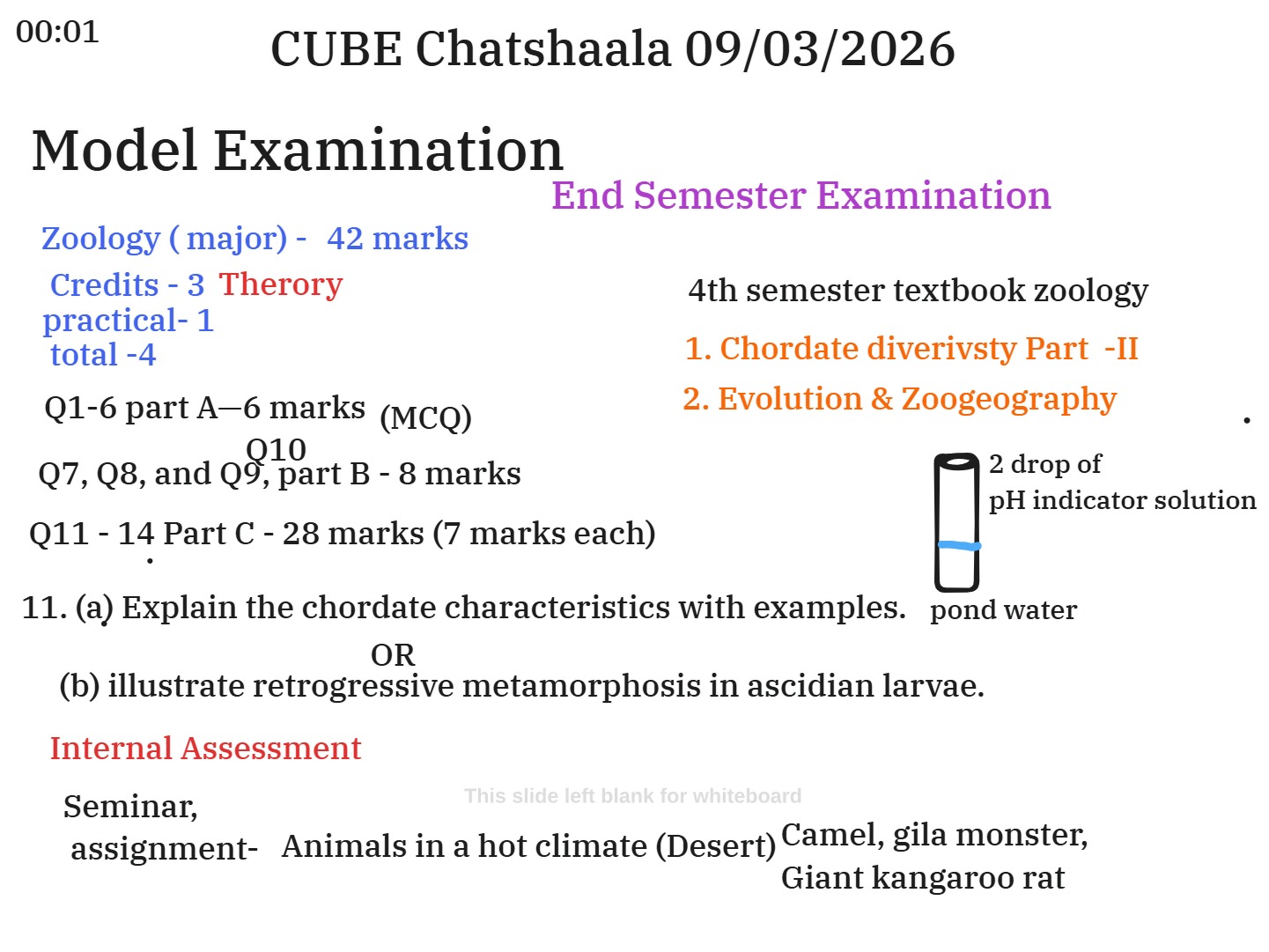
The first part of the discussion outlined the structure of the zoology end semester examination for the 4th semester. The exam is divided into three parts:
- Part A (MCQs) – 6 marks
- Part B (short answers) – 8 marks
- Part C (long answers)—28 marks, with questions requiring explanation or illustration of key zoological concepts such as chordate characteristics and retrogressive metamorphosis in ascidians as an example.
Internal assessments were also highlighted, including seminars and assignments on desert-adapted animals like camels, gila monsters, and kangaroo rats.
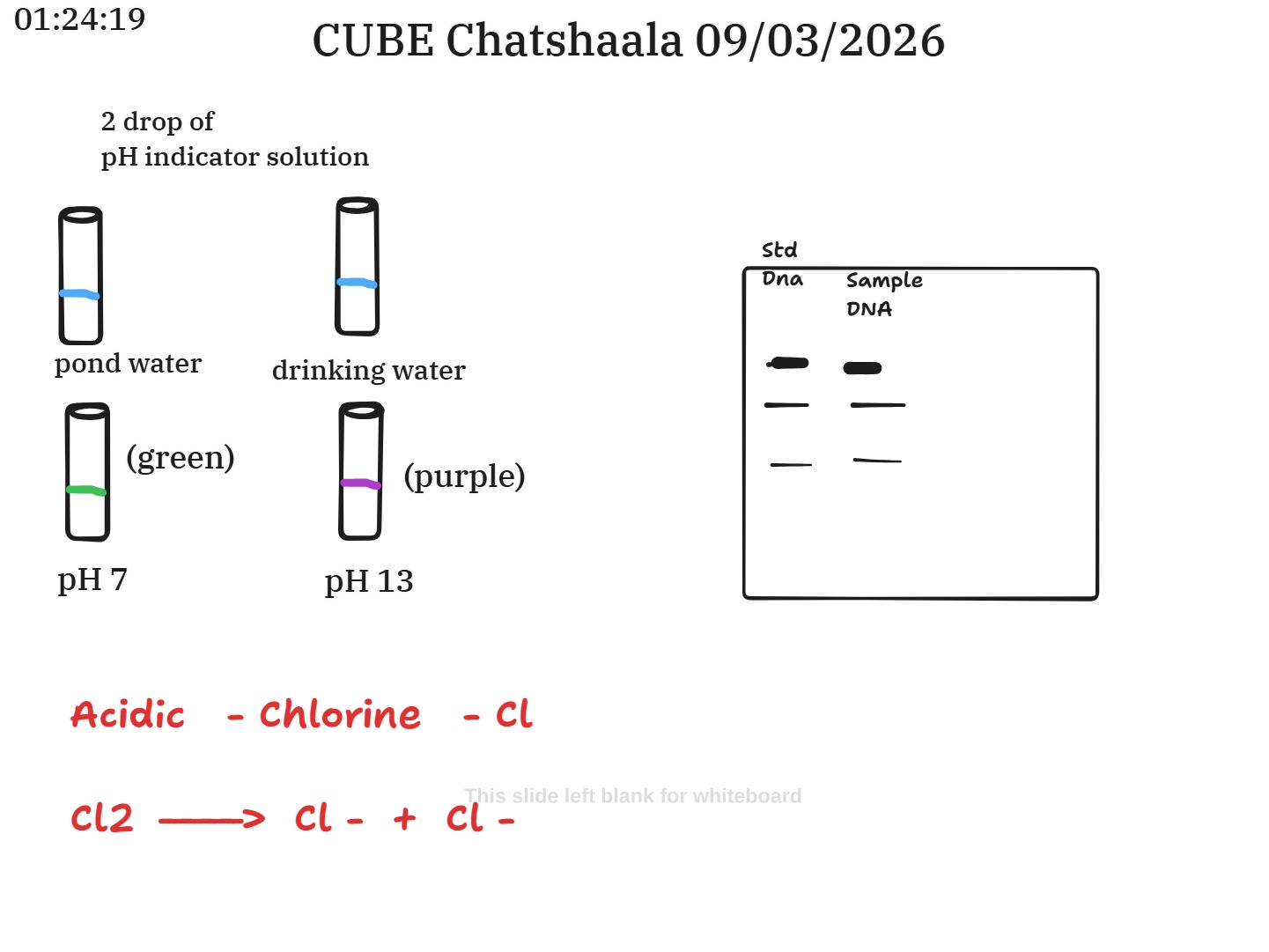
The second part of the session shifted to experimental demonstrations. Participants examined water samples using pH indicators, comparing pond water (neutral, pH 7, green) with drinking water (strongly alkaline, pH 13, purple). This experiment sparked discussion about environmental chemistry and the role of chlorine in water treatment, supported by the chemical equation:
Cl₂ ‐‐‐‐> Cl⁻ Cl⁺
Additionally, a DNA gel electrophoresis diagram was presented, contrasting standard DNA with sample DNA, showing distinct banding patterns. This opened dialogue on molecular biology techniques and their relevance to biodiversity studies.
Together, these discussions bridged theoretical zoology, practical experimentation, and conceptual understanding of evolution, diversity, and environmental science.
 Provocative Questions
-
How does retrogressive metamorphosis in ascidians challenge our traditional understanding of evolutionary progress?
-
What ecological implications arise when drinking water shows a highly alkaline pH compared to natural pond water?
-
Could chlorine’s dual ionic forms (Cl⁻ and Cl⁺) explain both its disinfectant properties and potential risks to living organisms?
-
How might DNA banding patterns in electrophoresis be used to trace evolutionary relationships among chordates?
-
In desert ecosystems, what physiological adaptations make animals like kangaroo rats more efficient than camels in conserving water?
-
Should internal assessments (seminars and assignments) carry equal weight as written exams in evaluating zoology students’ understanding?
 What I Have Learned
-
Integration of theory and practice: Zoology education is not limited to memorizing textbook facts but extends into experimental validation, such as pH testing and DNA analysis.
-
Environmental awareness: Simple experiments like water pH testing reveal hidden chemical realities that directly affect ecosystems and human health.
-
Evolutionary perspective: Retrogressive metamorphosis and DNA banding patterns highlight the complexity of evolution, reminding us that progress is not always linear.
 TINKE Moments (This I Never Knew Earlier)
-
Unexpected alkalinity in drinking water: The strong pH 13 result was surprising, raising questions about water treatment practices and their biological consequences.
-
Retrogressive metamorphosis as an evolutionary puzzle: Learning that ascidians lose complex features as they mature challenges the assumption that evolution always favors increasing complexity.
-
DNA banding as a fingerprint of diversity: The visualization of molecular differences between standard and sample DNA provided a tangible way to connect genetics with zoological diversity.
 Gaps and Misconceptions
-
Water chemistry misunderstanding: Some cubists initially assumed drinking water must always be neutral; the experiment revealed otherwise, highlighting a gap in everyday scientific awareness.
-
Evolutionary misconceptions: The idea that evolution is a straight path toward complexity was challenged by ascidian development, showing the need to rethink simplistic narratives.
-
Assessment balance: There was debate over whether internal assessments are undervalued compared to exams, suggesting a gap in recognizing diverse forms of student learning.