CUBE Chatshaala Summary – 18/04/2026
Today’s CUBE Chatshala session focused on a collaborative citizen-science activity to study human nail growth. In this investigation, voting ink marks were used as a safe and natural way to measure nail growth without causing any harm.
Participants from different regions of India contributed their nail data, which helped in building a collective understanding of nail structure, growth direction, and measurement techniques. The session also helped us learn how shared observations can lead to meaningful scientific conclusions.
Context and Background Observations
In this investigation, we studied nail growth using shared images and careful observations  .
.
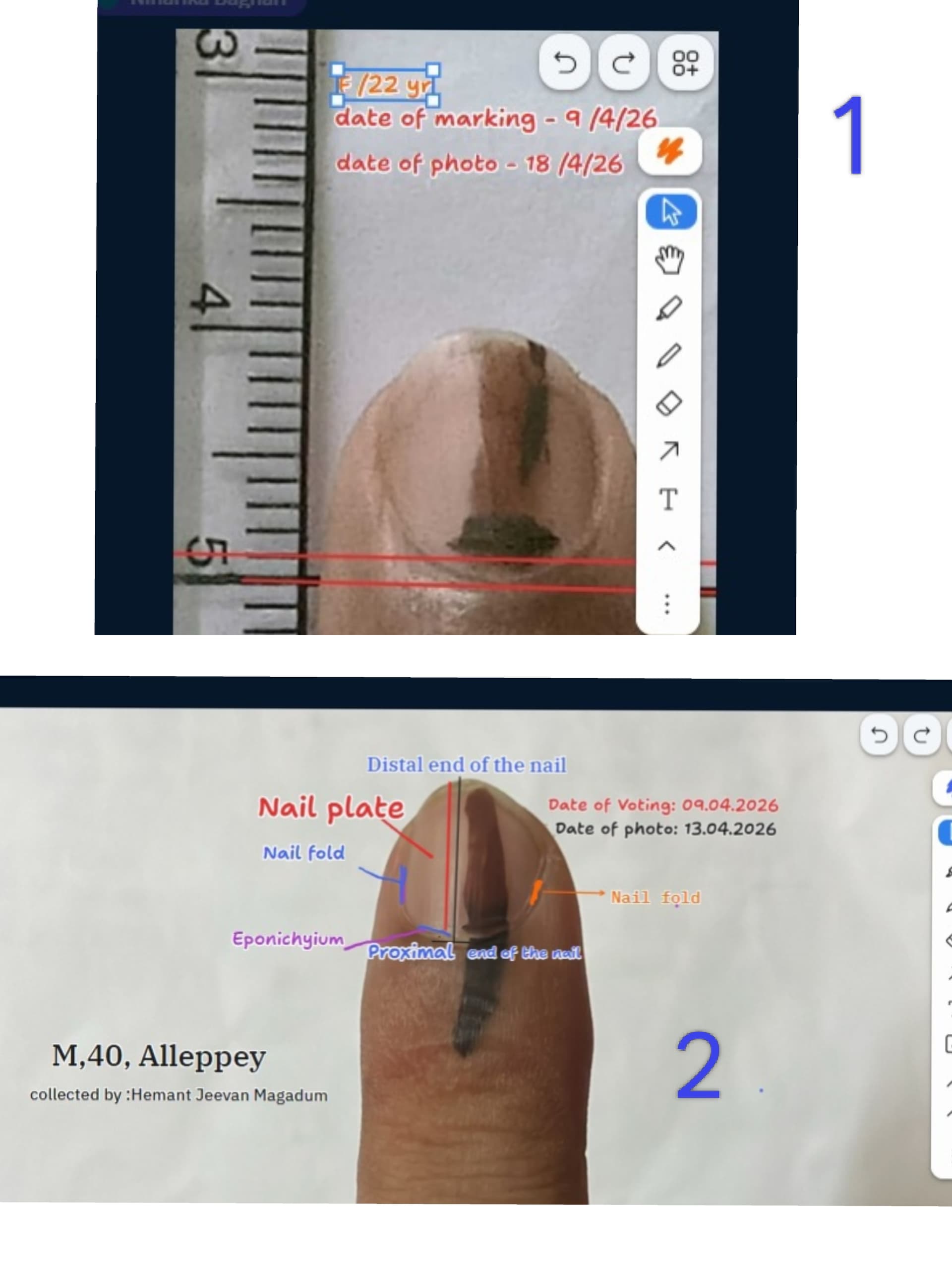
In the first image, nail growth data was contributed from Kerala  by Seethalakshmi Ma’am. In this image, we carefully observed:
 Date of marking
 Date of photo
 Position of the ink mark
 Distance moved by the mark
By comparing the dates and positions, we estimated that the nail growth was approximately about 1 mm .
2nd picture -
showed that nail growth occurs slowly but steadily, and it can be measured scientifically.
In the second image, nail data was shared by Hemant Jeevan Magadum Sir, showing the index finger nail
 with a marking date of 9 April .
While observing this image, we noticed an important gap between the eponychium (base skin) and the ink mark.
 This gap clearly showed nail growth, because as the nail grows, the ink mark moves forward toward the distal end, creating a visible space or gap near the proximal area. Observing this gap helped us understand how nail growth can be visually tracked over time.
This observation helped us realize that small visible changes, like a gap, can provide strong scientific evidence of growth  .
.
 Understanding Proximal and Distal Using Shoulder and Palm
One of the most helpful explanations was given by Himanshu sir who explained the meaning of proximal and distal using a simple shoulder and palm example  .
.
He explained:
The shoulder is closer to the center of the body, so it is called proximal
The palm is farther from the center of the body, so it is called distal
So we learned:
Proximal = Near to the body center (like shoulder)
Distal = Away from the body center (like palm) 
Using this example made it easy to understand:
Proximal end of the nail → The base of the nail near the skin 
Distal end of the nail → The tip of the nail away from the body
This real-life comparison helped remove confusion and made the terms easy to remember  .
.
 Understanding Nail Anatomy
During the session, we learned about the structure of the nail.
Important parts include:
1- Nail Plate 
The hard and visible part of the nail.
2- Nail Fold 
The skin surrounding the sides of the nail.
3- Eponychium 
The protective skin at the base of the nail that covers the growing region.
Proximal End
The base of the nail near the body.
Distal End
The tip of the nail away from the body.
Ink Movement – A New Learning
One of the most interesting discoveries was observing ink movement 
 .
.
Earlier, I never knew that:
Ink marks move forward as nails grow
The movement always happens from proximal to distal direction
The growing nail creates a visible gap near the base, which shows growth
Measuring this movement helps calculate nail growth
This made me realize how tiny movements can reveal important scientific patterns
 Tinke moment - This I never knew earlier -
I understood that nail growth happens from proximal to distal direction.
I learned the difference between proximal and distal in the hand:
Proximal → Near to the body (like shoulder)
Distal → Away from the body (like palm and fingertips)
 In CUBE Chatshala, I learned how to copy sentences correctly by observing carefully and writing the same information clearly
I learned to notice small gaps near the base of the nail, which show nail growth.
 I learned how to measure movement using a ruler.
I also learned new nail anatomy terms like nail plate, nail fold, and eponychium.
 Final Reflection-
This session helped me understand that even a small nail can teach powerful scientific concepts .
From this investigation, I learned:
 The meaning of proximal and distal using shoulder and palm examples
The structure and anatomy of the nail
How to measure nail growth scientifically
How a visible gap helps show nail growth
How to record observations properly
 This session showed that science exists in everyday life, and even a tiny nail can help us understand growth, measurement, and observation in a scientific way .
Screenshots during Chatshaala