 CUBE ChatShaala – Meeting Summary (06 December 2025)
Today’s session brought together participants preparing for the National Research Scholars Meet 2025, with discussions spanning laboratory-based cancer research and field-level plant exploration. The group examined both formal laboratory workflows in immunohistochemistry and the observational tools that make simple field biology meaningful. The meeting emphasized how scientific understanding emerges from both structured protocols and everyday natural phenomena.
1. Immunohistochemistry (IHC) Workflow Discussion
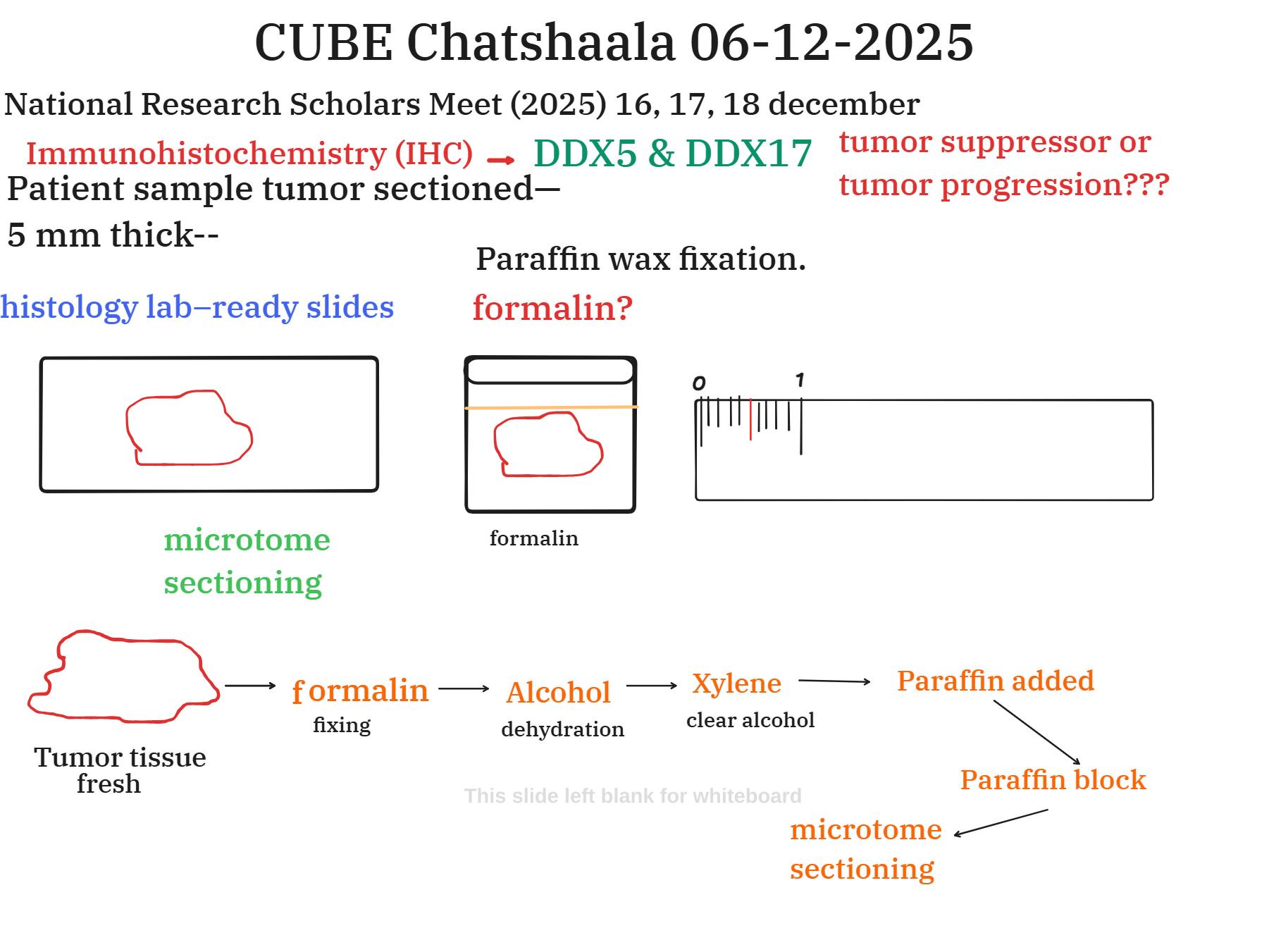
Participants reviewed the full workflow of preparing tumor tissues for IHC, focusing on the analysis of DDX5 and DDX17, two RNA helicases implicated either in tumor suppression or disease progression.
The whiteboard summary outlined the steps:
- Formalin fixation to prevent tissue decay
- Alcohol dehydration
- Xylene clearing to remove alcohol
- Paraffin embedding to stabilize tissue
- Microtome sectioning into thin slices
- Mounting on histology-ready slides
Discussions highlighted how each step can influence antigen preservation and staining quality, especially in clinical research relying on molecular markers.
2. Paraffin Processing and Microtomy
Members analyzed how deviations in the embedding process—such as over-fixation, insufficient dehydration, or incorrect microtome calibration—can distort tissue structure. Attention was drawn to the micrometer scale drawn on the whiteboard, stressing how precision determines the clarity of IHC staining.
3. Field Botany Observation (Cardamine)
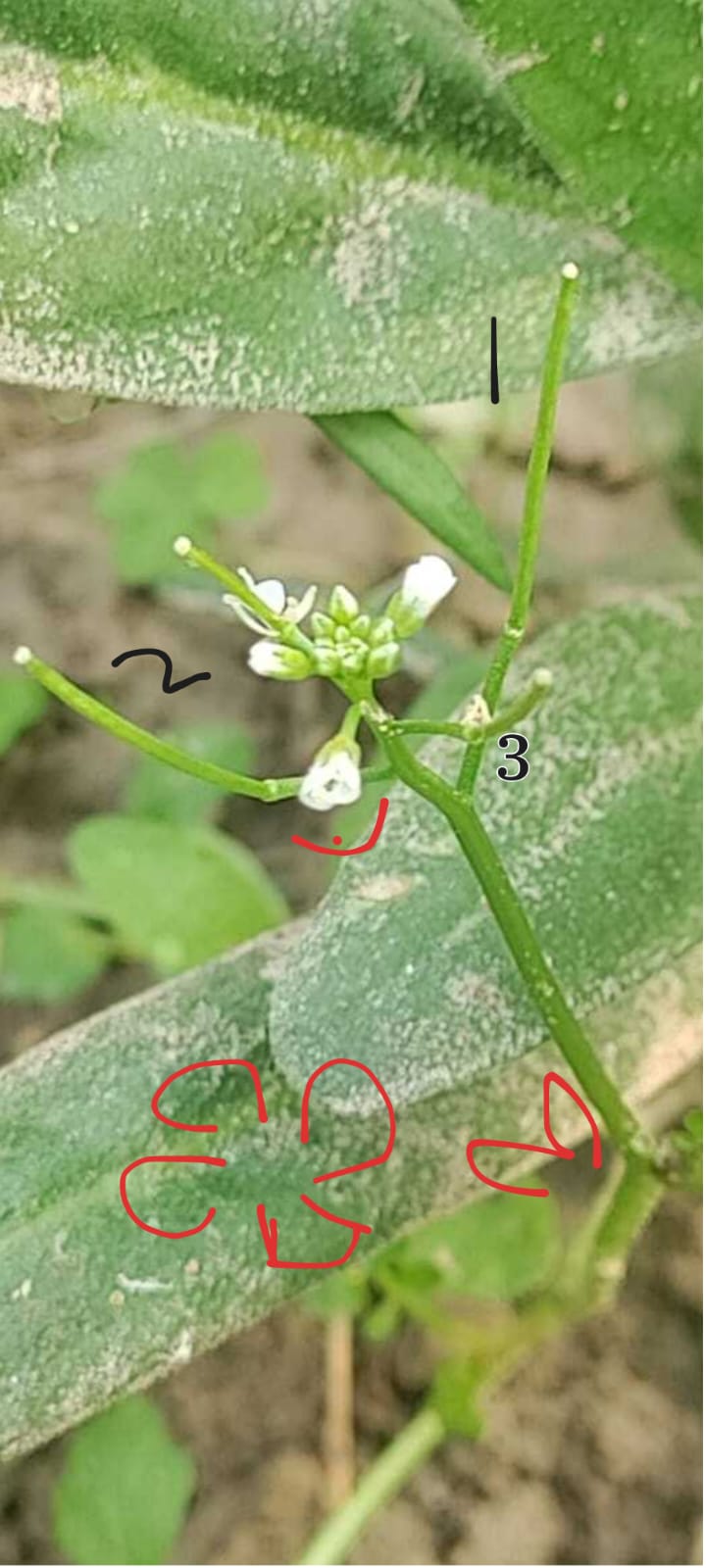
The second image inspired a discussion on the plant morphology of Cardamine. Participants noted:
- Developing buds
- Pedicels and branching patterns
- White, possibly five-petalled flowers
- Symmetry patterns sketched for interpretation
This reinforced the power of careful observation and how even small botanical features contribute to species identification and developmental understanding.
 Engaging Follow-Up Questions Inspired by the Session
-
How do fixation and processing choices alter long-term antigen detectability in histological samples?
-
Why do markers like DDX5 and DDX17 show contrasting roles in different cancers?
-
How does section thickness influence staining intensity and microscopic interpretation?
-
What morphological characters are most reliable when identifying a plant species from field photographs?
-
What examples from today’s session demonstrate that discovery does not depend solely on advanced instruments?
 What I Have Learned
-
Every step of the IHC protocol has consequences—clarity of staining is a direct reflection of technique.
-
Protein markers cannot be boxed into fixed categories; their behavior changes with cellular context.
-
Botanical observation teaches pattern recognition: symmetry, bud sequence, and branching all matter.
-
Good science begins with curiosity, not technology.
 Gaps and Misconceptions
-
Some assumed that formalin preserves all structures uniformly.
In reality, over-fixation can mask antigens, making IHC less effective. Antigen retrieval may then become inconsistent. -
Many did not realize that xylene’s main role is to replace alcohol with a medium compatible with paraffin. If dehydration is incomplete, residual water prevents proper infiltration.
-
The belief that DDX5/DDX17 have universal behavior oversimplifies cancer biology. A marker may suppress tumors in one tissue type but promote growth in another.
-
Some thought thicker microtome slices give more “information.”
Instead, thicker sections often cause: uneven staining
overlapping cell structures
poor antibody penetrationOptimal sections (3–5 μm) improve clarity.
-
Participants sometimes believed accurate identification requires microscopy or lab work.
In reality, morphology alone can be powerful, and field-based systematic observation is a valid scientific method.
 TINKE Moments (Things I Never Knew Earlier)
-
Antigen accessibility can be altered simply by the timing of fixation.
-
Floral symmetry patterns (Cardmine) can be sketched to hypothesize family-level classification.
-
A protein’s “role” in cancer is a spectrum, not a category.
-
Paraffin infiltration is affected by something as subtle as incomplete dehydration.
-
Field observations can raise research-level questions just as effectively as lab experiments.
 Photographs during Chatshaala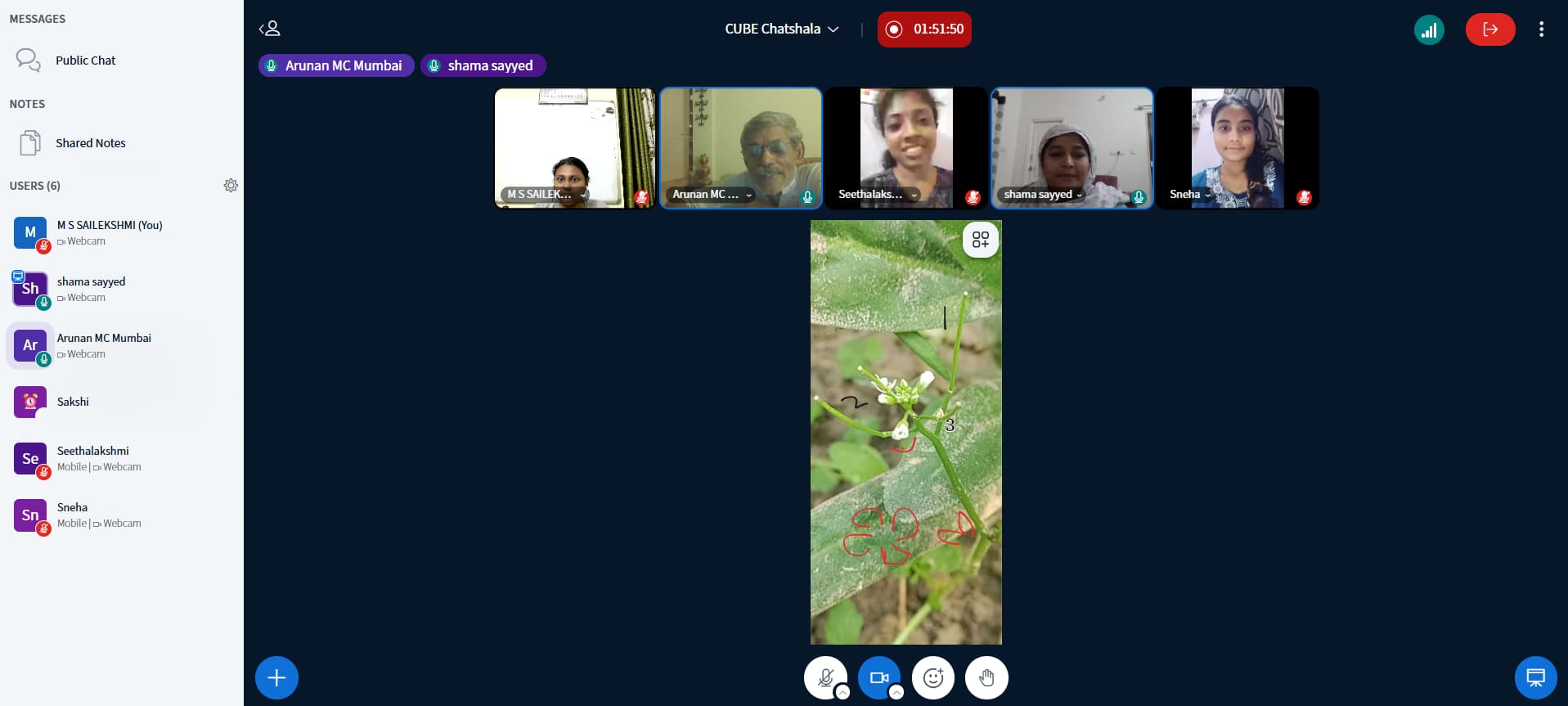
 Reference