 CUBE ChatShaala – Discussion Summary
Date: 12 May 2026
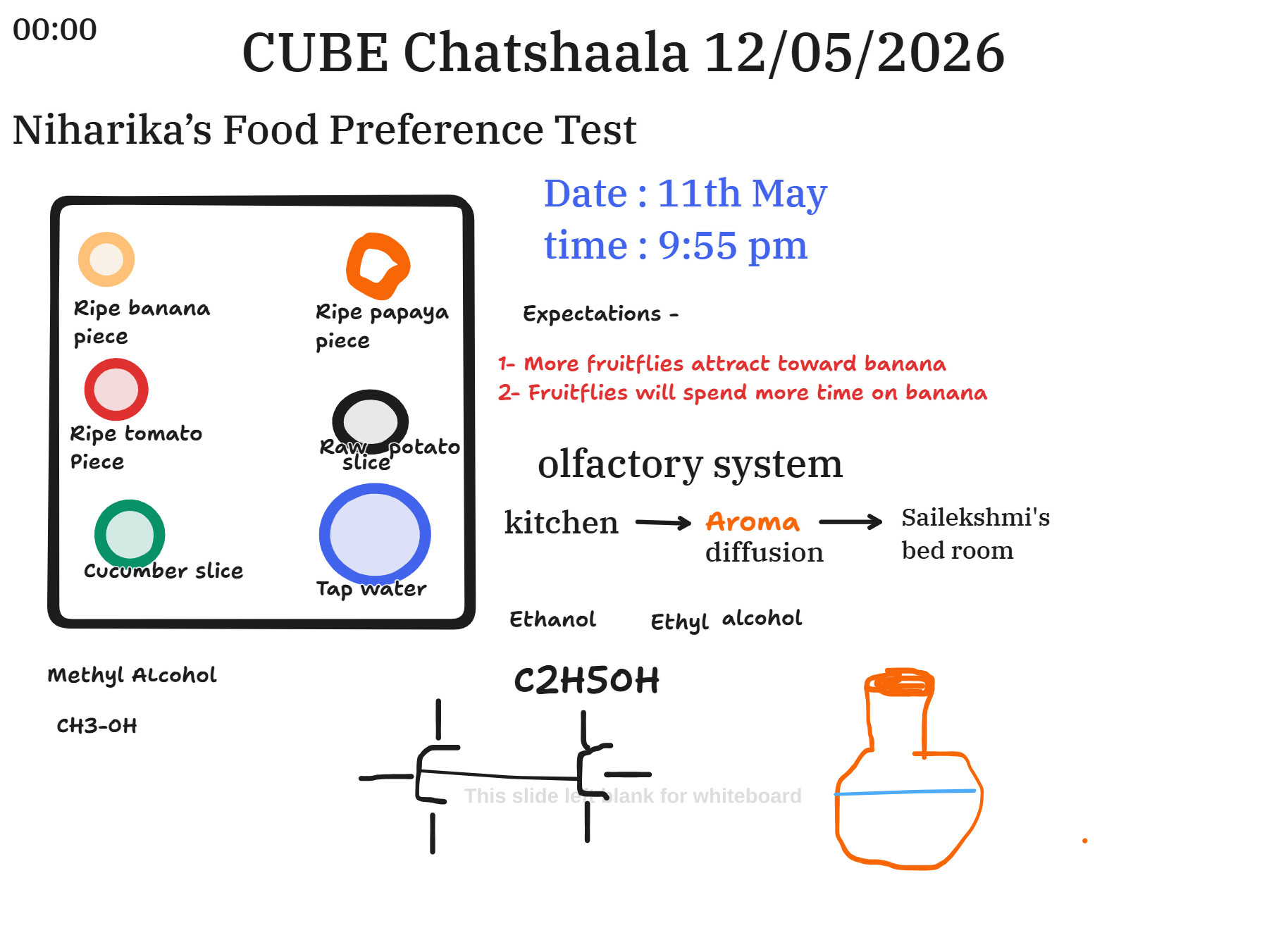
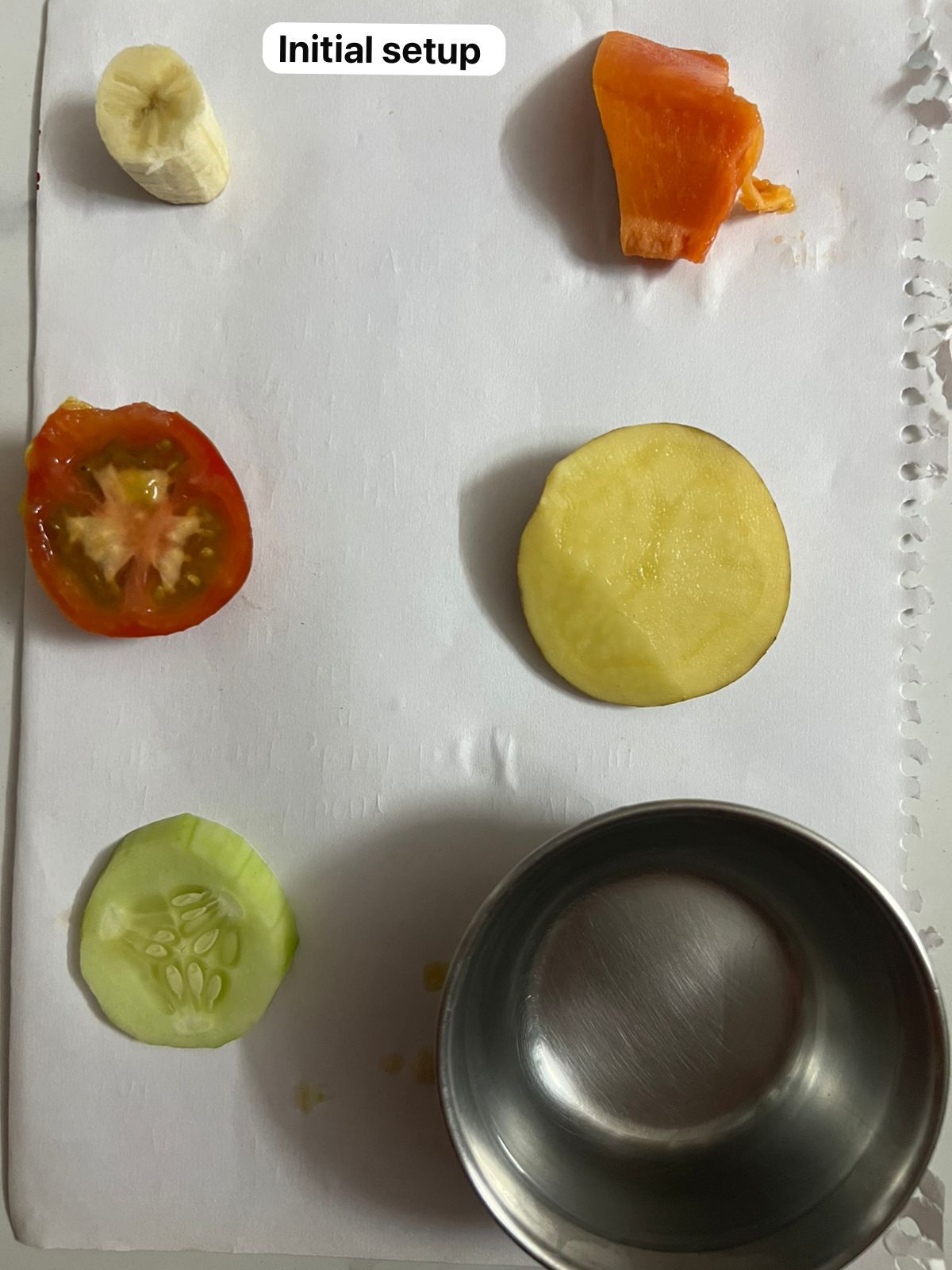
Today’s CUBE ChatShaala session centred on a food-preference experiment conducted by Niharika Baghari, designed to investigate whether fruit flies (Drosophila melanogaster) exhibit a measurable preference for certain fruits over others. The experiment was set up on the night of 11th May 2026 at 9:55 pm, with five food samples — ripe banana, ripe papaya, ripe tomato, raw potato, and cucumber — placed separately on a white sheet, along with a steel bowl of tap water as a control. The setup was left undisturbed under natural indoor conditions in Haldwani, where the temperature ranged between 28°C and 33°C.
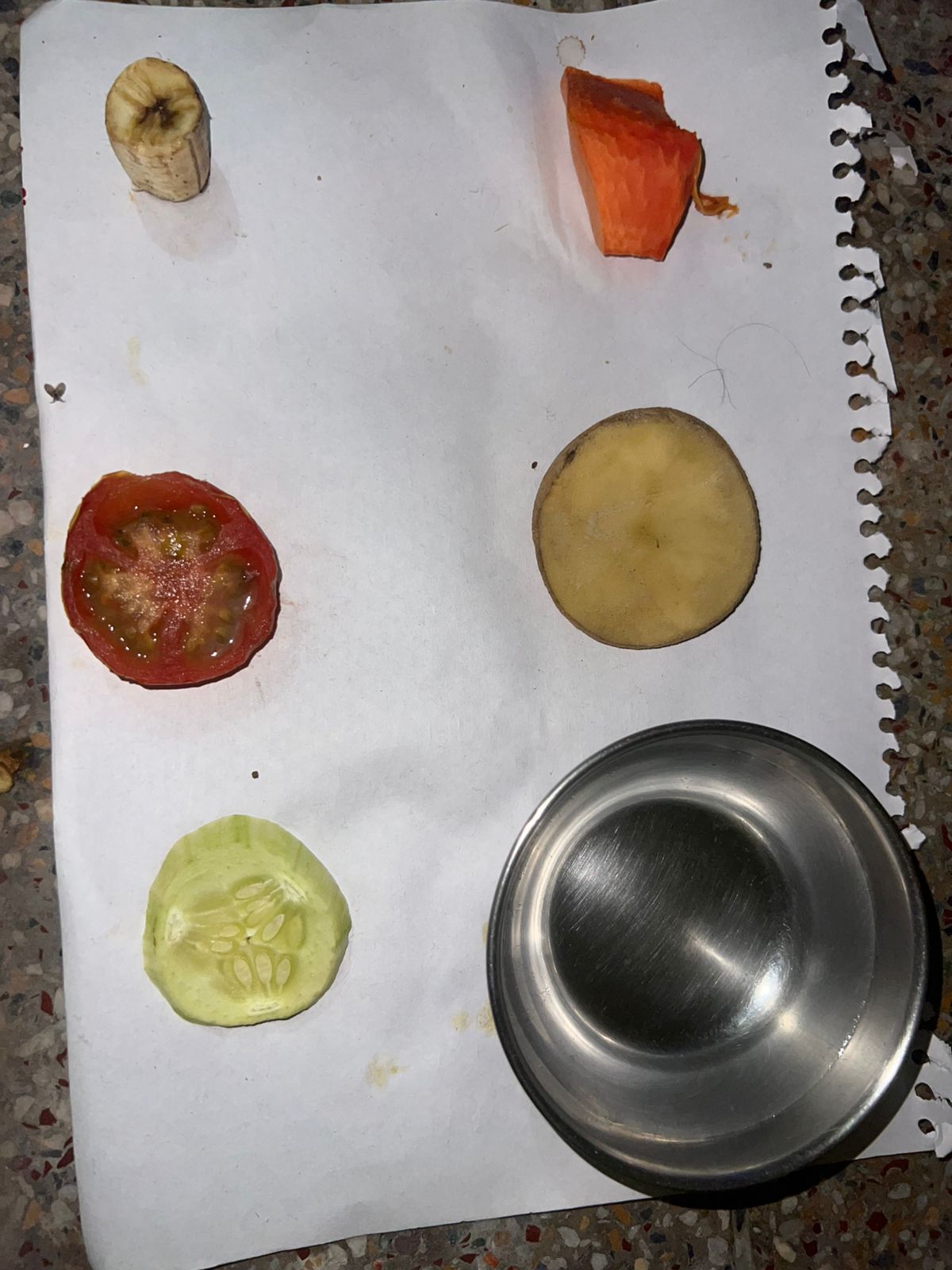
The primary hypothesis driving the experiment was straightforward and biologically motivated: fruit flies were expected to be more strongly attracted to the banana and spend more time on it than on the other food items. This expectation was grounded in what we generally know about Drosophila — that they are drawn to fermenting, sugar-rich substrates, and that banana is one of the most commonly used attractants in laboratory culture of these flies. Two specific predictions were framed:
- More fruit flies would be attracted to the banana piece.
- Fruit flies would spend more time on the banana compared to other food items.
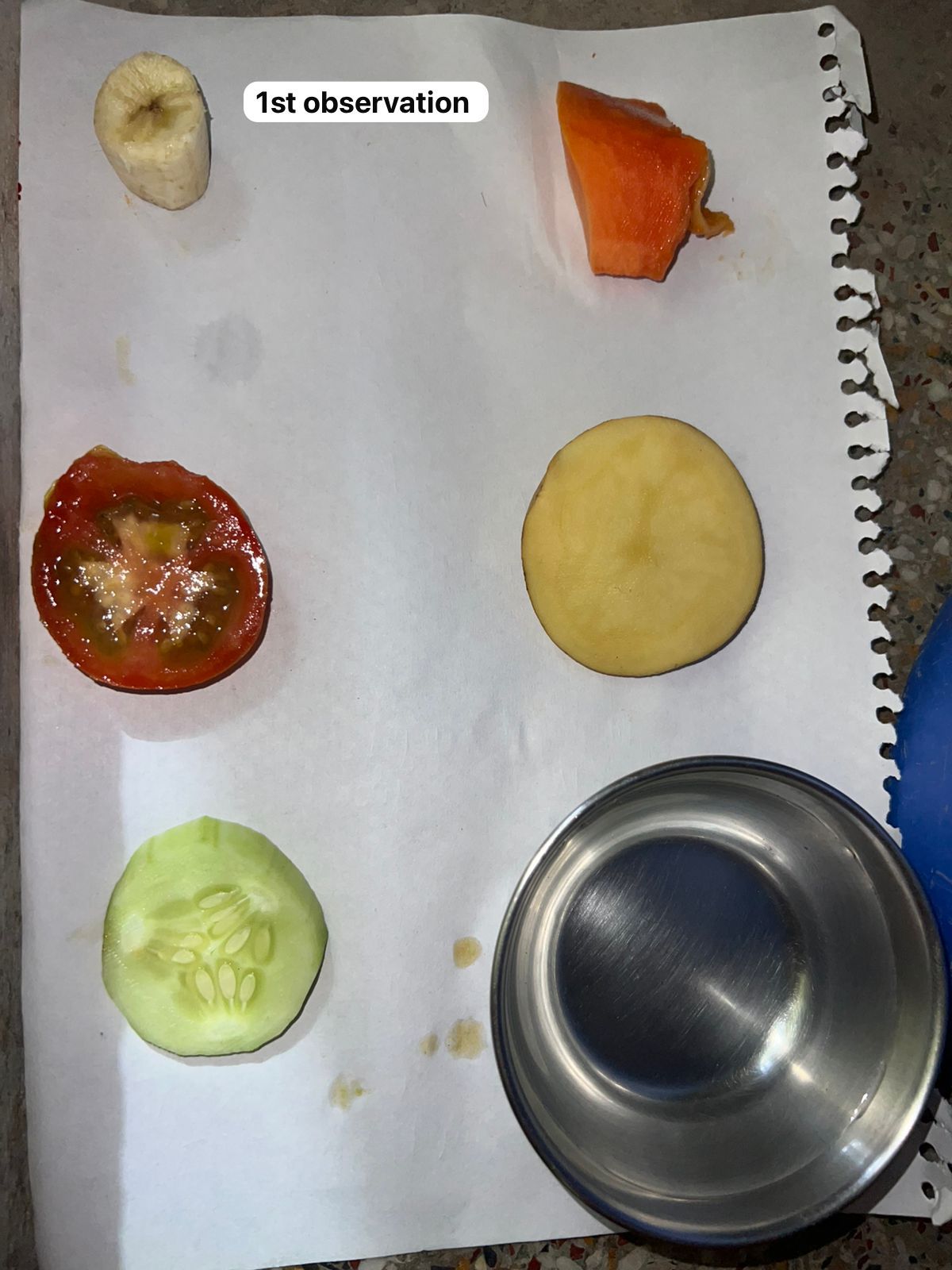
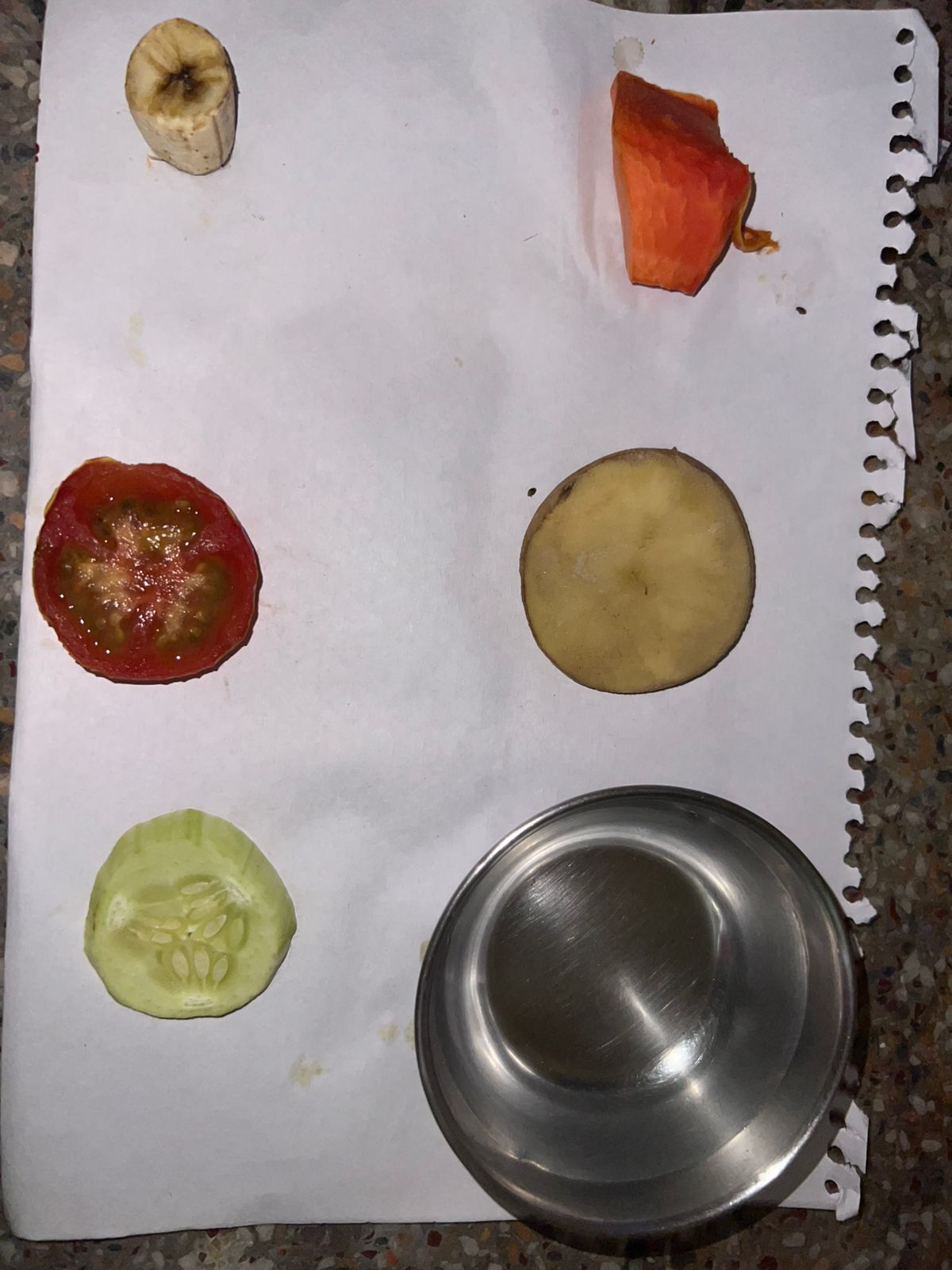
However, the results from both observation rounds were surprising. During the first observation at 10:30 pm on the same night, no fruit flies were visible on any of the food items. A second observation, conducted the following morning at 10:35 am, also recorded no fly activity. By the evening observation at 6:30 pm, only one fruit fly was noted — and it was seen on the white paper surface near the food items, rather than on any particular food. No food-specific preference could be established from these observations.
An important part of the session’s discussion revolved around understanding why the flies were not appearing as expected. Several threads were explored:
The Role of the Olfactory System: A significant conceptual anchor in today’s discussion was the olfactory system of fruit flies and how aroma diffusion works as a cue for locating food. The whiteboard illustrated this with a vivid example — aromas from a kitchen can travel and reach a bedroom, just as volatile chemical compounds emitted by ripe fruit diffuse through the air and reach the sensory organs of fruit flies. Was the question raised: Is the aroma of a banana strong enough, and is the diffusion happening effectively under the experimental conditions?
Chemistry of Aroma and Ethanol: The session touched on the chemistry behind fruit aromas, particularly the role of ethanol (C₂H₅OH, also written as C₂H₆O). Ethanol is produced during the fermentation of sugars in ripe fruit, and it is one of the primary volatile compounds that Drosophila uses to locate food. The distinction between ethanol (ethyl alcohol, C₂H₅OH) and methanol (methyl alcohol, CH₃OH) was briefly discussed, noting that these are related but chemically distinct compounds with very different biological effects. Ethanol is the compound relevant to fruit fly attraction and is also the active ingredient in alcoholic beverages.
Photographic Documentation: Niharika’s experimental photographs — covering the initial setup, the first observation, and subsequent time points — were shared and discussed. Across the images, the samples visibly aged over time: the banana darkened at the cut surface, the tomato began to lose moisture, and its interior became more exposed, and the potato showed mild surface changes. Despite these physical changes that would normally suggest increasing fermentation and odour, no significant fly activity was recorded.
Environmental and Temporal Factors: The group considered whether the late-night setup time (9:55 pm) was optimal for fly activity. Fruit flies are predominantly diurnal — active during daylight hours — which may explain the absence of flies during the nighttime observation. The lack of flies during the daytime observations, however, remained an open question, pointing to the possibility that flies were simply not present in the domestic indoor environment at the time.
Connection to Broader CUBE Themes: The session also briefly touched on foundational concepts in biology that connect to this experiment — diffusion (linking to a referenced Metastudio discussion on “The Great Water Escape”), and the legacy of T.H. Morgan’s Nobel Prize-winning work with Drosophila, which established this tiny fly as one of biology’s most powerful model organisms. These connections helped situate Niharika’s humble kitchen experiment within a much grander scientific tradition.
 Provocative Questions
-
Fruit flies are widely considered reliable indicators of ripe or fermenting fruit — so why did none appear on the banana or papaya in this experiment, even after several hours? What does this tell us about the conditions necessary for olfactory attraction to work?
-
If the olfactory system of Drosophila is so sensitive that it can detect ethanol and other volatiles at very low concentrations, what threshold concentration of aroma must be present in the local air before a fly responds? How would you design an experiment to measure this threshold?
-
The experiment was set up at 9:55 pm. Given that fruit flies are primarily active during the day, how significantly does the time of setup affect the outcome? Would repeating the same experiment at noon yield a different result, and why?
-
The whiteboard notes compare ethanol (C₂H₅OH) with methanol (CH₃OH). Both are alcohols, and both are produced in biological systems. What specific molecular features make ethanol an attractant for Drosophila, while methanol is toxic? What does this suggest about how evolution has shaped the fly’s chemosensory system?
-
The experiment included tap water as a control. What was the scientific reasoning behind including water? Did water serve as a true negative control here, or could it also be mildly attractive to flies? How would you interpret a result where flies spent time near the water bowl?
-
Across the observation images, the banana piece visibly darkened and began to over-ripen. Does over-ripeness increase or decrease the attractiveness of fruit to Drosophila? Is there a “peak attractiveness” stage, and what chemical changes drive it?
-
The discussion connected aroma diffusion in a house (kitchen → bedroom) to the olfactory navigation of fruit flies. How do flies actually navigate toward a source using a diffuse odour gradient? What neural and behavioural mechanisms are involved?
-
T.H. Morgan won the Nobel Prize in 1933 for his work with Drosophila on chromosomal inheritance. How does the simplicity of maintaining Drosophila in a kitchen — as demonstrated in this experiment — connect to why it became such a dominant model organism in genetics and neuroscience?
-
The raw potato was included as a food item. What was the scientific justification for this choice? Is a raw potato a food source for fruit flies at all, or does it function primarily as a negative control in this context?
-
If you were to repeat this experiment with the same food items but in an outdoor setting, do you think the results would differ? What additional variables would be introduced outdoors, and how would you control for them?
 What I Have Learned
The most immediate lesson is about the gap between prediction and observation. Niharika hypothesised, quite reasonably, that a banana would attract the most fruit flies. This is a prediction supported by decades of laboratory practice — banana is practically synonymous with Drosophila culture. And yet, no flies appeared during the experiment’s timeframe. Rather than treating this as a failure, the session treated it as data worth interrogating. That shift in attitude — from disappointment to curiosity — is at the heart of what CUBE stands for.
I also found the discussion on the olfactory system genuinely illuminating. It is easy to take for granted that smells “travel,” but thinking carefully about aroma diffusion as a physical and chemical process — volatile molecules spreading through a concentration gradient in air — gives the phenomenon real depth. Connecting this to the molecular chemistry of ethanol (C₂H₅OH) as the key attractant compound made the biology feel tangible and grounded.
The distinction between ethanol and methanol was a small but important conceptual note. It is the kind of detail that students often blur together, and having it flagged clearly — that these are different molecules with different biological roles — is genuinely useful.
Perhaps most importantly, I have come away with a stronger appreciation for the importance of experimental conditions. Time of day, ambient temperature, and whether the location has an established fly population — all of these can be the difference between a result and a null result. Science rarely fails; it just tells you that your conditions were not right, and that the next step is to ask why.
 TINKE Moments (This I Never Knew Earlier)
TINKE 1 — Fruit Flies Are Not Always Around
Many participants likely assumed, as the experimenter did, that setting out ripe fruit at home would reliably attract fruit flies within a short time. The null result challenged this assumption directly. TINKE: Fruit flies are not omnipresent. Their presence in a given location depends on an established local population, season, building conditions, and proximity to outdoor sources. An experiment that yields no flies does not mean the hypothesis is wrong — it may mean the population density was simply too low at that location and time.
TINKE 2 — Nocturnal Setup and Diurnal Flies
It was not immediately obvious to everyone that Drosophila follows a diurnal activity rhythm. Setting up the experiment at nearly 10 pm and expecting flies to respond overnight reflects a gap in understanding the temporal biology of the organism. TINKE: The biology of the model organism — including when it is active, when it feeds, and when it mates — is not background noise. It is essential experimental knowledge.
TINKE 3 — Ethanol vs. Methanol Is Not a Trivial Distinction
Both ethanol and methanol are simple alcohols and look deceptively similar in their structural formulae. The whiteboard notation of CH₃OH versus C₂H₅OH may seem like a minor chemical detail, but for an organism like Drosophila that has evolved to detect ethanol as a food-quality signal, this distinction is biologically critical. TINKE: Even a one-carbon difference in molecular structure can mean the difference between attraction and toxicity.
TINKE 4 — Aroma Diffusion Is a Physical Process, Not Magic
There was an implicit assumption in the discussion that strong-smelling food “just attracts” flies. Unpacking this through the concept of olfactory cues and volatile diffusion — the idea that molecules physically travel through the air from a source to a receptor — added precision to the thinking. TINKE: Food attracts flies because specific volatile compounds reach their chemosensory organs at sufficient concentrations. Understanding this opens up entirely new experimental possibilities, such as testing whether filtered or ventilated environments reduce fly attraction.
TINKE 5 — The Control Matters
Including tap water in the experiment was noted as a methodological choice, but its significance as a true control was perhaps not fully explored in real time. TINKE: What exactly does the water control? It controls for movement and presence on the paper surface unrelated to food odour. Without it, you cannot distinguish between flies attracted to food versus flies that are just wandering.
 Gaps and Misconceptions
Gap 1 — Population Baseline Not Established
The experiment did not begin with any attempt to establish whether fruit flies were actually present in Niharika’s home environment before the setup. Without this baseline, it is impossible to say whether the null result reflects a failure of attraction or simply an absence of flies in that domestic space. Future iterations of this experiment should include a pre-experiment survey: leave out a banana overnight before the actual trial to confirm flies are present.
Gap 2 — No Quantitative Measure of Aroma Strength
The assumption throughout was that the banana and papaya were emitting sufficient volatile compounds to attract flies. But ripe fruit varies enormously in how much ethanol and esters it releases, depending on the exact stage of ripeness, temperature, and surface exposure. No attempt was made to characterise the relative “aroma strength” of the food items. This is a legitimate gap in the experimental design.
Gap 3 — Observation Intervals Were Inconsistent
The first observation was approximately 35 minutes after setup (9:55 pm to 10:30 pm), the second was the following morning at 10:35 am, and the third was the same evening at 6:30 pm. These intervals are quite long and uneven. Flies, if present, could have come and gone between observations. Continuous monitoring — even through time-lapse photography — would significantly improve data quality.
Gap 4 — Misconception: Ripe Automatically Means Attractive
There is a common and understandable conflation between “ripe fruit” and “fruit that attracts flies.” In reality, Drosophila is most strongly attracted to fermenting fruit — fruit that has begun to break down and is producing ethanol and acetic acid through microbial fermentation. Freshly cut ripe fruit may not yet be at this stage. This distinction — between ripeness and fermentation — was not fully drawn out during the session and represents a conceptual gap worth addressing explicitly.
Gap 5 — Misconception About Methyl vs. Ethyl Alcohol
While the whiteboard noted both CH₃OH (methanol) and C₂H₅OH (ethanol), there was no explicit discussion of why the difference matters to the fly. Some participants may have left the session thinking these are interchangeable names for the same compound. To be clear: methanol is toxic to most organisms and is not produced in significant quantities during normal fruit fermentation. Ethanol is the biologically relevant molecule here, and the two should not be conflated.
Gap 6 — The Role of Tap Water Was Under-Discussed
The tap water in the steel bowl was included in the experimental setup, but its role as a control was not rigorously defined during the discussion. Is it a negative control (no food cue), a hydration source, or both? Without clarity on what the water is controlling for, its presence in the data interpretation remains ambiguous.
 Photographs during Chatshaala
 Referance