 CUBE ChatShaala Summary – 24.08.2025
Theme: Fruit Fly Activity Monitoring Over Time
Today’s ChatShaala focused on the systematic observation of fruit fly activity at a kitchen window, using continuous data collection over two consecutive days (21st and 22nd August).
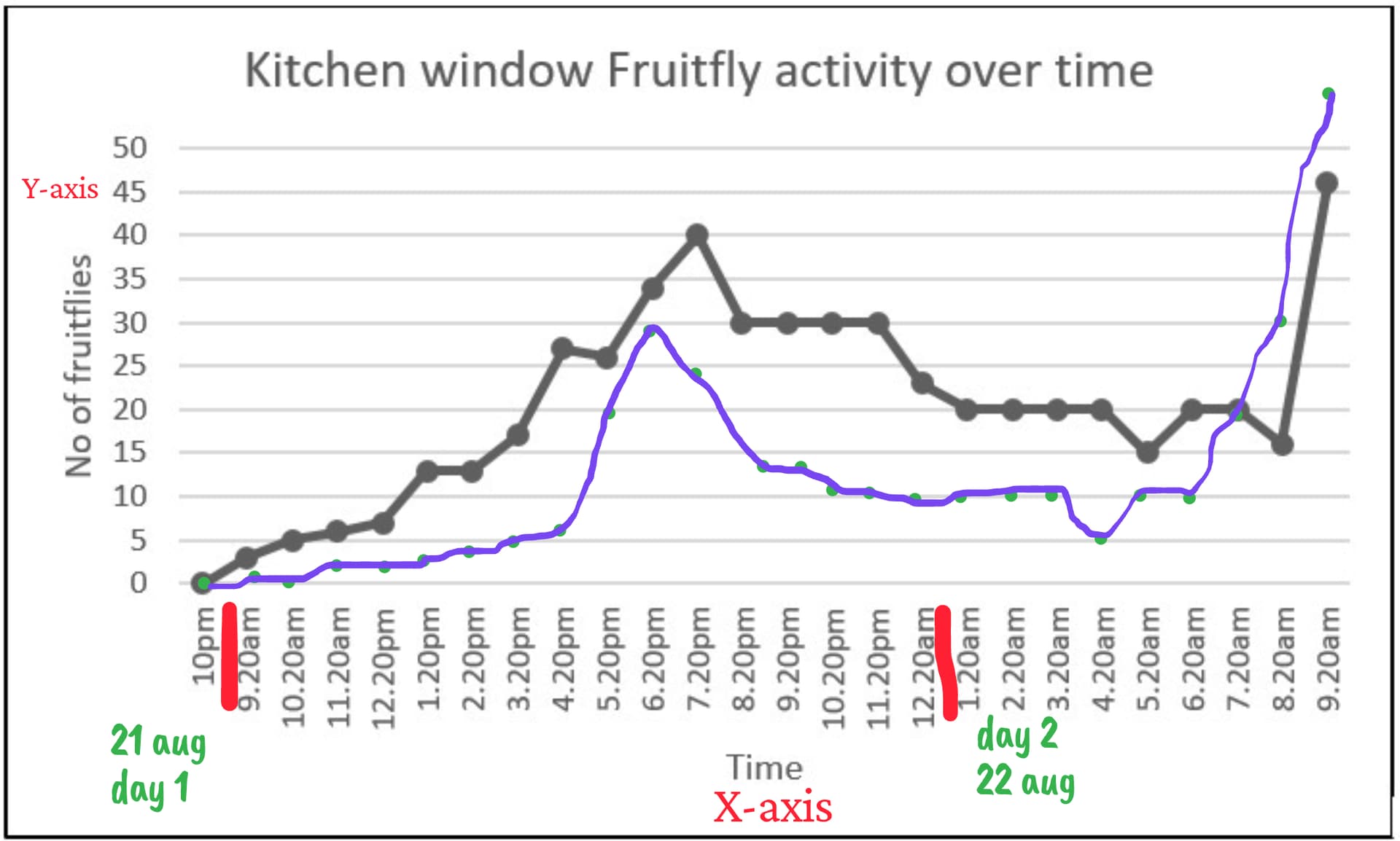
The graph presented depicted the number of fruit flies (Y-axis) plotted against time intervals (X-axis).
 Key Observations
-
On Day 1 (21 Aug), fruit fly activity began gradually increasing after morning hours, showing a clear evening peak around 6:20 PM with nearly 40 flies.
-
After this, activity declined but remained steady through late night until a minor dip at midnight.
-
On Day 2 (22 Aug), a dramatic surge in activity was recorded in the early morning hours, especially around 9:20 AM, where numbers exceeded 50 flies.
The contrasting patterns suggest that fruit flies may show different peaks of activity on different days, possibly influenced by environmental factors like temperature, humidity, light, or food availability.
This experiment highlights the importance of long-term, continuous monitoring rather than relying on isolated observations.
 TINKE Moments (This I Never knew Earlier)
-
Systematic data plotting can reveal hidden behavioral patterns in small organisms like fruit flies.
-
Activity peaks are not fixed—they may vary across days, reminding us of the need for replication.
-
Even kitchen windows can become powerful observation sites for meaningful scientific inquiry.
-
Collaboration in noting and discussing anomalies sharpens our interpretation.
 What I Learned
Careful time-based data collection helps understand organism behavior in naturalistic settings.
Biological rhythms, such as diurnal activity, may be context-dependent and require multiple-day studies.
Graphs are not just for representation—they actively guide us in asking better questions.
 Provocative Queries for the Community
-
Why do fruit flies show a major evening peak on one day but an early-morning peak on another?
-
Could kitchen-specific factors (like leftover food, temperature near cooking, or light sources) be influencing these changes?
-
What would happen if the observation was extended over an entire week—would we see a consistent rhythm or random variation?
-
Can this experiment help us relate to our own biological rhythms, such as sleep and activity cycles?
@Arunan @KiranKalakotiR @magpie @Hinaiqbal_Mudgal @sakshiconsultant2002 and others.