 CUBE ChatShaala Summary – 22nd October 2025:sparkles:
Today’s CUBE ChatShaala unfolded a fascinating discussion connecting fruit fly behavior, circadian rhythms, and genetic understanding through simple homelab setups.
 Highlights of the Discussion:
-
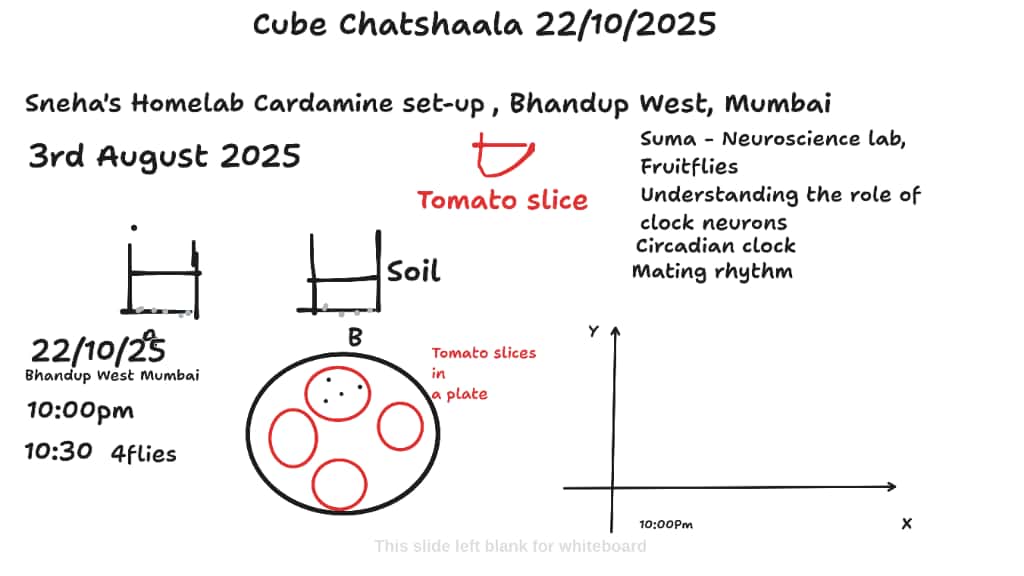
Sneha from Bhandup West, Mumbai, shared her Cardamine and fruit fly setup, using tomato slices as bait, observed from 10:00 PM onward.
-
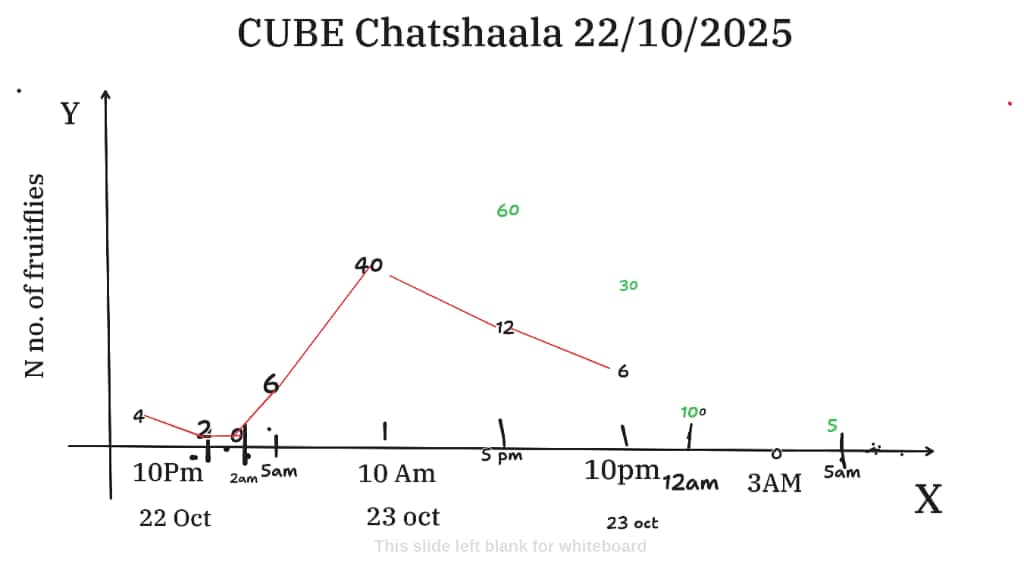
The group collectively analyzed data showing changes in the number of fruit flies visiting the setup at different times of the day and night (as seen in the plotted graph).
- At 10 PM, 4 flies were seen.
- Numbers fluctuated overnight, peaking at 40 flies by 10 AM on the 23rd, before dropping again.
-
This pattern sparked an engaging discussion about biological clocks, mating rhythms, and how fruit flies (Drosophila) serve as a model for studying the circadian clock—similar to ongoing research in neuroscience labs.
-
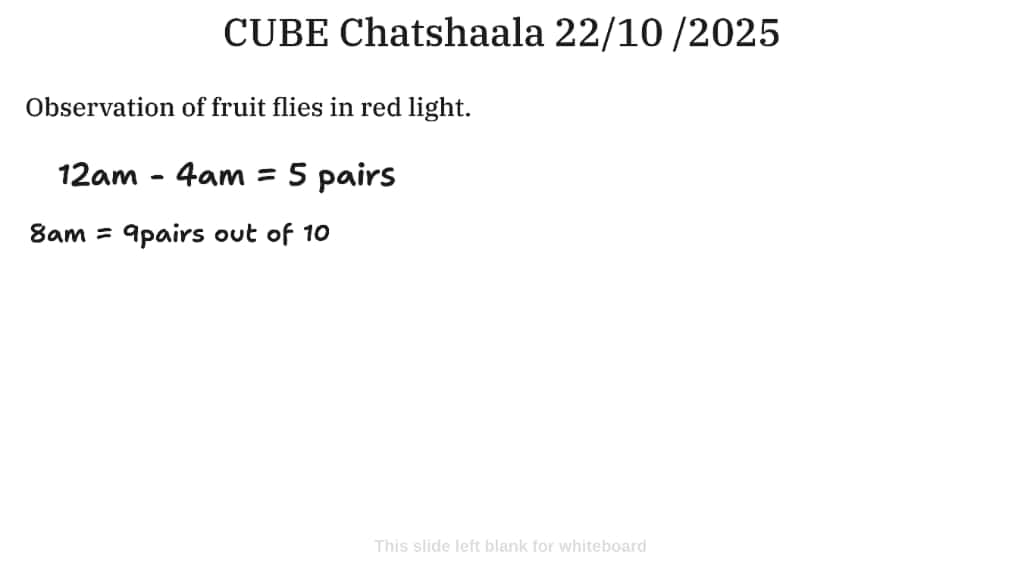
The observation in red light (12 AM–4 AM = 5 pairs; 8 AM = 9 pairs out of 10) raised the question of how light wavelength and time of day influence mating behavior in flies.
 What I Learned Today:
- Simple homelab experiments can mirror real neuroscience and genetics research, making complex concepts like circadian biology tangible.
- Data recording over time, when represented graphically, helps in visualizing biological rhythms.
- Observing flies’ activity under different light conditions (like red light) can reveal how neurons respond to light-dark cues—a fundamental aspect of clock gene studies.
 TINKE Moments (Things I Never Knew Earlier):
-
Fruit fly mating rhythms can be time-dependent, aligning with circadian cycles.
-
Even simple tomato-bait experiments at home can yield insights comparable to lab-based circadian studies.
-
The idea that light color might not disrupt circadian behavior as much as white light—hence, red light experiments help isolate the internal clock’s effect.
 Gaps and Misconceptions Identified:
-
Many participants initially assumed that flies mate randomly throughout the day, unaware of their time-specific mating peaks.
-
Confusion existed between the circadian clock (internal timing mechanism) and environmental cues like light or temperature that influence it.
-
Some mistook the increase in fly numbers as a sign of population growth, rather than a behavioral rhythm or activity pattern.
 Provocative Questions to Inspire All:
-
Could observing fruit flies’ daily rhythms at home help us understand our own sleep-wake cycles?
-
What if we changed the color or intensity of light—would it shift the flies’ mating time?
-
How might such small-scale experiments contribute to understanding human biological clocks?
-
Can Cardamine (the plant in Sneha’s setup) be genetically engineered to track time like fruit flies do?
 Reference
- Circadian Rhythms and Sleep in Drosophila melanogaster - PMC
- Frontiers | Living Without Temporal Cues: A Case Study
- 🌿 Seed to Seed in Weeks – Discovering the Hidden Power of Cardamine