 CUBE ChatShaala Summary – 19.08.2025
Themes Discussed:
-
Dissolved Oxygen, BOD, and Algal Growth (Chlorella)
-
Chlorohydra Culture and Hypoxia Inducible Factors (HIF)
 Discussion Highlights
1. Dissolved Oxygen & Algal Growth
Participants explored the relationship between algal growth (Chlorella) and oxygen availability in culture conditions.
The group reflected on how algae, being photosynthetic, can increase dissolved oxygen during the day but may reduce it at night due to respiration.
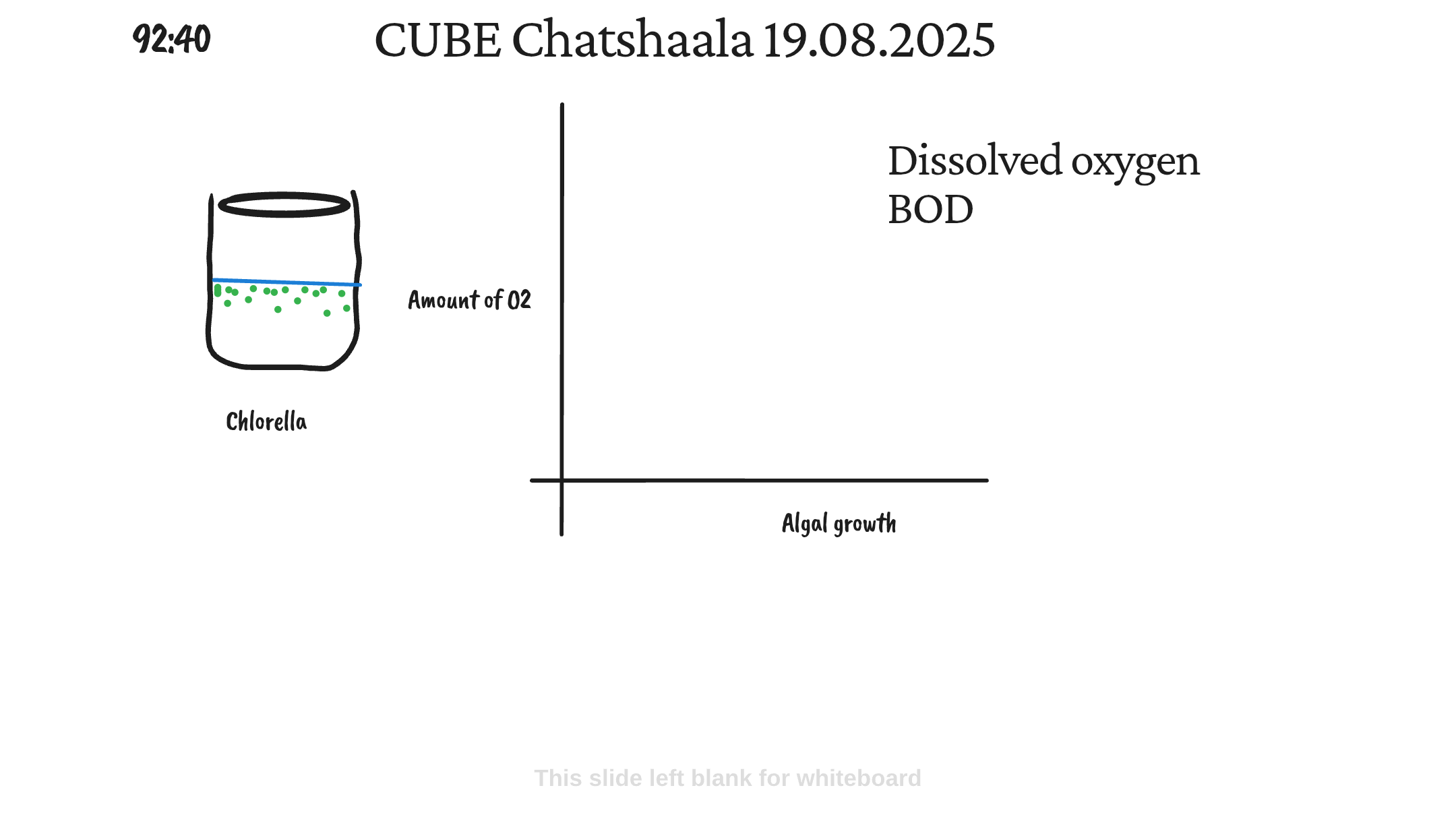
The concept of Biological Oxygen Demand (BOD) was introduced, connecting algal culture experiments to water quality studies.
A whiteboard sketch was used to compare dissolved oxygen levels with algal density, highlighting the balance between oxygen production and consumption.
2. Chlorohydra Culture (CHM College, Mumbai)
Students presented ongoing culture experiments of Chlorohydra in 250 ml beakers.
The focus shifted to low oxygen conditions (hypoxia) and the role of Hypoxia Inducible Factors (HIF) in regulating physiological responses.
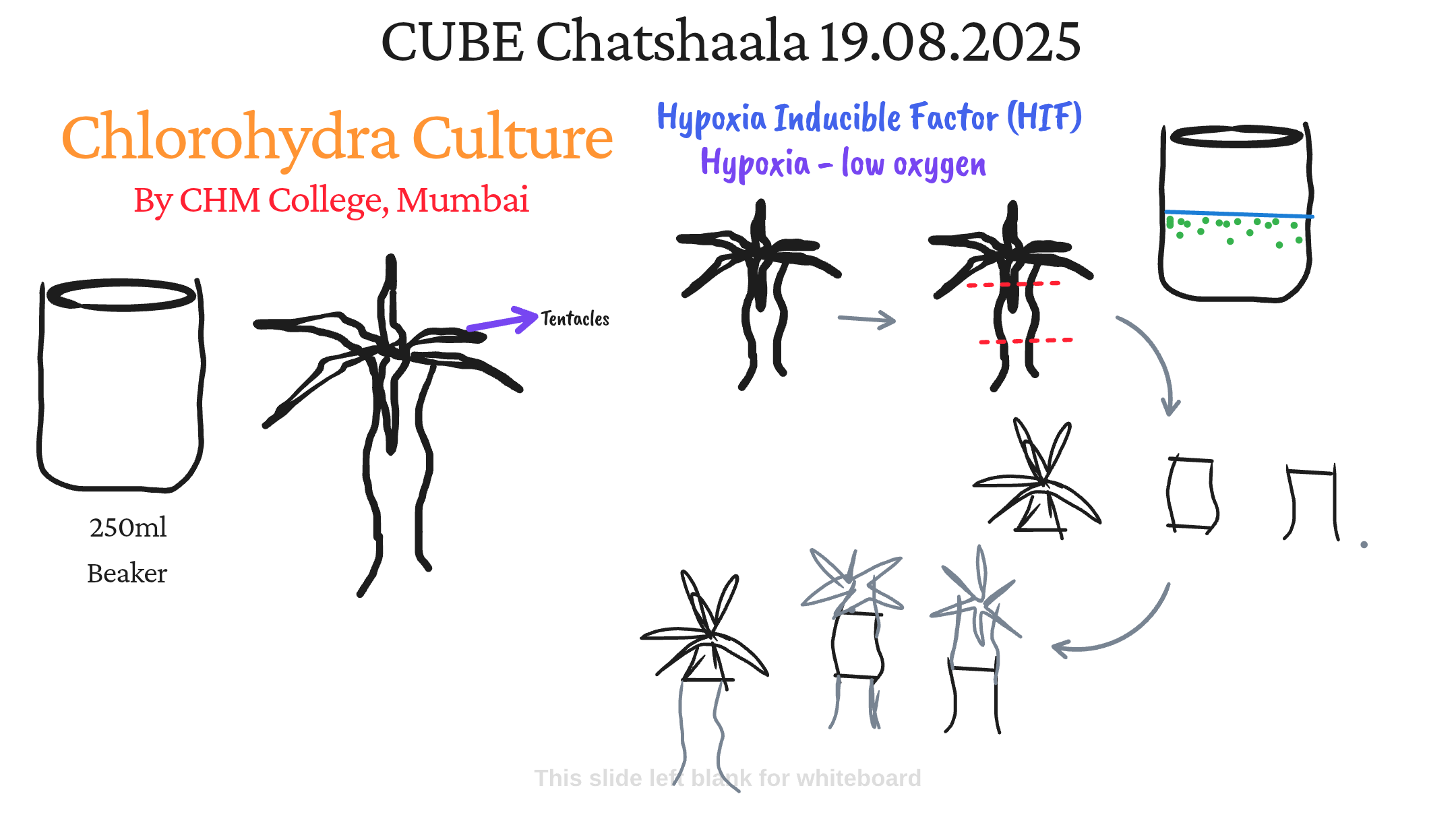
Observations of morphological changes in tentacles under different oxygen conditions were shared.
The group raised the possibility of using Chlorohydra as a simple system to model oxygen regulation in animals, linking it to broader biological and medical contexts.
 Queries for Engagement
-
How does algal overgrowth in water bodies affect dissolved oxygen and aquatic life survival?
-
Can home labs measure dissolved oxygen changes in a simple Chlorella culture?
-
What can a small organism like Chlorohydra teach us about human responses to low oxygen (e.g., at high altitudes or in diseases)?
-
Could culturing Chlorohydra help us design simple school-level experiments to study HIF activity?
-
How does the concept of Biological Oxygen Demand link to real-life issues such as sewage pollution and fish mortality?
-
Could citizen science communities contribute to monitoring BOD levels in local water bodies?
 What I Learned Today
The dynamic relationship between algal growth, dissolved oxygen, and BOD, showing how microscopic organisms influence whole ecosystems.
The relevance of hypoxia studies in simple organisms like Chlorohydra for understanding complex physiological processes in higher animals.
The importance of connecting home lab observations with global environmental and health challenges.
 TINKE Moments (This I Never Knew Earlier )
 Realizing that even a small beaker of Chlorella can serve as a model to understand critical environmental issues like oxygen depletion in water bodies.
Understanding how Chlorohydra cultures can be used not only for regeneration studies but also to explore oxygen regulation pathways.
Connecting classroom concepts of BOD and dissolved oxygen to real-world ecological crises and research frontiers in physiology.
 Reference
-
Google Search (Dissolved Oxygen)
-
https://bioflux.com.ro/docs/2020.2878-2885.pdf?utm_source=chatgpt.com

@Arunan @KiranKalakotiR @SN1261 @akanksha @magpie @ajitadeshmukh13 @2020ugchsncnseethala and others.