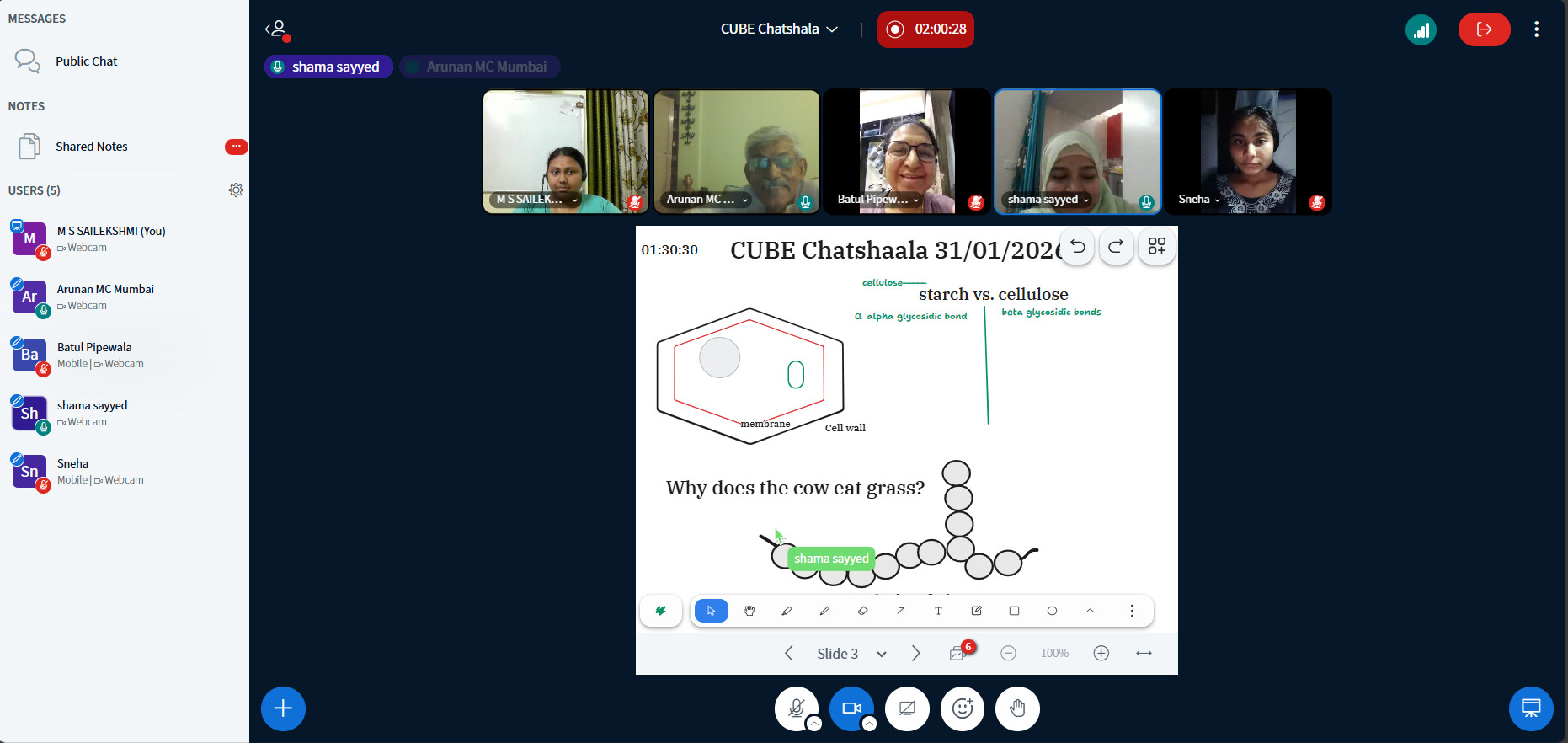
CUBE ChatShaala – Meeting Summary
Date: 31 January 2026
Theme: Activation Energy, Enzyme Action, and Structural Basis of Carbohydrate Utilisation
1. Purpose of the Session
The session aimed to bridge abstract biochemical concepts with everyday biological and cultural analogies, focusing on how activation energy, enzymes, and molecular structure determine whether a reaction occurs or fails. Emphasis was placed on why availability of raw materials alone does not guarantee a reaction.
2. Core Concepts Discussed
a) Activation Barrier and Energy Requirement
A fundamental principle was established:
Reactants can coexist without reacting unless the activation barrier is crossed.
This was illustrated using:
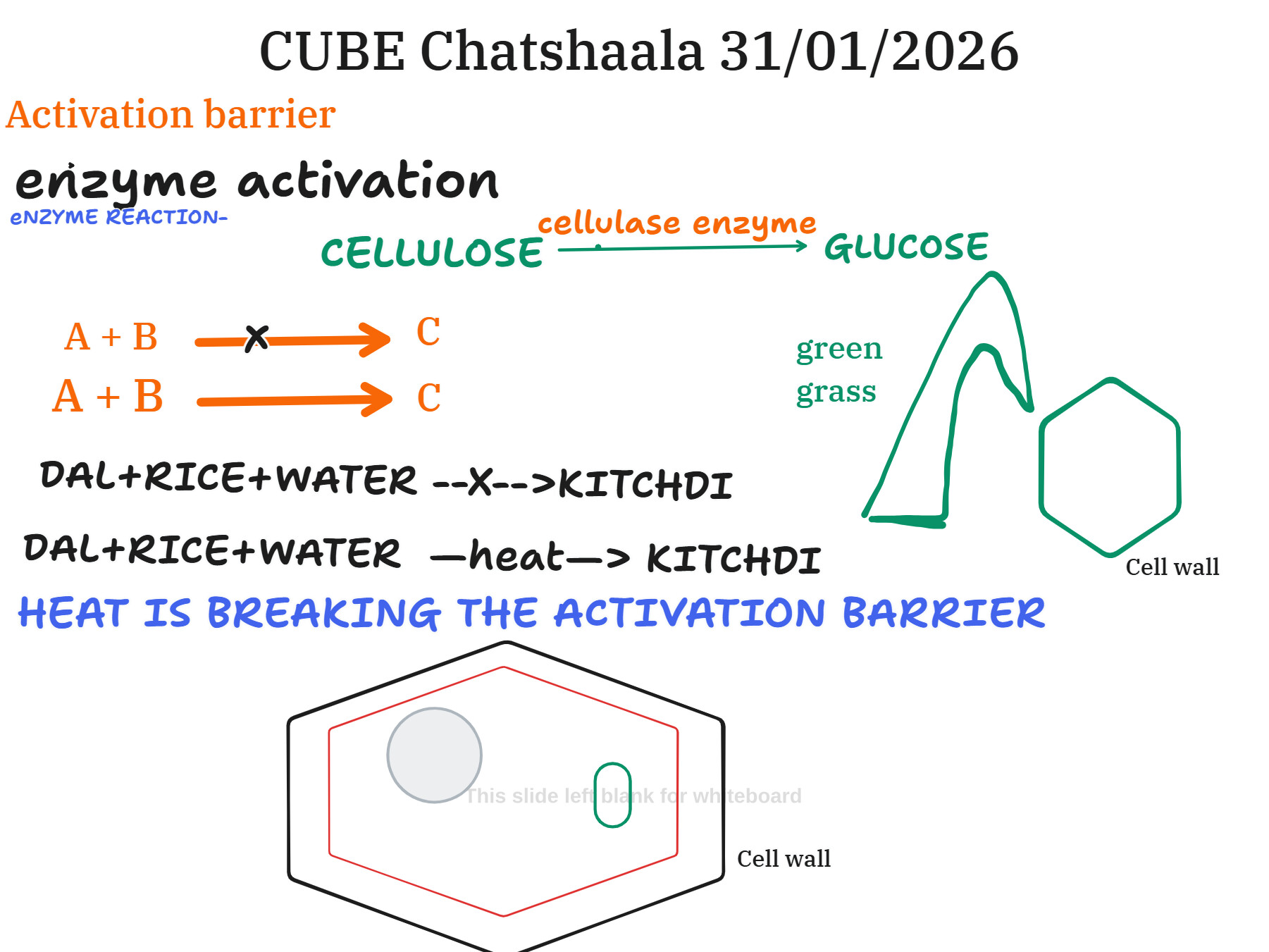
- A + B → C (reaction does not proceed without energy input)
- The same reaction proceeding once the barrier is removed.
The everyday analogy of dal + rice + water failing to become kichdi without heat made the concept intuitive. Heat was identified not as a reactant but as the energy input required to overcome the activation barrier.
b) Enzyme Action as an Alternative to Heat
The discussion moved from heat-driven reactions to enzyme-catalyzed reactions, highlighting that:
- Enzymes do not supply energy.
- They lower the activation energy by altering the reaction pathway.
This principle was explained using cellulase, an enzyme capable of breaking down cellulose into glucose, a reaction that does not occur spontaneously in most organisms.
c) Cellulose, Cell Wall, and Structural Resistance
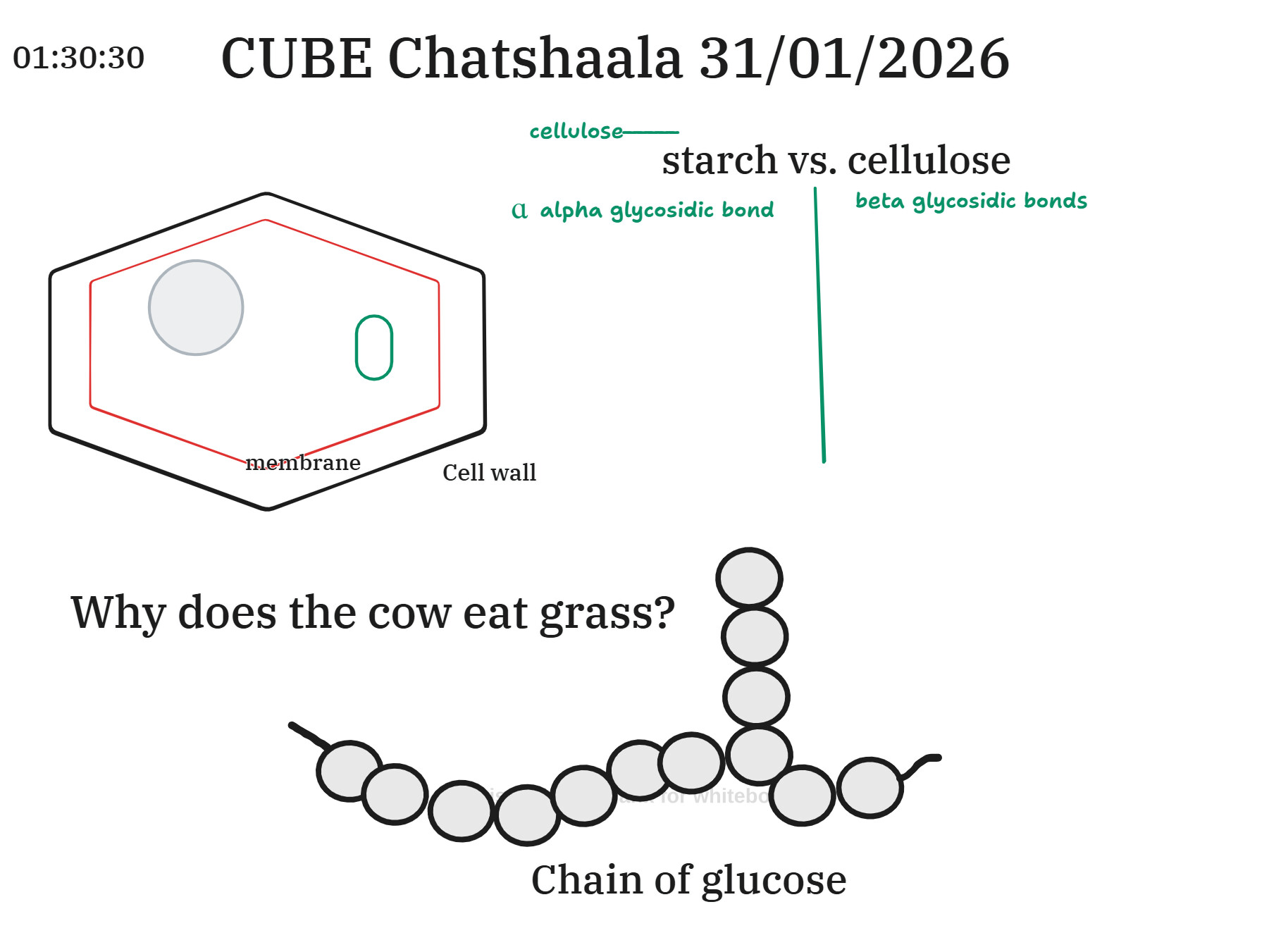
The whiteboard illustrations clarified that:
- Cellulose is a structural polysaccharide forming the plant cell wall.
- Its rigidity arises from β-glycosidic bonds, which resist digestion.
The presence of glucose units alone is insufficient; bond orientation and packing determine accessibility.
d) Starch vs. Cellulose—Same Units, Different Fate
A critical comparison was drawn:
- Starch: α-glycosidic bonds → digestible by humans.
- Cellulose: β-glycosidic bonds → indigestible without specialized enzymes.
This structural distinction answered the question posed on the board:
“Why does the cow eat grass?”
The answer lay not in the cow itself, but in its symbiotic microorganisms, which produce cellulase.
3. Key Integrative Insight
Biology is not governed by *what is present but by what is accessible.
Structure controls function. Energy controls possibility. Enzymes control feasibility.
 Whiteboard-Inspired Public Questions
-
If all required ingredients are present, what underlying energetic constraint prevents the reaction from occurring on its own?
-
Why does the human digestive system efficiently metabolize starch but fail to utilize cellulose, despite both being composed of glucose units?
-
Is grass intrinsically a nutrient source for cows, or does its digestion depend primarily on microbial assistance?
-
Why do living systems rely on enzymatic catalysis rather than high temperatures to drive biochemical reactions?
-
In food, is nutritional value determined primarily by energy content, or by molecular structure and biochemical accessibility
 What I Learned
-
Activation energy is not an abstract graph concept; it governs everyday processes.
-
Enzymes are precision tools, not energy suppliers.
-
Chemical similarity does not imply biological equivalence.
-
Digestion depends more on bond orientation than molecular composition.
-
Symbiosis is a biochemical strategy, not just an ecological one.
 TINKE Moments (This I Never Knew Earlier)
- Energy availability alone does not ensure a reaction; the direction and pathway of energy transfer are equally critical.
*Biological systems prioritize efficiency and specificity over brute force methods such as excessive heat.
*Molecular structure, often unnoticed, plays a decisive role in determining biological function and survival.
*The presence of glucose units does not inherently confer nutritional value; biochemical accessibility is essential.
*Digestion is not an isolated physiological process but a collaborative interaction involving symbiotic organisms.
Gaps and Misconceptions Identified
-
Misconception: Heat is part of the reaction.
Correction: Heat only helps cross the activation barrier. -
Misconception: All glucose polymers are nutritionally equal.
Correction: Bond type determines digestibility. -
Misconception: Humans cannot digest cellulose because it is “complex.”
Correction: The issue is enzymatic absence, not complexity. -
Gap: Limited awareness of microbial symbiosis in digestion.
Action Needed: Integrate microbiome concepts earlier in biology education.
 Photographs during Chatshaala