 CUBE Chatshaala - Discussion Summary
Today’s session of CUBE ChatShaala, held on 17th August 2026, brought together a familiar circle of participants Aarya Takke, Manali Bhujade, Kiran, Niharika Baghari, M S Sailekshmi, Arunan MC B Desai, and Susanta Tanti for a discussion that moved through two connected biological threads: migraine and hormonal influence, with nail growth flagged as a related area of interest for the group to explore further.
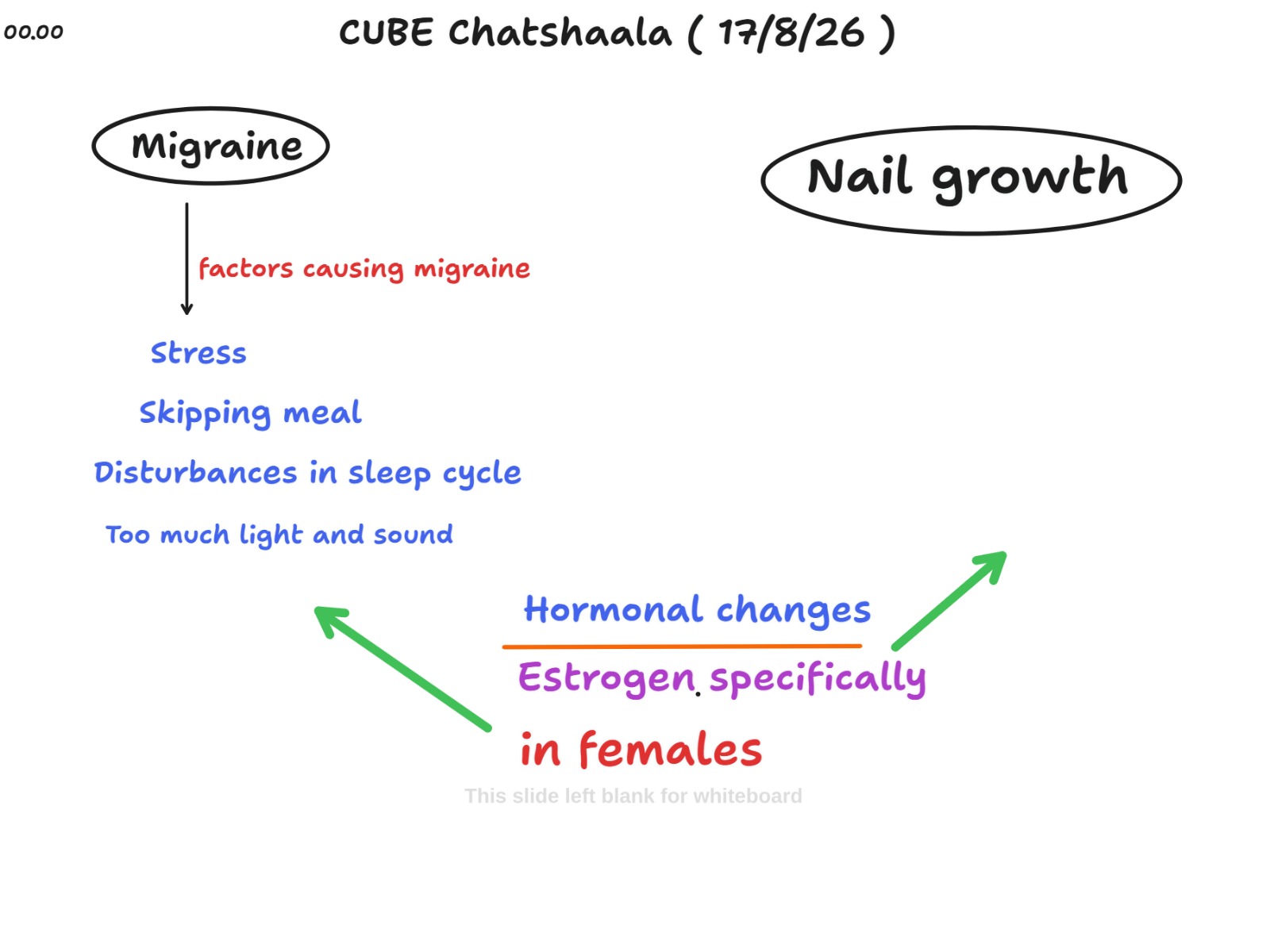

The conversation opened with migraine as the anchor topic. The participants mapped out the everyday triggers that most people already recognise intuitively but rarely examine closely: stress, skipping meals, disruptions to the sleep cycle, and overexposure to light and sound. What gave the discussion its depth, though, was the turn toward hormonal changes, and specifically the role of estrogen in women.
Aarya raised a set of pointed questions that shaped the rest of the session: whether migraine is hereditary, whether it affects men and women differently, and whether hormonal shifts tied to age or the menstrual cycle might also influence nail growth. Sailekshmi responded with a detailed explanation grounded in published research that women between the ages of 18 and 44 face a migraine risk two to three times higher than their male counterparts, and that this heightened risk stems not from elevated estrogen itself, but from estrogen fluctuation. She explained the concept of “menstrual migraines,” which tend to occur just before a period begins, when estrogen levels drop sharply. This tracks closely with the estrogen “withdrawal” theory long established in migraine research: a fall in estrogen appears to trigger migraine without aura, while sustained high estrogen states are more closely linked to migraine with aura.
Building on this, Sailekshmi noted that migraine risk tends to be lower during three specific life stages: before puberty, during pregnancy, and after menopause, precisely the periods when hormone levels are comparatively stable rather than fluctuating. Aarya connected the dots aloud, confirming that migraine risk should therefore decrease after menopause, a point Kiran affirmed.
To ground the discussion in credible literature, the participants referenced MacGregor’s 2004 paper in Lancet Neurology, “Oestrogen and attacks of migraine with and without aura,” alongside a resource from the Omega Hospitals blog on migraine causes and symptoms. Aarya and Sailekshmi also took a moment to walk the group through the nature of the sources being cited, introducing The Lancet as an independent, international medical journal founded in 1823, its specialised offshoot The Lancet Neurology as an authoritative forum in clinical neurology, and ScienceDirect as Elsevier’s digital repository housing millions of peer-reviewed publications. This part of the session served as a useful reminder that evaluating where information comes from is as important as the information itself.
The nail growth topic was introduced but not yet developed in depth during this session, positioning it as a natural continuation point for a future ChatShaala meeting.
 Provocative Questions
-
If estrogen withdrawal, not elevated estrogen, is the real trigger for menstrual migraines, why do many people still assume “too much hormone” is the culprit? What does this reveal about how we intuitively think about hormonal health?
-
Migraine risk drops before puberty, during pregnancy, and after menopause, three very different physiological states united only by hormonal stability. What does this pattern suggest about the nervous system’s relationship to consistency versus fluctuation, beyond migraine alone?
-
If migraine with aura and migraine without aura respond to opposite ends of the estrogen spectrum, should they really be treated as the same disorder, or are we grouping together two biologically distinct conditions under one familiar name?
-
Given that migraine is nearly three times more common in women during their reproductive years, why has it historically been underdiagnosed in men? What does this gap tell us about how symptom reporting and diagnosis can be shaped by assumptions about who “typically” experiences a condition?
-
The group is now curious whether hormonal changes across the menstrual cycle or with age might also affect nail growth. What kind of study design would actually be needed to test this, and how would you rule out other confounding factors like diet or seasonal variation?
 What I Have Learned
This session was a good reminder that the body’s most familiar complaints often hide fairly precise biological mechanisms once you look closely. I had always thought of “hormonal migraines” as a somewhat vague catch-all phrase, but working through Sailekshmi’s explanation clarified that it is really about the direction of hormonal change, a drop in estrogen, not a rise that sets off the more common form of migraine. That distinction between migraine with aura and without aura, each tied to opposite ends of the estrogen curve, was new and genuinely useful framing.
I also appreciated the moment where the group paused to examine the credibility of the sources being used. It is easy to treat a research citation as simply “proof,” but taking the time to understand what The Lancet Neurology actually is, and why ScienceDirect functions as a trustworthy aggregator, adds a layer of scientific literacy that strengthens the whole discussion. It is a habit worth carrying into every future session.
 TINKE Moments (This I Never Knew Earlier)
The clearest TINKE moment came when the group moved from a general sense that “migraine is linked to hormones” to a specific, mechanistic understanding: that it is estrogen withdrawal, specifically the sharp drop before menstruation, that drives the more common form of migraine, while high estrogen states are associated with the aura variant. This is a subtle but important distinction that many people, even those who experience migraines regularly, may not have articulated so precisely before.
A second TINKE moment surfaced when Aarya independently worked out the logical extension of Sailekshmi’s explanation that if migraine risk tracks hormonal fluctuation rather than hormone level, then menopause, as a period of hormonal stabilisation, should correspond to lower migraine risk. Kiran’s confirmation turned this from a guess into a shared, explicit piece of group knowledge.
 Gaps and Misconceptions
The session surfaced a few open threads worth flagging for future discussion. The nail growth topic was introduced at the very start but was not connected back to the hormonal discussion by the end of the session, leaving Aarya’s original question about whether hormonal changes with age or the menstrual cycle affect nail growth unanswered. This remains a gap worth returning to, ideally with its own dedicated reference material rather than being folded into the migraine discussion after the fact.
There is also a common misconception worth naming explicitly, since the session implicitly corrected it: the assumption that migraines are caused by “too much” of a hormone. As the discussion clarified, it is the fluctuation and specifically the withdrawal of estrogen that matters most for the more prevalent form of migraine, not sustained high levels. Making this distinction explicit in the write-up should help prevent that misconception from persisting among readers encountering the topic for the first time.
Finally, while the group touched on genetic and sex-based differences in migraine prevalence, the question of heredity that Aarya raised at the outset was not fully addressed within the session and could form the basis of a focused follow-up discussion.
 Photographs during Chatshaala


 Referance