 CUBE ChatShaala - Discussion Summary
Date: 27 June 2026
Today’s CUBE ChatShaala session was structured around the theme of immunology, with a specific focus on what happens at the skin-pathogen interface when a mosquito bites. The discussion opened with a brief academic context: Sailekshmi, a 5th-semester zoology student, noted that their coursework this semester comprises six papers, including Developmental Biology, Animal Physiology, Microbiology and Immunology, Ecology and Disaster Management, Freshers’ Science-III, and Vermiculture and Vermicomposting. It was within the framework of the Microbiology and Immunology paper that today’s deeper conversation unfolded.
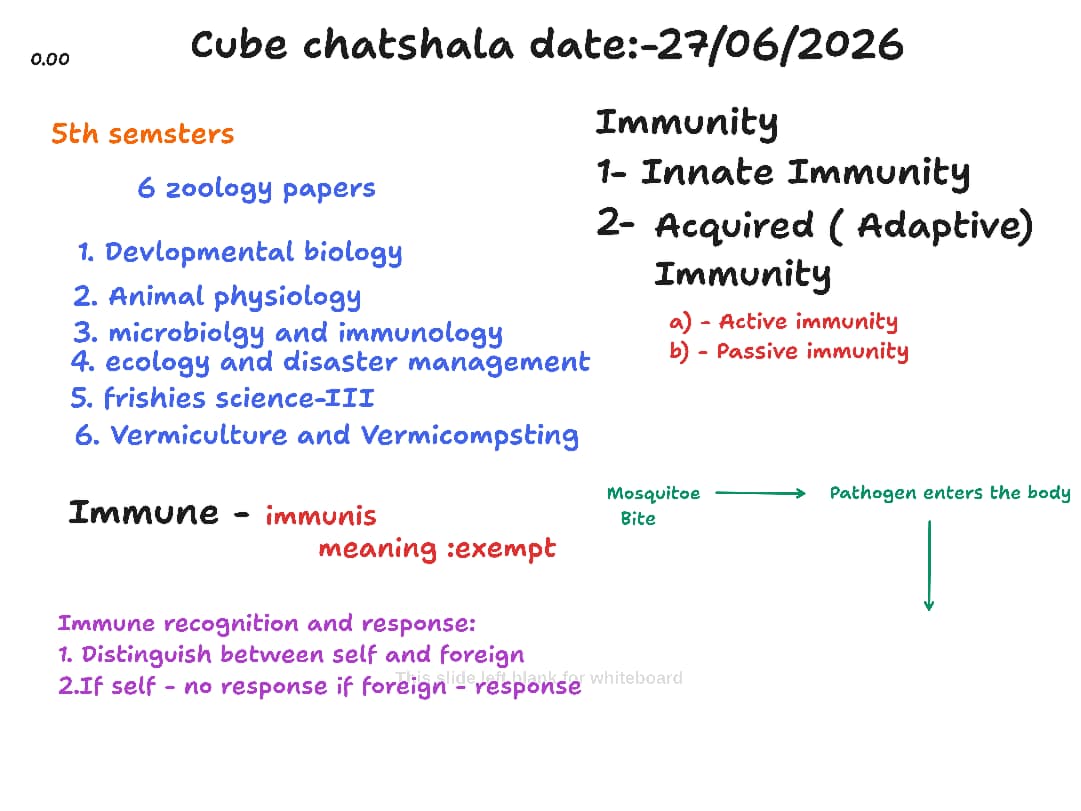
The facilitator anchored the session by the Latin root of the word “immune” — immunis — which means “exempt.” This etymological entry point was deliberate: it immediately invited participants to think about immunity not merely as a biological process, but as a conceptual stance. If “immune” means to be free from or exempt from something, then the question naturally follows — exempt from what, and how does the body achieve that exemption?
The group then mapped out the two major arms of immunity: innate immunity, which operates as the body’s first and non-specific line of defense, and acquired (or adaptive) immunity, which is further divided into active immunity (where the body generates its own immune response upon encountering an antigen) and passive immunity (where pre-formed antibodies are transferred, as in breastfeeding or serum therapy). This conceptual scaffolding was drawn clearly on the whiteboard and helped ground the subsequent exploration.
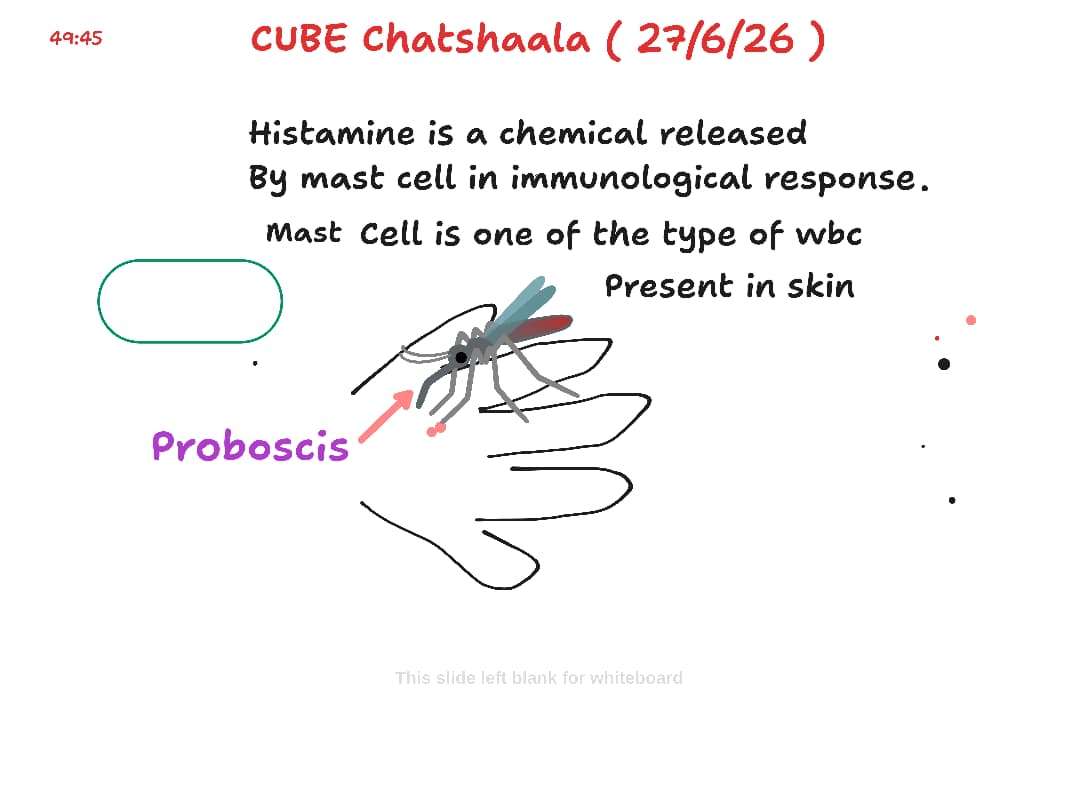
The discussion then pivoted to a concrete biological scenario: a mosquito bite. The group traced the sequence of events step by step. When a mosquito bites using its proboscis — a needle-like feeding structure — it injects saliva into the skin. Along with the saliva, pathogens, if the mosquito is a carrier, can enter the body. This is the beginning of an immune event.
Once the pathogen is inside, the immune system faces its first and most fundamental task: distinguishing self from non-self. If the entity is self, no response is mounted. If it is foreign, an immune response is triggered. This principle of immune recognition was identified by participants as the cornerstone of how the immune system functions.
The conversation deepened considerably when it moved to mast cells. Mast cells, it was clarified, are a type of white blood cell (WBC) found predominantly in the skin and connective tissue. When a mosquito bite introduces a foreign agent or antigen, mast cells respond by releasing histamine — a chemical mediator stored in their granules. Histamine release is responsible for the classic symptoms of a mosquito bite: the redness, the swelling, and most notably, the itch. This led to the second reference shared during the session: a review paper by Mack and Kim (Trends in Immunology, 2018) titled “The Itch-Scratch Cycle: A Neuroimmune Perspective,” published on PubMed Central (PMC8896504). Participants explored how the itch produced by histamine is not merely a nuisance but represents a complex neuroimmune interaction involving the peripheral nervous system, immune cells, and the skin epithelium. The paper highlights how itch sensation mediated through pruriceptors is deeply intertwined with the immune response, and how chronic itching can itself perpetuate a damaging cycle of skin barrier disruption and further inflammation.
The proboscis of the mosquito was specifically illustrated on the whiteboard as the entry point for pathogen transfer, and participants noted how the mechanics of the bite, the insertion of the proboscis through the dermis to locate a blood capillary, directly brings salivary antigens and pathogens into contact with the immune sentinels in the skin.
An important nuance raised during the session was around antihistamines. While histamine is the classical mediator of the itch response, it was noted, drawing from the Mack and Kim paper, that conventional antihistamines targeting the H1 receptor are often ineffective in chronic itch conditions like atopic dermatitis. Newer research suggests that histamine H4 receptor (H4R) antagonists may be more effective in certain contexts. This opened a small but significant window into how scientific understanding of even well-known immune mediators continues to evolve.
The session concluded with participants recognising that what begins as a simple mosquito bite is, at the cellular and molecular level, a remarkably orchestrated immune event involving pattern recognition, cell signalling, chemical mediator release, and a bidirectional dialogue between the nervous system and the immune system.
 Provocative Questions
-
The word “immune” comes from the Latin immunis, meaning exempt. But is complete exemption from foreign agents ever truly achievable, or does the body merely manage a constant negotiation with the non-self? What are the implications of this distinction for how we think about disease?
-
Mast cells release histamine when a mosquito bites, causing itching. But itching causes scratching, which damages the skin barrier — the very barrier that was meant to keep pathogens out. Does the immune response to a mosquito bite inadvertently create new entry points for infection? Can a protective response also be self-defeating?
-
The immune system’s fundamental rule is: no response to self, full response to non-self. But what happens when the body misidentifies self-tissue as foreign — as in autoimmune disease? Does today’s discussion help us understand why that distinction, once lost, is so difficult to restore?
-
Histamine is released by mast cells in the skin in response to a mosquito bite. But the same compound, histamine, also plays roles in gastric acid secretion and brain neurotransmission. How does one molecule serve such radically different functions in different tissues, and what does this tell us about biological context-dependence?
-
We discussed innate and adaptive immunity as two arms of the same system. But the mosquito’s saliva itself is known to modulate immune responses in ways that can suppress or delay an adaptive response. What does this suggest about the evolutionary arms race between host immunity and vector biology?
-
The Mack and Kim paper describes an itch-scratch cycle where itch leads to scratching, scratching damages the skin, and skin damage produces more itch-inducing signals. Is the mosquito-bite itch we experience after a bite the beginning of this cycle? Under what conditions might a simple mosquito bite escalate into a chronic itch disorder?
-
Mast cells are described as a type of white blood cell found in the skin. Given that the skin is our first line of defense against the external world, why would the body station immune cells there rather than deploying them only after a breach has occurred? What does this tell us about how the body anticipates threats?
 What I Have Learned
Attending today’s session was genuinely illuminating, particularly because it grounded abstract immunological concepts in a scenario almost everyone has lived through- being bitten by a mosquito.
The most important thing I took away from this discussion is the logic of immune recognition. The immune system does not simply attack everything that enters the body; it asks a more sophisticated question first: Does this belong here? If yes, silence. If not, respond. This two-step framework recognition before reaction is elegantly economical, and understanding it fundamentally changes how one thinks about both immunity and immune failure.
I also came to appreciate mast cells in a new way. I had previously thought of them in a fairly narrow context as cells involved in allergies. But placing them in the skin, as resident immune sentinels waiting at the boundary between self and world, gives them a much more meaningful role. They are, in a sense, the body’s border guards, and histamine is their alarm signal.
The connection between the itch of a mosquito bite and the neuroimmune axis was genuinely new to me. The idea that itch is not merely a skin-level event but involves a complex circuit between peripheral sensory neurons, immune cells, and the spinal cord expanded my sense of how integrated our biological systems really are. A mosquito bite, it turns out, is not just a dermatological event; it is a whole-body immunological and neurological event.
Finally, I learned something about the limits of our pharmacological tools. The fact that standard antihistamines targeting H1 receptors often fail in chronic itch conditions suggests that histamine’s role in persistent itch is more nuanced than the acute scenario. This is a reminder that understanding a phenomenon in its acute form does not automatically equip us to manage its chronic version.
 TINKE Moments (This I Never Knew Earlier)
-
The word “immune” means exempt. I had used the word “immune” countless times without consciously knowing its Latin root, immunis. Today I now know explicitly that immunity, at its etymological core, is about exemption — being free from obligation or burden. Applying this meaning to biology gives the concept new clarity: the immune system protects the body from the burden of foreign invasion, at least when it functions well.
-
Mast cells are a type of white blood cell specifically located in the skin. I had a vague sense that mast cells were immune cells associated with allergic reactions. What I now know explicitly is that they are classified as a type of WBC, that they reside specifically in connective tissue and skin, and that their skin location is not incidental — it is precisely because the skin is the body’s primary interface with the external environment.
-
Histamine is a chemical released by mast cells, not by any immune cell in general. Before today’s session, I would have loosely associated histamine with “the immune system.” I now know explicitly that histamine is produced and released specifically by mast cells (and basophils) in response to an immunological trigger, and that this release is what produces the characteristic redness, swelling, and itch of a mosquito bite or an allergic reaction.
-
The proboscis is the functional feeding structure of the mosquito. The whiteboard illustration made clear that the proboscis is not simply the mosquito’s “mouth” but a sophisticated needle-like structure that punctures the skin, navigates to a capillary, and delivers saliva — along with any pathogens the mosquito may be carrying — directly into the host’s tissue.
-
Scratching relieves itch temporarily by activating pain-sensory fibers that inhibit itch signals at the spinal cord. This was a striking detail from the reference paper. I had known that scratching “helps” an itch in some intuitive sense, but I now know explicitly that this relief has a neurophysiological mechanism — pain fibers, when activated, can suppress itch transmission at the level of the spinal cord. This also explains why the relief is only temporary.
 Gaps and Misconceptions
-
Gap: The precise cascade from mosquito saliva to immune activation remains underexplored in our discussion. We established that mosquito saliva triggers an immune response, but we did not trace in detail which specific components of mosquito saliva act as antigens, which pattern recognition receptors on mast cells or other innate immune cells detect them, and what downstream signalling pathways are activated. Filling this gap would require participants to look at the molecular immunology of vector saliva — an area rich with research potential.
-
Gap: The distinction between innate and adaptive immunity in the context of a mosquito bite was introduced but not fully elaborated. For instance, we did not discuss what happens in subsequent mosquito bites — how the adaptive immune system, having “remembered” the saliva antigens from prior exposure, mounts a faster and stronger response. This is why individuals who are bitten for the first time (such as infants) often show less of a wheal-and-flare response, while habitual exposure leads to stronger reactions. This temporal dimension of immune memory in the mosquito-bite context deserved more exploration.
-
Misconception (addressed): A common assumption that may have been held implicitly is that all itching from mosquito bites is directly caused by pathogens. In fact, the itch response is primarily triggered by the mosquito’s saliva itself — specifically by immune recognition of salivary proteins — rather than by any pathogen that may or may not be present. The itching occurs regardless of whether the mosquito was carrying a disease agent; it is the saliva, not the pathogen, that drives the immediate immunological reaction.
-
Misconception (addressed): Another implicit assumption worth correcting is the idea that antihistamines are the definitive solution to histamine-driven itch. As the reference paper clarified, conventional antihistamines targeting H1 receptors are often inadequate for chronic itch conditions. The histamine story is more complex than the textbook account suggests, involving at least four receptor subtypes (H1–H4) with different distributions and functions. This nuance is frequently missed in introductory treatments of immunology.
-
Gap: The role of the nervous system in the immune response to a mosquito bite was introduced through the Mack and Kim paper,r but not thoroughly discussed in the session itself. The concept of the neuroimmune axis — where neurons and immune cells communicate bidirectionally, and where neurotransmitters and cytokines both participate in mediating itch — is a relatively recent frontier in immunology. Future sessions could benefit from exploring how this applies not just to chronic disease states like atopic dermatitis, but to the acute scenario of a mosquito bite that participants encounter in everyday life.
-
Gap: The question of why only female mosquitoes bite, and how the biological imperative behind the blood meal (egg production) connects to the immune provocation of the host, was not raised during today’s session. This is an interesting intersection of entomology and immunology that CUBE participants, given their grounding in field naturalism and observational biology, are well-positioned to explore.
 Photographs during Chatshaala
 Referance
References shared during the session:
-
Mayo Clinic - Mosquito Bites: Symptoms and Causes. https://www.mayoclinic.org/diseases-conditions/mosquito-bites/symptoms-causes/syc-20375310
-
Mack MR and Kim BS (2018). The Itch-Scratch Cycle: A Neuroimmune Perspective. Trends in Immunology. PMC: The Itch–Scratch Cycle: A Neuroimmune Perspective - PMC