 CUBE ChatShaala Summary
Session Date: 02/12/2025
Theme: Model Organisms and Foundational Laboratory Techniques
(Inspired by the quote: “Sophistication is in the mind, not in the Lab.” - Obaid Siddiqi)
The CUBE ChatShaala convened on December 2, 2025, for a highly engaging session focusing on the practical and conceptual pillars of biological inquiry, specifically through the lens of model organisms and basic molecular biology protocols. The overarching message, championed by the renowned Indian researcher, Obaid Siddiqi who worked on Drosophila at TIFR (Tata Institute of Fundamental Research), Mumbai, Maharashtra , emphasized that intellectual clarity and rigorous experimental design are paramount, often surpassing the need for expensive or complex laboratory equipment.
I. Model Organisms and Biodiversity Exploration
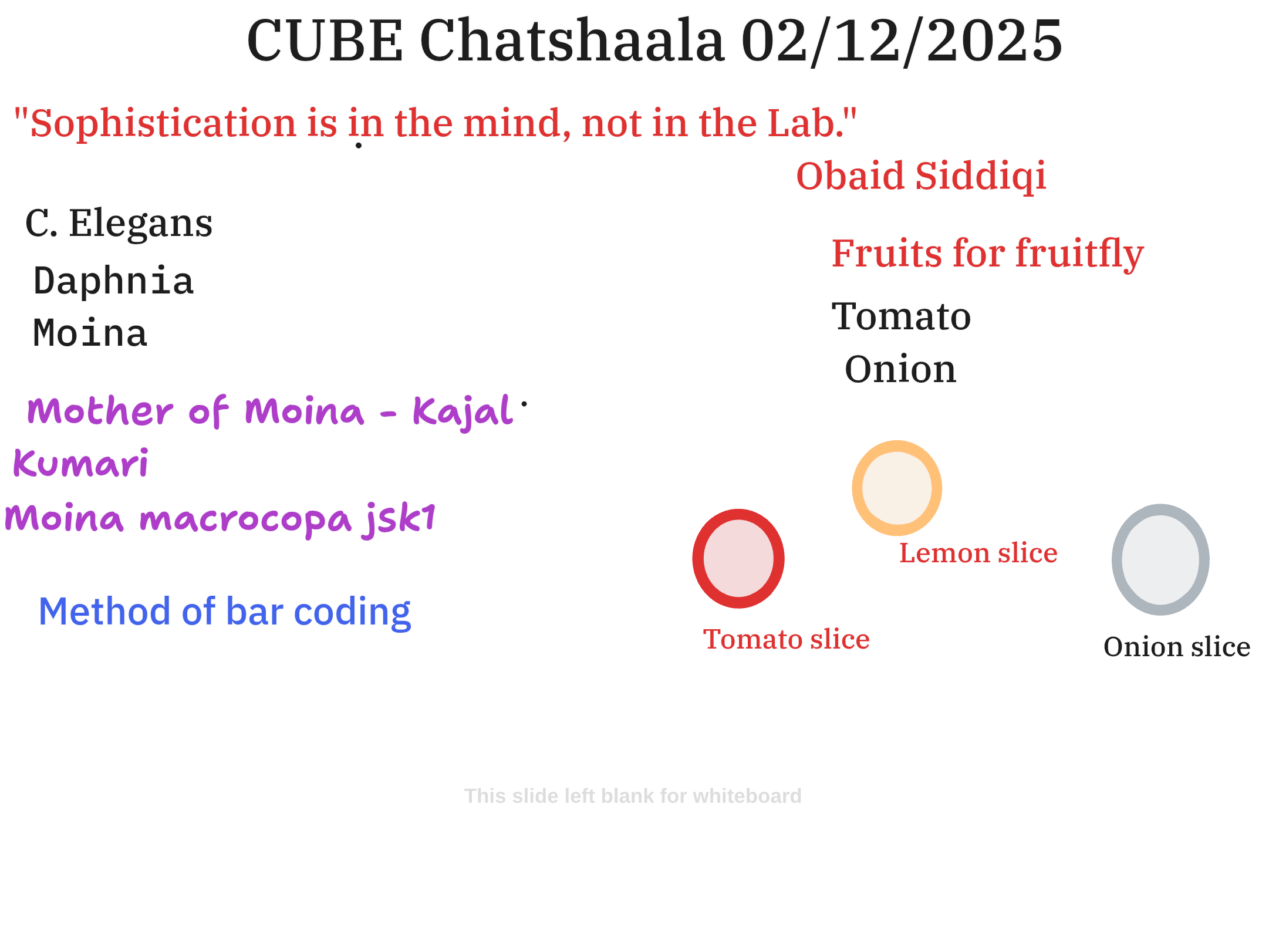
The initial segment cataloged several key model organisms currently under study within the CUBE community, highlighting the importance of locally sourced and maintained cultures:
- C. Elegans (Nematode)
- Daphnia (Water flea)
- Moina (Water flea)
Both Moina and Daphnia are freshwater.
A significant discussion point was the hands-on involvement of community members, exemplified by the mention of Kajal Kumari as the “Mother of Moina,” and the specific identification of one culture as Moina macrocopa jsk1. This underscores the grassroots effort in maintaining genetic stocks and promoting species identification skills.
The session also briefly touched upon the preparation of media and cultures for the fruit fly, listing Tomato and Onion as examples of potential food sources, alongside a Lemon slice component, which may imply an exploration into substrate preference.
II. Introduction to Molecular Barcoding and DNA Extraction
The technical segment transitioned into two critical areas:
-
Method of Bar Coding: The inclusion of this topic suggests an ongoing effort to genetically characterize the diverse organisms being studied, linking morphological identification with molecular classification.
-
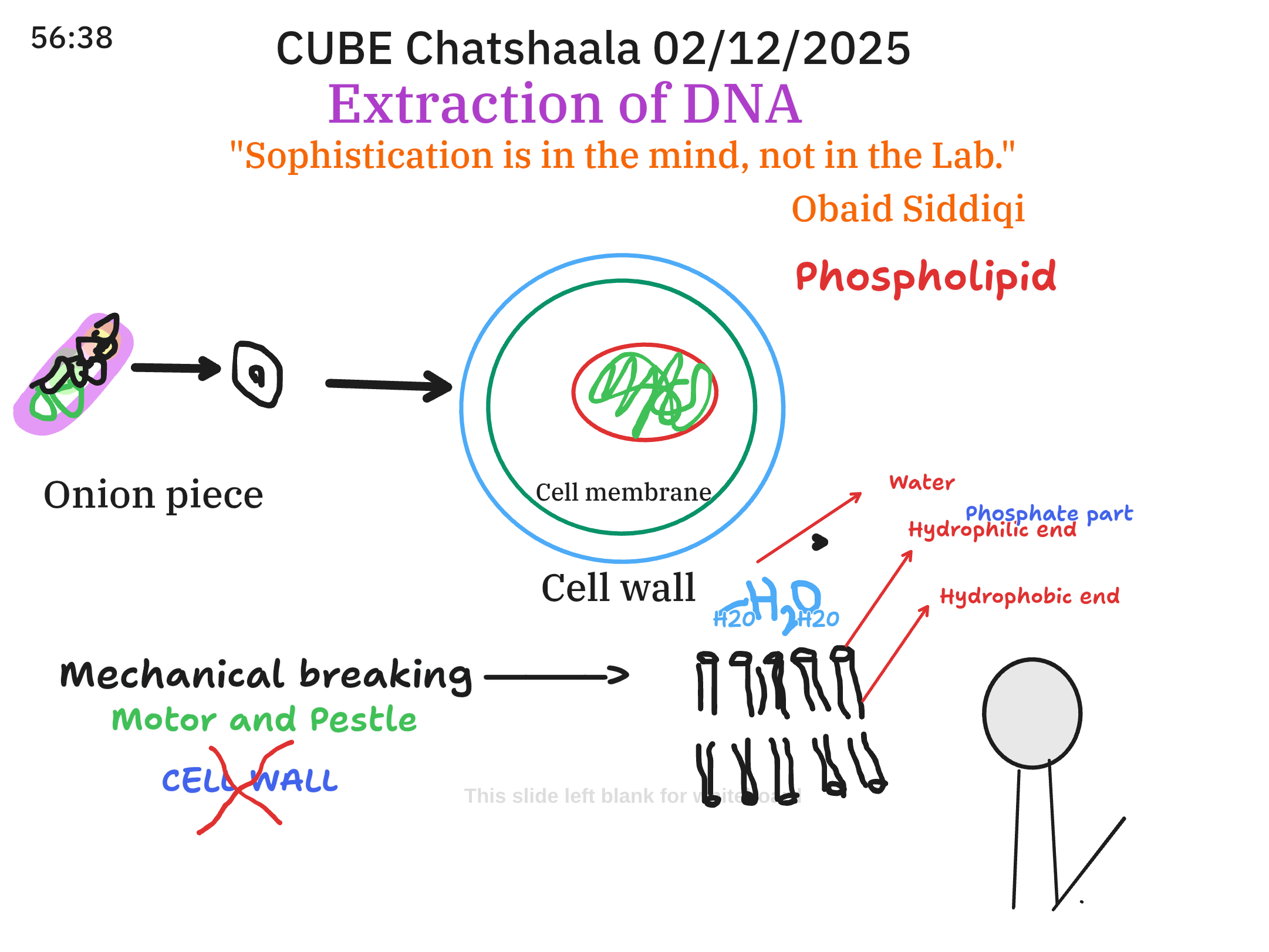
Extraction of DNA (Focus on Onion): This was the core practical demonstration. The steps involved in liberating genetic material were illustrated:
-
Starting Material: An Onion piece.
-
Cellular Disruption: Mechanical breaking using a Motor and Pestle was identified as the initial, low-cost method to physically rupture the Cell wall (which was explicitly shown being broken), releasing the cell contents.
-
Membrane Lysis and Chemistry: The subsequent diagram detailed the Cell membrane, composed of a Phospholipid bilayer. This section effectively illustrated the hydrophilic end (Phosphate part, interacting with Water) and the hydrophobic end, laying the conceptual groundwork for the detergent-based lysis step (though the detergent itself was not explicitly named in the image). The presence of H2O molecules interacting with the heads was highlighted.
-
 Provocative Queries for the General Audience
-
Obaid Siddiqi suggested that true sophistication resides in the mind, not the lab. How does choosing a simple organism like Moina or C. Elegans (which are easily maintained without high-end equipment) force a student to be more sophisticated in their experimental design and data interpretation than if they had access to a million-dollar genome sequencer?
-
If you can successfully isolate and observe DNA from a common onion in your kitchen, what are the fundamental limits of discovery that are truly imposed by lack of funding versus lack of imagination?
-
We discussed the method of barcoding. If we successfully barcode Moina macrocopa jsk1, what is the next non-traditional species in our local environment—perhaps a common weed or an urban insect—that absolutely needs to be barcoded by the CUBE community to contribute a new piece of data to the global genetic library?
-
The mechanical breaking of the Onion cell wall is the first critical step. What happens if this step is not thorough enough? Specifically, how would an incomplete rupture of the cell wall structurally prevent the rest of the DNA extraction protocol from succeeding, and how would this manifest in the final outcome?
 Personal Reflections: TINKE Moments, Gaps, and Misconceptions
 TINKE Moments (This I Never Knew Earlier)
| Moment | Description |
|---|---|
| Thinking | The quote by Obaid Siddiqi reframed my perspective: the essence of science is a good question, not a big budget. |
| Knowledge-ing | The clear diagrammatic breakdown of the Phospholipid bilayer was excellent. It provided instant clarity on why detergents are necessary: they disrupt the hydrophobic interactions of the membrane’s tail-to-tail structure, allowing the cell contents to spill out. |
| Experimenting | The realization that simple kitchen tools (Motor and Pestle) are the high-tech equipment for the mechanical stage of DNA extraction is inspiring. It validates the potential for true low-cost, high-impact science. |
 Gaps and Misconceptions
| Category | Observation |
|---|---|
| Gaps in Protocol | The step after mechanical breaking—the use of a lysis buffer (containing detergent/salt)—was conceptualized (by showing the phospholipid chemistry) but not explicitly named or detailed. A gap remains in the exact kitchen-equivalent reagents used for the lysis buffer. |
| Misconceptions | A potential misconception that may arise is confusing the Cell Wall and the Cell Membrane. The visual distinction was clear, showing the wall being broken and the membrane being lysed, but an audience member might think they are addressed by the same chemical/mechanical step. |
| Conceptual Gaps | The session established the need for barcoding but didn’t detail how the extracted DNA (the product of the Onion experiment) relates to the short, specific DNA fragment needed for barcoding (the concept of PCR amplification). This link is crucial for understanding the whole process. |
 Reference