 CUBE ChatShaala Summary – 01 December 2025
Theme: HOME LAB REVOLUTION—"Sophistication should be in the mind, not in the lab.”
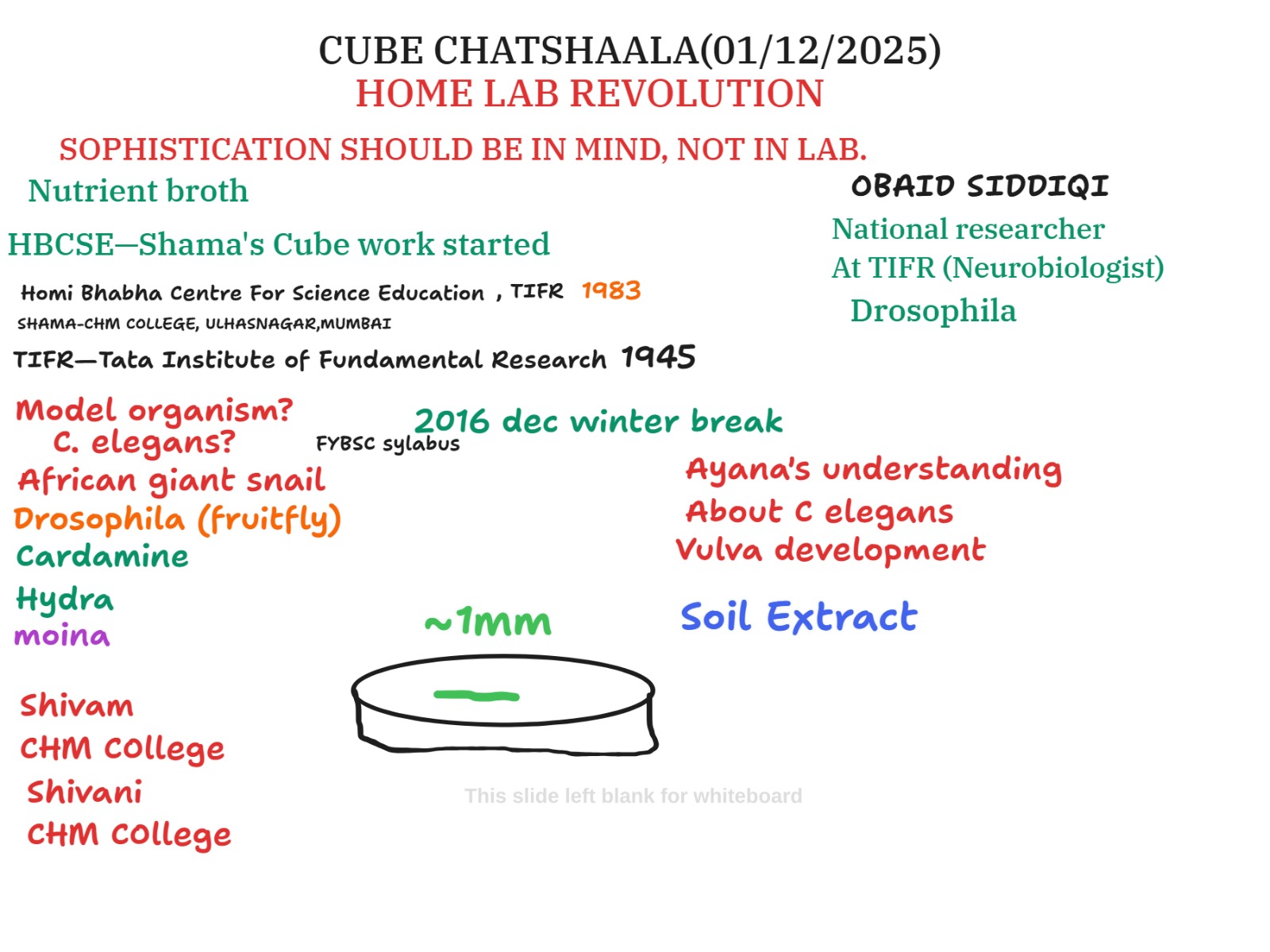
Today’s ChatShaala centered on the philosophy and practice of building scientific understanding using simple, home-based model systems. The discussion revolved around the origins of the Home Lab movement within CUBE, inspired by pioneering work at HBCSE–TIFR and the scientific legacy of Obaid Siddiqi, whose research in neurobiology and Drosophila genetics continues to influence CUBE’s culture of curiosity-driven science.
1. Revisiting the Roots of Home Labs
Participants traced the timeline from early efforts at HBCSE, including Shama’s foundational CUBE work, to the later emphasis at TIFR on using simple organisms to ask deep biological questions. The idea that “inexpensive science can still raise sophisticated questions” was reaffirmed.
The group reflected on Shama’s foundational work at HBCSE and how the 2016 winter break experiment series—including attempts to culture C. elegans using household materials—helped democratize research across colleges such as CHM College, Ulhasnagar.
2. Model Organisms Explored
The whiteboard discussion highlighted the diversity of model systems feasible within a home laboratory:
- Caenorhabditis elegans (Nematoda)
- African giant snail
- Drosophila melanogaster
- Cardamine
- Hydra
- Moina (water flea)
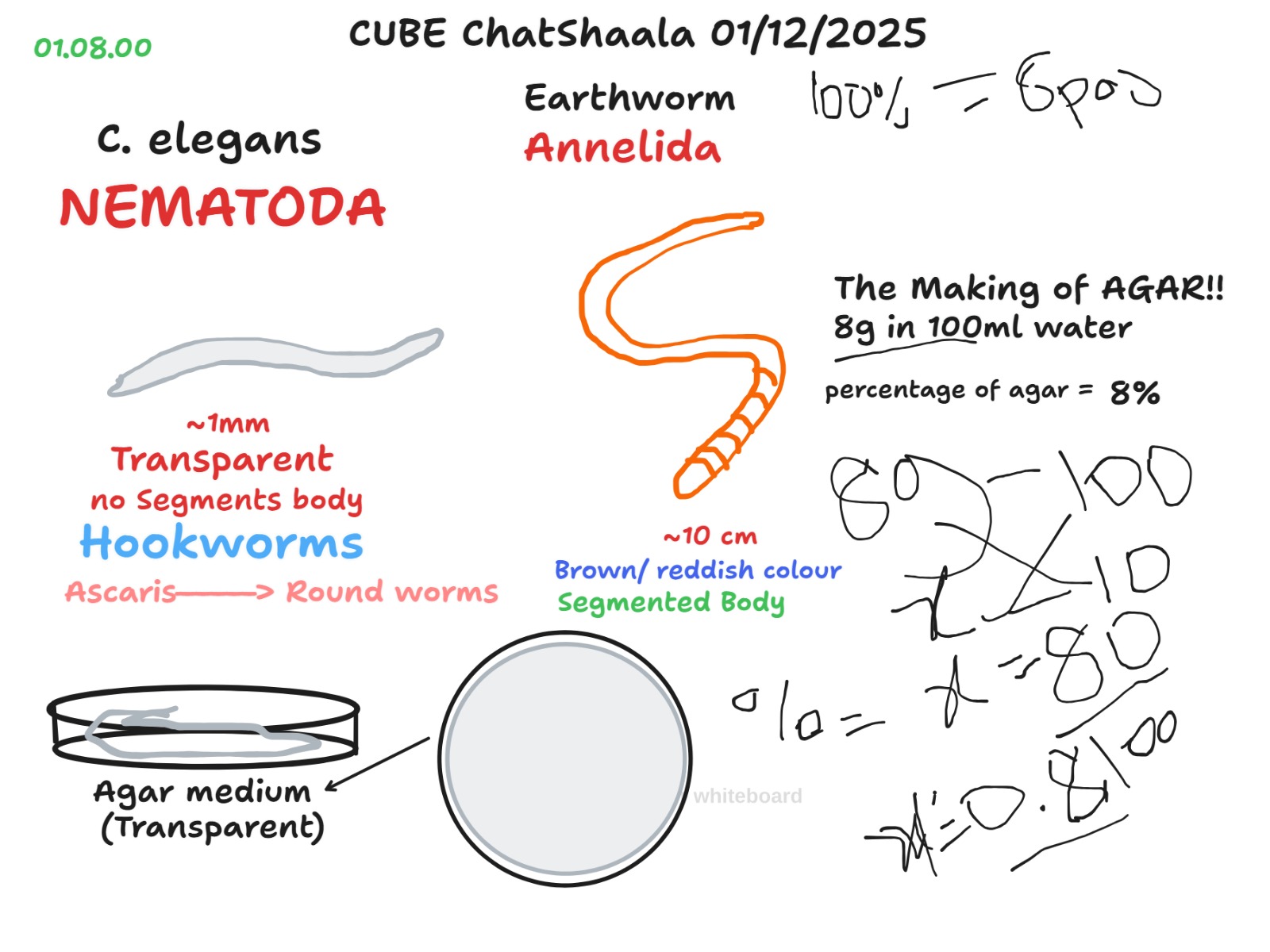
- Earthworms (Annelida)
The session compared nematodes and annelids, using sketches and morphological cues.
C. elegans (~1 mm) was identified by its transparent, non-segmented body, in contrast to earthworms (~10 cm), which are reddish-brown with clearly segmented bodies.
3. Practical Methods Refined
Participants revisited fundamental techniques, including:
- Preparation of basic agar medium (8 g agar in 100 mL water → 8% agar)
- Understanding the role of soil extract as a nutrient source
- Using nutrient broth substitutes available at home
- Simple observation strategies for transparent organisms using backlighting
The use of hand-drawn plates and dishes on the whiteboard highlighted ways of visualizing experimental setups without lab infrastructure.
4. Conceptual Understanding
A significant part of the session was devoted to revisiting Ayana’s earlier work on vulva development in C. elegans, demonstrating how students with basic tools can still contribute to conceptual understanding of developmental biology.
 Questions to Inspire the Community
-
What prevents us from asking big biological questions even when working in the most modest home-lab settings?
-
If nematodes like C. elegans exist in Indian soils, what does that mean for decentralized biological research?
-
How far can we push the idea of using household objects as scientific equipment?
-
When learners culture Drosophila, Hydra, snails, or nematodes at home, how does it reshape the meaning of ‘doing science’?
 What I Learned Today
-
Simple organisms can answer surprisingly complex developmental and evolutionary questions.
-
The contrast between nematodes and annelids provides a clear gateway into discussions about segmentation, transparency, body plans, and phylogeny.
-
Home-lab science relies more on thoughtful observation and experimental design than on expensive equipment.
-
Historical perspectives—from Obaid Siddiqi to early CUBE initiatives—show how scientific culture can empower students to take ownership of research.
-
Soil extraction remains one of the most accessible yet powerful entry points into model-organism discovery.
 TINKE Moments (Things I Never Knew Earlier)
- Transparent organisms like C. elegans can be cultured on simple agar plates without specialized labs.
- Soil itself is a rich reservoir of nematodes—even commonly overlooked ones.
- Vulva development in C. elegans is an elegant system that students can explore with very limited resources.
- The agar percentage formula (8 g in 100 mL → 8%) became intuitively clear during the discussion through simple whiteboard math.
 Gaps & Misconceptions Identified
1. Confusion Between Nematodes and Annelids
Some participants initially assumed earthworms and C. elegans share similar body structures.
Correction: Annelids are segmented; nematodes are not.
2. Misunderstanding Agar Concentration
Several participants needed clarity on how to convert grams per 100 mL into a percentage.
This was resolved through step-by-step calculations.
3. Assumption That “Sophisticated Science Requires Sophisticated Labs”
The discussion emphasized that creativity, not infrastructure, drives inquiry.
The whiteboard examples showed how soil extract and simple broth preparations can substitute for costly media.
4. “C. elegans is Rare in India” Misconception
The linked discussion from metastudio.org shows that students have successfully isolated nematodes from many Indian soils.
The challenge is not scarcity but correct identification.
 Reference