 CUBE ChatShaala – Discussion Summary
The session held on 12th July 2026 centred on two parallel lines of citizen science inquiry: snail feeding preferences and snail growth measurement. Both investigations reflect CUBE ChatShaala’s recurring emphasis on simple, replicable observations that can still yield scientifically meaningful insight.
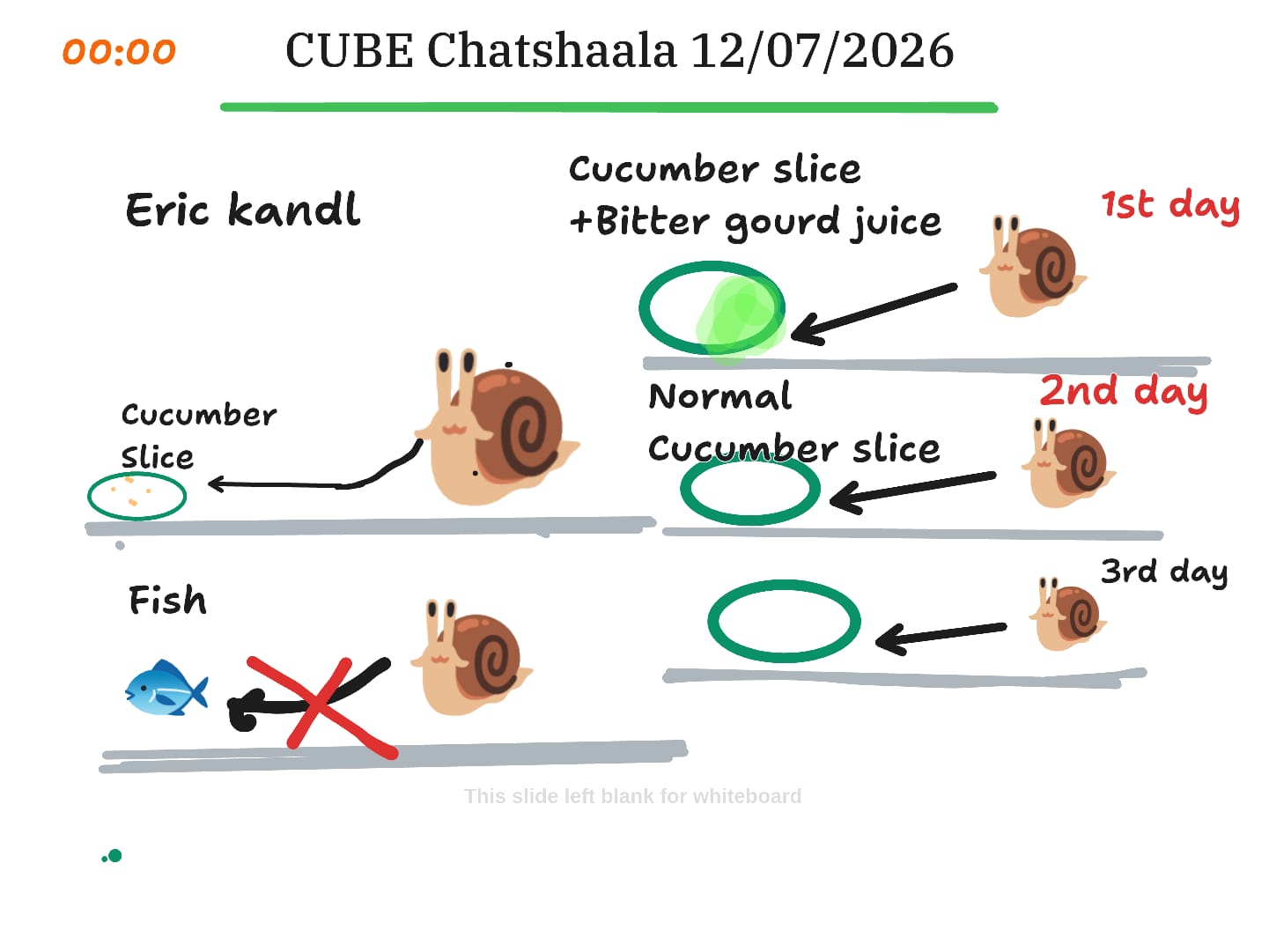
The first set of observations, presented under the heading “Eric Kandl,” examined how snails respond to different food sources over three days. On the first day, a snail was offered a combination of a cucumber slice and bitter gourd juice. The whiteboard notes indicate that by the second day, the offering had shifted to a normal cucumber slice, and by the third day, an empty circle was drawn, suggesting either complete consumption or the absence of remaining food. This progression appears to have been used to track feeding rate and preference across the three days.
A parallel branch of the same diagram shows a snail being offered a plain cucumber slice, with an arrow indicating movement toward the food, suggesting active feeding behaviour. In contrast, when fish was offered as a food source, the whiteboard shows a clear rejection, marked with a red cross. This observation is significant because it suggests that snails in this study did not treat fish as a viable or attractive food item, reinforcing what is generally understood about gastropods being primarily herbivorous or detritivorous rather than carnivorous under normal conditions.
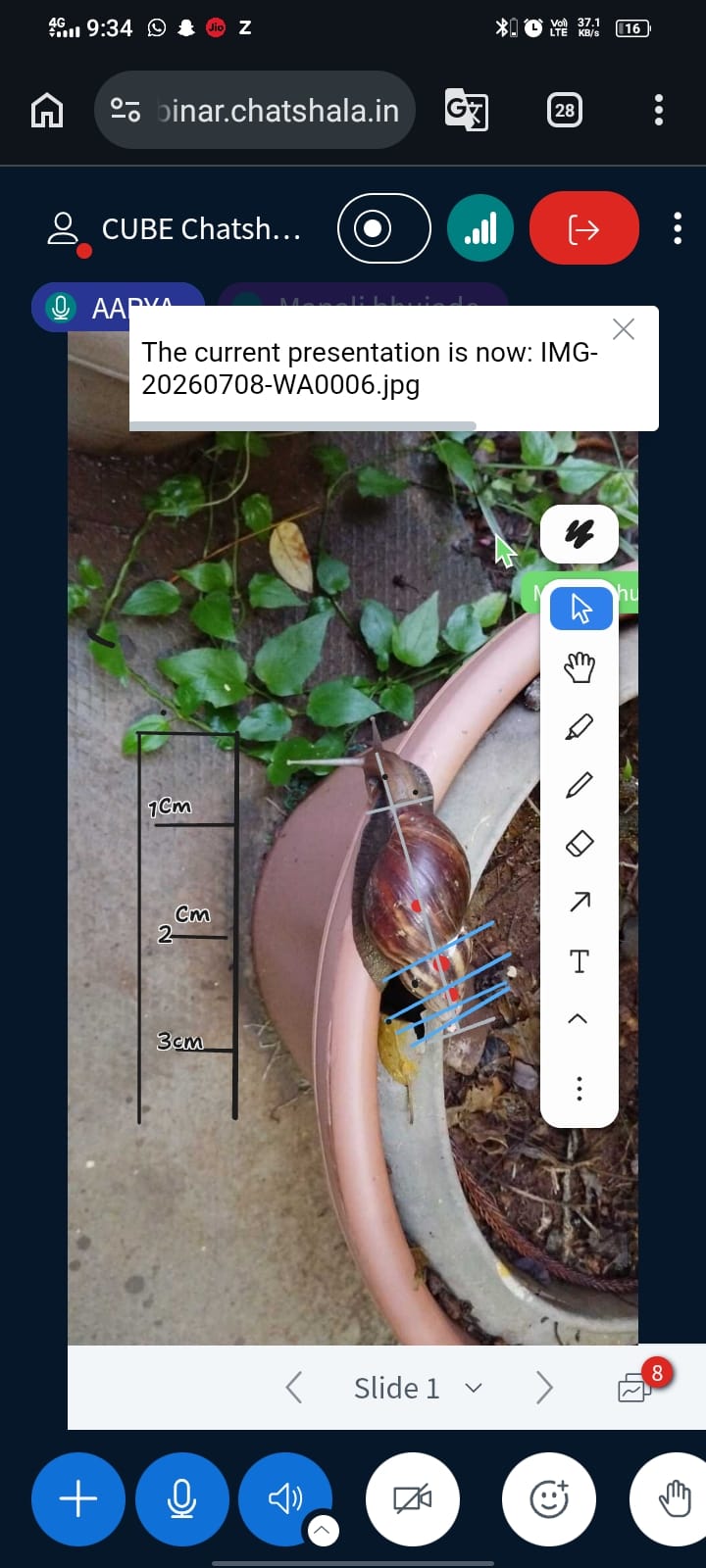
The second component of the session, visible in the accompanying screenshot from the ChatShaala platform, documents a snail growth measurement exercise. A simple centimetre scale (marked at 1 cm, 2 cm, and 3 cm intervals) was drawn alongside a live snail photographed in its natural outdoor setting, climbing along the rim of a pot. Blue and grey annotation lines were used to mark specific points on the snail’s shell, likely to track shell length or growth increments over time. This method reflects a hallmark of CUBE’s approach: using accessible materials and direct visual annotation to convert everyday observation into structured data collection.
Together, these two activities demonstrate the session’s dual focus on behavioural ecology (feeding preference) and morphometric tracking (growth measurement), both approached through low-cost, high-engagement citizen science techniques.
 Provocative Questions
-
Why might a snail readily accept a plain cucumber slice but show a different response when the cucumber is combined with bitter gourd juice? What does this suggest about taste discrimination in gastropods?
-
What could explain the snail’s complete rejection of fish as a food source? Is this purely a matter of physiological diet preference, or could texture, smell, or prior exposure play a role?
-
If the food circle appeared empty by the third day, how can we be sure the food was eaten rather than having dried up, evaporated, or been removed by another factor? What additional evidence would strengthen this claim?
-
How reliable is a hand-drawn centimetre scale for measuring shell growth in a live, moving organism, and what sources of measurement error should we anticipate?
-
Would repeating this experiment with multiple snails, rather than a single individual, change our confidence in the feeding preference results?
-
What would a properly controlled version of this experiment look like, particularly in terms of eliminating variables such as time of day, hunger state, or prior diet history?
 What I Have Learned
This session reinforced how much can be learned from paying close attention to ordinary organisms in ordinary settings. The snail feeding experiment, despite its simplicity, raises genuinely interesting questions about sensory discrimination and dietary preference in gastropods. I was particularly struck by the contrast between the snail’s apparent interest in cucumber and its outright rejection of fish, a reminder that even basic feeding trials can reveal something real about an organism’s biology when observed over time.
The growth measurement exercise also highlighted an important principle in citizen science: rigour does not require expensive equipment. A hand-drawn scale, applied consistently and photographed clearly, can serve as a legitimate tool for tracking change over time, provided its limitations are acknowledged. This is a useful reminder that good science is often about disciplined observation rather than access to sophisticated instruments.
Finally, this session reaffirmed the value of documenting each day’s observation individually, as the three-day cucumber and bitter gourd trial format did. Breaking an experiment into daily checkpoints, rather than only recording a final outcome, allows for a much richer understanding of the process rather than just the result.
 TINKE Moments (This I Never Knew Earlier)
The first TINKE moment emerged around the assumption that an empty food circle by day three straightforwardly means the food was consumed. On reflection, this is an assumption that had not been made fully explicit. Cucumber, in particular, can dry out or shrink significantly over three days regardless of whether a snail eats it, and this raises the question of whether the observation method distinguishes between actual consumption and simple evaporation or decay.
A second TINKE moment concerns the use of bitter gourd juice as a variable. It became clear during discussion that combining two substances (cucumber and bitter gourd juice) in a single trial makes it difficult to isolate which component is driving the snail’s response, if any behavioural difference was observed at all. This highlighted an implicit assumption that mixed-stimulus trials can still yield clean, interpretable results, an assumption worth revisiting in future experimental design.
A third TINKE moment arose from the growth measurement method itself. The realisation that a two-dimensional centimetre scale, held up against a three-dimensional, curved, and mobile shell, introduces potential parallax and positioning error was a useful moment of explicit recognition. It had perhaps been implicitly assumed that a ruler-style measurement would translate directly and reliably onto a living, moving organism.
 Gaps and Misconceptions
A clear gap in the current experimental design is the absence of a stated control condition for the feeding trials. Without a baseline, such as offering no food or a neutral, non-food item, it is difficult to distinguish genuine dietary preference from general background activity or movement.
There is also a gap around sample size. The observations recorded appear to be based on a single snail per condition, which limits the extent to which any conclusions about feeding preference or growth can be generalised to snails as a species, or even to the local population being studied.
A possible misconception worth addressing is the assumption that fish rejection by the snail is representative of all snails or all situations, when in fact it may reflect a single individual’s response on a single occasion. Similarly, the interpretation of the empty food circle as evidence of consumption, rather than desiccation, is a subtle misconception that would benefit from a follow-up trial using a non-perishable comparison item to separate these two possible explanations.
Finally, there appears to be an implicit gap in the growth measurement protocol regarding how frequently and consistently the centimetre scale is applied. Without a fixed schedule (for instance, always measuring at the same time of day, from the same angle, and against the same reference point on the shell), the resulting growth data may carry more noise than the raw numbers suggest.
 Photographs during Chatshaala
 Refernace