 CUBE ChatShaala Meeting Summary – 10 August 2025
Overview
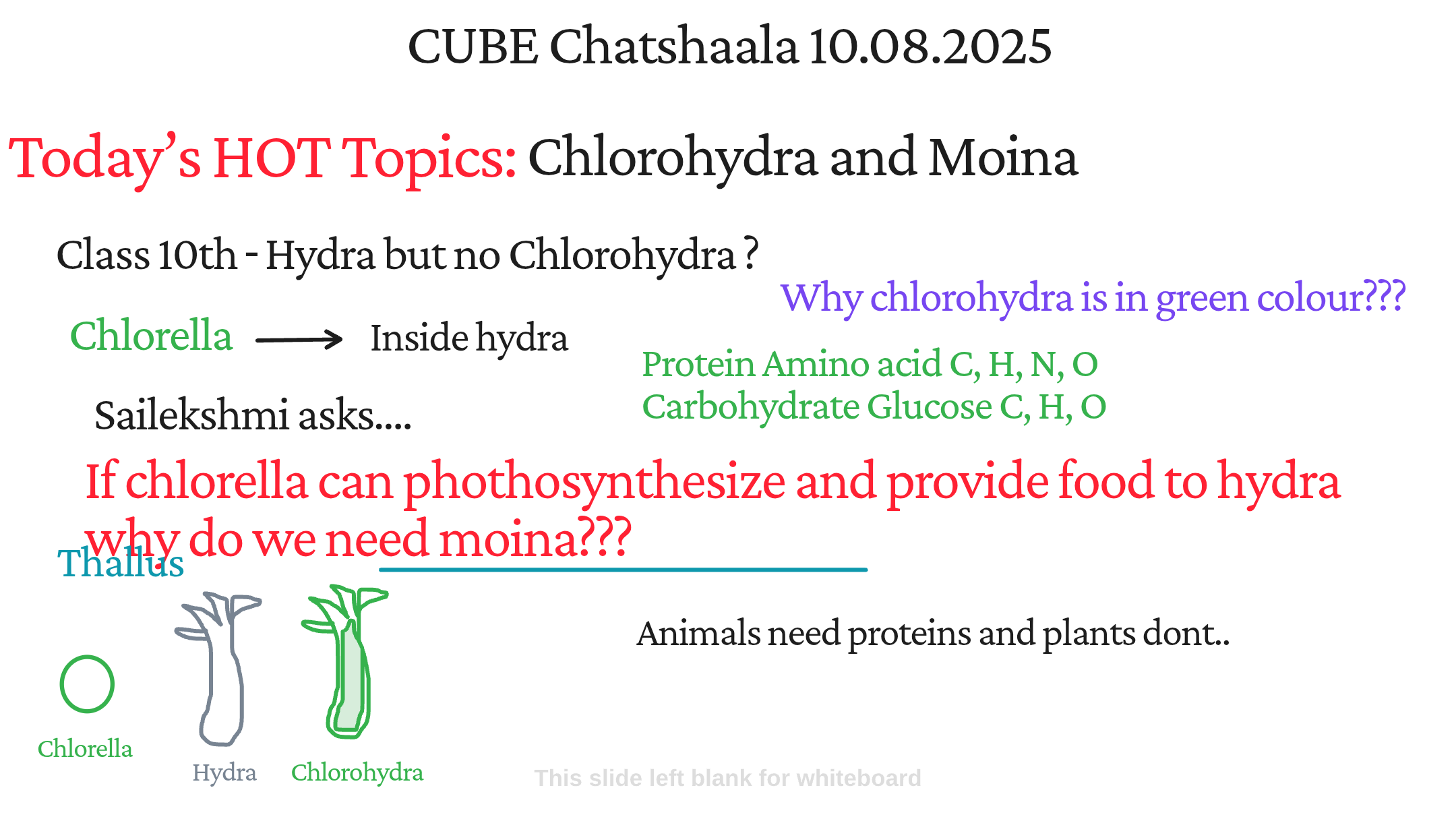
Today’s discussion revolved around an intriguing biological puzzle posed by Sailekshmi:
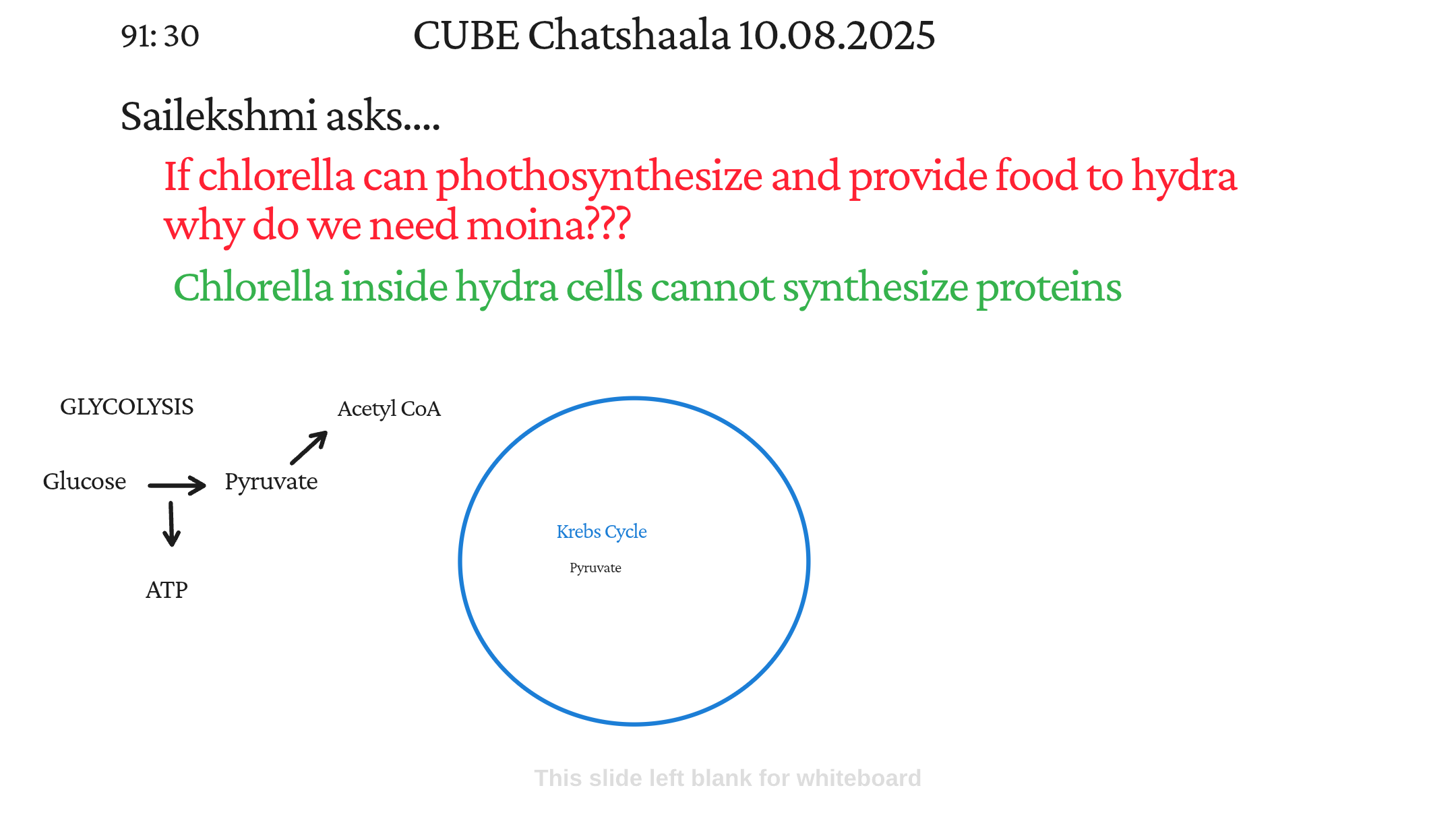
“If Chlorella inside Hydra can photosynthesize and provide food, why do we still need Moina?”
This led to an exploration of symbiotic relationships, nutrient requirements, and limitations of photosynthesis within host organisms.
 Key Points Discussed
1. The Context – Chlorohydra vs. Hydra:
-
Hydra is a freshwater cnidarian animal.
-
Chlorohydra refers to Hydra species harboring symbiotic green algae (Chlorella).
-
The green color in Chlorohydra is due to chlorophyll from Chlorella.
2. The Core Question:
-
Chlorella inside Hydra can photosynthesize and produce glucose.
-
However, Chlorella in this symbiotic state cannot produce all the proteins Hydra needs—especially nitrogen-rich compounds.
3. Biochemical Insight:
-
Carbohydrates (like glucose) from photosynthesis have C, H, O.
-
Proteins require C, H, O and nitrogen (and sometimes sulfur).
If nitrogen is unavailable or if the symbiont’s metabolic capacity is limited, Hydra must obtain amino acids from other food sources.
Moina, a small aquatic crustacean, provides these proteins and essential nutrients.
4. Metabolic Pathway Reference:
Glycolysis → Pyruvate → Krebs Cycle for energy metabolism.
While glucose can be broken down for energy, protein synthesis requires amino acids from diet.
5. Why Moina Is Still Needed:
◇ Moina supplies complete proteins and micronutrients missing from the photosynthetic output of Chlorella.
◇ This illustrates that photosynthesis alone cannot meet all animal nutritional requirements.
 TINKE Moments ( This I Never knew Earlier)
☆ Realizing that being green doesn’t guarantee self-sufficiency in animals—photosynthesis in a symbiont cannot replace all dietary needs.
☆ Understanding nutrient specificity—why nitrogen sources are critical for animal protein synthesis.
☆ Linking school textbook biology (photosynthesis, respiration) to real-life symbiotic relationships.
 Provocative Questions for the Community
-
 If photosynthetic symbionts cannot supply all nutrients, could genetic engineering make them more complete food sources for hosts?
 -
 Is there an upper limit to how much a symbiotic partner can contribute before it becomes parasitic?
 -
 Could we design a “super symbiont” that provides carbohydrates, proteins, and vitamins inside a host?
 -
 Why don’t more aquatic animals evolve with photosynthetic symbionts like Chlorohydra?
 What I Learned
 Symbiosis is not about replacing diet entirely, but about supplementing it.
Nutrient cycles (especially nitrogen) are critical to understanding why animals cannot rely solely on plant-based symbionts.
The relationship between Chlorella and Hydra is a fascinating example of mutualism with strict metabolic boundaries.
 Reference
-
https://www.botanyjournals.com/assets/archives/2024/vol9issue3/9019.pdf?utm_source=chatgpt.com
-
Metabolic co-dependence drives the evolutionarily ancient Hydra–Chlorella symbiosis | eLife
@Arunan @sakshiconsultant2002 @Chitralekha @vaishnavi @magpie and others.