 CUBE ChatShaala Summary – 28.08.2025
Theme: Chlorella–Hydra Association & Asexual Reproduction in Hydra
Today’s session revolved around two interconnected themes—the biology of Hydra and the role of Chlorella in symbiosis.
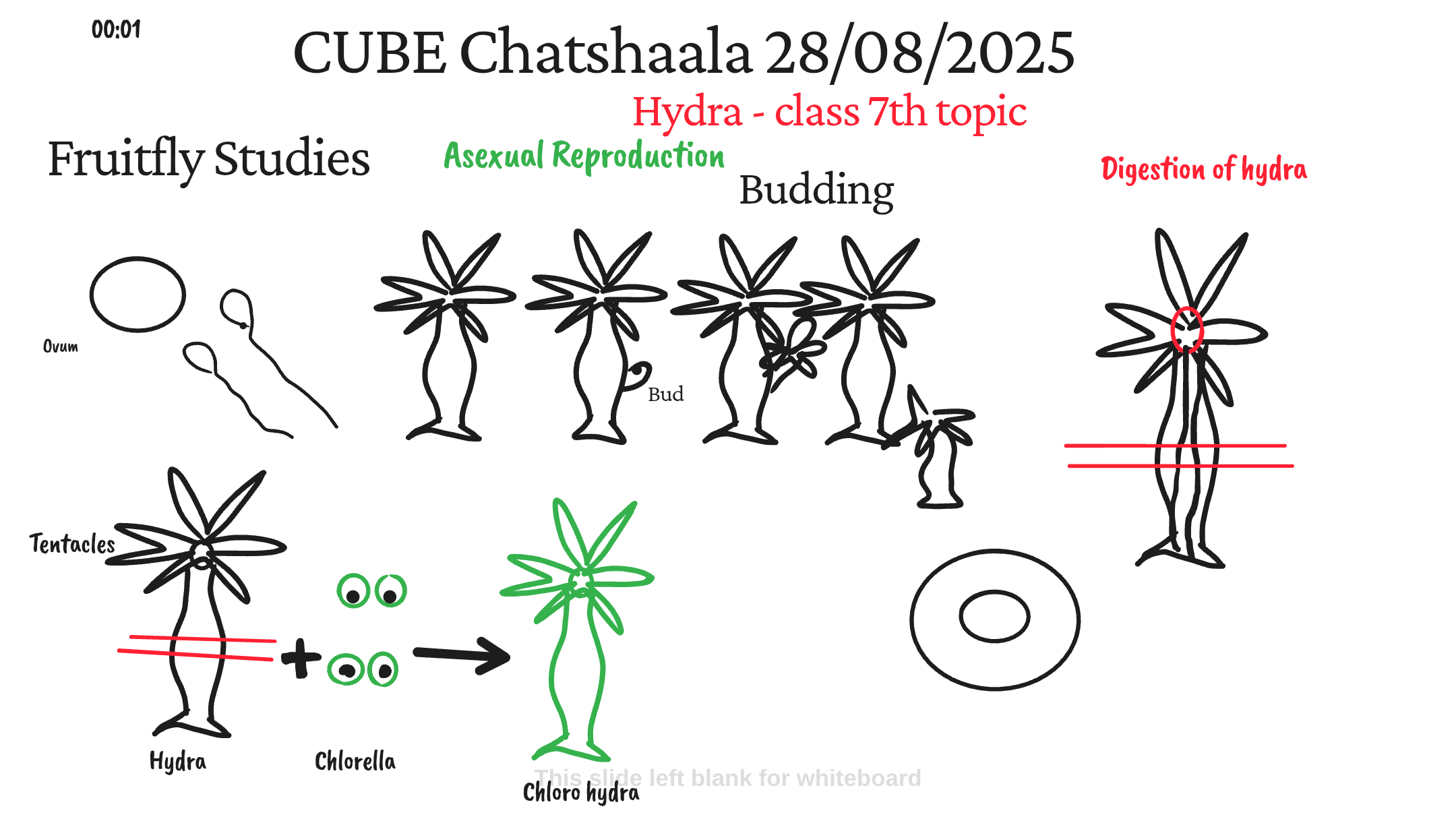
 Hydra’s Reproduction
The discussion began with Hydra’s well-known mode of asexual reproduction by budding. Drawings on the whiteboard illustrated the process, beginning with a small bud developing on the parent Hydra and gradually growing into an independent individual. The point of digestion and tentacle formation was also highlighted, giving us a clearer picture of Hydra’s structural and functional biology.
Chlorella: Structure & Life Cycle
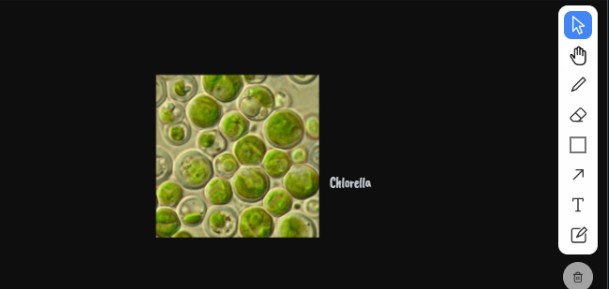
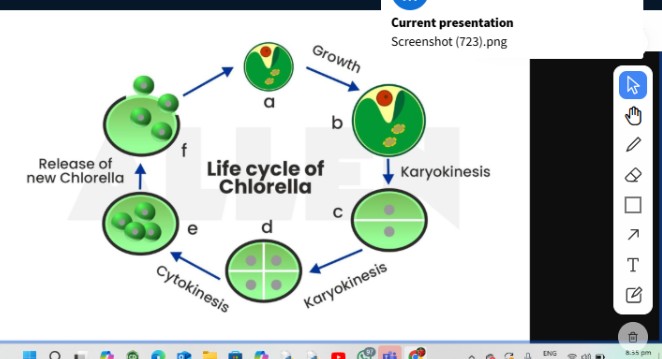
We then shifted focus to Chlorella, a unicellular green alga, seen under the microscope as spherical green cells. Its life cycle was explained step by step—from growth, karyokinesis, cytokinesis, and finally, the release of daughter cells. The importance of Chlorella in photosynthesis and its potential role when entering Hydra’s body was emphasized.
Chlorella–Hydra Symbiosis
A thought-provoking question guided the discussion: How does Chlorella enter into Hydra’s body?
Illustrations showed a possible fusion of Hydra and Chlorella leading to a Chloro-Hydra, symbolizing a symbiotic relationship where Hydra could benefit from Chlorella’s photosynthesis while Chlorella gains protection and nutrients.
Fruitfly Study Connection
Parallel discussions also touched upon Fruitfly observations, which linked the theme of cell studies and growth processes to everyday life, reinforcing the importance of learning biology through simple, visible models.
 TINKE Moments (This I Never Knew Earlier )
-
I now know about Hydra’s budding as a simple yet fascinating mode of reproduction.
-
I now know about the stepwise life cycle of Chlorella, involving karyokinesis and cytokinesis.
-
I now know about the concept of symbiosis between Chlorella and Hydra, which makes me question how organisms exchange benefits in nature.
-
I now know to connect lab observations (Chlorella under the microscope) with larger biological ideas (Hydra’s survival and growth).
 Provocative Questions to inspire
-
Can Hydra truly survive if it completely depends on Chlorella’s photosynthesis?
-
Is the entry of Chlorella into Hydra’s body accidental or an evolved adaptation?
-
Could Hydra be considered a “green animal” if Chlorella resides permanently inside it?
-
If plants and animals can merge functions in this way, what does it tell us about the boundaries of life forms?
-
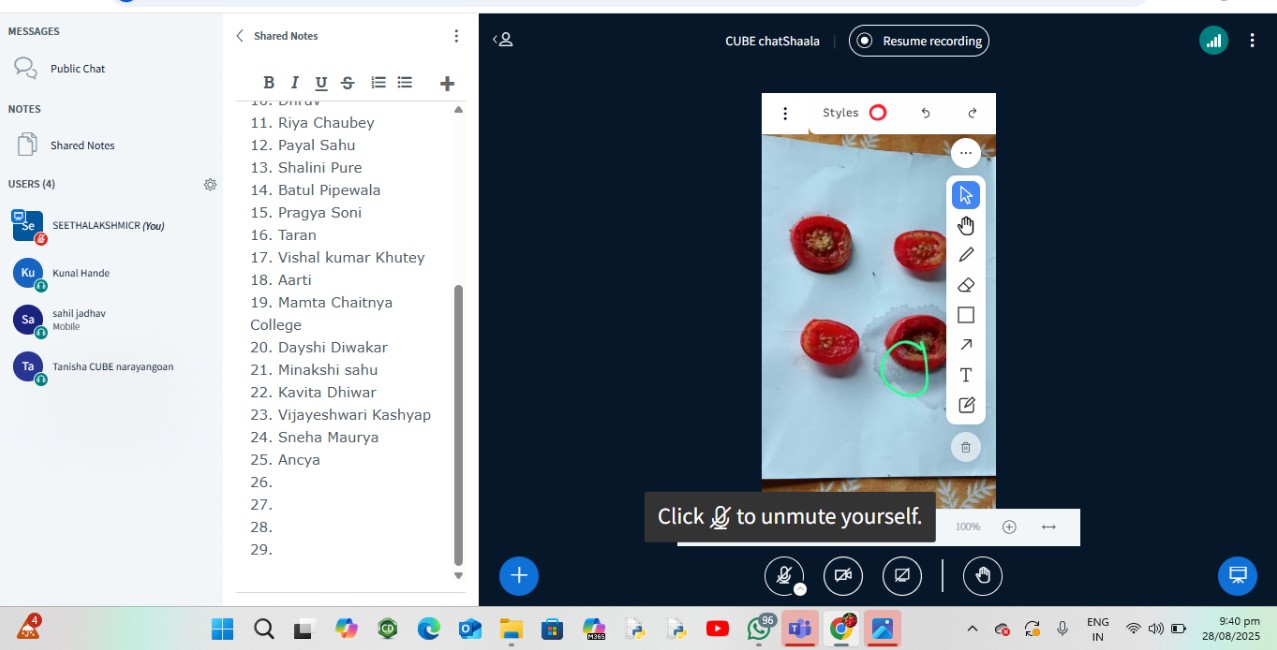
Can everyday observations, like studying tomatoes, help us understand larger scientific principles such as reproduction and symbiosis?
 What I Learned
Through today’s ChatShaala, I learned how simple organisms like Hydra and Chlorella can open doors to deeper biological concepts such as reproduction, symbiosis, and the blending of plant-like and animal-like features. This inspires me to look at even the tiniest organisms as models for understanding life’s bigger questions.
 Reference
-
https://www.botanyjournals.com/assets/archives/2024/vol9issue3/9019.pdf
-
Metabolic co-dependence drives the evolutionarily ancient Hydra–Chlorella symbiosis - PMC

@Arunan @2020ugchsncnseethala @Susanta_Tanti @dhanraj7 @magpie @SN1261 @Theertha and others