 CUBE ChatShaala — Discussion Summary
Date: 10.04.2026 | Topic: Voter’s Nail & Nail Polish as a Tool for Studying Nail Growth
Today’s session of CUBE ChatShaala was centred around one of the most delightfully accessible science experiments one can imagine — using the voter’s ink mark on a fingernail as a natural reference point to measure and study nail growth. The session was titled “Science on Our Finger Tip,” and it lived up to that name in the most literal sense.
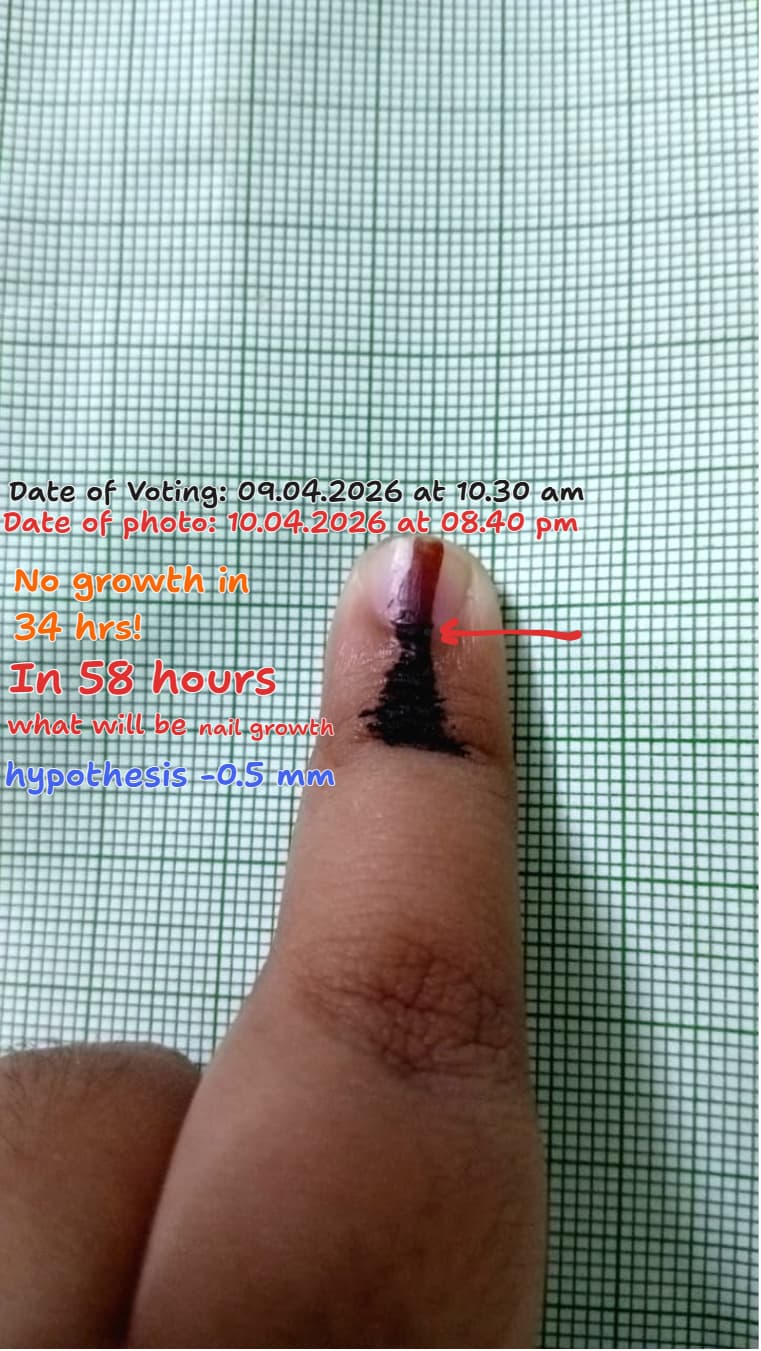
The discussion opened with a real-time observation shared by a participant. On 09.04.2026 at 10:30 am, the voter’s ink was applied to the left hand index finger during voting. A photograph taken the very next day — 10.04.2026 at 8:40 pm — showed that in approximately 34 hours, no visible nail growth had occurred. This immediately sparked curiosity: if no movement of the ink mark was detectable in 34 hours, how much growth could we expect by 58 hours? A hypothesis of 0.5 mm was put forward for the 58-hour mark.
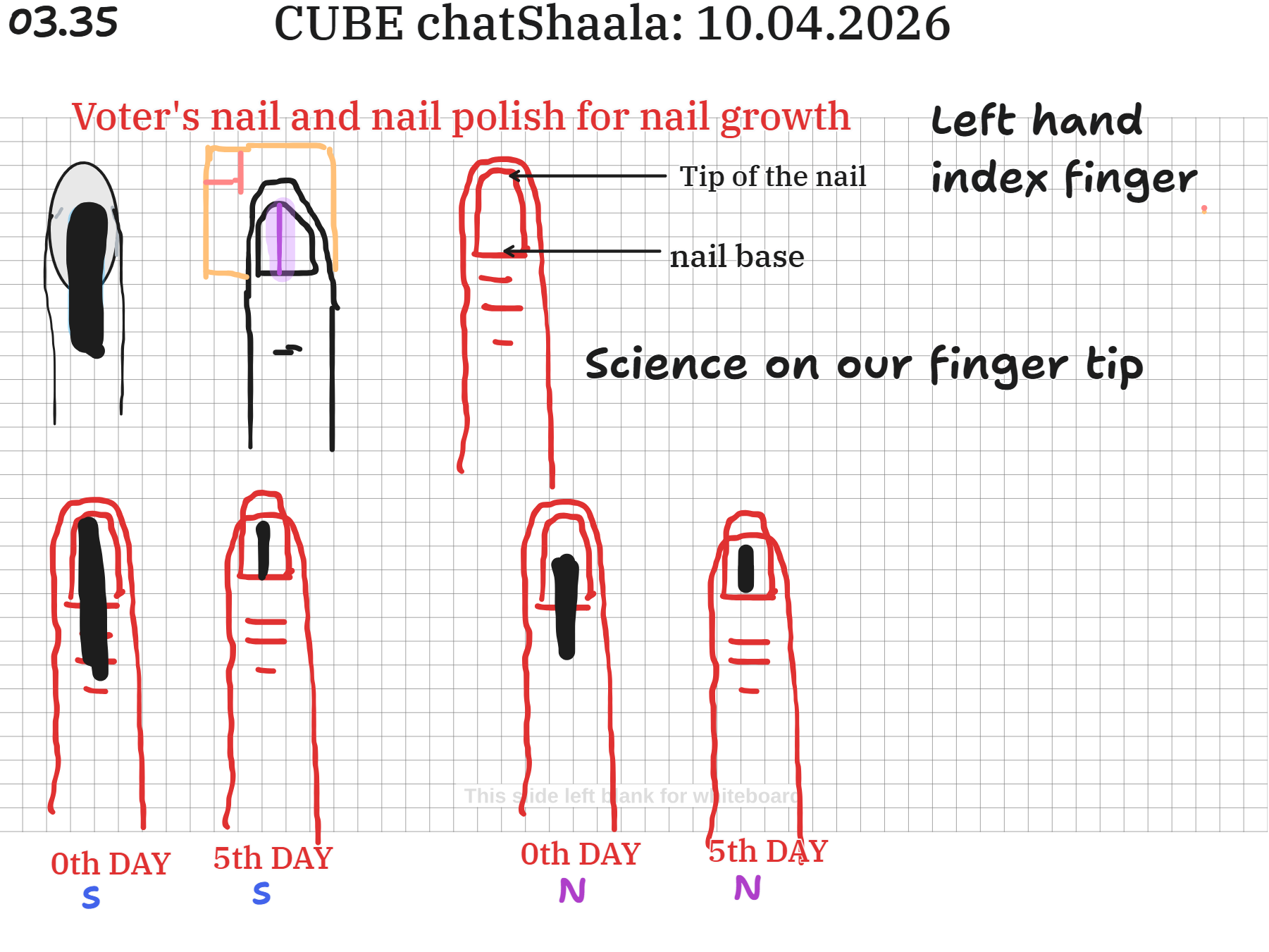
The whiteboard diagram elaborated the experimental design beautifully. Two conditions were drawn up and compared — “S” (with nail polish/stain) and “N” (without nail polish/stain), each tracked from Day 0 to Day 5 on the left hand index finger. The key anatomical landmarks — the tip of the nail and the nail base — were clearly labelled, reminding participants that understanding where nail growth originates is essential before any measurement can be meaningful.
The central insight the participants wrestled with was this: nail growth happens from the base (the matrix), not from the tip. The ink or polish mark placed near the tip does not itself grow outward — rather, as new nail plate cells are produced at the matrix, the entire nail moves forward, carrying the ink mark with it. Measuring the distance the ink mark travels from the nail base over time, therefore, serves as a proxy for the rate of nail growth.
The comparison between the “S” (stained) and “N” (unstained) nail conditions was discussed as a way to check whether the presence of ink itself interferes with or affects nail growth — a genuinely scientific control built into an everyday observation.
The session was energetic, grounded in real data, and demonstrated how citizen science can be practised with zero laboratory equipment.
 Provocative Questions
-
If no measurable nail growth was detected in the first 34 hours, does this suggest that nail growth is not linear — that it might accelerate in later hours or days? How would you design a study to test this?
-
The hypothesis for 58 hours is 0.5 mm. What is your basis for this number? Is it derived from known average nail growth rates, or is it a pure estimate? How do these differ scientifically?
-
Why is the left hand index finger specifically chosen for this experiment? Would the growth rate differ on the right hand, or on other fingers like the thumb or pinky? What does the literature say about growth variation across fingers?
-
The voter’s ink is not a controlled laboratory dye — it spreads, smudges, and fades. How does this introduce measurement error into the experiment, and how might participants account for it?
-
In the “S vs N” comparison (stained vs unstained), what exactly are we controlling for? Could the ink itself — its chemical composition or physical weight — affect the biology of the nail matrix, even slightly?
-
Nail growth is known to be influenced by factors such as age, nutrition, dominant hand use, season, and even illness. How many of these variables are being tracked alongside the ink experiment? Should they be?
-
The whiteboard diagram shows Day 0 and Day 5 as observation points. What happens in between? Would daily photographs provide a more accurate growth curve, and if so, what challenges would that introduce?
-
If a participant voted but did not photograph their finger until Day 2 or Day 3, is the experiment still valid? At what point does delayed documentation compromise the data?
-
What would it mean scientifically if the “N” (no stain) finger grew at a measurably different rate than the “S” (stained) finger? What conclusions could — and could not — be drawn from that?
-
This experiment uses the voter’s ink mark as a fiduciary marker. Can you think of another naturally occurring or ethically permissible marker that could be used on the body to measure a slow biological process in a similar way?
 What I Have Learned
Sitting through today’s session, the thing that struck me most was how a mundane civic act — voting — became the seed of a scientific inquiry. The ink on the finger is something most people wipe off or wait to fade. Here, it was transformed into a measurement instrument.
I learned that nail growth, while commonly understood as something that “just happens,” is actually a window into cellular biology. The nail matrix, sitting beneath the skin at the base of the nail, is where keratinocytes divide and push the nail plate forward. The ink mark moving away from the base is not the ink growing — it is the nail plate itself moving, carrying the mark along. This distinction between what we see and what is actually happening biologically is a core lesson in scientific literacy.
I also learned something about experimental design from watching this discussion. Comparing a stained finger (S) with an unstained finger (N) on the same hand introduces a simple but meaningful control. It asks: does our measurement tool interfere with the thing we are measuring? That is a question researchers in every field must ask, and it was refreshing to see it emerge naturally here.
Perhaps most importantly, I was reminded that science does not require a laboratory. It requires curiosity, a method, and honest documentation. A graph paper background, a photograph, a timestamp, and a hypothesis — that is enough to begin.
 TINKE Moments
TINKE — “This I Now Knew Earlier”
TINKE Moment 1: Nail growth is not visible in 34 hours
Several participants likely assumed that nail growth would be detectable within a day or two. The photograph from 34 hours post-voting showed no visible change, which challenges the common assumption that nails grow quickly and steadily. This moment revealed how poorly calibrated our intuitions are about the rate of slow biological processes.
TINKE Moment 2: The ink mark moves, not grows
There is a subtle but critical conceptual shift here. Many people instinctively think of the ink as something sitting on a static nail that will “grow out.” The correct understanding is that the nail plate itself is in constant forward motion from the base. The ink is just a passenger. Recognising this distinction is a TINKE moment — it changes how one thinks about nail biology entirely.
TINKE Moment 3: The nail base, not the tip, is where the action is
The whiteboard diagram carefully labelled the “tip of the nail” and the “nail base.” For many participants, the labelling prompted a realisation that they had never consciously thought about where nail growth originates. The tip is dead tissue; the base is where life is. That inversion of attention is worth sitting with.
TINKE Moment 4: A control condition is needed even for a personal experiment
The S vs N comparison might initially seem unnecessary — “why would the ink affect growth?” But the very act of questioning that assumption is a TINKE moment. Science asks us to be suspicious of our own confidence. Including a control, even informally, is a habit of mind that is more valuable than any single result.
 Gaps and Misconceptions
Gap 1 — Absence of a standardised measurement protocol
The current experiment relies on visual estimation from photographs. There is no described method for measuring the distance the ink mark has travelled in a reproducible way. Without a consistent ruler placement, scale reference in photographs, or image analysis approach, comparing data across participants will be difficult.
Gap 2 — Missing baseline data
The experiment began at the moment of voting, but there is no record of the nail’s initial length, the exact position of the ink mark relative to the nail base, or the shape of the nail. Without this baseline, the absolute growth value is hard to calculate.
Gap 3 — Individual biological variability is unaccounted for
Age, nutrition, health status, dominant hand, hydration, and even the season can all influence nail growth rate. None of these variables appear to be recorded alongside the observation. This does not invalidate the experiment, but it does limit how generalisable the findings are.
Misconception 1 — “No growth in 34 hours means nails grow slowly”
The absence of visible change in a photograph does not necessarily confirm zero growth. It may simply mean that the growth that occurred (which could be fractions of a millimetre) fell below the resolution of the photograph and the observer’s eye. This is a measurement sensitivity issue, not a biological fact.
Misconception 2 — “The stained and unstained fingers are perfectly comparable”
The two fingers on the same hand are not biologically identical. Dominant-hand fingers, fingers used more frequently in grip, and fingers with different levels of daily mechanical stress can all grow at slightly different rates. The S vs N comparison is useful but should not be treated as a rigorous controlled experiment without acknowledging these confounds.
Misconception 3 — “0.5 mm in 58 hours is a reasonable hypothesis”
This hypothesis may be well-founded, but if it is based purely on intuition rather than prior data or literature, it is more of a guess than a hypothesis. A true hypothesis in science is grounded in prior reasoning or evidence. The group would benefit from first looking up the known average human nail growth rate (approximately 3–4 mm per month, or roughly 0.1 mm per day) and working backwards from there to set a more evidence-anchored prediction.
 Photographs during Chatshaala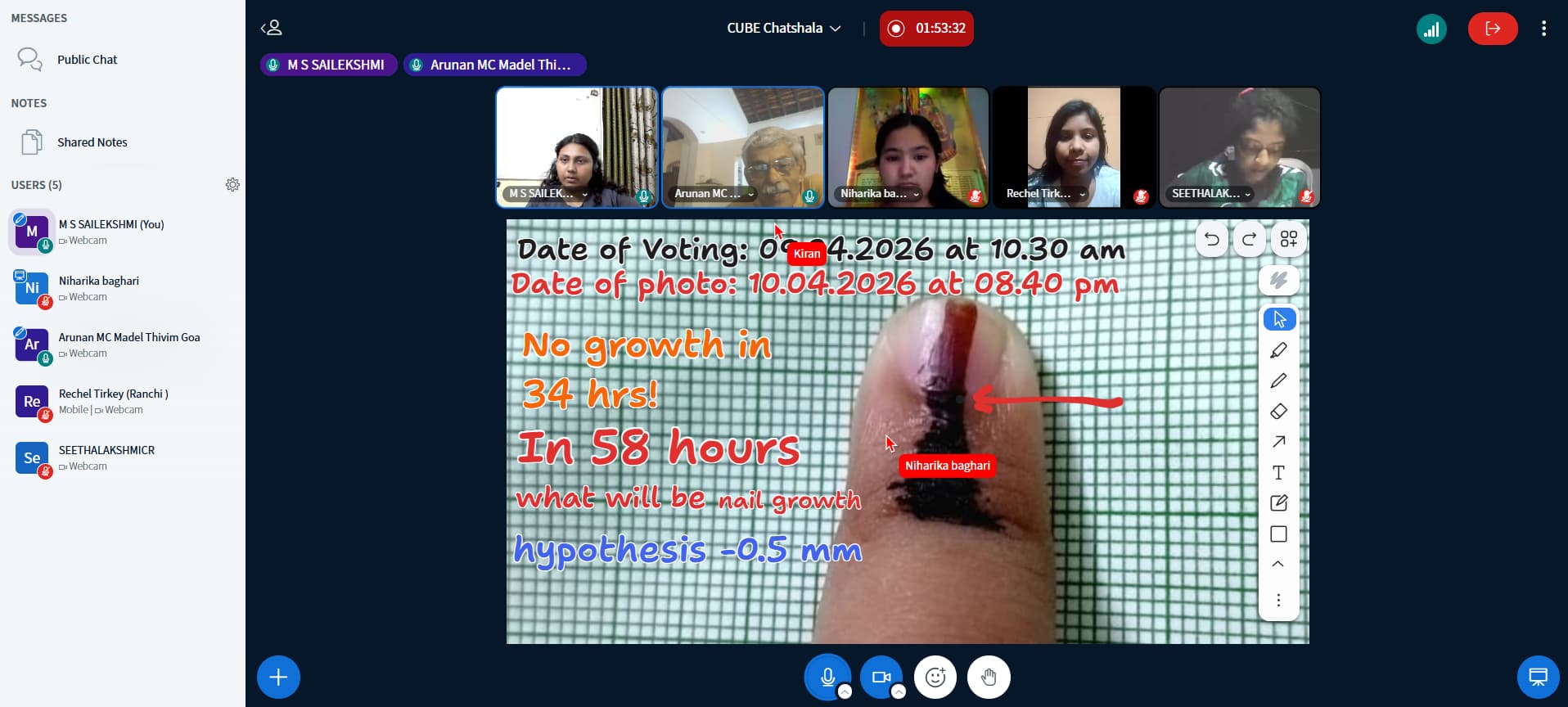
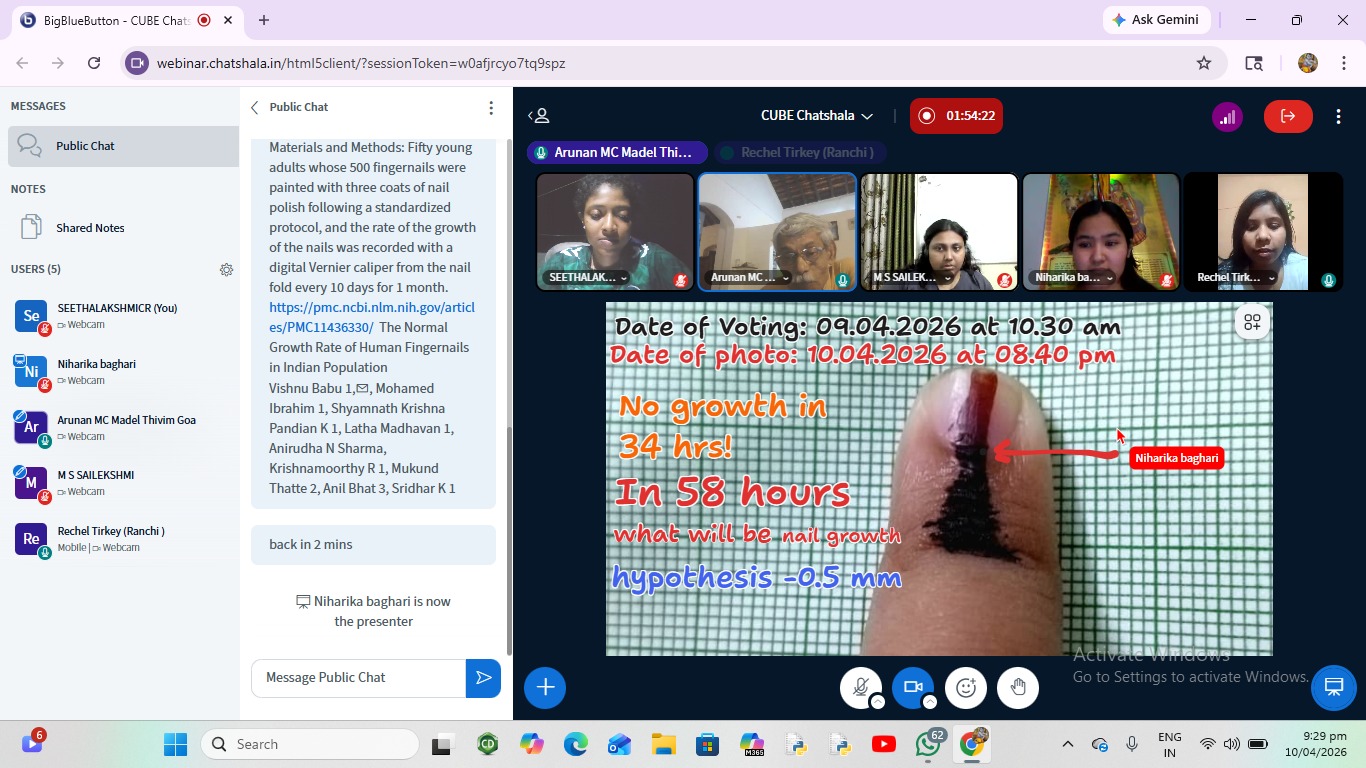

 Reference