 CUBE Chatshaala — Discussion Summary
2026-04-08T18:30:00Z
Today’s session of CUBE Chatshaala opened with a beautifully simple yet scientifically rich question: How can we use the indelible ink applied to a voter’s index finger during elections as a natural, non-invasive marker to study human nail growth?
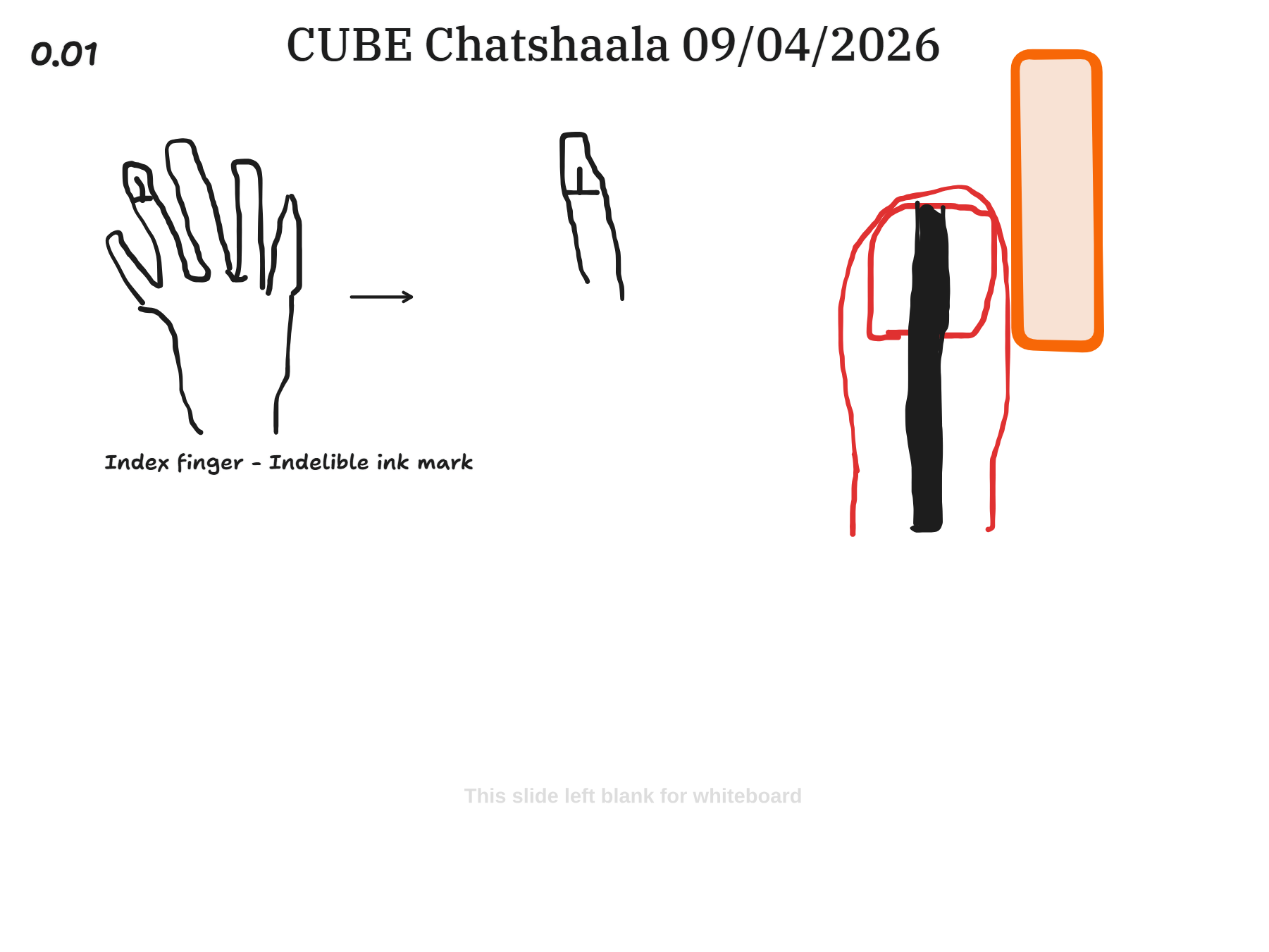
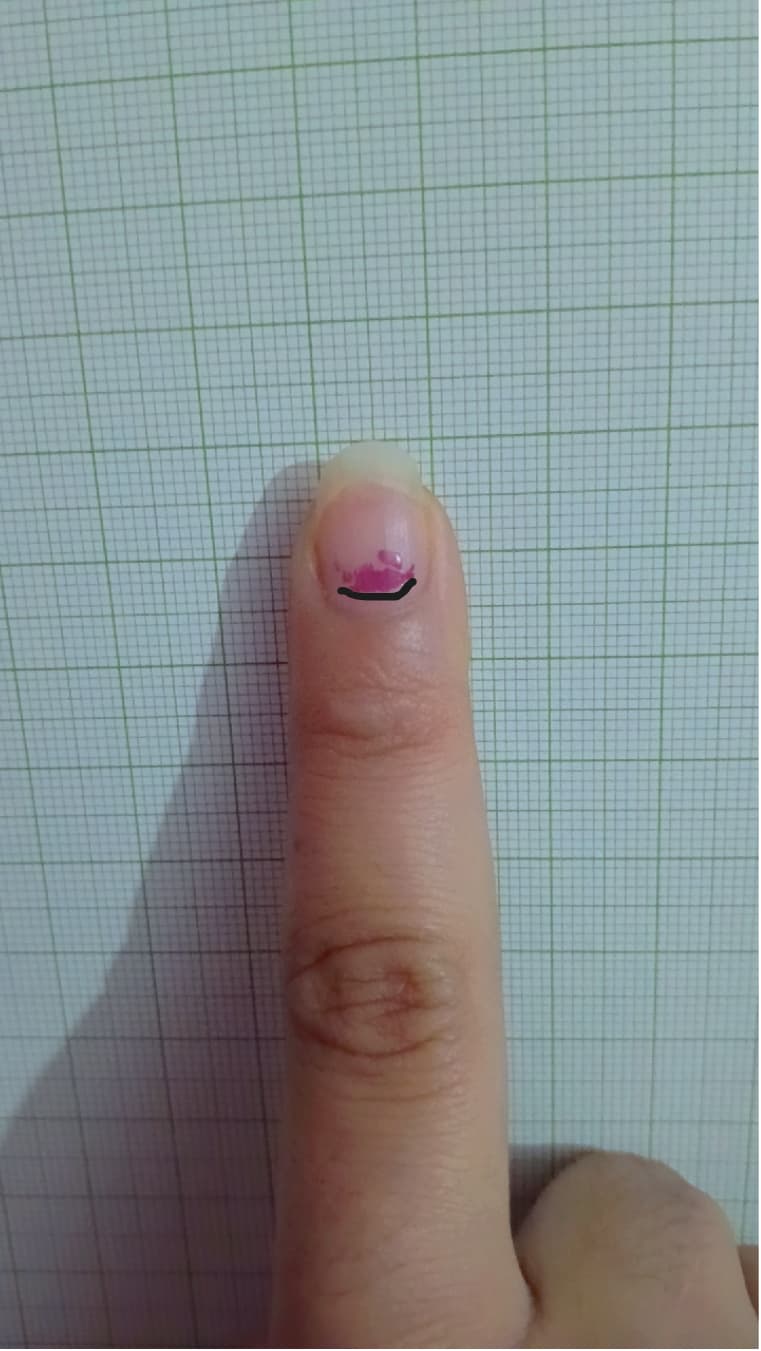
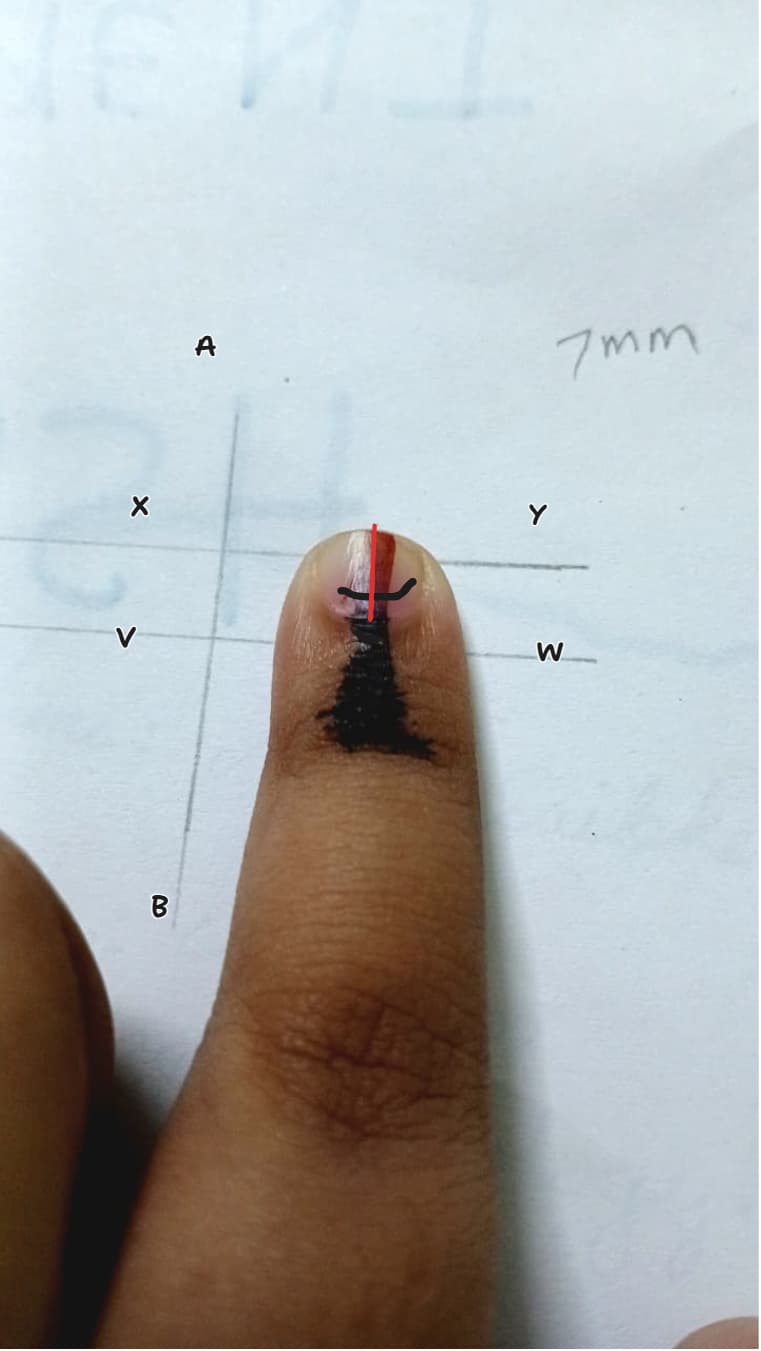
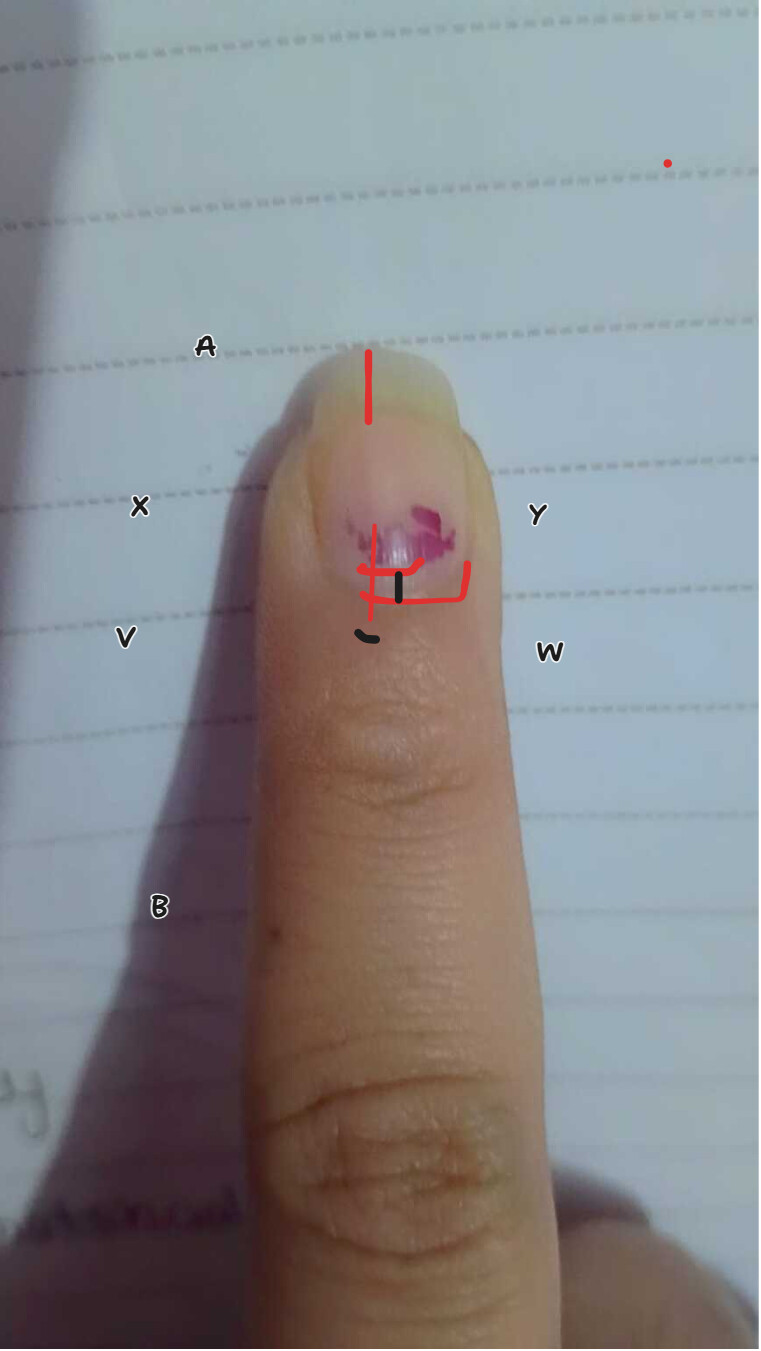
The whiteboard (slide 0.01) set the stage immediately. A hand diagram pointed to the index finger and explained that the voting ink — applied at the proximal end of the nail, right at the junction where the nail emerges from beneath the skin fold — serves as a fixed reference mark. Since nail tissue grows outward from the proximal end toward the distal (free) end, any movement of this ink mark over days can be measured as a proxy for nail growth rate. The 7mm annotation seen in Image 3 reflects an actual measurement taken from one participant’s finger, placing a real number into the conceptual framework being discussed.
The discussion drew heavily from data collected during the Lok Sabha Elections of 2024, a remarkable citizen-science collaboration in which CUBE members across Kerala, Maharashtra, and other states used the voting event as a natural experiment. Participants documented their ink-marked fingers by photographing them at regular intervals against graph paper or ruled backgrounds, with axis labels A, B, X, Y, V, W marked to create a consistent coordinate system for comparing photos across time.
Several important observations emerged from the accumulated data:
Age and nail growth rate formed the central theme. Data collected by Prithviraj (CUBE, Varkala) from 12 individuals showed a clear trend — younger individuals showed higher nail growth per day. Those below 30 years recorded approximately 0.122–0.152 mm/day, while individuals above 70 recorded as low as 0.078 mm/day. Those in the 40–50 age group hovered around 0.091 mm/day. Notably, a 28-year-old female (RV) showed greater growth than a 27-year-old female (AMV), highlighting that age alone does not determine everything, and individual variation matters.
Abhijeet Singh (Age 20, Navi Mumbai) documented his own nail growth meticulously. At 69 hours post-voting, no significant movement of the ink mark was visible on his nail. By 18 days, he recorded approximately 3 mm of growth, and at 1 month, the growth reached about 6 mm. His 23-year-old brother showed 5 mm at the same 1-month mark, and his 52-year-old father showed only 4 mm — a compelling within-family dataset that raised questions about age-dependent variation.
An interesting anomaly emerged early: Vijaya Tilak proposed the hypothesis that younger individuals should show higher nail growth rates. However, the data complicated this — Abhijeet (age 20) initially showed less visible ink displacement than his 24-year-old brother at the 69-hour mark, prompting researchers to ask whether a 3-year age gap alone can produce a measurable difference, or whether other factors like nutrition, activity level, hand dominance, or individual biology are confounding.
The methodology itself was also deliberated. Participants discussed the best way to photograph the nail consistently — using graph paper backgrounds, maintaining a fixed camera angle, placing the finger along a vertical axis, and ensuring the proximal nail fold is clearly visible. The coordinate system (A-B vertical axis, X-Y and V-W horizontal reference lines) visible in today’s images is a direct product of this methodological refinement.
 Provocative Questions
-
If nail growth rate decreases by approximately 0.5% per year after the third decade of life, what does that imply about the rate of cell division in the nail matrix as we age? Is this a slowing of stem cell activity or a change in the keratinocyte differentiation cycle?
-
The 20-year-old Abhijeet showed slower early nail movement than his 24-year-old brother. Does this challenge the hypothesis that younger equals faster, or does it simply mean that short-term measurements (< 3 days) are insufficient to detect growth differences?
-
Within-family data (Abhijeet, his brother, and father) shows a progression of 6 mm > 5 mm > 4 mm over one month. Can family-based datasets serve as controlled experiments where genetic and dietary variables are partially shared?
-
The ink mark in Image 3 shows a red vertical line (7 mm) against a coordinate grid. Is the 7 mm the total nail length, the distance the ink has traveled, or the ink mark’s current position from the proximal fold? How do we standardize this measurement across different participants?
-
Voter’s ink is described as indelible, yet some participants noted the ink fading or washing off the skin fold area (proximal fold) faster than from the nail plate. What does this differential persistence tell us about the surface chemistry of skin versus nail keratin?
-
Research literature shows that men grow nails faster than women until the sixth decade, after which women overtake men. Does the CUBE data support or contradict this published pattern?
-
Can nail growth rate serve as a meaningful biomarker for aging, as suggested in Bean’s 35-year self-observation study? If so, what would a longitudinal CUBE study over 5–10 years look like?
-
What would happen to the ink mark if a participant’s nail growth were somehow disrupted by illness, nutritional deficiency, or physical stress? Could abnormal ink movement patterns serve as a diagnostic clue?
 What I Have Learned
The most powerful insight from this session is that everyday civic events can be turned into scientific experiments with almost no additional resources. The voter’s ink study is a masterclass in low-cost, high-impact science — the “instrument” is literally applied by election officials, and the data collection requires only a smartphone camera and a ruler.
I also learned that nail growth is far from a simple linear phenomenon. It is influenced by age, gender, individual biology, possibly nutrition and health, and even the specific finger being measured. The nail plate grows from stem cells in the nail matrix (located just beneath the proximal nail fold), and any change in that cellular activity directly manifests as a change in growth rate. This makes the nail a surprisingly accessible window into cellular aging.
The importance of methodology was another major takeaway. The shift from casual photos to a structured coordinate system (the A-B-X-Y-V-W grid seen in the images) reflects how citizen scientists learn to refine protocols over time. Without consistent framing, measurements become incomparable across participants.
Finally, I learned that two data points are never enough for a conclusion. Arunan Sir’s gentle but firm reminder to Abhijeet — that one cannot draw conclusions from just two samples (himself and his brother) — encapsulates the scientific discipline that CUBE consistently instills: collect more data, question your assumptions, and always consider confounding variables before making claims.
 TINKE Moments
TINKE — “This I Never Knew Earlier”
1. The ink mark on the skin disappears faster than on the nail.
Several participants noticed that the portion of ink on the proximal skin fold faded or peeled away, while the portion on the nail plate persisted longer. This is a TINKE moment — most people assume all skin-adjacent surfaces behave similarly, but the composition and turnover rate of the nail plate (hard keratin) is fundamentally different from skin keratin, making it a more stable surface for the ink.
2. A 3-year age gap within siblings may produce measurable differences in nail growth.
Abhijeet’s brother (age 24) showed visible ink separation earlier than Abhijeet (age 20). This was unexpected and counter-intuitive — most participants assumed that two young adults would show nearly identical rates. The possibility that even small age differences within the same decade could yield measurable biological differences was a genuine surprise.
3. The nail does not grow uniformly fast in all age groups below 30.
The assumption that “young = fast growth” was challenged. The data showed variation even within the under-30 group, suggesting that peak nail growth might occur in the mid-twenties (around the third decade), consistent with published literature showing growth rate peaks “well into the 3rd decade.”
4. Nail growth has circadian and multi-year biorhythms.
Literature cited during the discussion revealed that nail growth is not a steady constant — it follows circadian rhythms and alternates between roughly 7-year periods of slower and faster decline. This was surprising to most participants, who assumed nail growth was a simple, monotonically declining function of age.
 Gaps and Misconceptions
Gap 1 — Confounding Variables Not Controlled:
The current dataset does not account for factors such as hand dominance (dominant hand nails grow faster), nutritional status, seasonal variation, or health conditions. Vijaya Tilak and Shalini both flagged this during earlier discussions — age cannot be treated as the sole variable without addressing these confounders.
Gap 2 — Short-term vs. Long-term Measurement:
Several early observations (e.g., at 69 hours) showed no detectable ink movement. This led some participants to initially question whether nail growth had occurred at all. The misconception here is that short measurement windows will always yield visible results. Growth of ~0.1 mm/day requires at least several days before differences become photographically detectable.
Gap 3 — Measurement Standardization:
Not all participants used the same protocol for photography or measurement. Some used graph paper, others used rulers directly on the skin. Without a truly standardized protocol (fixed camera distance, fixed lighting, consistent finger orientation), cross-participant comparison introduces noise. The coordinate grid system (A-B-X-Y-V-W) being refined in today’s session is a direct attempt to address this gap.
Gap 4 — Small Sample Sizes for Subgroups:
While the total number of participants is growing, age-specific subgroups remain too small for confident statistical claims. For example, comparing “above 70” nail growth requires more than one or two participants (PJ, age 76 was a rare data point). Broader mobilization — akin to the Republic Day Mango Challenge — is needed.
Misconception — “Younger Always Means Faster”:
The most persistent misconception challenged during this session is the blanket assumption that youth guarantees the highest nail growth rate. The data nuances this: peak growth appears to occur in the 25–35 range, not in the teens or early twenties. Additionally, individual variation can override age-group trends in specific cases.
 Photographs during Chatshaala
 Reference