 CUBE Chatshaala - Discussion Summary
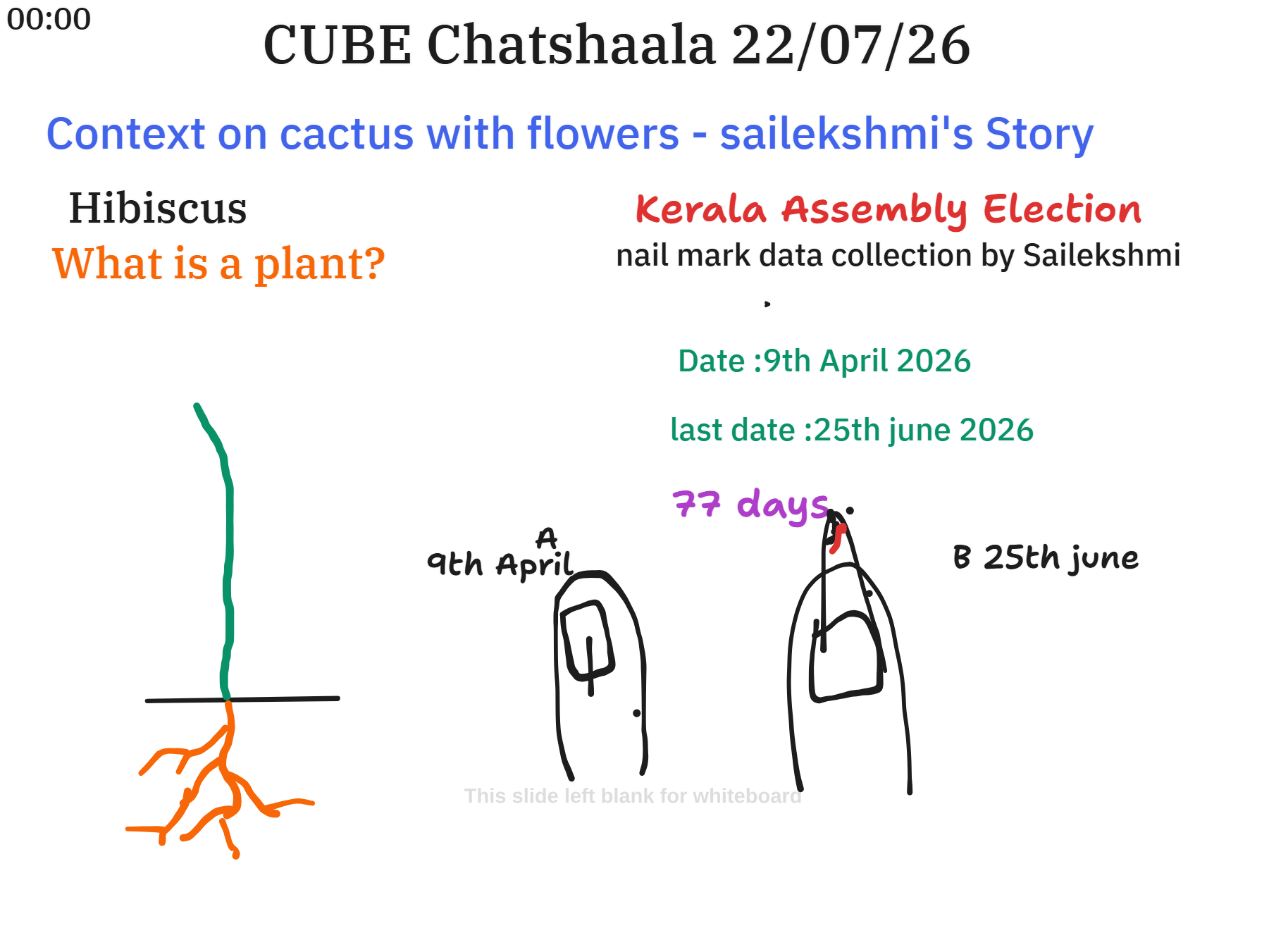
Today’s CUBE ChatShaala session opened with a story-driven exploration prompted by Sailekshmi, who used a personal encounter with a flowering cactus as the entry point into a broader question: what actually defines a plant? The discussion began with the hibiscus as a familiar reference organism, using its visible structure — roots below ground and stem rising above the soil line — to anchor the group’s thinking about basic plant anatomy before circling back to the more puzzling case of a cactus that flowers. The group used this to interrogate assumptions many people carry about plants, namely that spines or unusual body forms disqualify an organism from being considered a “typical” plant, and that flowering is somehow separate from the rest of a plant’s identity rather than being one stage in its life cycle.
This session ties into earlier ChatShaala threads on plant biology, including prior conversations distinguishing flowering plants from non-flowering groups such as mosses, ferns, and conifers, which reproduce through spores or exposed seeds rather than through flowers. Revisiting that distinction helped frame why a flowering cactus is worth pausing on: cacti are succulents adapted to arid environments, and their flowers, though sometimes short-lived and easy to miss, are very much part of standard angiosperm reproduction.
The second half of the session shifted into a completely different but equally rich strand of inquiry: Sailekshmi’s ongoing personal data collection project tracking nail growth using an ink-mark method, inspired by the mechanism behind election ink used during the Kerala Assembly Election. The whiteboard captured this transition clearly, moving from botanical sketches of roots and stems into a side-by-side diagram of two nail illustrations, one labelled “A, 9th April” and the other “B, 25th June,” with the gap between them marked as 77 days.
The connection Sailekshmi drew was clever and grounded in real civic infrastructure: election ink, most commonly formulated with silver nitrate, is applied to a voter’s nail and cuticle specifically because it resists ordinary washing and only fades as the nail itself grows out, taking anywhere from several weeks to a few months to disappear completely. Sailekshmi realised that this property, designed originally to prevent duplicate voting, doubles as a natural, low-cost timestamp for tracking nail growth. By marking a nail on a known date and photographing or measuring how far that mark travels toward the tip over a fixed number of days, a simple biological growth rate can be calculated without needing any specialised equipment.
This builds directly on a related ChatShaala investigation from earlier in the summer, where a nail growth study using the same ink-mark logic produced measurable results: roughly 6 millimetres of growth recorded over 62 days, giving an average rate close to 0.1 millimetre per day. That session had also introduced graph paper as a precision tool, since each small square corresponds to one millimetre, which allows very gradual biological changes to be measured with a level of accuracy a plain ruler alone cannot offer. Today’s session effectively extends that same method into a new dataset, using the Kerala Assembly Election’s ink stain as the marking event and 25th June as the observation endpoint, 77 days after the initial mark was made on 9th April.
Manali Bhujade, Aarya Takke, Kiran, and Arunan joined at various points through the session, contributing to what became a wide-ranging conversation bridging two seemingly unrelated domains: everyday plant identification and long-duration biological self-experimentation. The common thread running underneath both halves of the discussion was observation over time — noticing what a plant actually is by tracing its structure from root to flower, and noticing how a body quietly changes by tracking a fixed mark against a moving edge.
 Provocative Questions
-
If a cactus can flower and still be covered in spines instead of leaves, what features actually make something count as a “typical” plant, and should our intuitive definitions be revised?
-
Since election ink was engineered purely to prevent voter fraud, what other public health or civic technologies might be quietly repurposable as citizen-science measurement tools?
-
Does nail growth rate stay constant across a person’s own hand, or would data collected from different fingers on the same person show meaningful variation?
-
Given that the earlier nail growth investigation found close to 0.1 millimetre of growth per day, would Sailekshmi’s 77-day, election-ink-based measurement land near that same figure, or could seasonal and nutritional differences push it higher or lower?
-
Why might silver nitrate-based stains persist so much longer on the nail and cuticle than on ordinary skin, and what does that difference reveal about how nails are structured compared to skin?
-
Non-flowering plants such as ferns and mosses reproduce through spores rather than flowers. What evolutionary pressures might have led flowering plants to develop such a metabolically costly reproductive structure instead?
 What I Have Learned
Sitting through today’s session reinforced something I keep coming back to in ChatShaala: the best scientific questions often start from something almost embarrassingly ordinary. A cactus flowering shouldn’t be surprising, and yet it disrupts the mental shortcut many of us use where “cactus” and “flower” feel like they belong to different categories of plant. Walking back through the hibiscus’s root-and-stem structure before returning to the cactus question was a useful reminder that definitions in biology are rarely built from a single striking feature; they come from a cluster of shared traits, and outliers like cacti force us to hold multiple traits in mind at once rather than relying on a single visual cue.
The nail growth thread was, for me, the more unexpected highlight. I had not previously considered that election ink, designed entirely around preventing electoral fraud, could double as a precise biological clock. What makes this such a strong example of citizen science is that it needed no laboratory equipment at all, only a known starting date, a fixed mark, and patience across 77 days. It is a genuinely elegant illustration of the CUBE philosophy: frugal materials, careful observation, and rigorous measurement can produce data that means something, even when the “instrument” was never intended for scientific use in the first place.
 TINKE Moments (This I Never Knew Earlier)
The most significant TINKE moment of the session centred on the assumption that a plant’s identity is defined by a small set of obvious visual markers, such as having broad green leaves or lacking thorns. Working through the cactus example made explicit something that had likely been operating as an unspoken assumption for several participants: flowering is not an exception to a plant’s normal behaviour but an expected part of its reproductive life cycle, regardless of how unusual the rest of its body looks. This is a classic case of an implicit mental model becoming explicit once it was tested against a real, slightly surprising specimen.
A second TINKE moment emerged around the mechanism of election ink itself. Many participants likely knew, in a general sense, that the ink mark on a voter’s finger lasts “a while,” but the session made explicit why: the presence of silver nitrate causes it to bind into the nail and cuticle in a way that ordinary washing cannot remove, and it only fades out as new nail tissue physically replaces the old, stained tissue. Recognising that the ink’s longevity is tied to biological turnover rather than simple stain resistance was a meaningful shift from a vague, everyday understanding of “election ink lasts a long time” toward a mechanistic, biologically grounded explanation.
A third, quieter TINKE moment involved measurement itself. The habit of treating slow biological processes as effectively unmeasurable without specialised tools was challenged again today, echoing the earlier realisation from the June nail growth session that graph paper and a ruler are entirely sufficient for tracking sub-millimetre change over weeks. Applying that same logic to a new 77-day dataset shows this principle solidifying into a working habit rather than a one-off insight.
 Gaps and Misconceptions
One gap worth flagging is that today’s whiteboard did not specify which finger or nail was used for the 9th April to 25th June measurement, nor whether photographs or physical rulers were used to record the mark’s position at each checkpoint. Without that detail, it will be difficult to directly compare this dataset against the earlier 62-day study’s 0.1 millimetre-per-day rate, since growth rate can vary somewhat by finger and by individual.
A common misconception worth naming directly is the belief that election ink is simply a surface dye that eventually washes away like any other stain. In reality, part of what makes it effective as a fraud deterrent is that it is formulated to resist exactly that kind of removal, binding into the nail structure itself rather than sitting on top of it. Clarifying this distinction is useful both for understanding the civic mechanism and for trusting the nail growth data derived from it.
Finally, the cactus discussion surfaced a related misconception worth addressing explicitly in a future session: the idea that spines are structurally similar to leaves, or that a plant “chooses” between having leaves and having spines. Spines in cacti are in fact modified leaves adapted to reduce water loss, and unpacking that relationship more fully could make for a strong follow-up topic.
 Photographs during Chatshaala


 Referance
CUBE (Collaboratively Understanding Biology Education) HomeLab Movement - SciStarter
Non-Flowering Plants
From Nail Growth to Neural Connections – A Journey of Observation, Measurement, and Scientific Thinking🌸 Election ink - Wikipedia