 CUBE Chatshaala - Discussion Summary
The CUBE ChatShaala session on August 13, 2026, brought together participants including Sailekshmi, Aarya, Manali Bhujade, Arunan MC, Kiran, Niharika Baghari, and Riya. The discussion revolved around fruit fly (Drosophila melanogaster) behavioral hypotheses, experimental designs for food preference, and underlying genetic principles governing inheritance and chromosome structure.
1. Behavioral Hypotheses & Food Preference Experiments
-
Circadian & Activity Assumptions: Aarya proposed the hypothesis that fruit flies work primarily during the day and rest at night.
-
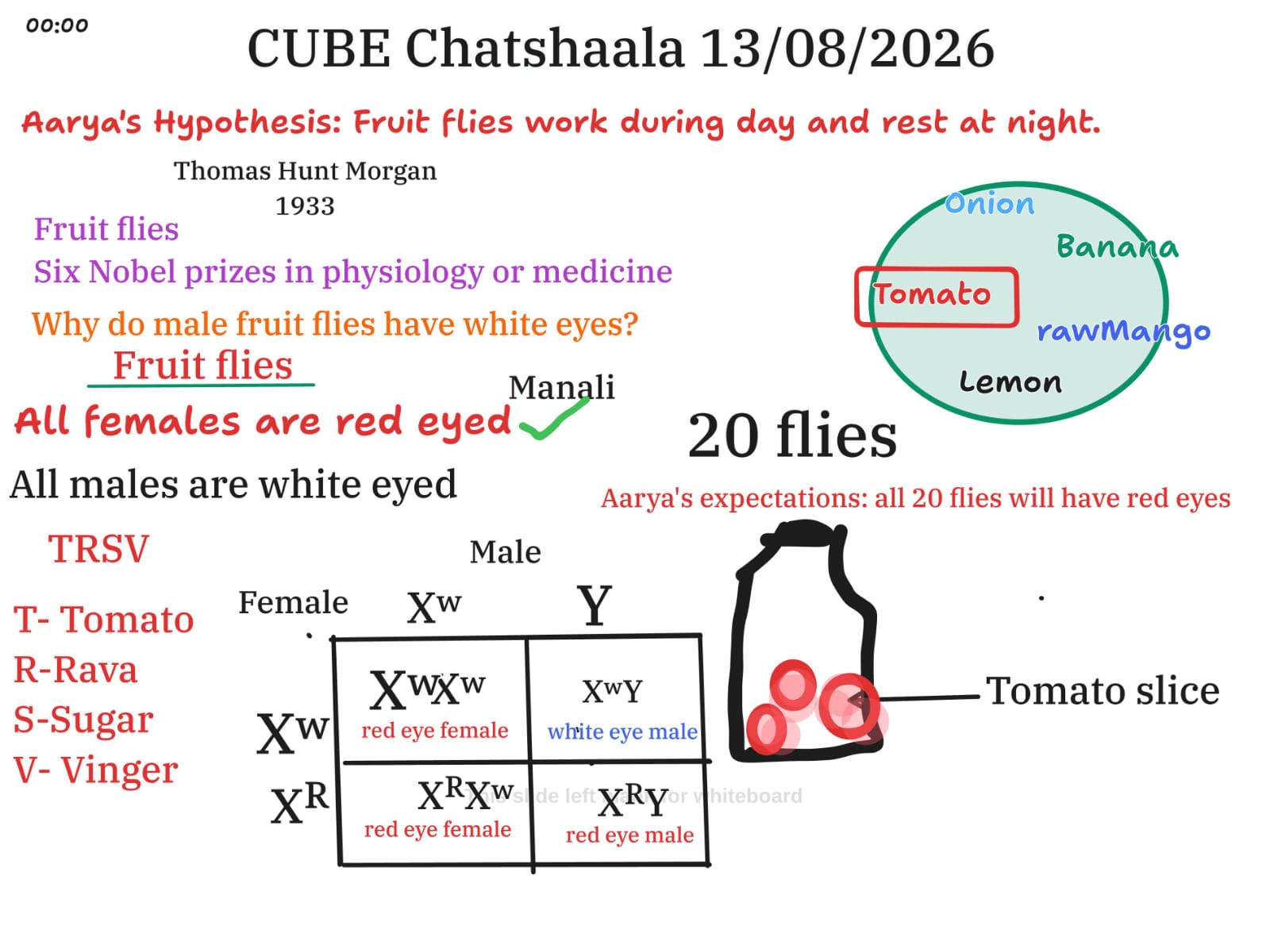
Food Trapping & Choice Preference: The team explored fruit fly attractants. A setup involving a culture jar with tomato slices was analyzed alongside expectations regarding fly capture. Aarya expected that all 20 captured test flies would have red eyes.
-
Substance Preferences: The participants discussed various food and olfactory sources mapped out in choice experiments, including onion, banana, raw mango, lemon, and tomato. Additionally, the TRSV media component framework (Tomato, Rava, Sugar, Vinegar) was highlighted as a foundational mixture for culturing and attracting fruit flies.
2. Drosophila Genetics & Inheritance Patterns
-
Historical Context: The discussion referenced Thomas Hunt Morgan’s landmark 1933 work and the legacy of fruit fly research, which has contributed to six Nobel Prizes in Physiology or Medicine.
-
Sex-Linked Inheritance: Participants examined the central question: Why do male fruit flies have white eyes while females typically exhibit red eyes?
-
Punnett Square Analysis: A cross involving sex chromosomes (X and Y) was detailed:
-
Female Genotype: X^w X^R (Red-eyed female carrier)
-
Male Genotype: X^w Y (White-eyed male)
-
Offspring Predictions:
-
X^w X^w: White-eyed female
-
X^R X^w: Red-eyed female
-
X^w Y: White-eyed male
-
X^R Y: Red-eyed male
-
-
3. Chromosome Architecture & Molecular Biology
-
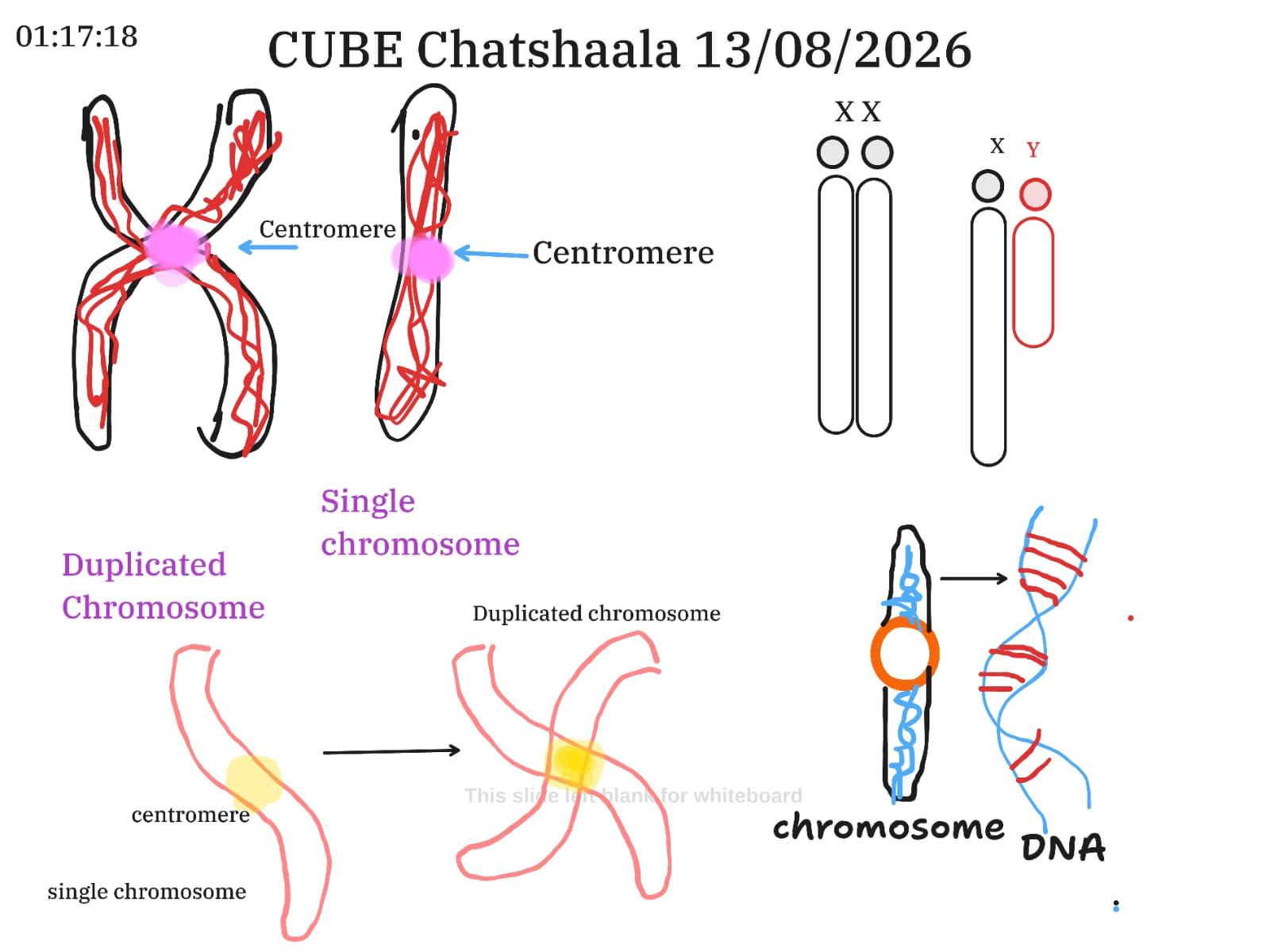
Structure & Duplication: The session transitioned into a physical analysis of chromosomes, distinguishing between a single chromosome (a single chromatid thread with a centromere) and a duplicated chromosome consisting of two sister chromatids joined at the centromere.
-
Sex Chromosome Morphology: Visual representations highlighted structural differences between the straight X chromosome and the distinctly shaped Y chromosome.
-
DNA Packaging: The conversation zoomed down to the molecular level, illustrating how double-stranded DNA helical molecules coil and pack tightly to form the higher-order structure of a chromosome.
 Provocative Questions
-
Behavior vs. Genetics: If Aarya’s hypothesis assumes flies are active by day and rest at night, how might circadian rhythms influence their foraging behavior and choice between food sources like banana versus tomato during different hours?
-
Genetic Ratio Realities: In the Punnett square cross (X^w X^R \\times X^w Y), we expect a 1:1 ratio of red-to-white eyes across sexes. Why might a real-world sample of 20 trapped flies deviate significantly from predicted Mendelian ratios?
-
Chromatid vs. Chromosome Counting: Why is a duplicated chromosome with two identical sister chromatids still counted as a single chromosome, and what physical landmark determines this definition?
-
Olfactory Selection: What specific volatile biochemical compounds in the TRSV mixture (Tomato, Rava, Sugar, Vinegar) trigger fly attraction compared to single-fruit traps like raw mango or lemon?
 What I Have Learned
-
Model Organism Significance: Fruit fly genetics serves as the bedrock of modern transmission genetics, illustrating principles that extend directly to human biology.
-
Visualizing Linkage: Understanding sex-linked traits requires mapping alleles specifically onto the X chromosome, as the Y chromosome lacks corresponding loci for eye color genes.
-
Chromosomal Clarification: A clear distinction was drawn between chromosome replication and chromosome count: counting centromeres is key to determining the actual number of chromosomes present during cell division phases.
-
Experimental Trapping Dynamics: Designing simple traps with TRSV media requires considering both physiological drives (hunger/odor attraction) and environmental variables like light and time of day.
TINKE Moments (This I Never Knew Earlier)
-
The Eye-Color Phenotype Discrepancy:
-
Challenge: Reconciling the initial statement that “All females are red-eyed / All males are white-eyed” with the actual genetic cross output which yields both red and white eyes in both sexes depending on parental genotypes.
-
Insight: Highlights the necessity of verifying parental genotypes rather than assuming wild-type dominance applies uniformly across all laboratory populations.
-
-
Single vs. Duplicated Chromosome Confusion:
-
Challenge: Conceptualizing how a chromosome changes from a single strand to an “X-shaped” duplicated structure while remaining a single functional chromosomal unit until anaphase separation.
-
Insight: Demonstrates a common barrier in learning genetics where the term “chromosome” is loosely applied to both un-duplicated chromatids and paired sister chromatids.
-
 Gaps and Misconceptions
-
Misconception on Sex-Linked Eye Color: Assuming that malunduplicated always have white eyes and females always have red eyes. White eyes are a recessive mutant phenotype (X^w); males only express it more frequently because they are hemizygous (XY), whereas females require two copies (X^w X^w) to show white eyes.
-
Circadian Generalization: Assuming fruit flies are strictly diurnal (“work by day, rest at night”) oversimplifies Drosophila activity patterns, which are often crepuscular—showing peaks of movement around dawn and dusk.
-
Chromatid vs. DNA Strand Gap: Confusing a single double-stranded DNA molecule with a duplicated two-chromatid chromosome. A single chromosome prior to replication consists of one double-stranded DNA helix, whereas a duplicated chromosome contains two identical double-stranded DNA molecules.
 Photographs during Chatshaala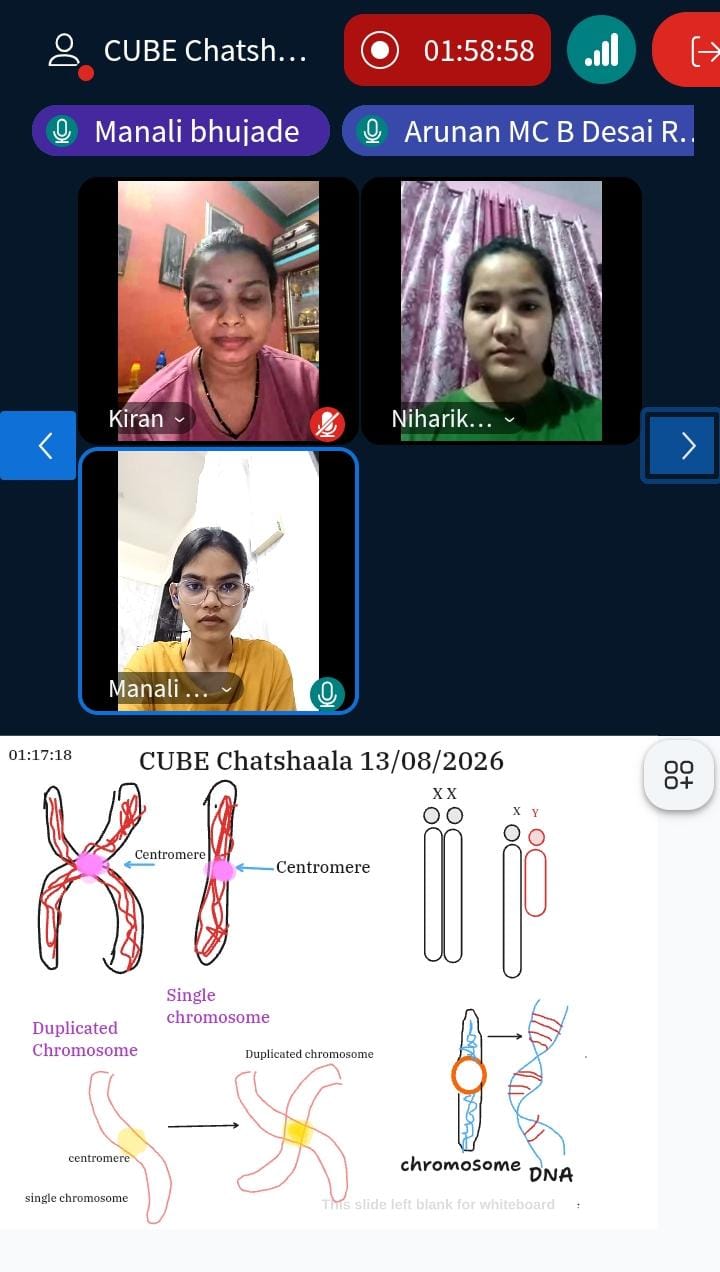
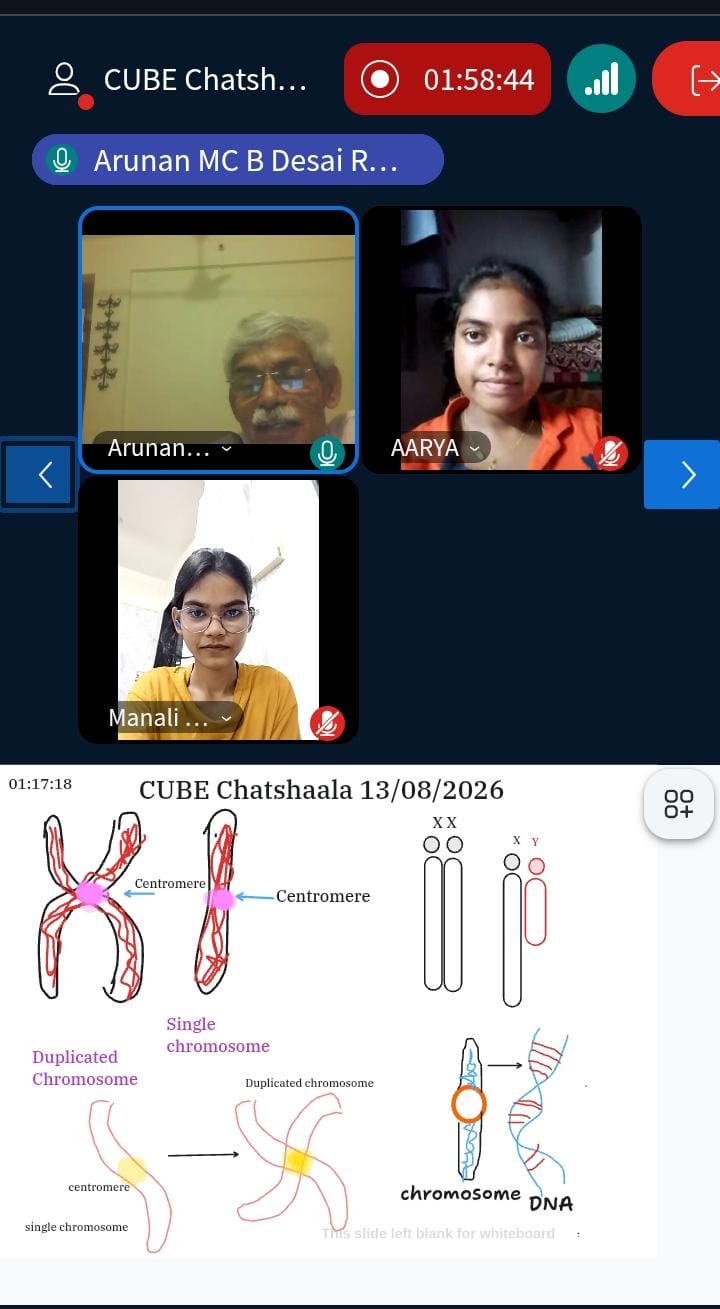
 Referance