 CUBE Chatshaala – Discussion Summary
Date: 22 May 2026
Today’s CUBE Chatshaala was a lively and genuinely enriching session. Two broad threads ran through the entire conversation — the first centred on Arunima’s field observations of Cardamine in Kozhikode, Kerala, and the second moved into a conceptual discussion on the distinction between a plant’s life cycle and its lifespan, using the Moong (green gram) plant as the central example. A quick but memorable diversion into plant classification, along with a CUET preparation question from Niharika, kept the session intellectually varied.
Arunima’s Cardamine Story from Kozhikode
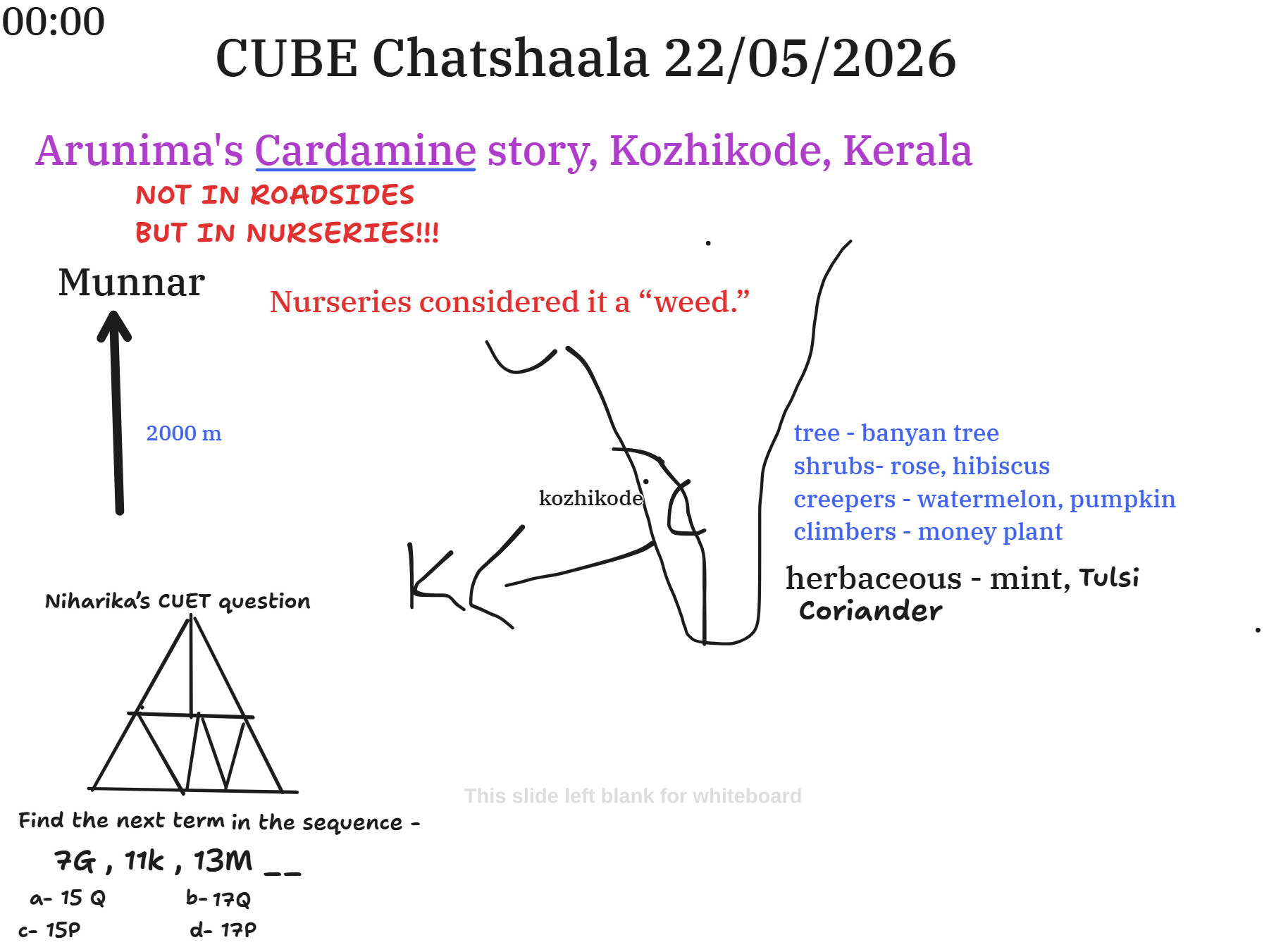
Arunima opened the session by sharing her field experience looking for Cardamine — a small herbaceous plant in the mustard family (Brassicaceae) — in and around Kozhikode. Her most striking observation was that Cardamine was completely absent from roadsides, where one might ordinarily expect to spot it as a spontaneous plant. Instead, she found it growing inside nurseries. This immediately raised an interesting question for the group: why would a plant that thrives at higher altitudes — Cardamine is commonly associated with cool, moist environments and is well-documented in places like Munnar, at elevations around 2000 metres — turn up in a coastal lowland nursery setting?
What made this even more thought-provoking was the attitude of the nursery workers themselves. They did not regard Cardamine as a cultivated or prized plant. To them, it was simply a weed — an uninvited occupant of their pots and beds. This is entirely consistent with how the term “weed” is understood in ecology and horticulture. According to Britannica, a weed is any plant growing where it is not wanted, regardless of its botanical identity or ecological value. The plant had not been deliberately introduced; it had simply appeared, presumably from spores or seeds carried in soil or through the air, and the nursery staff saw it as a nuisance rather than a subject of curiosity.
The group discussed what this pattern of distribution tells us. The fact that Cardamine appears in nurseries but not on roadsides in Kozhikode suggests it requires specific microhabitat conditions — possibly the shade, moisture, and cooler soil temperature that potted nursery environments can provide — rather than open, sun-exposed roadside conditions typical of a hot coastal city. This is a fine example of how a plant’s microhabitat preference can shape its distribution in ways that defy simple predictions.
Plant Classification Discussion
Following Arunima’s story, the group explored a classification of plants by growth form, which was noted on the whiteboard. The categories discussed were:
- Trees — represented by the banyan tree
- Shrubs — rose and hibiscus given as examples
- Creepers — watermelon and pumpkin cited
- Climbers — money plant noted
- Herbaceous plants — mint, Tulsi (holy basil), and coriander mentioned
This classification exercise grounded the conversation in everyday, observable biology and helped participants — particularly those preparing for competitive exams — connect familiar plants to formal botanical categories. The discussion naturally raised the question of where exactly Cardamine fits: it is a herbaceous plant, like mint or coriander, which partly explains why it would not survive easily on exposed, dry roadsides.
Niharika’s CUET Question
Niharika shared an interesting sequence-based problem from her CUET preparation:
Find the next term in the sequence: 7G, 11k, 13M, __
The options were: (a) 15Q, (b) 17Q, (c) 15P, (d) 17P.
The group worked through the pattern: the numbers 7, 11, and 13 are consecutive prime numbers, so the next prime is 17. The letters G, k, M follow a pattern tied to the periodic table — G(old? No — actually the group recognised these as initials of musical notes or, more likely, the letters correspond to positions). On closer examination, the letters are every other letter skipping two: G → K → M → Q (skipping H, I, J to K; skipping L to M; skipping N, O, P to Q). So the answer is 17Q, option (b). This was a brief but enjoyable logical puzzle that warmed up the group’s analytical thinking.
Life Cycle and Lifespan of the Moong (Green Gram) Plant
The second major segment of today’s session focused on a fundamental conceptual distinction that often confuses students: the difference between a plant’s life cycle and its lifespan.
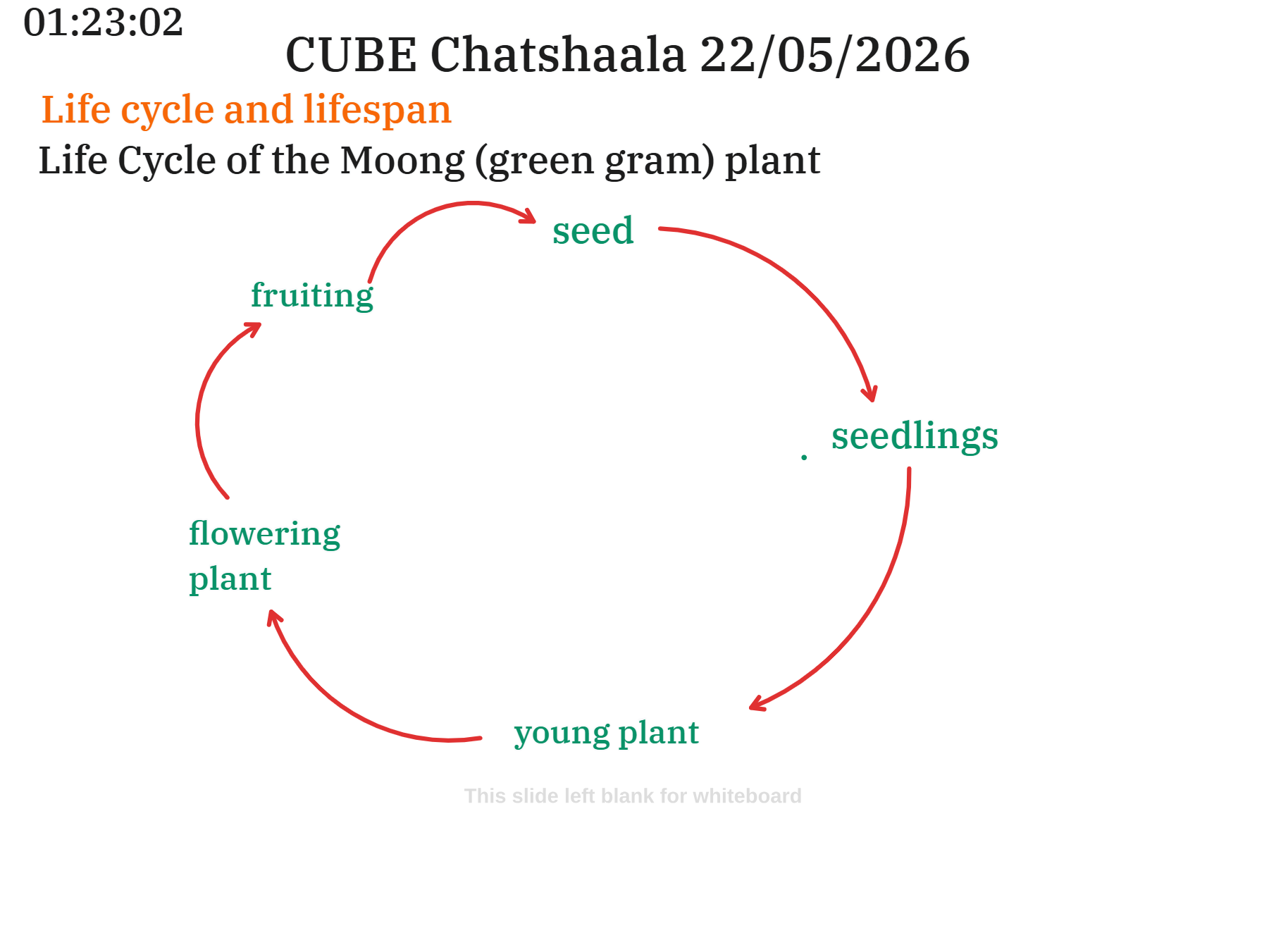
The whiteboard diagram showed the life cycle of the Moong (green gram, Vigna radiata) plant as a circular sequence:
Seed → Seedlings → Young Plant → Flowering Plant → Fruiting → back to Seed
The group discussed how the life cycle describes the sequence of developmental forms or stages an organism passes through — from germination to reproduction — and is essentially a qualitative, repeating biological pattern. The lifespan, on the other hand, is the actual duration of time the individual organism lives, from germination to natural death. For Moong, the lifespan is relatively short — approximately 60 to 90 days under normal growing conditions — making it an annual plant.
A key insight that emerged was this: two plants of the same species share the same life cycle (the same sequence of stages), but their individual lifespans may differ depending on environmental conditions, nutrition, and stress. This distinction between “pattern” and “duration” is easy to overlook but is biologically very significant.
The Moong example is also pedagogically powerful because it is a plant that many participants had grown themselves at home, making the abstract stages of a life cycle concrete and personally meaningful.
 Provocative Questions
-
Cardamine is found in Kozhikode’s nurseries but not on its roadsides, while it thrives naturally around Munnar at 2000 metres. What specific environmental factors — temperature, humidity, light intensity, or soil composition — do you think the nursery microhabitat shares with high-altitude conditions? Can you design a simple experiment to test one of these factors?
-
Nursery workers in Kozhikode consider Cardamine a weed. But by Britannica’s definition, a weed is simply “any plant growing where it is not wanted.” Does this mean the concept of a “weed” is entirely human-centric and contextual, with no biological basis? What does this tell us about how we impose value judgments on nature?
-
The Moong plant completes its life cycle in roughly 60–90 days. If you grew two Moong plants — one under ideal conditions and one under mild water stress — would their life cycles differ, or only their lifespans? What would change and what would remain the same?
-
In the plant classification discussed today, Cardamine was placed among herbaceous plants alongside mint, Tulsi, and coriander. What common structural or physiological features justify grouping these plants, and how do these features differ from those of shrubs like hibiscus?
-
Niharika’s CUET sequence question combined prime numbers with alphabetical skipping patterns. Can you construct a similar sequence using biological data — for example, chromosome numbers or the number of petals in flowers from a plant family — that a fellow student would need to decode?
-
If Cardamine seeds are being inadvertently brought into Kozhikode nurseries through commercial soil or plant material, what does this suggest about the unintended role of the horticultural trade in plant dispersal? Could this be a mechanism by which mountain species slowly colonise new altitudinal ranges under a warming climate?
-
The Moong life cycle diagram shows a smooth, closed loop: seed to fruiting and back to seed. But in reality, many individual plants fail to complete this cycle. What are the most common points of failure, and what does this tell us about the difference between a “population-level” life cycle and an individual organism’s life history?
 What I Have Learned
Today’s session reminded me that fieldwork rarely gives you what you expect — and that is precisely where the science begins. Arunima did not find Cardamine where she predicted she would, and instead of treating that as a failure, the group treated it as data. The absence of a plant from its expected location is itself an observation worth explaining.
I also came away with a much clearer sense of the difference between a life cycle and a lifespan. Before today, I likely would have used these terms loosely and interchangeably. The Moong diagram made it viscerally clear: the cycle is the shape of development, and the lifespan is the clock ticking alongside it. Both matter for understanding a species, but they answer entirely different questions.
The plant classification exercise reinforced that everyday plants around us — the coriander on the kitchen windowsill, the money plant climbing the wall — are living examples of biological categories we discuss abstractly in textbooks. CUBE’s approach of rooting everything in observable, accessible organisms makes these categories feel real rather than arbitrary.
Finally, Niharika’s CUET puzzle was a good reminder that pattern recognition — whether in number sequences or in biological phenomena — is a core scientific skill. The ability to spot what comes next in a series is not just an exam trick; it is the same cognitive habit that lets a biologist notice that a species is appearing in unexpected places and ask why.
 TINKE Moments (This I Never Knew Earlier)
TINKE 1: Cardamine in nurseries, not roadsides
Most participants assumed that a plant reported in the hills around Munnar would either be absent from Kozhikode entirely or, if present, would appear as a roadside weed. The discovery that it lives in nurseries — and is considered a nuisance weed there — was a genuine surprise. It shifted the framing from “is Cardamine present in Kozhikode?” to “what conditions in a coastal nursery mimic a high-altitude habitat enough to support this plant?”
TINKE 2: Nurseries as unintentional microhabitat refuges
The idea that commercial nurseries — spaces designed entirely for cultivated plants — can inadvertently host ecologically interesting species like Cardamine was new to many participants. It opens up the possibility that nurseries could serve as accidental biodiversity hotspots or as stepping-stones for altitude-associated plants moving into new regions.
TINKE 3: “Weed” is a relational, not biological, category
Many participants came in treating “weed” as a botanical classification. The discussion clarified that it is entirely relational — defined by human context and purpose. A plant is a weed only in relation to a place where someone does not want it. Cardamine is not inherently a weed; it becomes one the moment it occupies a nursery pot uninvited.
TINKE 4: Life cycle ≠ Lifespan
This was probably the most widely shared TINKE moment of the session. The distinction between these two terms — cycle as a sequence of stages, lifespan as the duration of individual survival — is rarely made explicit in standard teaching, and participants appreciated having it laid out clearly with the Moong diagram as a concrete reference.
Gaps and Misconceptions
Gap 1: Altitudinal ecology of Cardamine
The group discussed Cardamine’s distribution across altitude but did not go deeply into the specific physiological reasons why this plant is restricted to cooler, moister environments. A fuller discussion of its temperature and moisture tolerances — and how those relate to the nursery microhabitat — would strengthen the ecological argument considerably.
Gap 2: Verification of the CUET sequence answer
While the group arrived at 17Q through pattern recognition, the underlying logic of the letter sequence was not fully formalised during the session. It would be worth verifying whether the letter progression follows a strict rule or involves an element of ambiguity that could make another answer defensible.
Gap 3: Stages of the Moong life cycle — timing not discussed
The diagram showed the stages of the Moong life cycle clearly, but the session did not attach approximate timeframes to each stage. Knowing that germination takes 3–5 days, that the plant begins flowering at around 35–40 days, and that fruiting completes by 60–90 days would make the life cycle discussion much more concretely useful, especially for students linking it to agricultural practice.
Misconception 1: All herbaceous plants are small or delicate
In the classification discussion, there may be an implicit assumption that herbaceous plants are necessarily small or fragile. In reality, many herbaceous plants — including some species of banana, which lack woody tissue — can be quite large. Clarifying that “herbaceous” refers to the absence of persistent woody stems, not to size, would prevent a common conflating of the two.
Misconception 2: Life cycle = lifespan (already partly addressed)
As noted above, this conflation is common and was directly addressed in today’s session. However, it may persist in practice if students continue to see the two terms used interchangeably in their textbooks or exam materials. Explicit, repeated distinction — as done today using the Moong diagram — is the best remedy.
Misconception 3: A weed is a specific type of plant
Some participants initially treated “weed” as a botanical category equivalent to a plant family or growth form. Clarifying that, with the Britannica definition as backing, it is a functional and contextual label — not a taxonomic one — is important for precision in biological thinking.
 Photographs during Chatshaala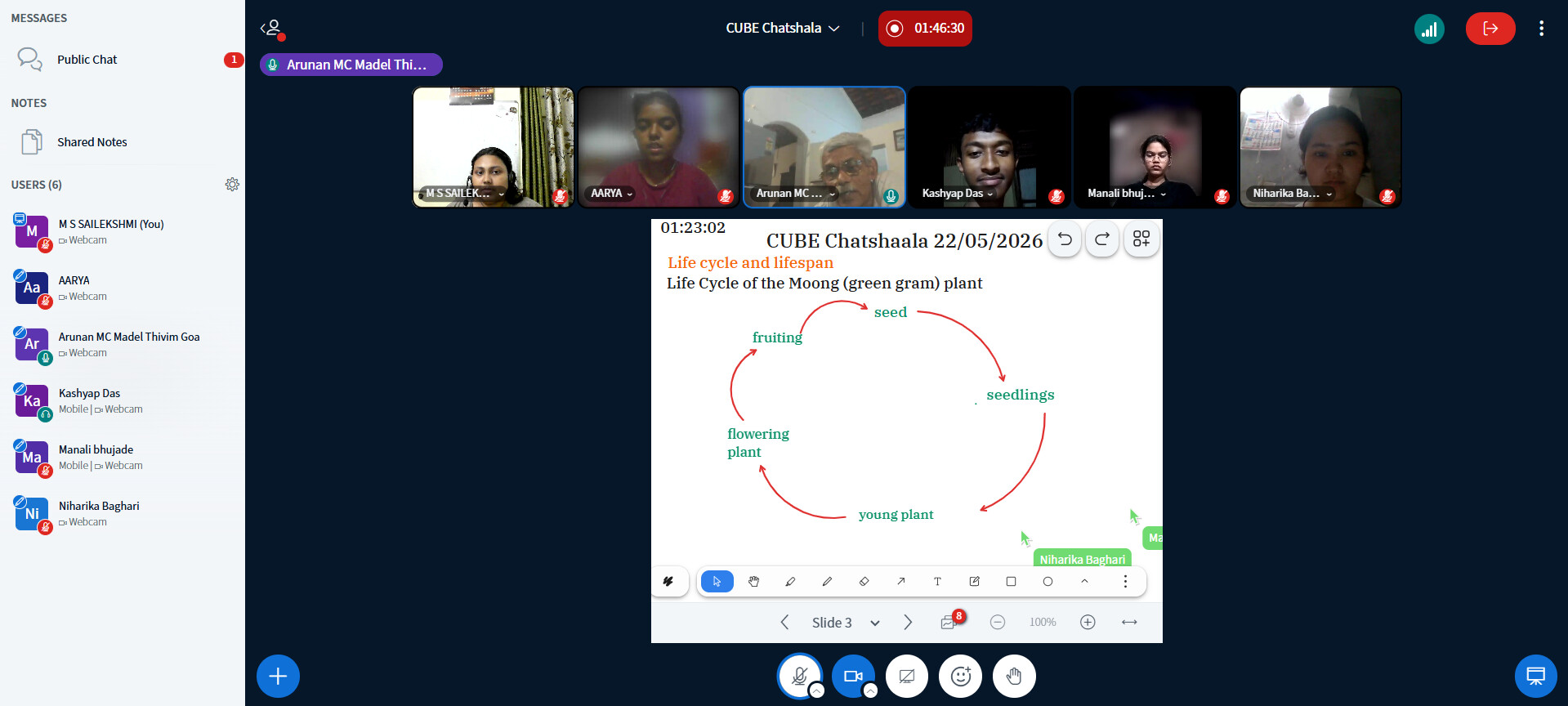
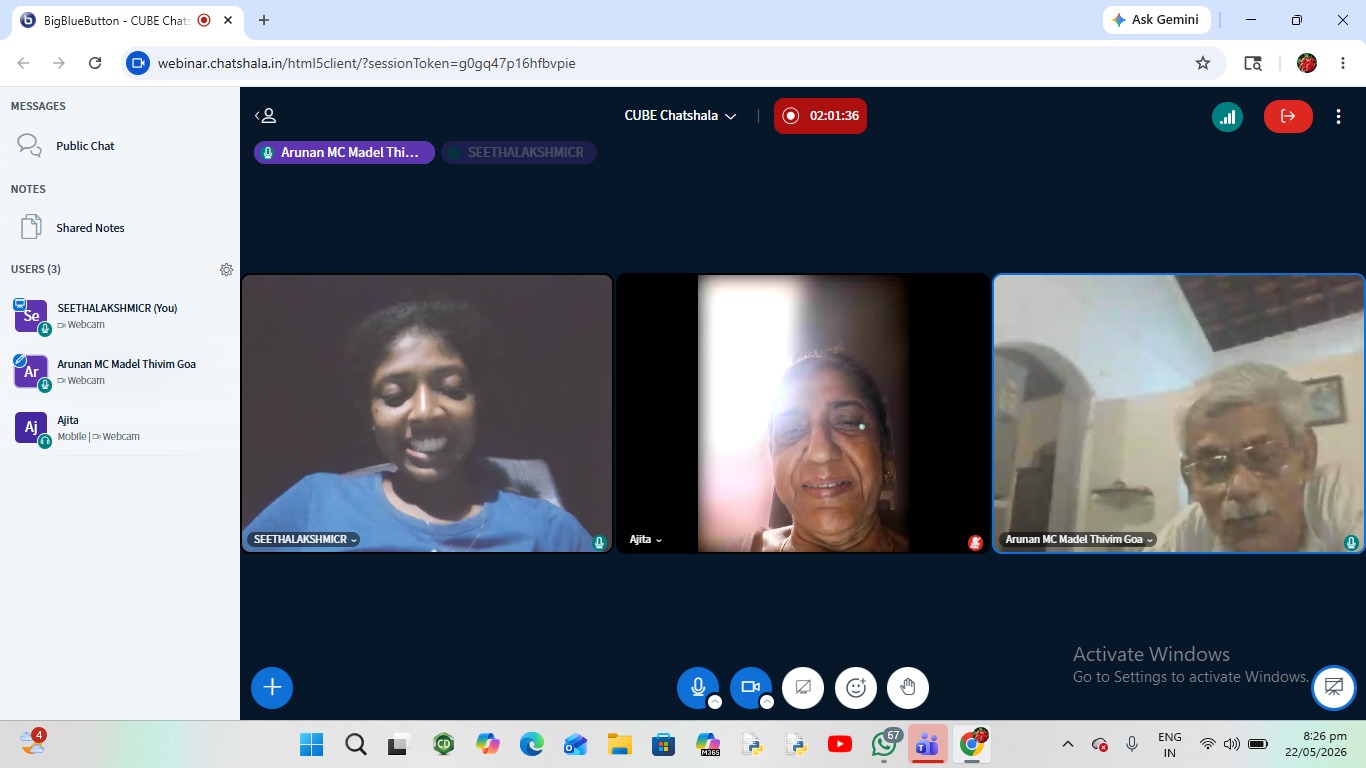
 Referance