CUBE ChatShaala – 03 January 2026
Whiteboard Summary & Reflections
The ChatShaala session on 03/01/2026 unfolded as a rich, interdisciplinary dialogue that moved fluidly between observation, basic scientific reasoning, and applied biological techniques. The discussions were anchored strongly to the whiteboard explorations, allowing ideas to evolve visibly and collaboratively.
Meeting Summary
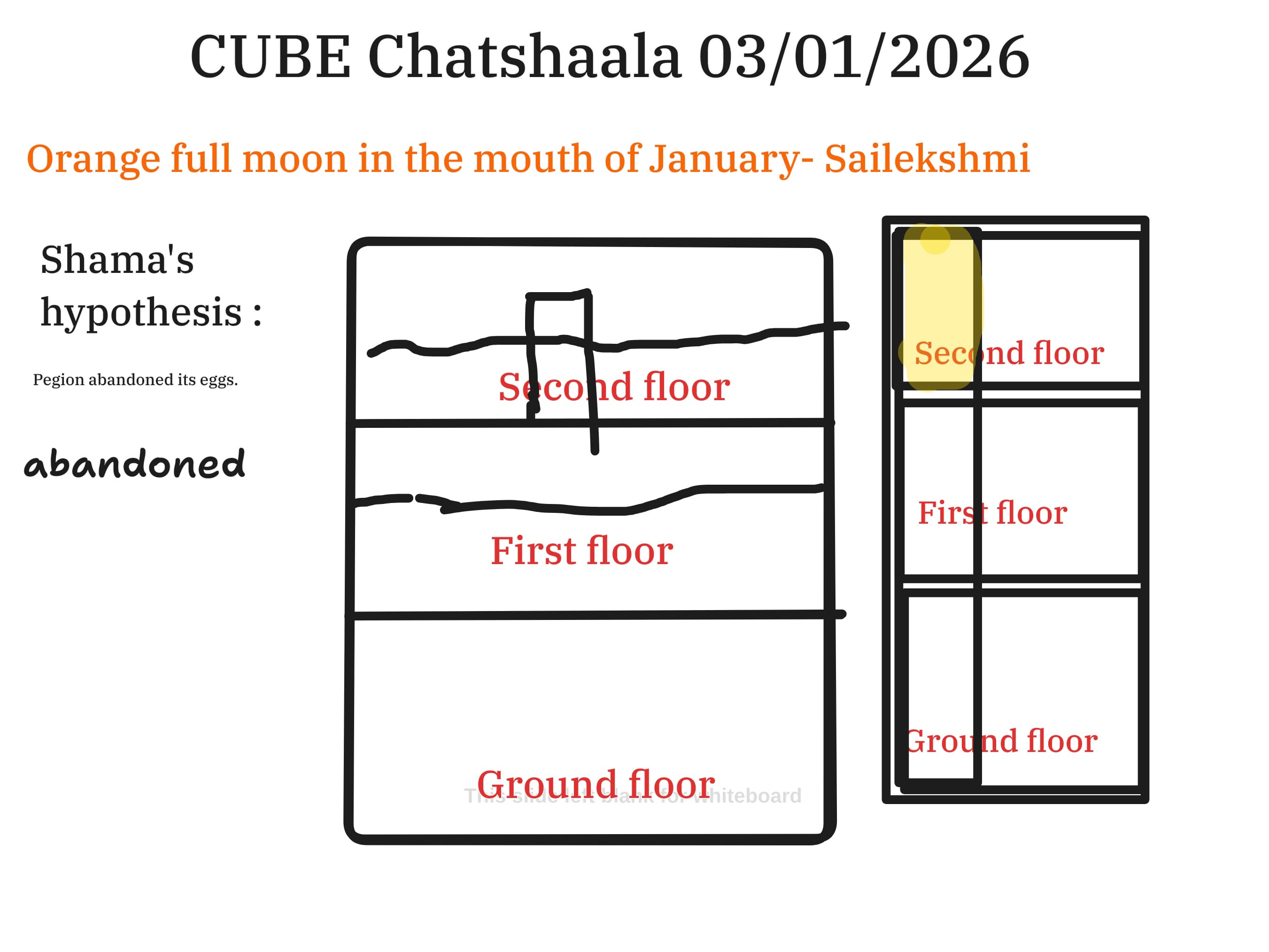
The session opened with a reflective observation titled “Orange Full Moon in the Month of January”, which set a contemplative tone by Sailekshmi . Then it leads to the observation of Shama’s hypothesis regarding a pigeon abandoning its eggs.The spatial sketch of a multi-storeyed building (ground, first, and second floors) helped contextualize environmental and positional factors that might influence animal behavior. Rather than settling on a single cause, the group examined how disturbance, height, light exposure, and human activity could interplay, reinforcing the idea that biological outcomes are often multifactorial.
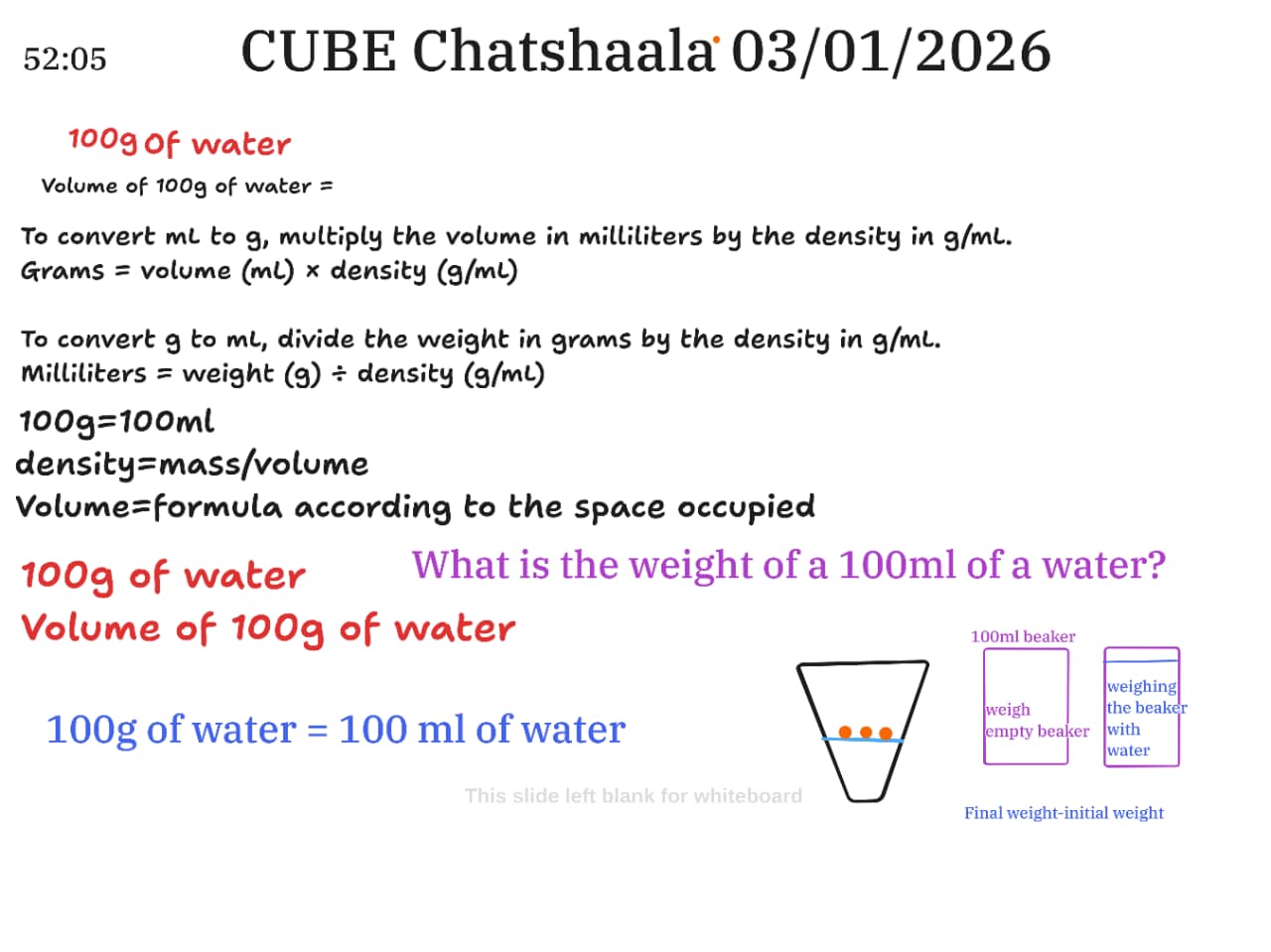
The discussion then transitioned into a quantitative exploration of mass, volume, and density, using water as a reference substance. The group revisited the foundational relationship:
Density = Mass / Volume, clarifying why 100 g of water corresponds to 100 ml under standard conditions. This led naturally to the question, “What is the weight of 100 ml of water?”, which helped participants distinguish between intuitive assumptions and scientifically grounded answers.
From water, the conversation expanded to cooking and oil conversions, highlighting that unlike water, oils do not follow a 1:1 mass–volume relationship. Examples such as sunflower oil (≈910 g per litre) and groundnut oil demonstrated how density variations affect real-life measurements. The livelytable reference supported this discussion, grounding it in everyday applicability and reinforcing that “volume” and “weight” are context-dependent concepts.
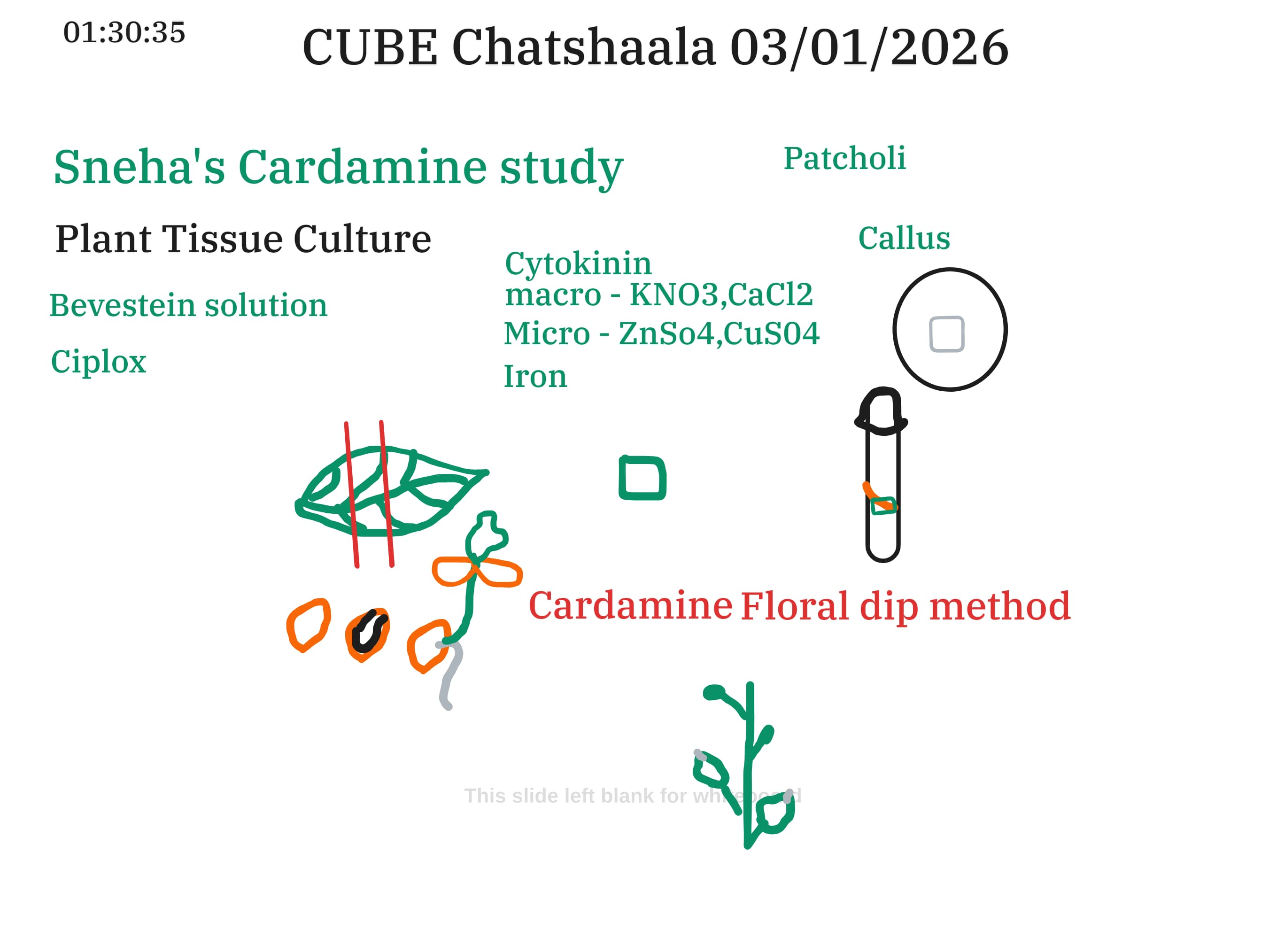
In the latter half of the session, Sneha presented her Cardamine study & Plant Tissue Culture study, shifting the focus from physical chemistry to applied plant biotechnology. Key elements discussed included sterilization agents (Bevestin solution, Ciplox), nutrient composition (macro- and micronutrients such as KNO₃, CaCl₂, ZnSO₄, CuSO₄, and iron), callus formation, and the floral dip method. The sketches of explants, callus, and culture tubes made the process tangible and accessible, even for those new to tissue culture techniques.
Overall, the session exemplified ChatShaala’s strength: weaving together observation, calculation, and experimentation into one coherent learning experience.
 Proactive Questions to Inspire
-
What assumptions do we unknowingly carry from school science into everyday life?
-
How much of behavior is shaped by environment, and how much by disturbance we fail to notice?
-
From kitchens to laboratories, how do context and material properties redefine ‘accuracy’?
-
What does tissue culture teach us about the future of agriculture and conservation?
 What I Learned Today
-
Simple formulas, like density = mass/volume, gain real meaning only when applied across different substances.
-
Water is the exception, not the rule, when it comes to mass–volume equivalence.
-
Everyday practices such as cooking measurements are deeply rooted in scientific principles, even if we rarely acknowledge them.
-
Plant tissue culture is not just a laboratory technique but a bridge between theoretical biology and real-world applications.
 TINKE Moments (This I Never Knew Earlier)
-
Oils can vary significantly in weight per litre, even when their volumes look identical.
-
A basic observational sketch can open up complex ecological and behavioral discussions.
-
Callus formation is not just a stage in tissue culture but a powerful symbol of cellular potential and regeneration.
 Gaps and Misconceptions
-
The assumption that all liquids behave like water in terms of weight and volume.
-
Confusion between “weight” and “mass” when discussing measurements.
-
An initial tendency to look for single-cause explanations in biological behavior, rather than interconnected factors.
-
Limited awareness of how carefully controlled sterilization and nutrient balance are in plant tissue culture.
 Photographs during Chatshaala
Closing Reflection
Today’s ChatShaala reminded us that learning thrives at the intersection of curiosity and clarity. Whether observing a moonlit building, weighing a beaker of water, or culturing a fragment of plant tissue, the session reinforced one core idea: science becomes meaningful when we question the obvious and connect it to lived experience.
 Reference