 CUBE ChatShaala—Meeting Summary
Date: 27 January 2026
Session Theme: rDNA Technology and Plant Genetic Engineering (Bt Cotton as a Case Study)
Meeting Summary
Purpose of the Session
The session aimed to build a clear conceptual understanding of recombinant DNA (rDNA) technology through the practical example of Bt cotton, focusing on how genetic engineering is used to protect crops from insect pests such as the cotton bollworm.
Summary of Discussion
The discussion began with an overview of rDNA technology, emphasizing its role in modern agriculture. Using cotton as the reference plant, the group explored how pest resistance can be introduced by transferring a specific gene rather than the entire organism.
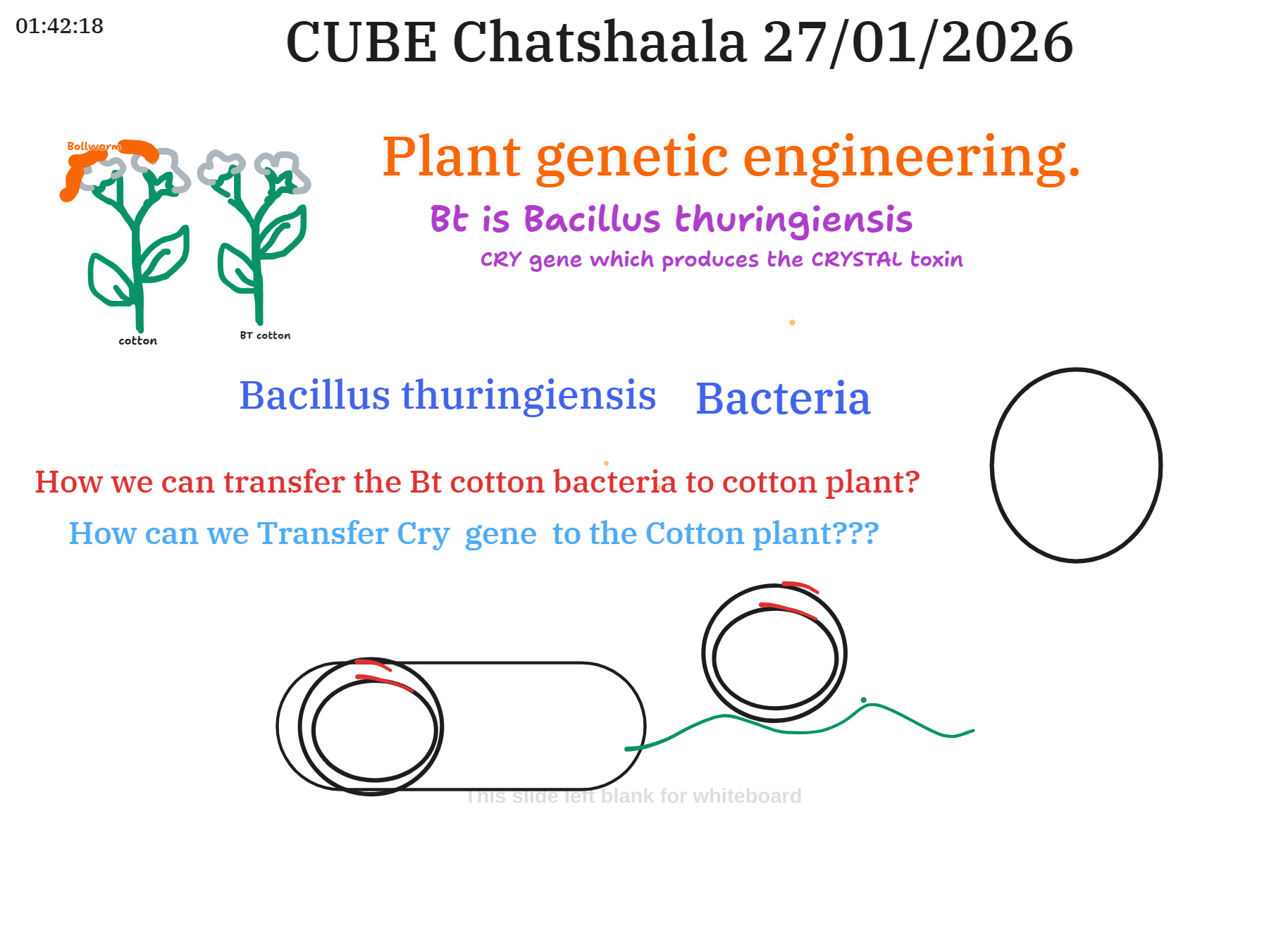
The facilitator explained that Bt cotton derives its insect-resistant property from Bacillus thuringiensis, a soil bacterium. This bacterium produces a Cry (crystal) protein, which is toxic to certain insect larvae, particularly the cotton bollworm. Through genetic engineering, the cry gene is isolated and inserted into the cotton plant genome.
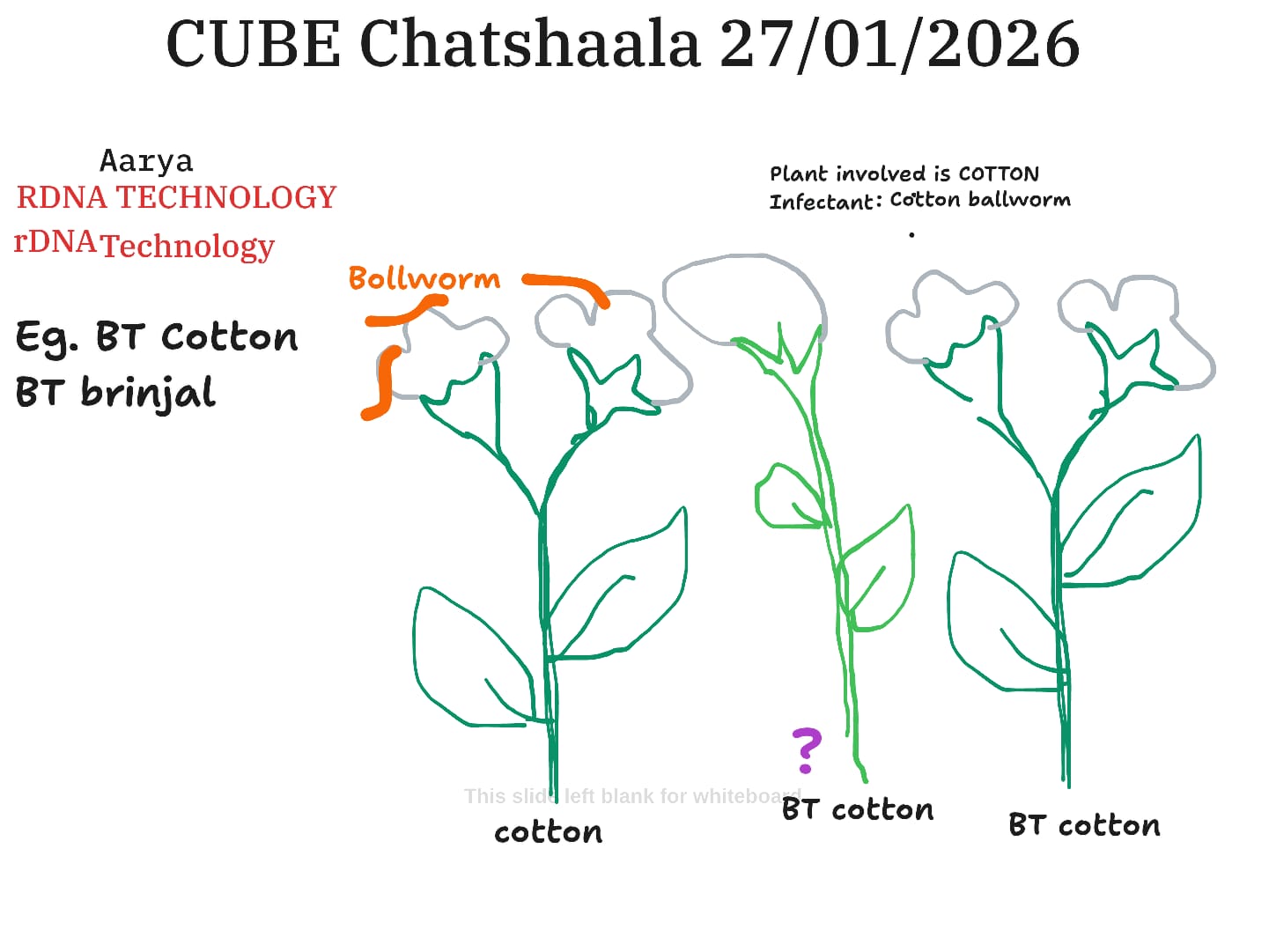
Whiteboard sketches were used to compare:
- Normal cotton plants affected by bollworm infestation
- Bt cotton plants remaining healthy due to internal production of Cry toxin
A key focus was placed on how the gene is transferred, clarifying that the bacterium itself is not introduced into the plant. Instead, molecular tools (vectors) are used to insert the cry gene into the plant’s DNA so that the trait is inherited and continuously expressed.
The session concluded by linking Bt cotton to broader themes in plant biotechnology, sustainability, and reduced pesticide dependence.
Key Takeaways
-
Bt cotton is a genetically engineered crop developed using rDNA technology.
-
Only the cry gene, not the whole bacterium, is transferred to the plant.
-
The Cry protein specifically targets bollworm larvae without harming the plant.
-
Genetic engineering differs fundamentally from traditional breeding methods.
-
Bt crops illustrate how biotechnology can address real agricultural challenges.
 Whiteboard-Based Follow-Up Questions
-
Based on the diagram showing Bacillus thuringiensis, what exactly is transferred into cotton—whole cells or a gene fragment?
-
Referring to the damaged vs. healthy cotton sketches, how does the Cry toxin specifically affect bollworm gut?
-
Looking at the single-gene (cry) emphasis on the board, what are the advantages and risks of relying on one gene for pest resistance?
-
From the plant comparison drawing, should Bt cotton be considered a pesticide or a genetic trait—and why?
-
Considering the repeated healthy Bt cotton sketches, how might long-term use affect bollworm populations?
 What I Have Learned
-
Genetic engineering works at a molecular level, not at the level of whole organisms.
-
Bt cotton is an example of precision intervention, not random modification.
-
Scientific diagrams greatly simplify complex biological processes.
-
Misunderstandings about GM crops often arise from unclear explanations, not evidence.
 TINKE Moments (This I Never Knew Earlier)
-
rDNA technology provides targeted solutions to agricultural problems.
-
The specificity of the Cry toxin is central to the safety of Bt crops.
-
Explore gene transfer vectors such as Agrobacterium tumefaciens.
-
Bt cotton is a genetic trait, not a chemical treatment.
-
Ability to explain Bt cotton development in simple biological terms.
 Gaps and Misconceptions Identified
Misconception 1:
“Bt cotton contains live bacteria.”
Correction: Only the cry gene is transferred, not the bacterium itself.
Misconception 2:
“Bt cotton kills all insects.”
Correction: Cry proteins are species-specific and mainly affect bollworm larvae.
Gap 1:
Unclear understanding of gene transfer methods.
Clarification: Gene transfer is mediated by vectors, not direct bacterial infection.
Gap 2:
Confusion between hybrid crops and GM crops.
Clarification: Hybridization occurs within species; genetic engineering can cross species barriers.
 Photograph during Chatshaala

 Reference