 CUBE ChatShaala – Discussion Summary (12/03/2026)
Today’s ChatShaala session revolved around citizen science in genetic engineering, with a strong focus on plant biology, entomology, and the broader implications of biotechnology in agriculture.
-
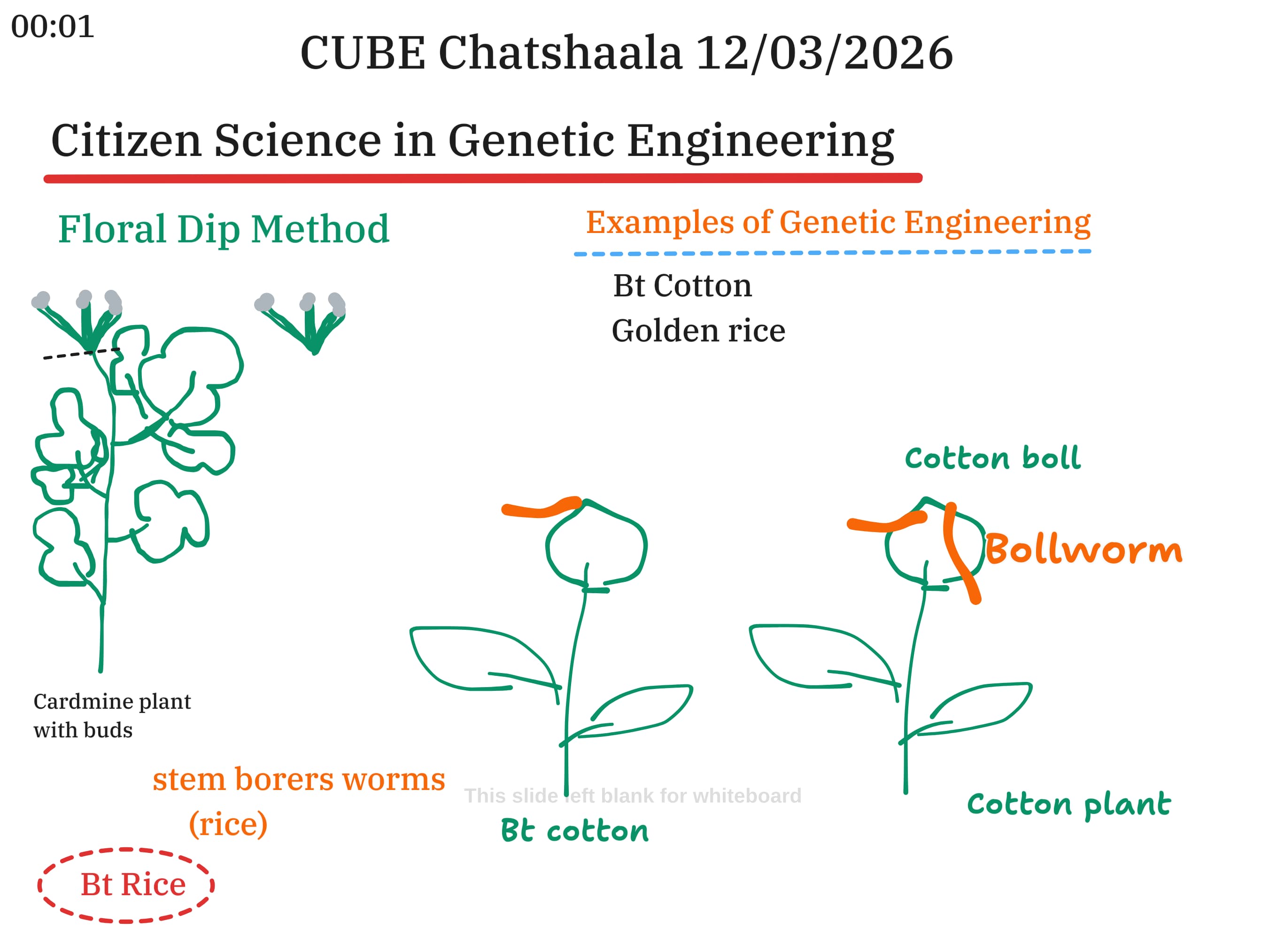
Floral Dip Method: The group discussed the floral dip technique using Cardamine plants, where flower buds are dipped in a solution to introduce genetic material. This method was highlighted as a simple yet powerful citizen science experiment for genetic transformation.
-
Genetically Engineered Crops: Examples such as Bt Cotton, Bt Rice, and Golden Rice were examined. Bt cotton is shown to resist bollworms, while Bt Rice targets stem borers. Golden Rice was discussed as a nutritional intervention against Vitamin A deficiency.
-
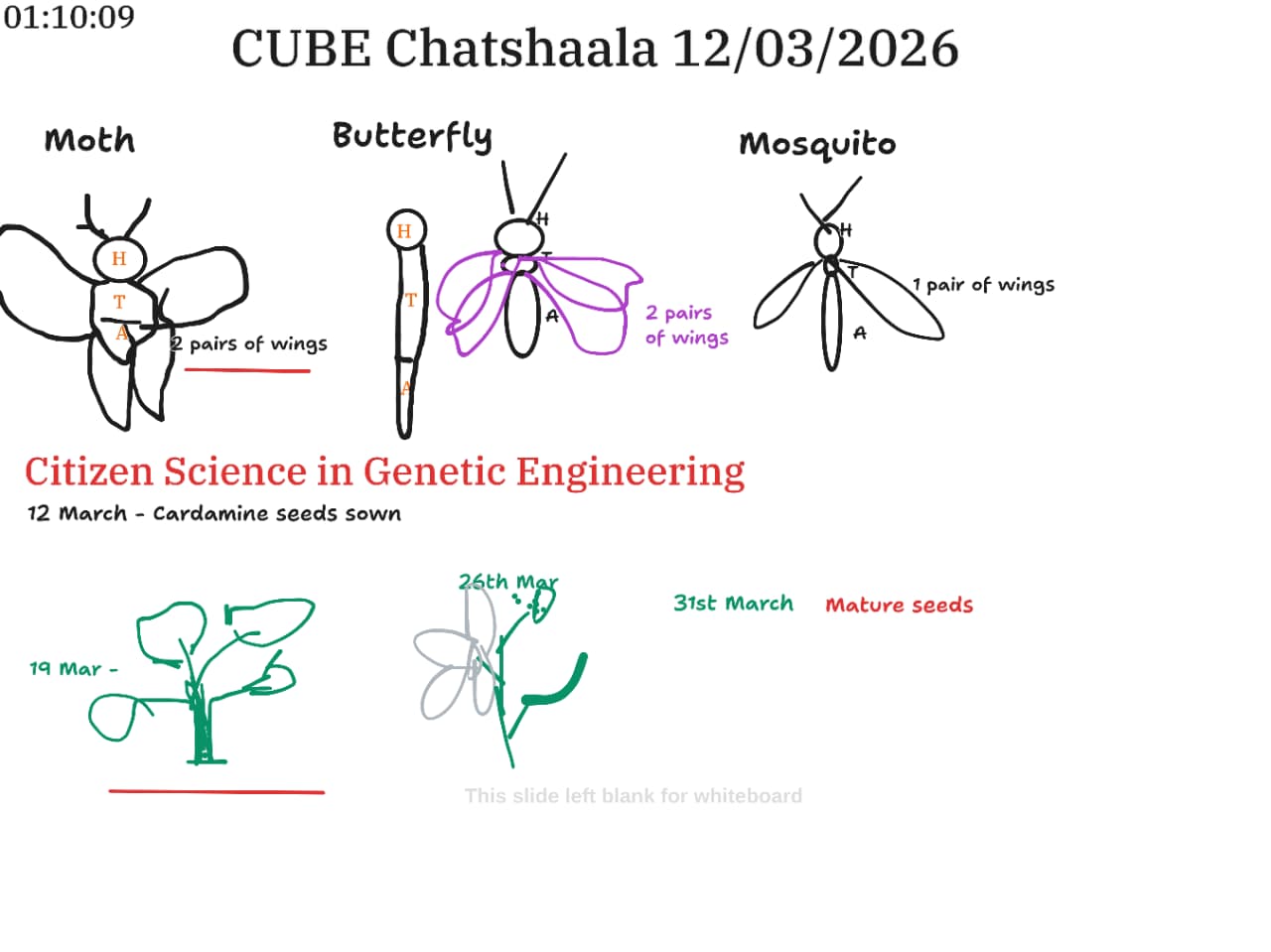
Entomology Connections: Diagrams of moths, butterflies, and mosquitoes were used to compare insect anatomy (head, thorax, abdomen) and wing pairs. This tied into pest biology, showing how understanding insect life cycles is crucial for crop protection.
-
Seed-to-Seed Timeline in Cardamine: Participants tracked the growth stages of Cardamine from sowing (12 March) to seed maturity (31 March), emphasizing the rapid life cycle and its suitability for genetic studies.
-
Citizen Science Perspective: The discussion reflected on whether genetic engineering is inevitable in agriculture, weighing benefits (pest resistance, nutrition) against ecological and ethical concerns.
 Provocative Questions
-
How does the floral dip method democratize genetic engineering for citizen scientists compared to lab-based techniques?
-
Could Bt crops unintentionally affect non-target insects such as butterflies or beneficial pollinators?
-
What lessons can be drawn from the rapid seed-to-seed cycle of Cardamine for accelerating citizen-led experiments?
-
Is Golden Rice a sustainable solution to malnutrition, or does it risk oversimplifying complex dietary challenges?
-
How might citizen science projects bridge the gap between entomology and genetic engineering in real-world agriculture?
-
Should genetic engineering be considered inevitable in agriculture, or can ecological farming practices provide viable alternatives?
 What I Have Learned
-
The Floral Dip Method is a remarkably accessible technique, making genetic engineering approachable for non-specialists.
-
Bt crops illustrate both the promise and controversy of biotechnology: they solve pest problems but raise ecological concerns.
-
The Cardamine plant is an ideal citizen science model due to its short life cycle, allowing rapid experimentation and observation.
-
Understanding insect anatomy and life cycles is not just academic—it directly informs strategies for crop protection.
-
Citizen science can play a transformative role in democratizing biotechnology, but it must be paired with critical reflection on ethics and sustainability.
TINKE Moments (This I Never Knew Earlier)
-
Cardamine’s Seed-to-Seed Speed: Discovering that Cardamine completes its life cycle in just a few weeks was eye-opening. It challenges assumptions about plant growth timelines and opens new avenues for rapid experimentation.
-
Bt Rice and Stem Borers: Many participants were surprised to learn that Bt technology is being extended beyond cotton to rice, targeting stem borers—a pest often overlooked in citizen discussions.
-
Entomology Linkages: The comparison of moths, butterflies, and mosquitoes clarified how insect morphology directly connects to agricultural pest management.
-
Citizen Science in Genetic Engineering: The realization that ordinary citizens can meaningfully engage in genetic engineering experiments was both empowering and thought-provoking.
 Gaps and Misconceptions
-
Some participants assumed Bt crops eliminate pests entirely, but in reality, pests can develop resistance over time.
-
There was confusion between Golden Rice as a nutritional supplement and the broader issue of dietary diversity—highlighting the need to distinguish between single-trait solutions and holistic nutrition.
-
A few misconceptions arose around mosquitoes and wing pairs, reminding us that careful observation is essential in entomology.
-
Ethical debates around genetic engineering sometimes leaned toward extremes, suggesting a need for more nuanced discussions balancing risks and benefits.
 Reference
-
🌿 Seed to Seed in Weeks – Discovering the Hidden Power of Cardamine
-
https://www.sciencedirect.com/topics/agricultural-and-biological-sciences/parboiling
-
https://www.entsoc.org/sites/default/files/files/Science-Policy/2018/ESA-Factsheet-Bt.pdf
-
Moth Vs Butterfly: How To Tell The Difference, Pictures & Examples