 CUBE ChatShaala – Discussion Summary (03/04/2026)
The session focused on understanding the mutualistic relationship between Rhizobium bacteria and leguminous plants, with a practical orientation toward observing root nodule formation. The central objective was clear but narrow: to compare nodule development in soybean, fenugreek, and green gram, while also examining a control setup using non-leguminous seeds (mustard).
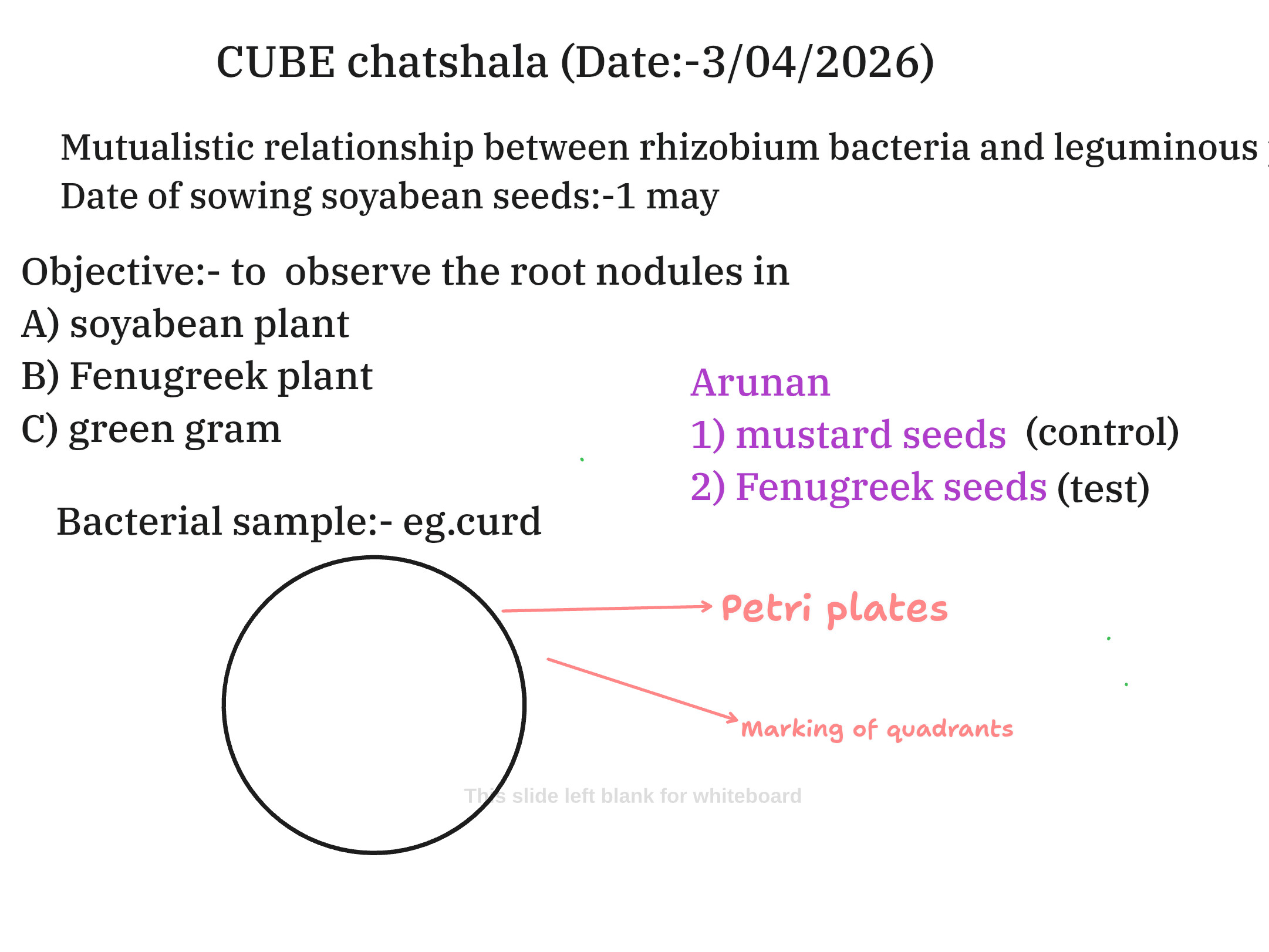
The discussion established that root nodules are not present at the initial stages of germination. Participants acknowledged that Rhizobium infection begins only after root emergence, meaning any expectation of early-stage nodulation is scientifically incorrect. This corrected a common misunderstanding early in the session.
A simple experimental design was proposed:
- Test plants: Fenugreek (legume)
- Control plants: Mustard (non-legume)
- Observation target: Presence or absence of nodules
- Medium: Petri plates divided into quadrants for structured comparison
- Bacterial source: Informal example (curd) was mentioned, though this is biologically flawed for Rhizobium work
The group also briefly connected the experiment to broader plant biology concepts using examples like Cardamine, a fast-growing model plant. This highlighted how rapid plant life cycles can support quick experimental observations.
However, the methodology lacked rigor. The use of “curd” as a bacterial sample indicates confusion between lactic acid bacteria and nitrogen-fixing bacteria, which are fundamentally different. No clear protocol for Rhizobium inoculation, sterilization, or controlled growth conditions was outlined.
Overall, the discussion was conceptually sound but experimentally weak. The idea is valid; the execution needs correction.
 Provocative Questions
-
If nodules form only after root development, why design observations starting from Day 1 without accounting for biological timelines?
-
What exactly is being tested if the bacterial source is not Rhizobium? Isn’t the experiment invalid at that point?
-
Why use mustard as a control instead of including a non-inoculated legume for a more meaningful comparison?
-
How would results differ between sterile soil vs natural soil conditions?
-
Can nodulation efficiency be quantified instead of just observed qualitatively?
-
What role do environmental factors (moisture, pH, temperature) play in Rhizobium infection success?
-
Why was Cardamine introduced—does it serve the experiment, or is it a conceptual distraction?
 What I Have Learned
-
Root nodules are not immediate structures; they form only after successful bacterial infection of roots.
-
Rhizobium specifically associates with leguminous plants, not all plants.
-
A valid experiment requires correct bacterial inoculum, not random microbial sources.
-
Controls must be logically designed, not just different species for the sake of comparison.
-
Fast-growing plants like Cardamine can accelerate observation cycles, but relevance to the core experiment must be justified.
 TINKE Moments (This I Never Knew Earlier)
-
Critical Misunderstanding Identified
The assumption that nodules might appear immediately after sowing was corrected. This was a key conceptual shift. -
Experimental Design Weakness Exposed
The suggestion to use curd as a bacterial source revealed a fundamental error. This exposed a gap in microbiological understanding. -
Control vs Test Confusion
Using mustard as a control without a non-inoculated legume showed incomplete experimental thinking. -
Surface-Level Planning
The use of petri plates and quadrants looked organized, but lacked scientific depth—no mention of sterilization, replication, or variables.
 Gaps and Misconceptions
-
Incorrect Bacterial Source
Curd contains Lactobacillus, not Rhizobium. This invalidates the experiment if used. -
Lack of Timeline Awareness
Nodulation takes days to weeks. Immediate observation is pointless. -
Weak Control Design
A proper control should isolate variables, not just change plant type. -
No Mention of Inoculation Method
Without proper Rhizobium inoculation, nodules will not form reliably. -
Missing Environmental Controls
Factors like soil sterility, moisture, and temperature were ignored.
 Photographs during ChatShaala
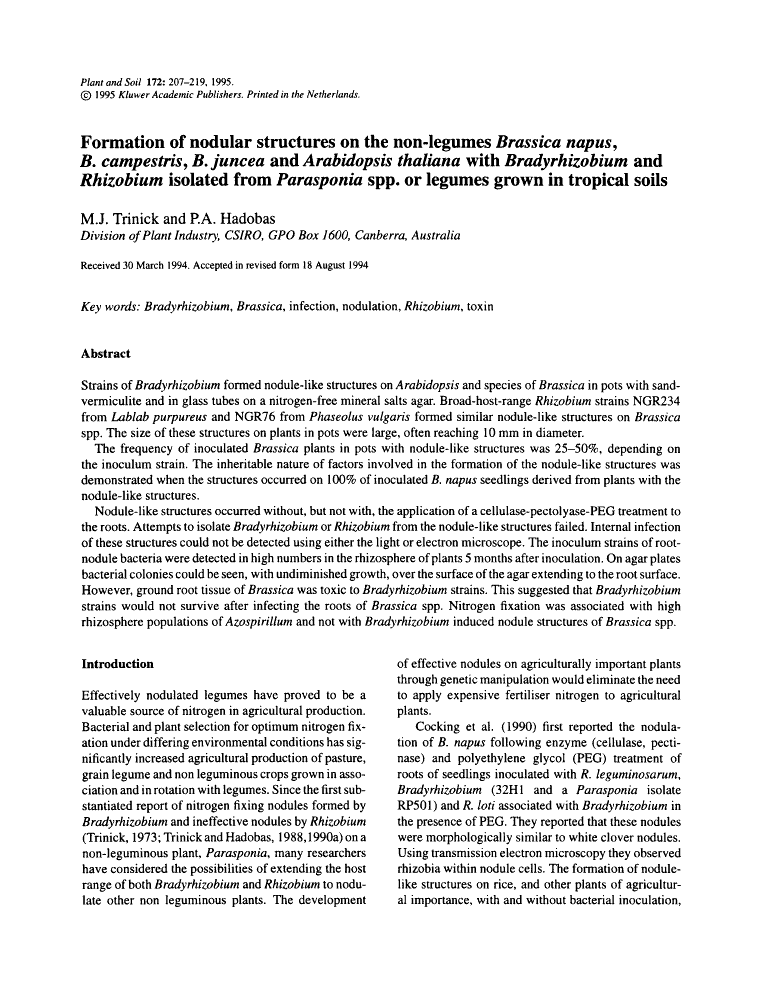
 Reference