 CUBE Chatshaala - Discussion Summary
Date: 22/04/2026 | Topic: Zebrafish Care & Aquaculture Basics
Today’s CUBE Chatshaala session focused on the B.Sc. The Zoology 4th Semester curriculum covered topics from their current syllabus, including Livestock Management, Fisheries Science (Part II), Evolution & Zoogeography, and Chordate Diversity – II. The session, however, took on a deeply practical and inquiry-driven tone as the discussion centred around hands-on zebrafish (Danio rerio) maintenance and its connection to aquaculture concepts.
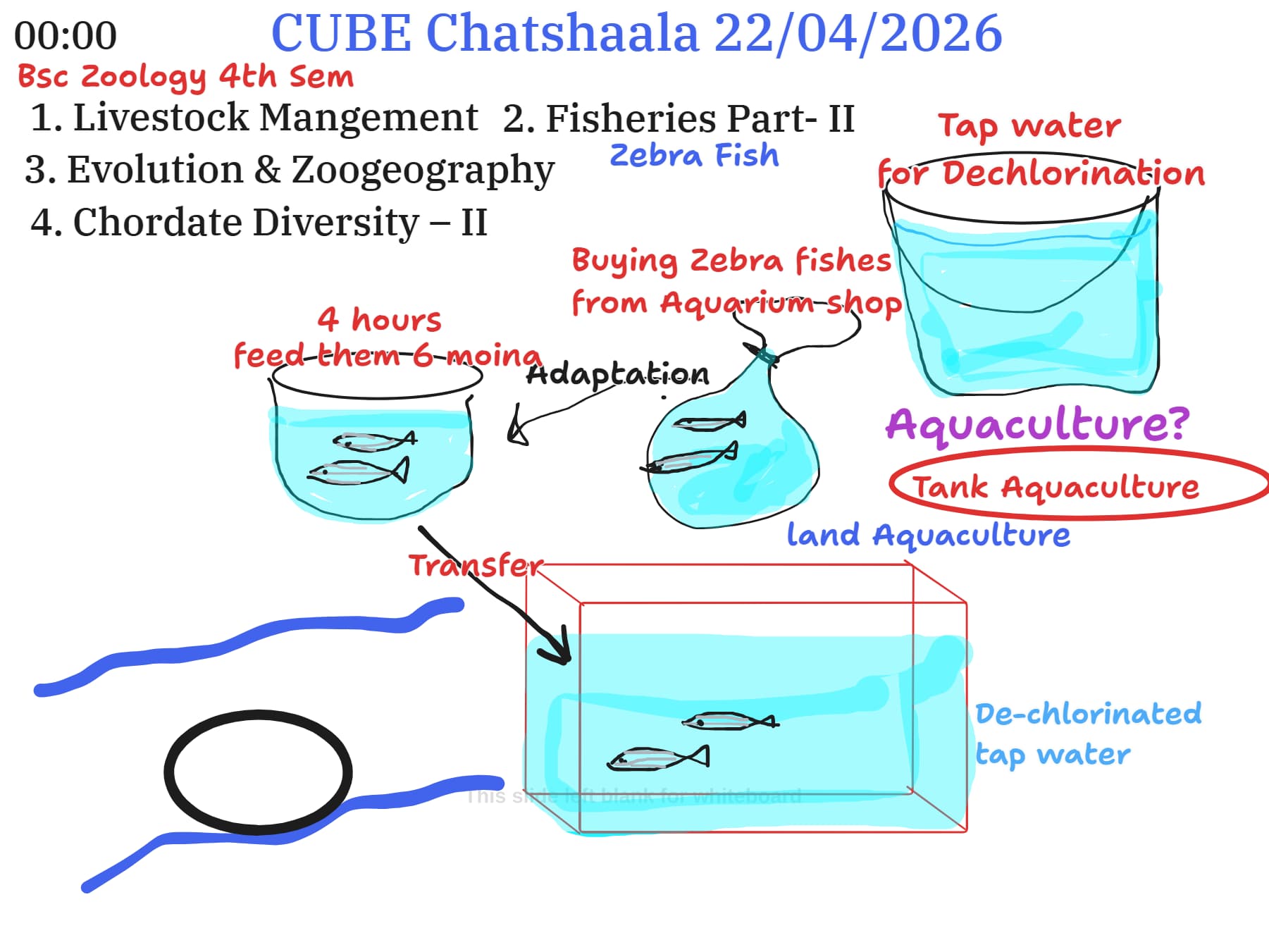
The session opened with a very grounded, real-world question: where do we get zebrafish from, and how do we begin keeping them? Participants discussed the practice of sourcing zebrafish directly from local aquarium shops, which is a common and accessible starting point for student researchers in the CUBE (Collaborative Understanding of Biology Education) framework. This immediately connected classroom biology to something tangible and doable.
One of the central threads of discussion was the step-by-step process of setting up a proper environment for zebrafish once they are brought from the aquarium shop. The whiteboard illustrated this clearly — fish are first kept in a smaller holding vessel, then transferred to a larger tank system. A key highlight was the importance of using de-chlorinated tap water. Tap water, as most participants noted, contains chlorine added for human drinking safety, but chlorine is toxic to fish. To remove it, tap water is left open or aerated for a period of time before use. This process of dechlorination emerged as a non-negotiable step in responsible fish keeping.
The discussion then moved toward feeding practices. It was noted on the whiteboard that zebrafish should be fed Moina (a type of small crustacean used as live feed) approximately every 4 hours. This raised interesting questions about what constitutes appropriate nutrition for zebrafish in a lab or home-tank setting, and why live feed like Moina is preferred over dry or artificial feed, particularly when researchers are observing natural behaviour and developmental stages.
A particularly rich moment in the session was the conversation about adaptation. When zebrafish are transferred from a pet shop bag or holding container into a research or lab tank, they go through a period of physiological and behavioural adjustment. The word “adaptation” was explicitly written on the board near the transfer arrow, prompting discussion about what the fish experience during that transition — changes in water chemistry, temperature, light, and space.
The session also explored the broader concept of aquaculture, specifically distinguishing between two types: Tank Aquaculture (highlighted in red on the board and circled for emphasis) and Land Aquaculture. Tank aquaculture involves raising fish in controlled indoor or outdoor tank systems, whereas land aquaculture — as referenced in the Kerala Fisheries Department’s aquaculture framework — includes bio-secured pond farming. Kerala’s fisheries sector actively promotes both these approaches, and connecting student lab practice to real-world fisheries policy made the discussion particularly relevant for students studying in the region.
The visual on the whiteboard showed a clear, step-by-step pipeline: tap water is collected → left to dechlorinate → zebrafish are procured from the aquarium shop → held temporarily in a smaller vessel → fed Moina at regular intervals → then transferred to a larger tank with de-chlorinated water. This whole sequence forms the foundation of a basic zebrafish maintenance protocol, which is also documented in the CUBE Metastudio research thread on observing growth and developmental stages of zebrafish.
 Provocative Questions
-
Why is chlorine specifically harmful to zebrafish at concentrations considered safe for human consumption? What is the physiological mechanism behind chlorine toxicity in teleost fish?
-
When we say zebrafish “adapt” after being transferred to a new tank, what exactly is happening at the cellular and hormonal level? Is this adaptation reversible if the fish is moved back?
-
Moina is recommended as live feed — but what happens to zebrafish behaviour and growth if only dry feed is provided over multiple generations? Would we observe any measurable difference in developmental milestones?
-
The whiteboard shows a 4-hour feeding interval. Is this interval based on zebrafish metabolism, or is it a practical guideline adopted by student researchers? How was this number arrived at?
-
Tank aquaculture is circled and emphasised on the board. In what ways is tank aquaculture more sustainable or more challenging than pond-based land aquaculture, particularly in a state like Kerala with high rainfall and water availability?
-
Kerala’s fisheries department promotes bio-secured pond farming. What does “bio-security” mean in the context of freshwater aquaculture, and how would a student replicate any aspect of that principle in a classroom tank setup?
-
If zebrafish are purchased from a commercial aquarium shop, how do we know they are healthy enough for scientific observation? What baseline health indicators should a student check before introducing fish into a research tank?
-
The CUBE Metastudio thread focuses on observing growth and developmental stages. At what age or developmental stage is it most meaningful to begin systematic observation of zebrafish, and what parameters should be recorded?
-
Why is the zebrafish (Danio rerio) specifically chosen as a model organism for biological research? What makes it more suitable than other small freshwater fish that are equally available in local aquarium shops?
-
How does the concept of “land aquaculture” connect to Evolution and Zoogeography — one of the syllabus topics listed on the board? Has human-managed aquaculture influenced the geographic distribution of fish species?
 What I Have Learned
Today’s session was a reminder that science is most alive when it connects to something you can actually touch, observe, and care for. Here are my most important takeaways from this ChatShaala:
Water quality is not just a background condition — it is the experiment itself. Before we can observe any behaviour, development, or response in zebrafish, we have to get the water right. The dechlorination step, simple as it sounds, is where a lot of beginners go wrong. Leaving tap water open for sufficient time is not optional — it is step one of responsible fish keeping and a real scientific variable.
Feeding is a form of environmental design. Choosing Moina over processed feed is a deliberate decision that affects the entire experimental ecosystem. Live feed introduces movement, natural foraging behaviour, and nutritional variety. This choice shapes what we observe in the fish.
Adaptation is not just a textbook concept. Watching zebrafish settle into a new tank is an observable event with biological depth. The stress response, the gradual resumption of normal swimming patterns, the exploration of the new space — these are all things a student can document and connect to what they are reading in Chordate Diversity and Evolution.
Aquaculture is not one thing. The distinction between tank aquaculture and land aquaculture matters — not just for the fisheries exam, but for understanding how food systems work. Kerala’s approach to bio-secured pond farming is a real-world application of principles we discuss in livestock management and fisheries papers.
The CUBE method turns observation into inquiry. The power of this session was that no one just received information. Questions were raised, steps were drawn out, and connections were made to both the syllabus and to ongoing collaborative research documented on Metastudio. That is a different kind of learning — it stays.
 TINKE Moments
TINKE stands for “This I Never Knew Earlier” — moments of genuine realisation where a gap in understanding becomes visible.
TINKE 1 — Dechlorination is time-sensitive, not just procedural.
Many students assume that any water from a tap, once left out for a few minutes, is safe for fish. Today’s discussion made it clear that proper dechlorination takes time — often hours — and that this is a step that must be planned, not done at the last moment. This is something that sounds obvious but is easily overlooked by beginners.
TINKE 2 — “Adaptation” in a tank transfer is a stress event.
The word “adaptation” on the board was initially interpreted by some participants as a passive, automatic process. But on closer examination, transferring a fish from a plastic bag to a new tank is actually a physiological stressor. The fish’s osmoregulatory system, stress hormones, and immune response are all activated. Calling it merely “adaptation” without unpacking this could give students a false sense of security about fish welfare.
TINKE 3 — The source of zebrafish matters scientifically.
Buying from an aquarium shop is practical and accessible, but it comes with unknowns — the fish may have been bred under very different conditions, may have been treated with antibiotics, or may carry pathogens. Students doing developmental observations need to factor in the unknown history of their fish as a real variable. This was not explicitly discussed today, but emerged as a gap worth addressing.
TINKE 4 — Tank aquaculture is a legitimate research context, not a simplified version of “real” aquaculture.
Some participants seemed to see tank setups as merely simplified or educational approximations of real aquaculture. The discussion helped reframe this: tank aquaculture is itself a valid and commercially important form of fish farming, with its own set of management principles, and Kerala’s fisheries sector formally recognises it as such.
 Gaps and Misconceptions
Gap 1 — No discussion of water temperature or p..
The session covered dechlorination well but did not address other critical water parameters such as temperature, pH, dissolved oxygen, and ammonia levels. For zebrafish, which thrive in specific conditions, these parameters are equally important. Future sessions should include a basic water quality checklist.
Gap 2 — The 4-hour feeding interval was stated but not questioned enough.
The note on the board says “feed them, Moin, every 4 hours,” but there was limited discussion of why this specific interval. Is it based on zebrafish gut transit time? Is it a CUBE convention? Is it adjustable based on tank density or the age of the fish? This should be explored in a follow-up session.
Gap 3 — Connection to the formal syllabus topics remained loose.
The session topics listed — Livestock Management, Fisheries Part II, Evolution & Zoogeography, Chordate Diversity II — were not all explicitly tied into the zebrafish discussion. While the connections are there (especially Fisheries and Chordate Diversity), they were implicit rather than drawn out. A more deliberate mapping of the practical activity to syllabus outcomes would strengthen the academic value of the session.
Misconception — “Land aquaculture” means farming on dry land.
A few participants initially interpreted “land aquaculture” as referring to terrestrial or soil-based farming. The correct understanding is that land aquaculture refers to fish farming conducted on land (as opposed to open-water or marine aquaculture), typically in constructed ponds or tanks. This is a common confusion that is worth addressing clearly at the start of any aquaculture discussion.
Misconception — Zebrafish adaptation is instantaneous.
The transfer process was drawn as a single arrow on the board, which may have reinforced the idea that adaptation is a one-time event. In reality, zebrafish may take anywhere from several hours to a few days to fully settle into a new environment, depending on the degree of change in water conditions. Observational notes should ideally begin only after this settling period.
 Photographs during Chatshaala
 Referance