InShot_20260405_123830381|664x499
 *Experiment: Solubility of Glucose, Sucrose and Starch in Water
Observed by:
Niharika Baghari
Date: 5/04/26
Time: 11:10 am
Location: Chalkana, Bageshwar (Uttarakhand)
Water taken: 250 mL (each sample)
 Objective
To determine whether glucose, sucrose, and starch dissolve in water and to understand the scientific reason behind their behavior.
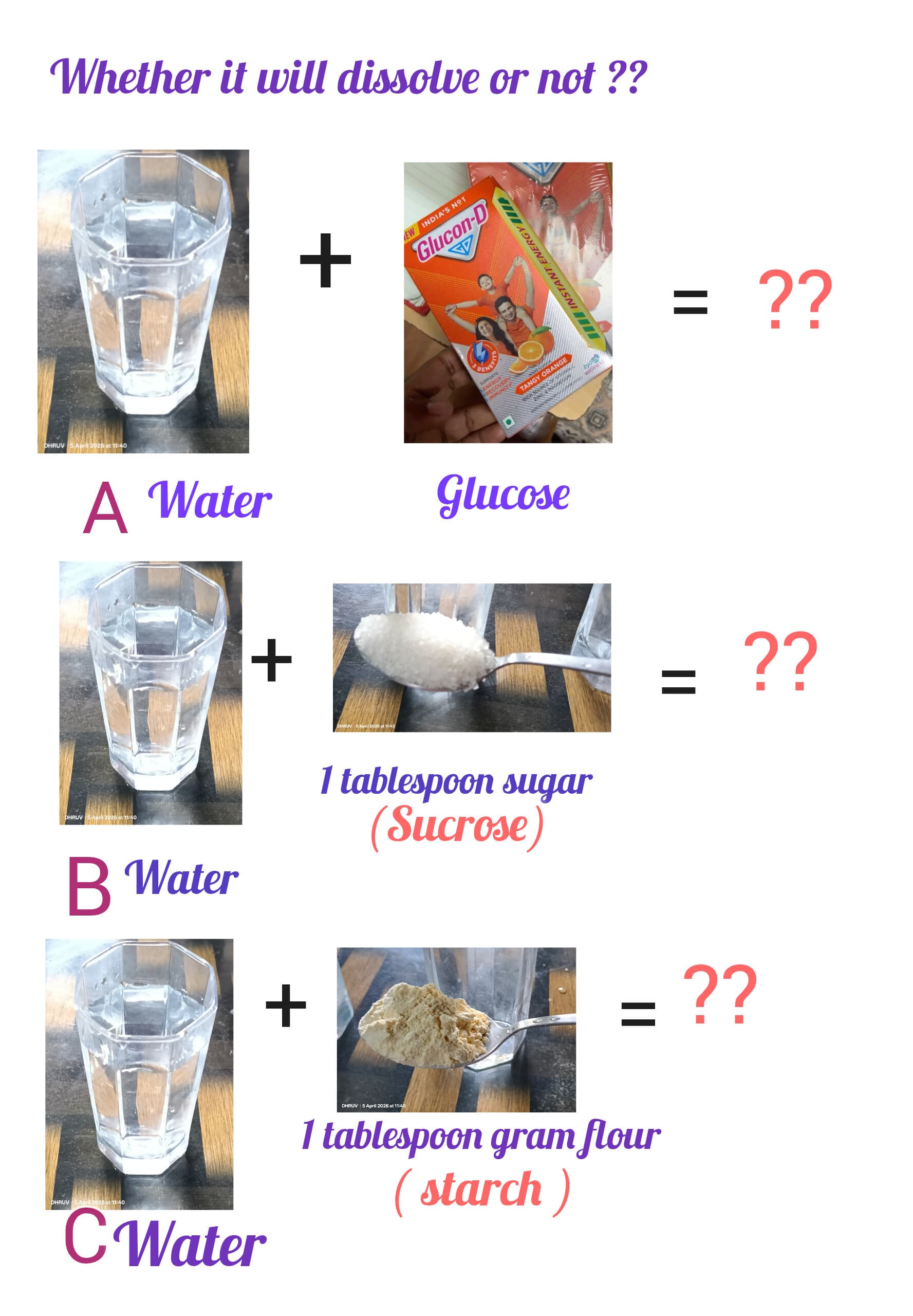
 Experimental Setup (A, B, C)
A: Water + Glucose (Glucon-D)
B: Water + Sugar (Sucrose)
C: Water + Gram Flour (Starch)
 Observation
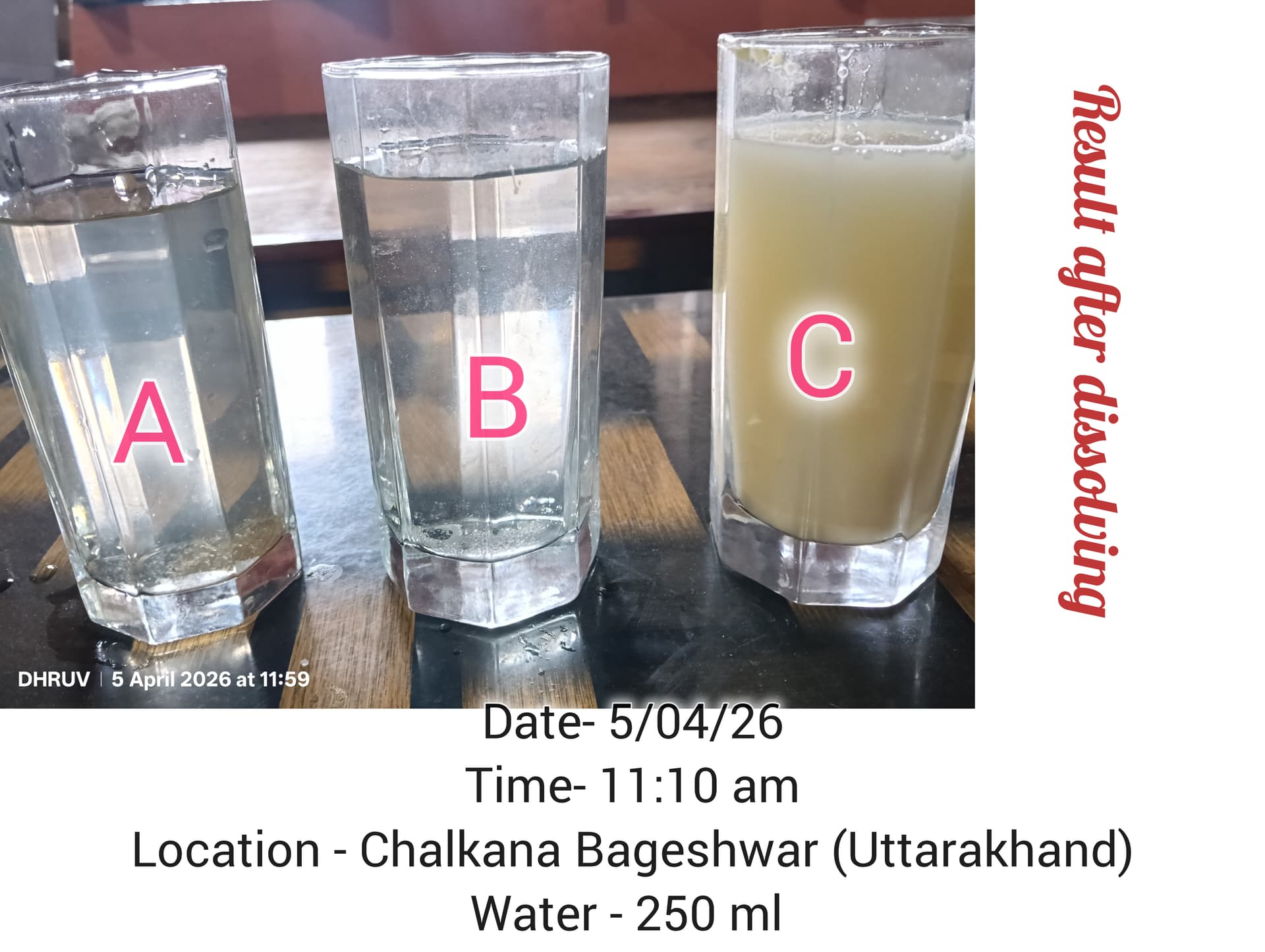
 Sample A (Glucose)
Completely dissolved
Transparent, clear solution formed
No particles visible → Homogeneous mixture
 Sample B (Sucrose)
Completely dissolved
Clear solution similar to A
No residue → True solution
🅲 Sample C (Starch)
Did not dissolve
Cloudy (turbid) appearance
Particles remain suspended → Colloidal mixture
 Result
Glucose and sucrose are soluble in water.
Starch is insoluble in cold water, but forms a colloid (not a true solution).
 Scientific Interpretation (Deep Explanation)
 Why Glucose & Sucrose dissolved:
Both contain many –OH (hydroxyl groups) → highly polar molecules
Water is also polar
Due to hydrogen bonding, water molecules surround and separate solute particles
 Result: Complete dissolution → true solution
 Why Starch did NOT dissolve:
Starch is a large polymer (polysaccharide) made of glucose units
Has complex coiled structure (amylose & amylopectin)
Strong internal hydrogen bonding inside starch granules
Water cannot easily break these interactions at room temperature
So it forms a cloudy colloid, not a solution
 Bond Concept (Important Insight)
Dissolving glucose/sucrose:
Only intermolecular forces break
No covalent bonds break → physical change
In starch:
Strong internal bonding resists separation
Needs heat (energy) to break structure
 TINKE Points (Things I Never Knew Earlier)
Not all substances that look similar (white powders) behave the same in water.
Dissolving depends on molecular size + structure, not just appearance.
Starch is not fully insoluble — it forms a colloid, which is a different type of mixture.
Hydrogen bonding can both help (glucose) and prevent (starch) dissolution.
Dissolution is a physical process, not always a chemical reaction.
Large molecules (polymers) behave very differently from small molecules.
 Misconceptions (Common Mistakes)
“If something disappears, it always reacts chemically”
Actually, glucose/sucrose just dissolve → no chemical reaction
“Starch is completely insoluble”
It can dissolve in hot water (gelatinization)
“All soluble substances form same type of solution”
There are true solutions, colloids, and suspensions
“Breaking bonds means chemical change”
Only weak intermolecular forces break here, not strong bonds
 Questions Arising in My Mind
Why does starch dissolve when heated but not in cold water?
If starch is made of glucose, why is its behavior so different?
What is the exact difference between:
True solution (A, B)
Colloid (C)
Can enzymes (like saliva amylase) convert starch into soluble sugars?
What happens at microscopic level when glucose dissolves?
How does temperature affect solubility of different substances?
Advanced Concept (Deep Understanding)
“Like dissolves like” principle:
Polar substances dissolve in polar solvents
But also depends on:
Molecular size
Structure
Energy required to break internal forces
For starch:
Energy required > energy available (room temp) → no dissolution.
 Final Conclusion
This experiment clearly shows that solubility is not just about mixing but depends on molecular interactions, structure, and energy. Small polar molecules dissolve easily, while large polymers like starch require special conditions, proving that different substances behave differently at the molecular level.