InCUBE ChatShaala - Discussion Summary
Today’s CUBE ChatShaala session, held on 15th August 2026 as an Independence Day special, brought together Sailekshmi, Niharika, Aarya, Kiran, Kiran Varma, Arunan MC, and Chitralekha for a wide-ranging discussion that moved between two connected threads of nematode biology and a brief detour into human blood cell morphology.
Nematodes .pdf (875.8 KB)
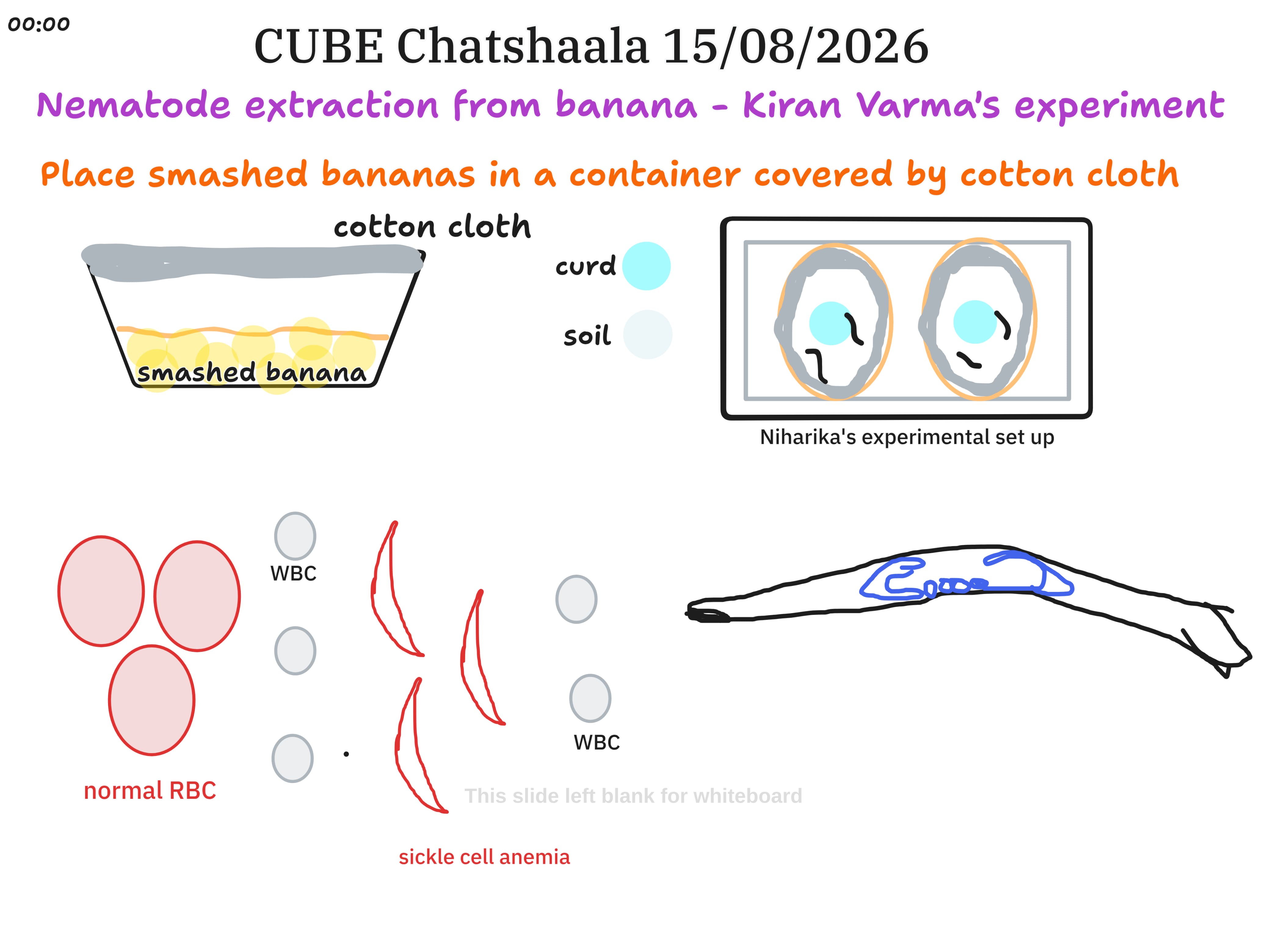
The session opened with Kiran Varma presenting a simple, elegant home-lab protocol for extracting nematodes from bananas. The method involved placing smashed bananas inside a container covered with cotton cloth, allowing the setup to sit undisturbed so that nematodes present in the decomposing fruit would migrate upward and collect near the cloth surface. Niharika’s parallel experimental setup was also discussed, in which two slices of potato were prepared using curd and soil in the container box with a lid, with nematodes visibly gathering near the drop of curd placed at the centre of each. This comparison sparked a useful conversation about which household substances work best as bait for nematode isolation, and why curd, likely due to its bacterial content, appeared to be a stronger attractant than soil alone.
The discussion then shifted to a more detailed presentation on Caenorhabditis elegans, built around a set of slides and images documenting a school-based investigation into finding this roundworm in Indian native soil. The group reviewed the defining features of C. elegans: a transparent, roundworm-like organism roughly 3 mm in length, with eggs visible under magnification. The presentation explained why this organism has become such a valuable model in biological research. Its ease of maintenance in a laboratory setting, since it can be fed Escherichia coli (E.coli) and requires little upkeep, was highlighted as a major practical advantage. Equally significant is its simple, fixed anatomy of around a thousand cells, which allows researchers to trace cell lineages with a level of precision that is simply not possible in more complex animals. Its transparency permits direct observation of internal processes under a standard microscope, and its short life cycle of about three days makes it ideal for large-scale genetic studies where researchers need to observe several generations quickly.
Participants also discussed the broader scientific significance of C. elegans, noting that its genome has been thoroughly mapped and that dedicated genetic tools now exist to manipulate it precisely. The organism has been central to three separate Nobel Prize-winning discoveries and shares a substantial number of genes with humans, making it useful for modelling human diseases such as Alzheimer’s. A particularly striking point raised was the contrast between its 302 neurons and the millions found in the human nervous system, illustrating how a comparatively simple nervous system can still yield insights applicable to far more complex organisms.
The practical portion of the session detailed the school’s own investigation, which used soil collected from a campus pot as the source material. Potato slices were prepared with a drop of curd placed at the centre and a ring of soil packed around the edge, following a design intended to draw nematodes inward along a defined path toward the curd. This method echoes an established protocol previously documented on Metastudio, where students placed a thick layer of moist soil around the edges of raw potato slices and observed nematodes migrating toward the centre over roughly 33 hours, later confirming their identity under a compound microscope by examining features such as the cylindrical body, the mouth, and the vulval opening. In the current session’s setup, the group observed nematodes moving along this same kind of path over the following days, eventually confirming, through microscope footage dated 8th November, that specimens resembling C. elegans had indeed been recovered from the soil sample. The team acknowledged institutions such as NCBS Bangalore, TIFR Mumbai, HBCSE-TIFR Mankhurd, Cold Spring Harbor Laboratory, and the University of Massachusetts as centres where C. elegans research is actively pursued, situating their own citizen-science effort within a much larger global research tradition.
Toward the end of the session, the whiteboard briefly touched on human blood cell morphology, comparing normal red blood cells and white blood cells against the crescent-shaped red blood cells characteristic of sickle cell anaemia. Although this segment was left relatively undeveloped compared to the nematode discussion, it served as a useful visual anchor for thinking about how cell shape relates directly to function and disease, a theme that echoes the structural precision discussed earlier in the context of C. elegans anatomy.
 Provocative Questions
-
Why does curd appear to attract nematodes more effectively than soil alone in these home-lab setups, and what does this tell us about what nematodes are actually seeking, food, moisture, or a specific bacterial signal?
-
If C. elegans has a completely mapped connectome of just 302 neurons, why does replicating even simple animal behaviours in artificial systems remain so difficult?
-
Given that nematodes found on rotting bananas or in garden soil could be C. elegans, a related species, or something else entirely, how confident can a citizen scientist be in a visual identification without access to genetic sequencing tools?
-
What does the ease of misidentifying insect eggs or larvae as nematodes reveal about the limits of home-lab microscopy, and what additional checks could make identification more rigorous?
-
Sickle cell anaemia changes the shape of a red blood cell dramatically. Could studying shape-driven dysfunction in something as accessible as C. elegans offer any conceptual bridge to understanding how structural changes disrupt function in human cells?
-
Why has a soil-dwelling worm from Algeria become one of the most thoroughly studied animals on Earth, and what does its story suggest about how scientists choose model organisms in the first place?
 What I Have Learned
This session reinforced something I keep coming back to in citizen science: the most powerful experiments are often the simplest ones. Watching how a banana, a bit of cotton cloth, and patience can reveal an entire hidden world of nematodes reminded me that sophisticated biology doesn’t always require sophisticated equipment. What struck me most was learning just how deliberately C. elegans was chosen as a research organism. It isn’t simply that it happens to be convenient. It occupies a very particular sweet spot of complexity, complex enough to be biologically meaningful, but simple enough to be fully mapped and understood. That balance is what has made it valuable across three Nobel Prizes and decades of genetic research. I also came away with a sharper appreciation for the discipline required in identification. Seeing how easily insect larvae can be mistaken for nematodes was a good reminder that careful, patient observation, checking movement patterns, body features, and behaviour rather than jumping to conclusions, is at the heart of doing this kind of science responsibly. Finally, connecting our own soil sample from a school campus pot to a global lineage of research happening at places like TIFR and Cold Spring Harbor gave me a genuine sense of how citizen science threads into something much larger than any single classroom or home lab.
 TINKE Moments (This I Never Knew Earlier)
The first TINKE moment of the session centred on the realisation that not everything wriggling in a soil or banana sample is necessarily a nematode. Before this discussion, it would have been easy to assume that any small, moving organism found in decomposing organic matter was automatically a nematode. The session made explicit that insect eggs and larvae can closely resemble nematodes at first glance, and that the real distinguishing features- the presence of black jaw hooks in larvae, the stillness of eggs, and the sideways, snake-like locomotion unique to nematodes- require deliberate, careful observation to catch. This shifted the group’s understanding from a general awareness of nematodes to an explicit, actionable identification framework.
A second TINKE moment emerged around the comparison of curd and soil as attractants in Niharika’s setup. It became explicitly clear during the discussion that nematodes were not simply drawn to any organic material, but appeared to respond more strongly to the curd, likely due to the bacteria it contains, since nematodes such as C. elegans feed on bacteria rather than on the substrate itself. This reframed the group’s understanding of the extraction method from “nematodes like moist organic matter” to a more precise “nematodes are following a bacterial food source,” which has direct implications for how future extraction setups might be optimised.
A third, smaller TINKE moment arose from the discussion of neuron counts. Knowing in the abstract that C. elegans has far fewer neurons than humans is one thing, but explicitly grasping that 302 neurons versus millions still permits complex, mapped, and even genetically manipulable behaviour reframed how the group thought about biological complexity, suggesting that the value of a model organism lies not in its similarity to humans in scale, but in the precision with which its systems can be understood.
 Gaps and Misconceptions
Several gaps remain open from today’s session. Chief among them is the question of rigorous species confirmation. Visual and behavioural cues under a basic microscope can strongly suggest C. elegans, but without genetic sequencing or access to detailed morphological keys, there remains a real possibility of misidentifying a closely related nematode species, as the earlier Metastudio investigation found when its own specimens matched morphological features more consistent with Oscheius tipulae thann C. elegans itself. This is an important gap for the group to keep in mind as future soil samples are examined.
A further gap concerns the incomplete integration of the sickle cell anaemia discussion into the rest of the session. While the whiteboard drawing usefully contrasted normal red blood cells, white blood cells, and sickled cells, this segment was not connected back to the nematode work in any explicit way during the discussion, leaving an opportunity for a future session to explore structural biology across both plant, invertebrate, and human systems more cohesively.
Finally, a common misconception worth flagging for newer participants is the assumption that finding C. elegans in Indian soil should be straightforward simply because it has been found in soil elsewhere in the world. The reality, as this session demonstrated, is that isolating and confirming the species locally requires repeated sampling, patient observation over many hours, and careful cross-checking against known morphological features, a process that is as much about ruling out look-alikes as it is about finding the worm itself.
 Photographs during Chatshaala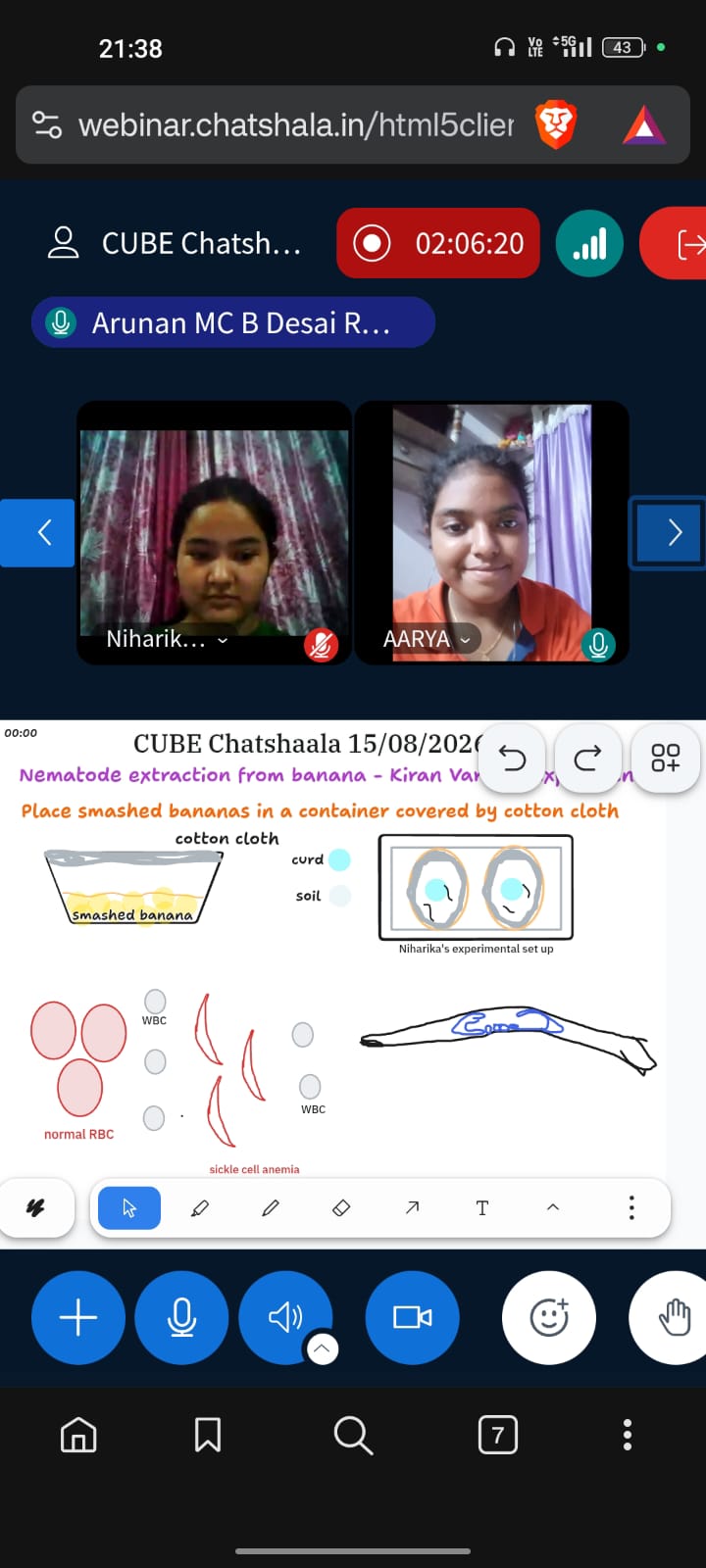

 Referance