 CUBE ChatShaala—Discussion Summary
Date: 26 January 2026
Theme: Latitudinal variation in mango flowering and the question of early flowering onset
Objective of the Session
The primary objective of today’s ChatShaala (Republic Day special) was to see if mango flowering is occurring earlier than expected across different latitudes in India, using independently collected field data. The session aimed to compare flowering percentages in northern and southern locations, as well as investigate the potential impact of latitude, seasonality, and microclimate.

Data Presented and Discussed
A. Assam (Sapekhati, 27°N)
-
Observer: Susanta
-
Date: 24.01.2026 (Republic Day season)
-
Method: Cycling-based ground survey
-
Total trees observed: 228
- Flowering trees: 193
- Non-flowering trees: 35
-
Flowering percentage: ~85%
This dataset showed a remarkably high flowering intensity at a relatively higher latitude during late January.
B. Assam (Kashyap’s Observation)
- Date: 15.01.2026
- Flowering trees: 8
- Non-flowering trees: 21
- Flowering percentage: ~27%
This smaller dataset introduced intra-regional variability, reminding the group that scale, sampling area, and tree age matter.
C. Kerala Observations (Lower Latitudes)
-
Locations discussed:
- Thiruvananthapuram (8°N)
- Thrissur (10°N)
- Kozhikode (11.2°N)
-
Observer: Theertha
-
Timeframe: First week of November 2024
-
Sample size: 15 trees
- Flowering trees: 7 (46%)
- Non-flowering trees: 8 (54%)
Despite being closer to the equator, flowering was not uniformly advanced in southern Kerala.
Key Discussion Points
-
Higher latitudes (Assam) showed strong flowering signals in January, while lower latitudes did not show consistently earlier flowering in November.
-
Latitude alone does not explain flowering onset.
-
Seasonal temperature drops, dry spells, and tree-specific factors may be more
influential than geographic position. -
The idea of “earlier flowering everywhere” was challenged with real data.
Provisional Inference
The cubists agreed that mango flowering cannot be explained by latitude in isolation. The evidence suggests a more complex interaction between climate cues, local weather patterns, and tree physiology. Claims of universally early flowering are currently unsupported without longer-term, synchronized datasets.
 Whiteboard-Derived Questions for the Community
-
If Assam’s mango trees are already 85% in bloom, what does “early season” even mean anymore?
-
For decades, we taught students that southern India flowers first. Are our textbooks aging faster than our trees?
-
Is flowering now a survival response rather than a seasonal rhythm?
-
Are we misreading natural variability as climate change signals?
 What I Learned
-
Field observations, even when simple, can disrupt comfortable assumptions.
-
More data does not always mean clearer answers—better-structured data does.
-
Latitude is an easy explanation, but rarely a sufficient one.
-
Comparing datasets forces humility; contradictions are productive, not problematic.
 TINKE Moments (This I Never Knew Earlier)
-
Mango flowering can be extremely high at higher latitudes during late January.
-
Southern regions do not automatically show earlier phenological events.
-
Small sample sizes can tell a story—but not the whole story.
-
Stress (dryness, cold nights) may be a stronger flowering trigger than warmth.
 Gaps and Misconceptions
-
Misconception: “Lower latitude = earlier flowering.”
Reality: Data from Kerala does not support this consistently. -
Gap: Lack of synchronized, multi-year observations across regions.
Action Needed: Repeat observations across the same months for at least 3 consecutive years. -
Misconception: Single-location data can represent an entire region.
Reality: Kashyap and Susanta’s Assam data already show strong internal variation. -
Gap: Tree age, variety, and management practices were not recorded.
Action Needed: Add basic tree metadata to future surveys.
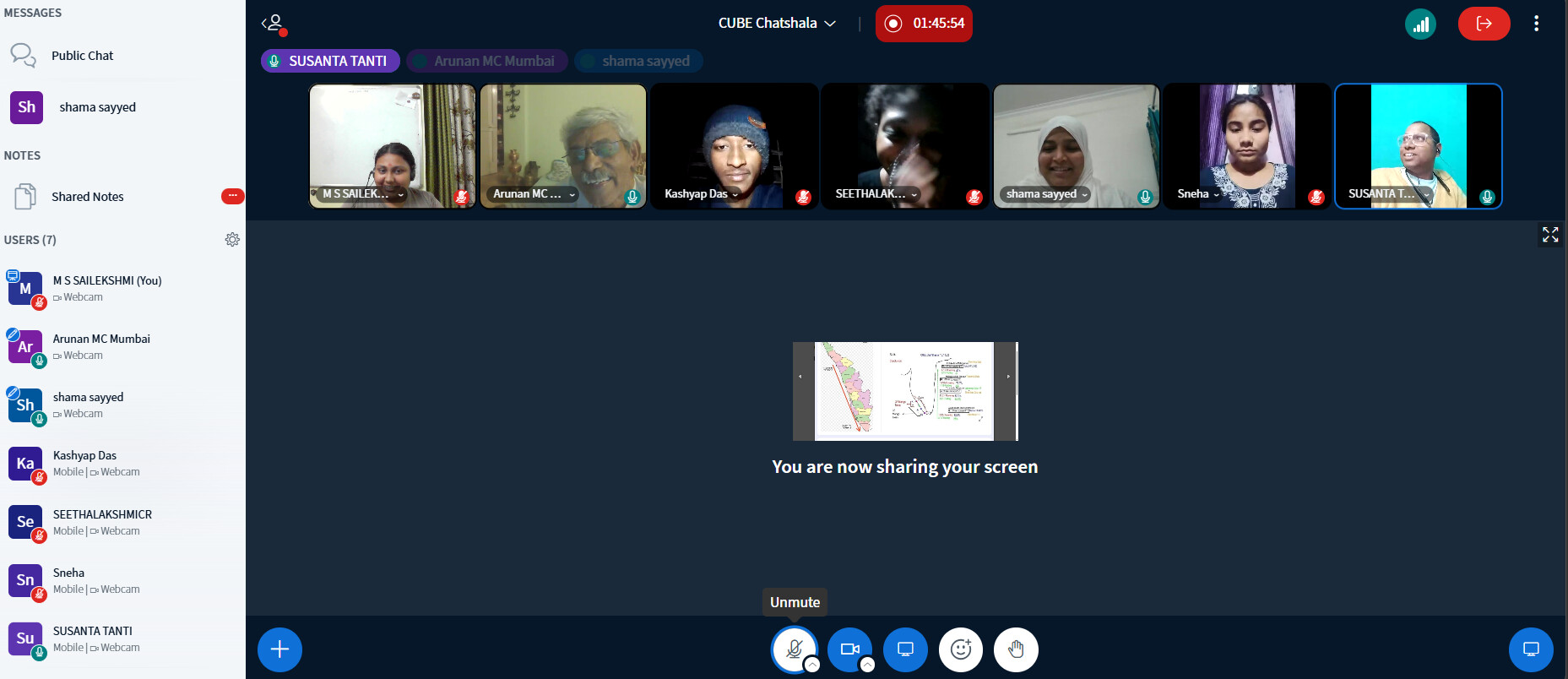
 Photographs during Chatshaala
 Reference
- Process of Mango flowering - #6 by Theertha
- 🥭 How Many Mango Trees Are Enough to Speak for a Region? (Note: The upload date is on January 21, 2026, not September 21, 2026.)