 CUBE Chatshaala - Discussion Summary
Date: 3rd July 2026
Today’s session opened with a demonstration of the hanging drop technique, a staple method in microbiology classes for observing live bacteria under the microscope without squashing them between slide and coverslip. The whiteboard sketch showed how a drop of the sample is suspended from a coverslip over a concave slide, allowing bacteria to be viewed in their natural, unrestricted state.
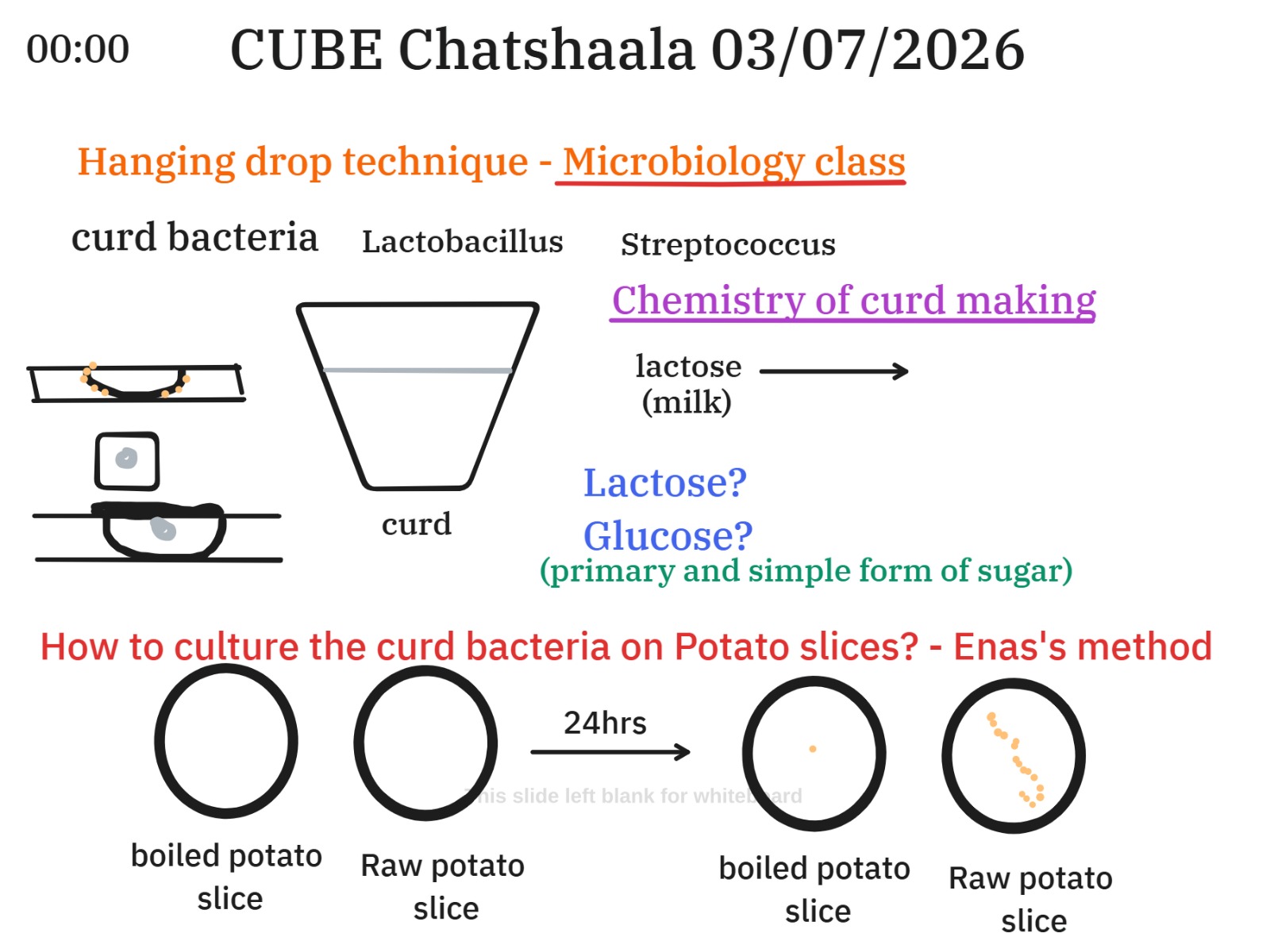
From there, the participants moved into a discussion on curd bacteria, naming Lactobacillus and Streptococcus as the two genera most commonly associated with curd formation. Lactobacillus acidophilus in particular came up as the species most frequently cited for converting milk into curd. As the reference material shared during the session confirms, when milk is heated to a temperature of 30-40 degrees centigrade and a small amount of old curd is added to it, the Lactobacillus in that curd sample gets activated and multiplies, and these convert the lactose into lactic acid, which imparts the sour taste to curd. This lines up neatly with what was sketched on the board under “Chemistry of Curd Making,” where the group traced the pathway from lactose (present in milk) forward, while also pausing to ask whether it is lactose or glucose that plays the primary role, eventually noting that glucose is considered the more basic and simple form of sugar in this context.
It’s also worth flagging, for accuracy, that the broader scientific literature does not restrict curd fermentation to a single genus. Lactic acid bacteria as a category include several genera beyond just Lactobacillus and Streptococcus, and curd-making in practice usually involves more than one species working together rather than a lone organism.
The second half of the whiteboard was devoted to Enas’s method for culturing curd bacteria on potato slices, an elegant home-lab technique that compares boiled versus raw potato slices as growth surfaces. The setup starts with two plain slices side by side, and after a 24-hour incubation period, visible bacterial growth appears, with the raw potato slice showing a noticeably denser spread of colonies compared to the boiled one. This visual comparison offers a simple, low-cost way to illustrate how surface sterilization (via boiling) affects microbial colonization, since boiling would have killed off much of the native microbial population already present on the raw potato’s surface, and leaves the curd bacteria a much freer field to establish themselves on the untreated slice.
On the community side, the session welcomed Sneha Yadav, a first-year B.Sc. student from Menon College in Bhandup East, Mumbai, who joined after hearing about ChatShaala from Sneha Maurya of Ratnam College (located on the western side of Bhandup). Sneha Maurya had visited Menon College to conduct a workshop on microscale techniques in chemistry, which is what led to this connection and Sneha Yadav’s participation today. It’s a nice reminder that these sessions often grow through informal, peer-to-peer word of mouth across colleges rather than formal outreach.
M.C. Arunan also made a valuable meta-observation during the discussion, pointing out that misunderstandings arising after a microbiology class session can themselves become the seed of a publishable article. Rather than treating confusion as a dead end, he suggested it could be documented and examined as a legitimate area of inquiry, which fits well with CUBE’s broader philosophy of treating gaps in understanding as opportunities for structured investigation.
 Provocative Questions
-
If both Lactobacillus and Streptococcus are present in curd, do they act independently on lactose, or is there a cooperative or sequential relationship between the two genera during fermentation?
-
Why does the raw potato slice show denser bacterial growth than the boiled one after 24 hours? Is it purely due to the boiling process eliminating competing native microbes, or could the potato’s own biochemistry (starch availability, moisture, or surface texture) also change after cooking?
-
The whiteboard poses the question “Lactose? Glucose?” directly. What is the actual chemical relationship between lactose and glucose in this fermentation pathway, and where does glucose enter the picture? Is it a breakdown product of lactose or a separate simple sugar altogether?
-
Could Enas’s potato slice method be adapted to compare other bacterial sources, such as soil or fermented foods other than curd, to see if the same boiled-versus-raw pattern holds?
-
What would change in the hanging drop observation if the curd sample were taken at different stages of fermentation, say at 2 hours versus 24 hours, in terms of bacterial density or motility?
-
Arunan’s comment about misunderstandings being publishable raises an interesting point: what would a “misconception paper” arising from today’s session actually look like, and which specific misunderstanding from today would be the strongest candidate?
 What I Have Learned
This session reinforced how much can be learned from very simple, accessible materials; a potato slice and a bit of curd can become a genuine microbiology experiment. Enas’s method stood out to me as a particularly good example of citizen science done well: it does not require expensive equipment, but it still generates a clear, comparable, and repeatable visual result. I also came away with a better appreciation of the practical side of the hanging drop technique, since it is one thing to read about it and another to actually see it sketched out step by step on the board.
The lactose-versus-glucose question was a good check on my own assumptions. I had a general sense that curd formation involves the conversion of milk sugar into lactic acid, but the discussion pushed me to think more carefully about the specific chemical players involved rather than treating “lactose” and “glucose” as interchangeable terms. It was a useful reminder that even in a topic that feels familiar, precision matters.
Finally, Arunan’s framing of misunderstandings as publishable material was, for me, the most memorable takeaway of the day. It shifts the way I think about confusion during a session, from something to be quietly resolved and forgotten, to something worth documenting and sharing with the wider community.
 TINKE Moments (This I Never Knew Earlier)
-
The realization that boiling a potato slice does more than just “cook” it; it actively removes the native microbial population that would otherwise compete with the curd bacteria being introduced. This had likely been an implicit assumption for several participants, and seeing it made explicit through the boiled-versus-raw comparison helped ground the experiment in a clearer rationale.
-
The distinction between Lactobacillus and Streptococcus as separate, named contributors to curd formation, rather than a vague, undifferentiated notion of “curd bacteria.” Naming the specific genera on the whiteboard turned a fuzzy general idea into something participants can now reference precisely.
-
The open question around lactose and glucose became explicit rather than staying assumed. Several participants seemed to hold an unspoken belief that the two terms were roughly equivalent in this context, and voicing that uncertainty out loud was itself a TINKE moment; it converted a silent assumption into an explicit question the participants could now investigate.
 Gaps and Misconceptions
-
The exact biochemical pathway connecting lactose to lactic acid, and where glucose fits into that sequence, was raised but not fully resolved on the board. This is a good candidate for a short follow-up reading or a dedicated mini-session.
-
The whiteboard and discussion referenced Lactobacillus and Streptococcus as though they were the sole bacteria responsible for curd formation, when the wider literature recognizes a broader family of lactic acid bacteria, including Lactococcus, Enterococcus, Pediococcus, Leuconostoc, and others, that can contribute to fermentation in dairy products more generally. This is worth clarifying so the group’s working model of curd fermentation doesn’t become overly narrow.
-
Enas’s potato slice method, while visually convincing, has not yet been discussed in terms of controls: for instance, was the raw potato slice tested to confirm what native bacteria (if any) were already present before the curd bacteria were introduced? Without that baseline, it is hard to say with certainty how much of the growth difference is due to the boiling step versus other variables.
-
No mention was made of temperature or humidity conditions during the 24-hour incubation period for the potato slices, both of which can meaningfully affect bacterial growth rates and would be useful to record in future write-ups for reproducibility.
 Photographs during Chatshaala

 Referance
-
[Solved] Which bacteria is responsible for the formation of curd?
-
https://www.sciencedirect.com/topics/food-science/lactic-acid-bacteria
-
Alternative Media for Growing Bacteria in Home Labs, CUBE-KB National Meet, Somaiya College
-
🥛 Curd, Thermometers, and Syllabus Dilemmas: The Science Behind Everyday Learning!