 CUBE ChatShaala – Discussion Summary
Date: 19 July 2026
Today’s session opened with a comparative exercise on nutrition, using the humble earthworm as an entry point into a much larger conversation about what living things actually need to grow. The whiteboard split the discussion into two parallel lists: nutrients required by an earthworm and nutrients required by a human being. What made this exercise interesting was not the lists themselves, since both turned out to contain the same five categories: carbohydrates, protein, vitamins, minerals, and fats or lipids, but the discussion around why an organism as structurally simple as an earthworm would need the same broad nutritional building blocks as a human. This became a natural bridge into a conversation about how nutritional needs are less about the complexity of an organism and more about the basic biochemistry every cell, regardless of the body it belongs to, has to carry out.
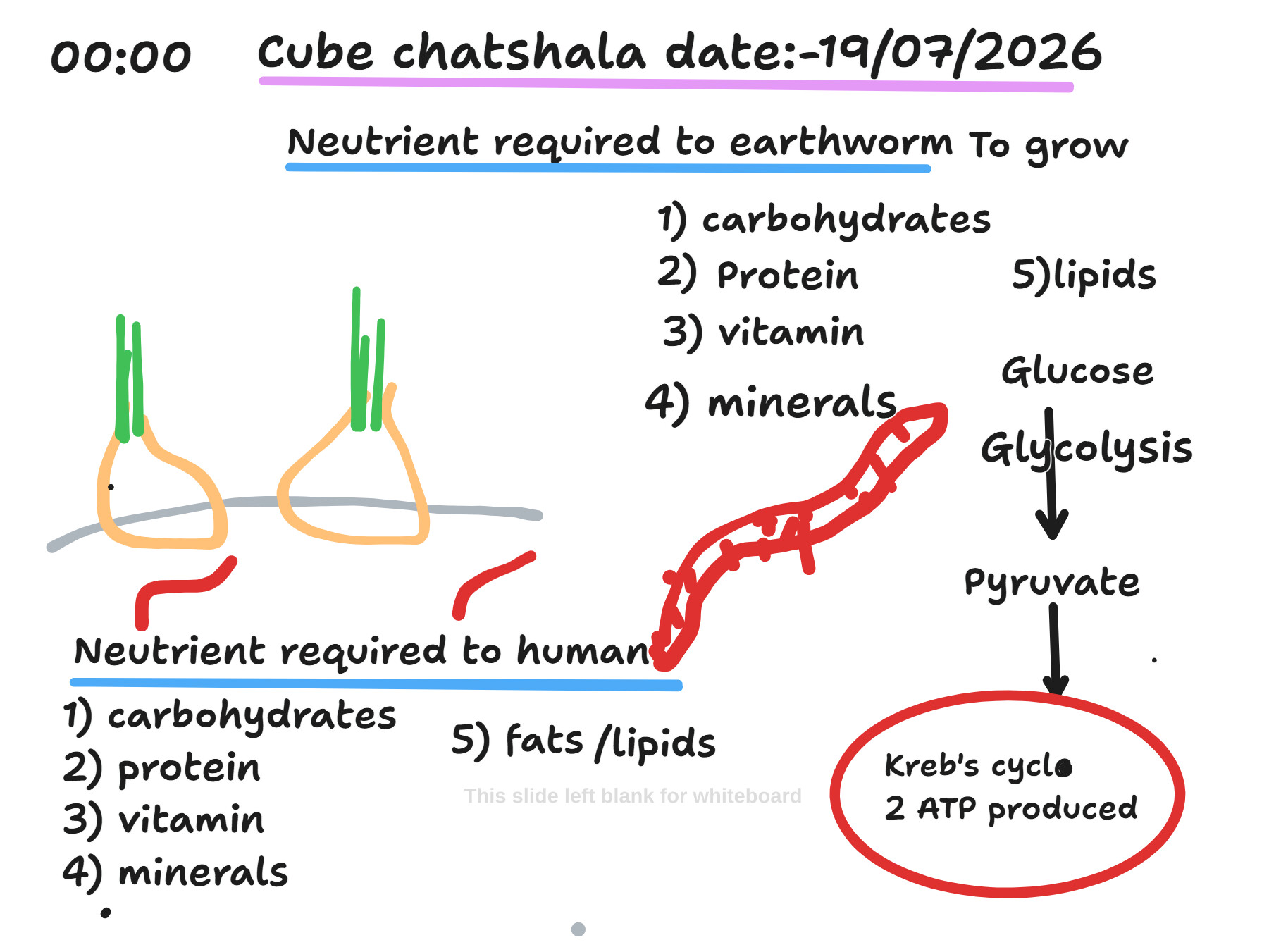
From there, the group moved into cellular respiration, tracing the pathway from glucose through glycolysis to pyruvate, and then into the Krebs cycle, where the whiteboard noted the production of two ATP molecules. This was used to explain, quite concretely, where the “carbohydrates” on the nutrient list actually go once they enter the body: not just as bulk material but as fuel that gets broken down step by step to release usable energy. Connecting the nutrient chart to the respiration pathway helped ground an otherwise abstract list of nutrient categories in an actual biochemical process.
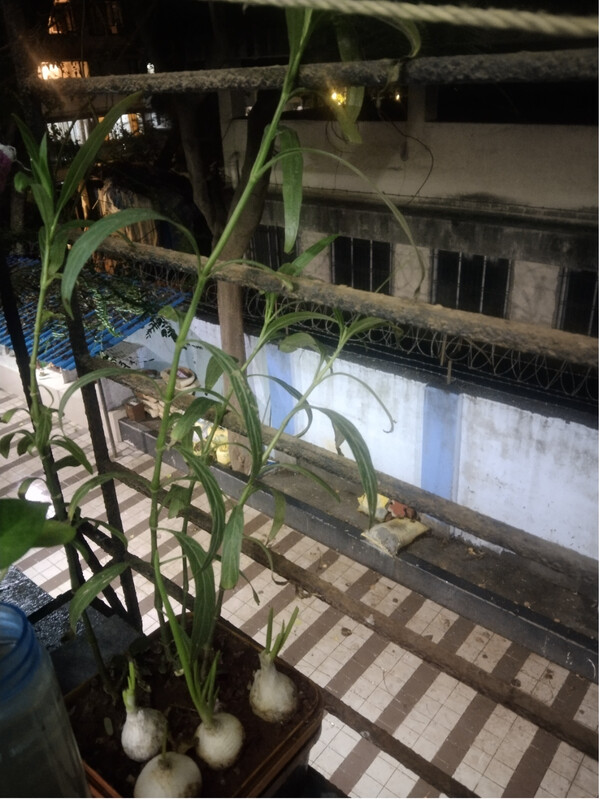
Alongside this, the participants examined a photograph of a small container garden on a balcony, showing bulb-forming plants with narrow, elongated leaves rising from swollen white bases nestled in soil. This served as a live specimen for discussing bulb morphology and tuberous roots, drawing a natural connection to the two reference plants shared for the session: Ruellia tuberosa, a small tuberous-rooted plant known variously as minnieroot or cracker plant, whose fusiform tuberous roots and popping seed pods make it a favourite subject for observational botany, and the common onion (Allium cepa), whose bulb is formed from shortened, compressed underground stems surrounded by fleshy modified leaf scales that envelop a central bud. The group used these references to discuss how food reserves accumulate differently in tuberous roots versus true bulbs, a distinction that is often blurred in casual observation but is structurally quite different.
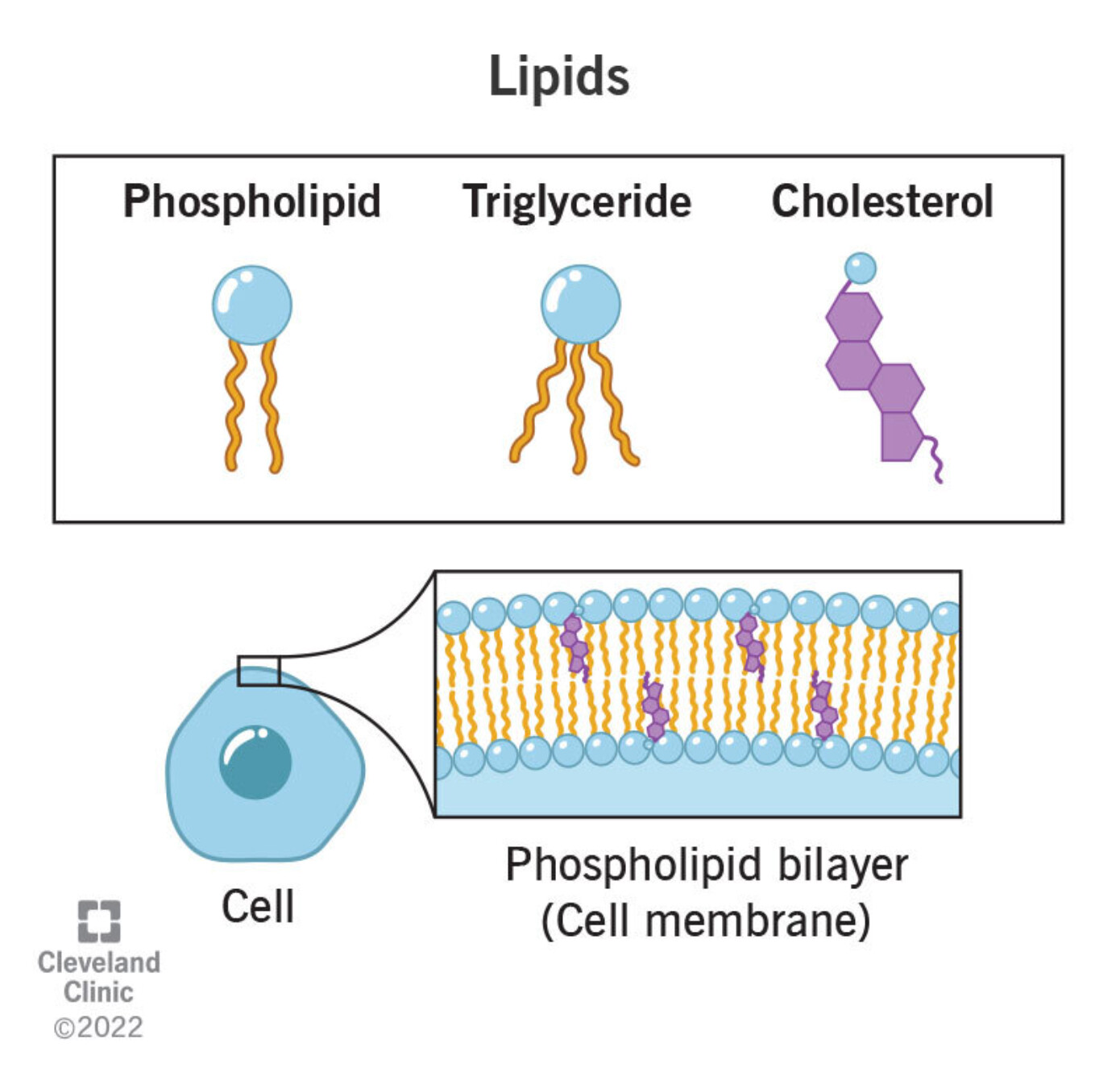
The lipid diagram brought the day’s biochemistry theme full circle. It illustrated how phospholipids, triglycerides, and cholesterol, despite sharing the same basic hydrophilic-head-and-hydrophobic-tail architecture, serve very different roles: triglycerides as energy storage, phospholipids as the structural backbone of the cell membrane, and cholesterol as a modulator embedded within that membrane. This tied back neatly to the nutrient chart from the start of the session, giving the “fats/lipids” category real biological weight rather than leaving it as just another item on a list.
 Provocative Questions
-
If an earthworm and a human need the very same five categories of nutrients, does that tell us more about the earthworm or more about how universal cellular biochemistry really is across the animal kingdom?
-
The Krebs cycle yields only two ATP directly, with the bulk of energy coming later from the electron transport chain. Why do we tend to remember the Krebs cycle as “the” energy-producing step when so much of the real payoff happens elsewhere?
-
A tuberous root and a bulb can look deceptively similar from the outside. What would you need to dissect or observe to tell them apart with confidence, and why does that distinction matter ecologically?
-
Onion bulbs are essentially compressed underground stems wrapped in modified leaves. Why is it that garden metaphors like “digging up the root” persist even when what is being dug up botanically is a stem?
-
Cholesterol is often talked about only in the context of human health and disease. What does it mean that the same molecule is doing quite structural work inside every one of our cell membranes?
-
If phospholipids, triglycerides, and cholesterol are all technically lipids yet function so differently, does lumping them together as “fats” in everyday nutrition advice actually help or hinder people’s understanding?
What I Have Learned
Sitting through today’s discussion reminded me that nutrition is never really about the organism; it is about the cell. The overlap between the earthworm’s needs and our own is not a coincidence or a simplification for the sake of a whiteboard exercise; it reflects the fact that biochemistry at the cellular level is remarkably conserved across very different life forms. That single realization did more to explain “why nutrients matter” than any amount of memorizing food groups ever could.
I also came away with a much sharper appreciation for how respiration is not an isolated topic but the mechanism that gives meaning to the nutrient chart. Carbohydrates are not just “energy” in the abstract; they are glucose molecules being funnelled through glycolysis and the Krebs cycle, generating ATP that the body then spends on everything else it does. Seeing that pathway drawn out beside the nutrient list made the connection between “what we eat” and “what our cells do with it” far more tangible.
Finally, the lipid diagram was a good reminder that structure and function are inseparable in biology. A phospholipid and a triglyceride share the same basic chemical vocabulary, two fatty acid tails and a polar head, yet one builds the wall around every cell in our body while the other is simply stored energy. That kind of structural nuance is easy to skip over when lipids get grouped casually as “fats,” and today’s session did a good job of resisting that oversimplification.
 TINKE Moments (This I Never Knew Earlier)
TINKE 1 — Universality of basic nutrient categories across taxa. It became explicitly clear that the five broad nutrient categories on the whiteboard were not tailored separately to “earthworm biology” versus “human biology.” This surfaced the assumption, often held implicitly, that simpler organisms must have simpler nutritional needs. The session made explicit that nutritional requirements track cellular biochemistry, not organismal complexity.
TINKE 2 — The Krebs cycle’s modest direct ATP yield. Writing “2 ATP produced” next to the Krebs cycle circle on the whiteboard surfaced an assumption that often goes unchallenged: that the Krebs cycle is the primary energy-generating step of respiration. Naming the number explicitly made it clear that its real contribution lies in the reduced carriers it hands off downstream, not in the ATP it produces on its own.
TINKE 3 — Bulbs are modified stems, not roots. The balcony photograph and the onion reference together made explicit something easy to misstate casually: an onion bulb is not a swollen root at all, but a shortened, compressed underground stem surrounded by fleshy modified leaves. This distinction, between true tuberous roots like those of Ruellia tuberosa and true bulbs like the onion, had been sitting as an unexamined assumption before today’s comparison brought it into the open.
TINKE 4 — Lipids are not a single functional category. Looking at the phospholipid, triglyceride, and cholesterol diagram side by side made explicit that “lipid” is a structural classification, not a functional one. The same head-and-tail chemistry supports energy storage, membrane architecture, and membrane regulation as three distinct biological jobs, a distinction that is easy to lose when lipids are discussed only in the context of diet.
 Gaps and Misconceptions
-
A recurring implicit assumption is that nutritional complexity should scale with organismal complexity. Today’s earthworm-versus-human comparison directly challenges that assumption, but it is worth revisiting explicitly in future sessions with other simple organisms to see how far the pattern holds.
-
The whiteboard’s shorthand of “2 ATP produced” next to the Krebs cycle, while accurate for substrate-level phosphorylation within the cycle itself, could be misread as the total energy yield of the cycle’s contribution to respiration if not paired with a discussion of NADH and FADH2 feeding into the electron transport chain.
-
The visual similarity between tuberous roots and bulbs remains a common source of confusion, and today’s session only partially resolved it through comparison rather than direct dissection or cross-sectional observation, which would be a valuable follow-up activity.
-
Lipids are still frequently discussed in everyday and even semi-technical conversation as a single undifferentiated “fat” category, which risks obscuring the very different structural roles that phospholipids, triglycerides, and cholesterol actually play.
 Photographs during Chatshaala
 Referance