CUBE Chatshaala - Discussion Summary
Today’s ChatShaala session, held on the 12th of August 2026, brought together participants, including Sailekshmi, Kiran, Aarya, Manali Bhujade, Niharika Baghari, Amit Yadav, Arunan MC, Abdullah Shaikh, Abhijeet Singh, and Susanta Tanti, among others, joining from different cities across the network. The central theme for the day was framed around the sleep-wake cycle in the Phyllanthus plant. However, the discussion quickly branched into a rich exploration of fruit fly behaviour, olfaction, and the chemistry of fermentation, all tied together through Aarya’s proposed hypothesis that fruit flies rest at night and become active during the day.
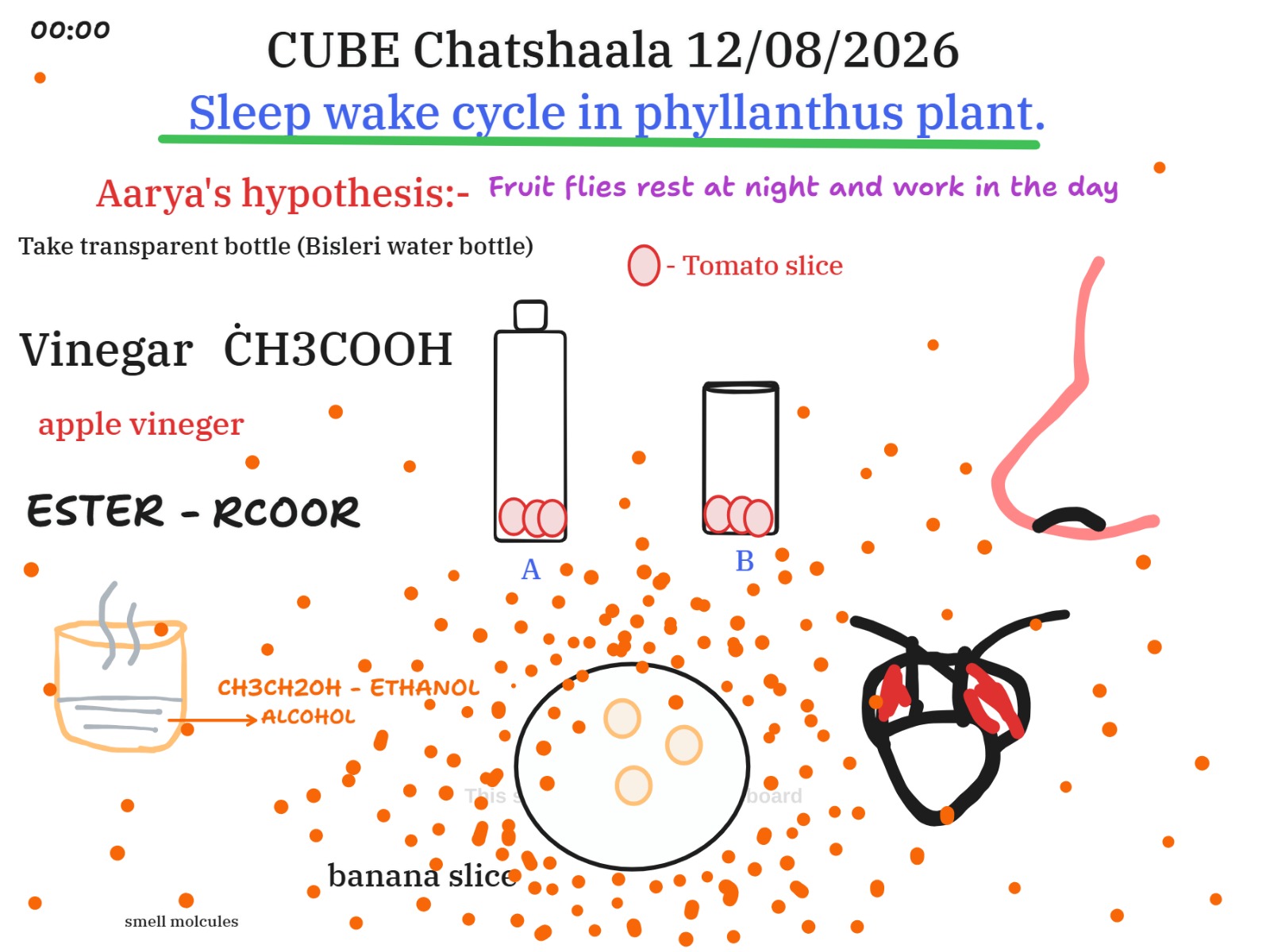
Aarya opened the discussion with a home-lab design intended to test whether fruit flies exhibit a distinct pattern of activity between daylight and darkness. The setup was elegantly simple: two transparent Bisleri water bottles, labelled A and B, each baited with a few slices of tomato. Bottle A, drawn larger in the whiteboard sketch, was proposed to sit alongside a smaller bottle B, allowing for a comparison of fly response across two different container volumes or conditions. The idea was to observe over a defined period whether flies gathered more actively around the bait during the day and settled down at night, thereby giving a rough behavioural signature of a circadian rhythm in the insects.
The chemistry of the bait itself became a talking point of real depth. The participants discussed vinegar, chemically acetic acid (CH3COOH), and how apple cider vinegar in particular carries a distinctive sweet and sour character that comes from the way it is produced. As explained during the session, apple cider vinegar starts its life when crushed apples are exposed to yeast, which ferments the natural sugars into alcohol; a second round of fermentation, this time driven by bacteria, converts that alcohol into acetic acid, and it is this acid that gives vinegar its characteristic sour bite and pungent smell. This naturally led into a conversation about ethanol (CH3CH2OH), the alcohol intermediate in that same fermentation pathway, and about esters, generally represented as RCOOR, which are responsible for many of the fruity aromas that so effectively lure fruit flies toward ripening or fermenting produce.
The whiteboard captured this beautifully with a diagram showing smell molecules radiating outward from a banana slice toward a fly’s antennae, illustrating how airborne odour compounds are picked up by the insect’s olfactory system. This connects directly to the well-documented biology of Drosophila olfaction: a fly’s two antennae function as its “nose,” covered in tiny hairs called sensilla, within which olfactory neurons detect volatile compounds such as the esters given off by rotting or ripening fruit. Reference was made to newer findings on how fruit flies process carbon dioxide as an olfactory cue, a chemical that can signal either a food source, when detected in fluctuating pulses (as when yeast ferments sugars in ripening fruit), or a warning sign of an overcrowded, oxygen-poor environment when levels stay continuously high. According to this line of research, the neurons that detect carbon dioxide can directly communicate with the neurons that detect esters, effectively letting the fly’s nervous system pre-process smell information before it even reaches the brain, and this crosstalk shapes whether the fly is drawn toward or repelled by a given source depending on the timing of the CO2 signal.
The session also revisited earlier CUBE homelab work on food preference testing in fruit flies, referencing the well-known experiments where a combination of overripe grapes, orange slices, onion, and banana peel was set up with and without a slice of tomato to see which food source drew the greatest number of flies. Past observations from these home experiments had repeatedly pointed to tomato as an especially attractive bait, more so than mango, lemon, cucumber, or grapes, which raised fresh questions today about what specific compound or compounds in tomato might be responsible for this strong pull.
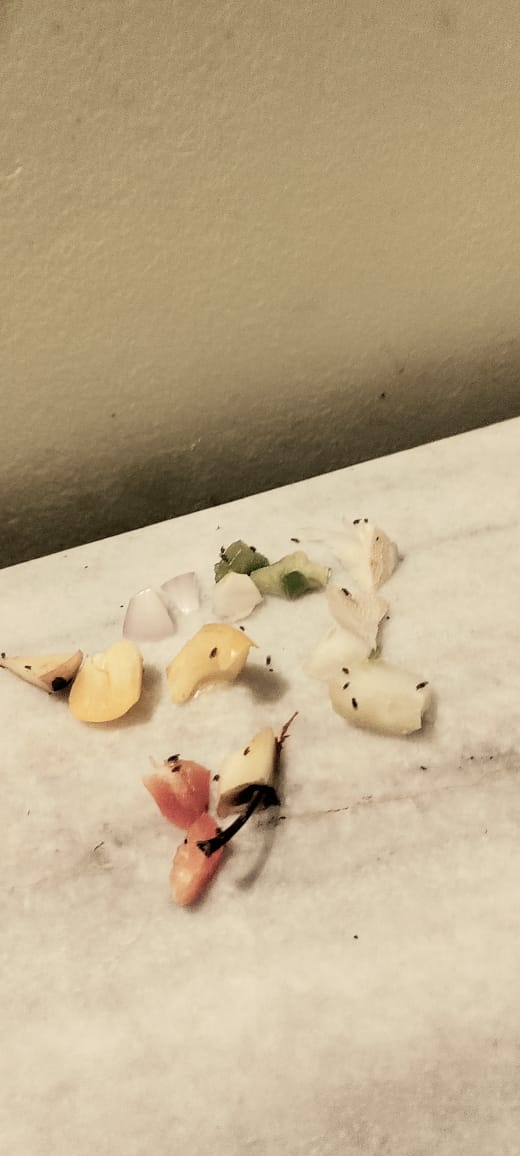
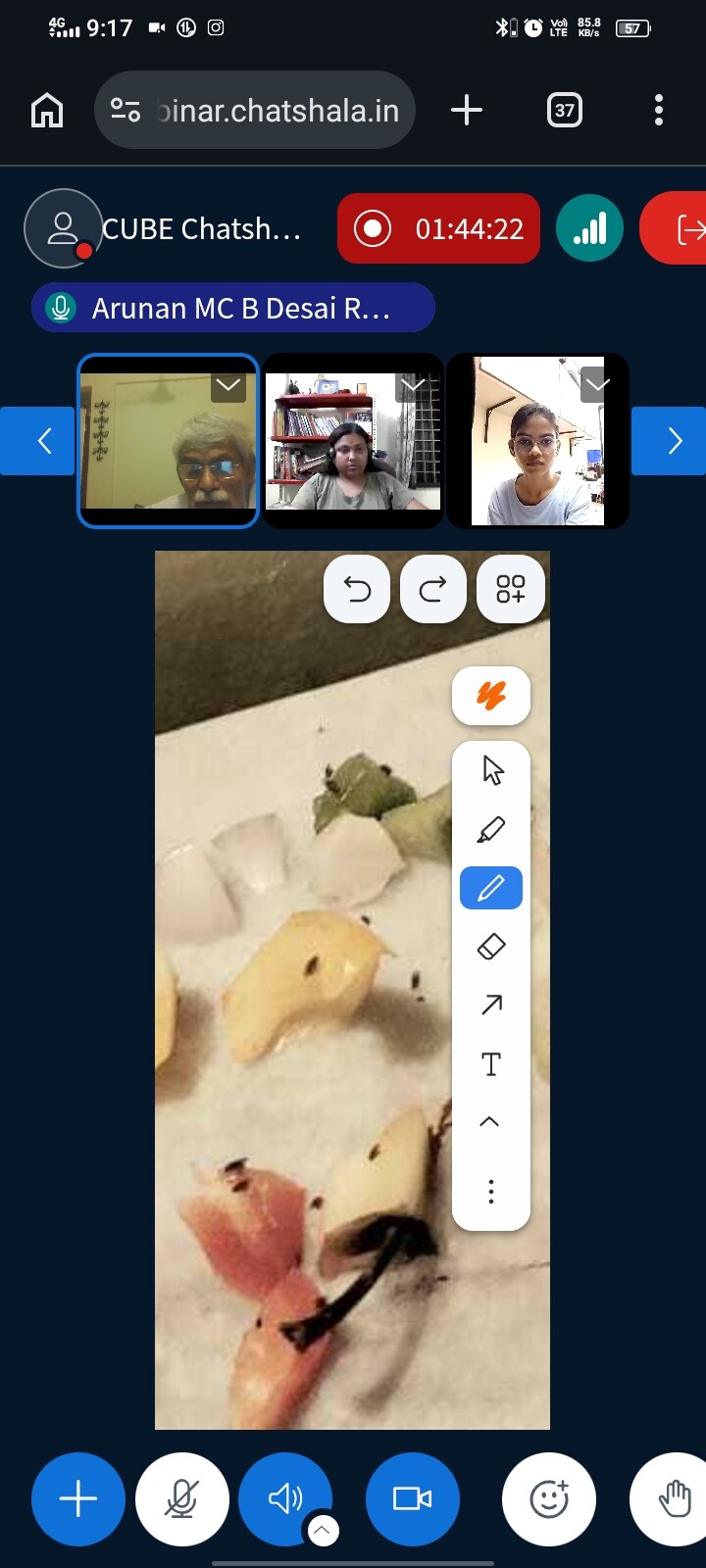
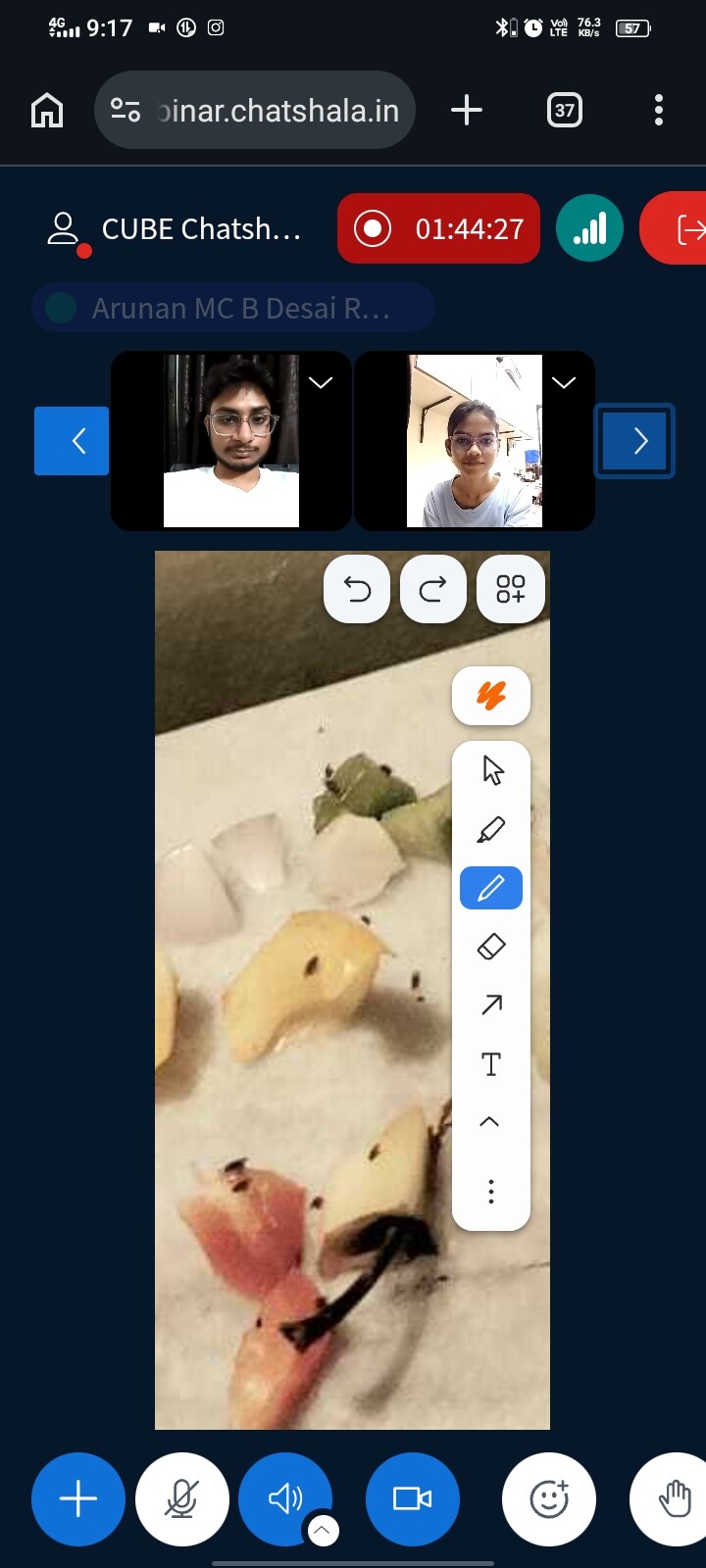
The uploaded image of the actual experimental set-up, showing tiny pieces of onion, capsicum, garlic, and what appears to be pieces of tomato and possibly ginger arranged on a marble surface with small dark specks (very likely the fruit flies themselves) scattered among the food pieces, served as tangible evidence that this was very much a live, in-progress home experiment rather than a purely theoretical exercise. This kind of hands-on documentation is precisely the spirit that CUBE ChatShaala aims to cultivate: careful, low-cost, reproducible citizen science conducted from ordinary kitchens and homes.
 Provocative Questions
-
If fruit flies genuinely rest at night and work during the day, as Aarya’s hypothesis suggests, does this rhythm hold steady even when the flies are kept in constant artificial light, or does it collapse the way many circadian rhythms do under continuous illumination?
-
What is it about tomatoes, chemically speaking, that seems to consistently outcompete grapes, bananas, onions, and citrus in attracting fruit flies? Is it a specific ester, a sulphur compound, or perhaps the balance of sugars and acids unique to a ripening tomato?
-
Bottle A and Bottle B differ in size in today’s whiteboard sketch. Could the volume of headspace inside each bottle change how concentrated the smell molecules become, and would that alone be enough to bias which bottle attracts more flies, independent of any day-night effect?
-
Since acetic acid and ethanol are both intermediates or products of the same fermentation pathway that produces fruit odours, could a controlled comparison of plain vinegar, plain ethanol, and a fruit-and-vinegar combination help isolate which specific molecule is doing the real work of attraction?
-
The Caltech research on carbon dioxide sensing shows that fly behaviour flips depending on whether CO2 arrives in pulses or stays constantly elevated. Could a similar timing-dependent response be occurring with the tomato-based setup, where fresh, pulsing odour release from a newly cut tomato behaves differently from the steadier, weaker smell of a tomato slice left out for hours?
-
How might the team design a fair, controlled version of this experiment that separates the “day versus night” variable from confounding factors such as bottle size, tomato freshness, ambient temperature, and humidity?
 What I Have Learned
Sitting through today’s session reminded me just how much can be uncovered by watching something as commonplace as fruit flies gathering on a kitchen counter. What struck me most was the layered nature of the investigation: what began as a fairly straightforward question about whether flies are more active during the day evolved into a genuine dive into organic chemistry, insect neurobiology, and experimental design, all within a single conversation.
I found the connection between vinegar production and fruit fly attraction particularly satisfying to trace through. Understanding that acetic acid and ethanol both arise from the same two-step fermentation process that turns apple sugars first into alcohol and then into vinegar gave me a much clearer picture of why fermenting or overripe fruit is such an irresistible signal to these insects. It is not simply that the fruit smells “sweet”; specific molecules, esters among them, are the messengers doing the actual work of attraction, and the fly’s antennae are remarkably tuned instruments for picking up exactly these cues.
I also came away with a renewed appreciation for how much rigour a seemingly simple home experiment demands if it is to produce trustworthy results. Aarya’s bottle A and bottle B setup is a wonderful starting point, but today’s discussion made clear that variables such as container size, bait freshness, and even the time the tomato was cut could all quietly influence the outcome unless they are carefully controlled or at least acknowledged. That is, in many ways, the real value of ChatShaala: not just running an experiment, but learning to ask what else could explain the results before jumping to a conclusion.
 TINKE Moments (This I Never Knew Earlier)
The first TINKE moment of the day centred on the true source of the vinegar smell. Several participants initially treated “vinegar smell” as a single, undifferentiated odour, but the discussion clarified that this smell is specifically due to acetic acid, a distinct chemical entity with the formula CH3COOH, produced only after a two-stage fermentation process that first converts sugar to ethanol and then ethanol to acid. This I Now Know Explicitly: the sour bite of vinegar and the sweeter, more alcoholic smell of something like the warm glass sketched on the whiteboard are chemically distinct stages of the very same fermentation pathway, not interchangeable descriptions of the same thing.
A second TINKE moment emerged around the role of esters in fruit odour. It became explicit during the session that the generalised formula RCOOR represents an entire family of compounds, not a single molecule, and that different esters are responsible for the specific, recognisable smells of different fruits. This helped move the group’s understanding from a vague notion of “fruity smell attracts flies” to a more precise appreciation that the identity of the particular ester or blend of esters likely determines which fruit or vegetable proves most attractive.
A third TINKE moment surfaced in the framing of Aarya’s hypothesis itself. Initially framed simply as “flies rest at night and work in the day,” the conversation helped surface the recognition that this statement is really a claim about a circadian, or roughly 24-hour, behavioural rhythm, and that testing it properly requires observation across a full day-night cycle rather than a single time point. This distinction between casual observation and a testable hypothesis linked to an internal biological clock was an important clarifying moment for the group.
 Gaps and Misconceptions
One area that remains unresolved is the precise mechanism by which tomatoes outcompete other fruits and vegetables in attracting fruit flies. While repeated home observations point to tomato as consistently more attractive, today’s session did not settle on a specific chemical explanation, and this gap represents a promising direction for a future, more targeted experiment, perhaps comparing tomato against other Solanaceae family members to see whether the effect is shared across the plant family or unique to tomato itself.
A second gap lies in the experimental design of the bottle A and bottle B comparison. As currently sketched, the two bottles differ in size, which introduces a confounding variable that could affect airflow, smell concentration, and the number of flies able to physically enter or gather at the bait, independent of any genuine day-night behavioural difference. Without standardising bottle volume, or explicitly accounting for it in the analysis, it will be difficult to attribute differences in fly activity solely to the light or dark condition being tested.
Finally, there is a subtle but common misconception worth flagging: equating the presence of flies near a food source with feeding or “work,” and their absence with “rest.” Flies could be inactive near a bait for reasons unrelated to sleep, such as depleted odour cues from a drying-out tomato slice, temperature shifts in the room, or simple relocation to another undetected spot. Distinguishing genuine circadian rest from a fly’s response to a weakening or changing stimulus will be an important refinement for the next stage of this investigation and would strengthen the reproducibility and credibility of the conclusions drawn from this home-lab setup.
 Photographs during Chatshaala

 Referance