 CUBE Chatshaala - Discussion Summary
The CUBE ChatShaala session on 2 March 2026 focused on two interconnected themes: mango flowering in India and Cardamine-based genetic engineering as a citizen science project.
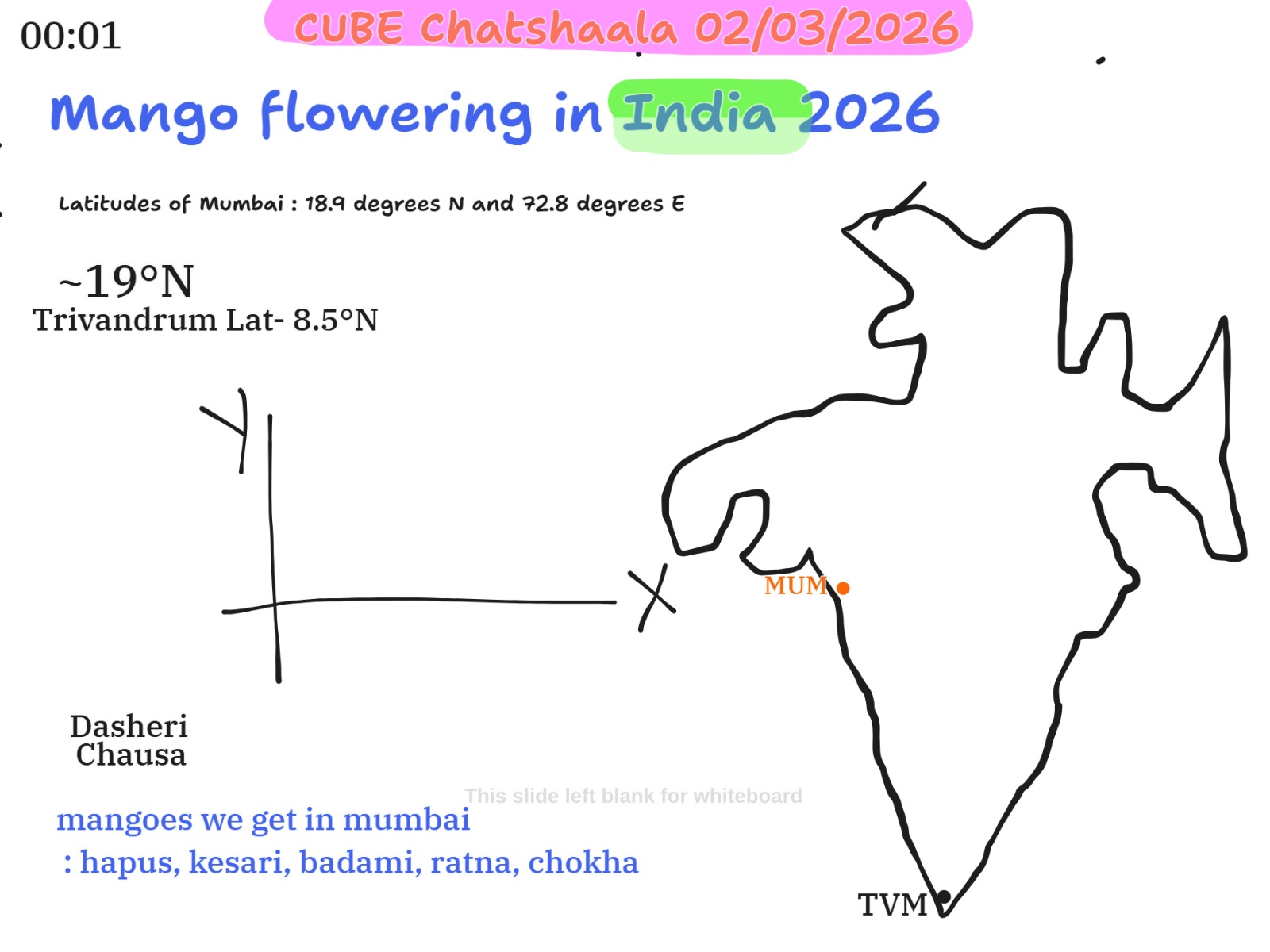
The discussion began with a geographical exploration of mango varieties across India, emphasizing the role of latitude in determining flowering patterns. Cubists noted that Mumbai lies at approximately 19°N, while Thiruvananthapuram (Trivandrum) lies at 8.5°N, highlighting how climatic and latitudinal differences influence the types of mangoes grown. Varieties such as Hapus, Kesari, Badami, Ratna, and Chokha were identified in Mumbai, while Sailekshmi mentioned Koithoorkonam, Aroor, and Nedungolam mangoes for Trivandrum. The conversation clarified the distinction between latitude (north-south, Y-axis) and longitude (east-west, X-axis), reinforcing the importance of mapping in agricultural studies.
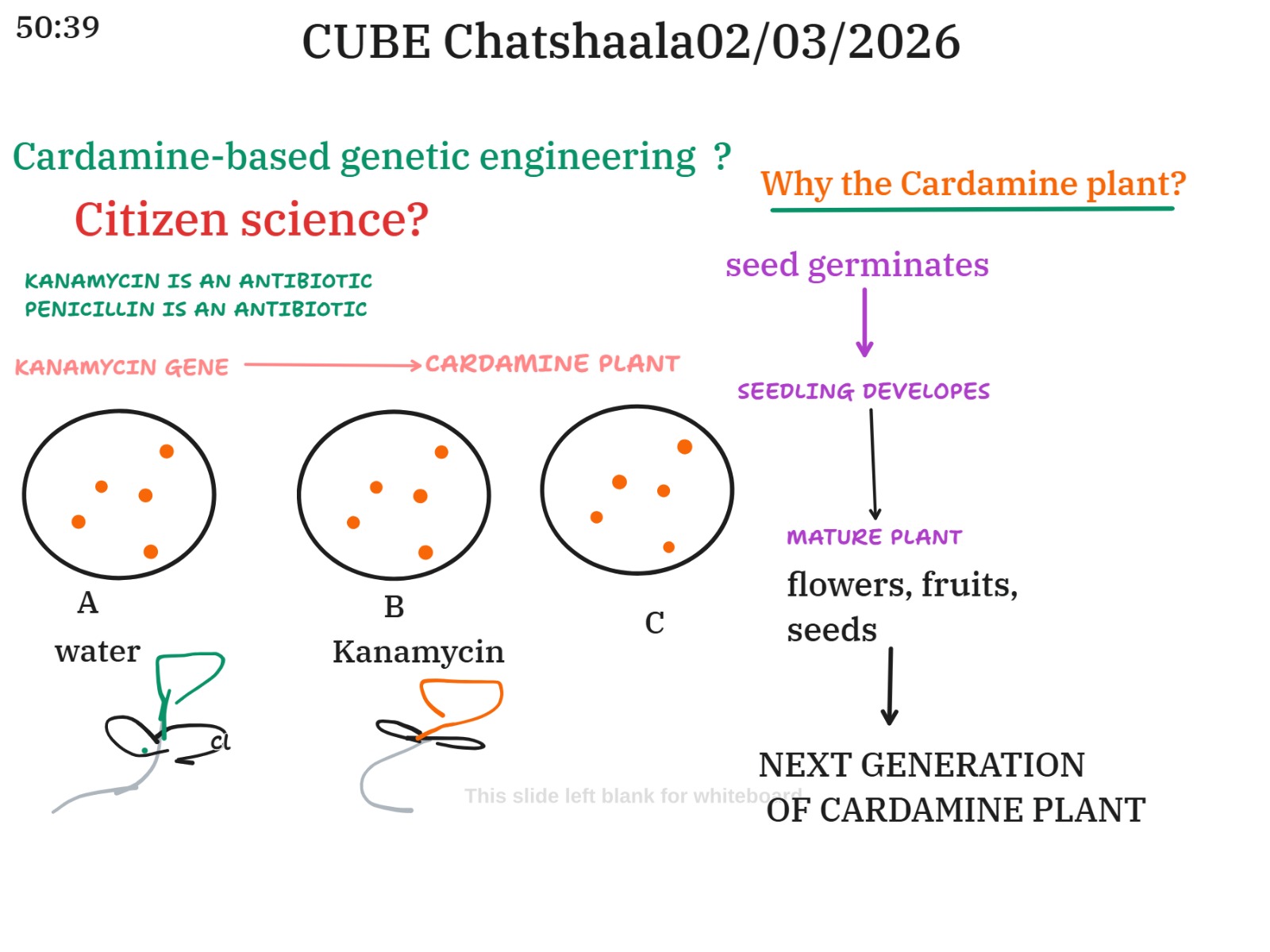
The second half of the session shifted to Cardamine as a model plant for genetic engineering. Participants compared Cardamine with Arabidopsis thaliana, noting that while Arabidopsis is globally recognized as a model organism, it is not native to India and requires controlled laboratory conditions. In contrast, Cardamine thrives naturally in Indian gardens, has a short life cycle (~30–45 days from seed to seed), and belongs to the same family (Brassicaceae). This makes it an accessible alternative for citizen science experiments.
The cubists discussed the use of kanamycin resistance genes as markers in transformation experiments. Through methods such as the floral dip technique, transformed seeds can be distinguished from non-transformed ones: resistant seedlings remain green and healthy in kanamycin-containing media, while non-transformed seedlings appear pale and stunted. Ribosomal differences (80S in the cytoplasm vs. 70S in organelles) were also highlighted to explain the molecular basis of antibiotic selection.
Finally, the session emphasized the citizen science approach, where individuals of different ages and backgrounds collaborate to conduct meaningful experiments, bridging professional science with community participation.
 Provocative Questions
-
How does latitude influence the timing and success of mango flowering across different regions of India?
-
Could mapping mango varieties against latitude and longitude help predict future shifts in cultivation due to climate change?
-
Why is Cardamine a more practical choice for citizen science in India compared to Arabidopsis, despite Arabidopsis being the global standard?
-
What challenges might arise when using antibiotic resistance genes (like Kanamycin) in citizen science projects, especially regarding biosafety and ethics?
-
How can citizen science projects ensure that participants understand complex molecular concepts, such as ribosomal differences, without oversimplifying?
-
Could mango flowering studies and Cardamine genetic engineering be integrated into a broader citizen science framework that connects agriculture and biotechnology?
 What I Have Learned
-
Latitude matters: The geographical positioning of cities like Mumbai and Trivandrum directly influences the types of mangoes grown and their flowering cycles.
-
Citizen science is powerful: it democratizes research, allowing non-specialists to meaningfully contribute to scientific inquiry.
-
Cardamine as a model plant: Its short life cycle, accessibility, and similarity to Arabidopsis make it ideal for genetic engineering experiments outside formal labs.
-
Genetic engineering basics: The use of marker genes like Kanamycin resistance provides a clear way to distinguish transformed plants from non-transformed ones.
-
Science communication: Explaining ribosomal differences and transformation techniques in simple yet accurate terms is crucial for engaging diverse audiences.
 TINKE Moments (This I Never Knew Earlier)
-
Latitude as Y-axis, Longitude as X-axis: While GPS often lists coordinates as “Lat, Long,” the mapping corresponds to a graph-like system, clarifying spatial representation.
-
Cardamine’s rapid life cycle: Learning that Cardamine completes its seed-to-seed cycle in just 30–45 days was striking, as it opens doors for quick experimental iterations.
-
Ribosomal distinction: The presence of 80S ribosomes in the cytoplasm and 70S ribosomes in organelles reflects evolutionary origins and has practical implications for genetic engineering.
-
Citizen science inclusivity: The idea that people of all ages and backgrounds can collaborate meaningfully in scientific projects challenges traditional notions of research being confined to experts.
 Gaps and Misconceptions
-
Equator confusion: Some participants initially misunderstood the concept of multiple equators; clarification was provided that there is only one equator at 0°, dividing the globe into northern and southern hemispheres.
-
Arabidopsis vs. Cardamine: While Arabidopsis is widely used globally, its unsuitability for Indian conditions was a misconception corrected during the discussion.
-
Antibiotic use in experiments: There may still be gaps in understanding biosafety concerns when using antibiotic resistance genes in citizen science projects, requiring further discussion.
 Photographs during Chatshaala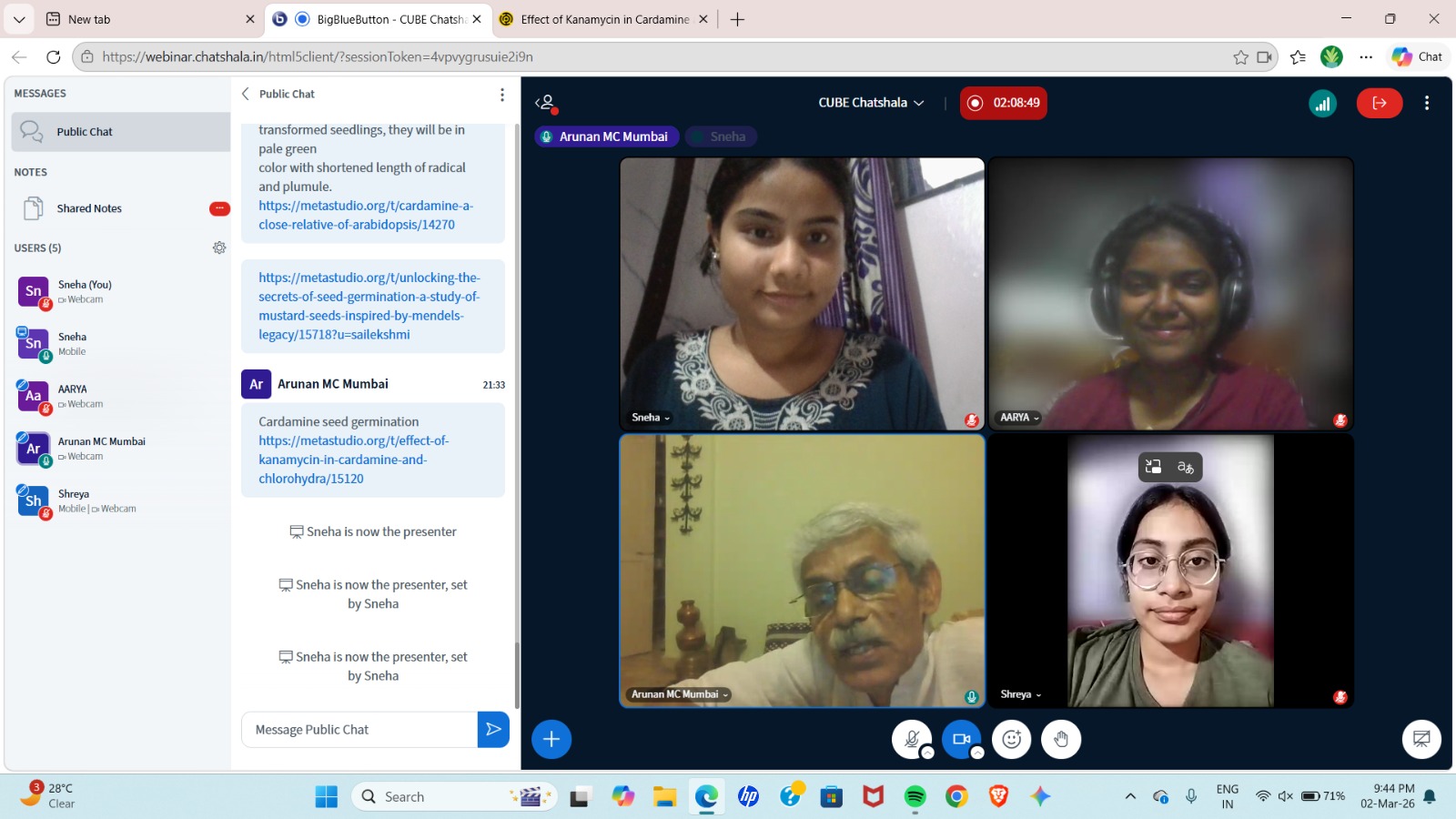
 Reference